






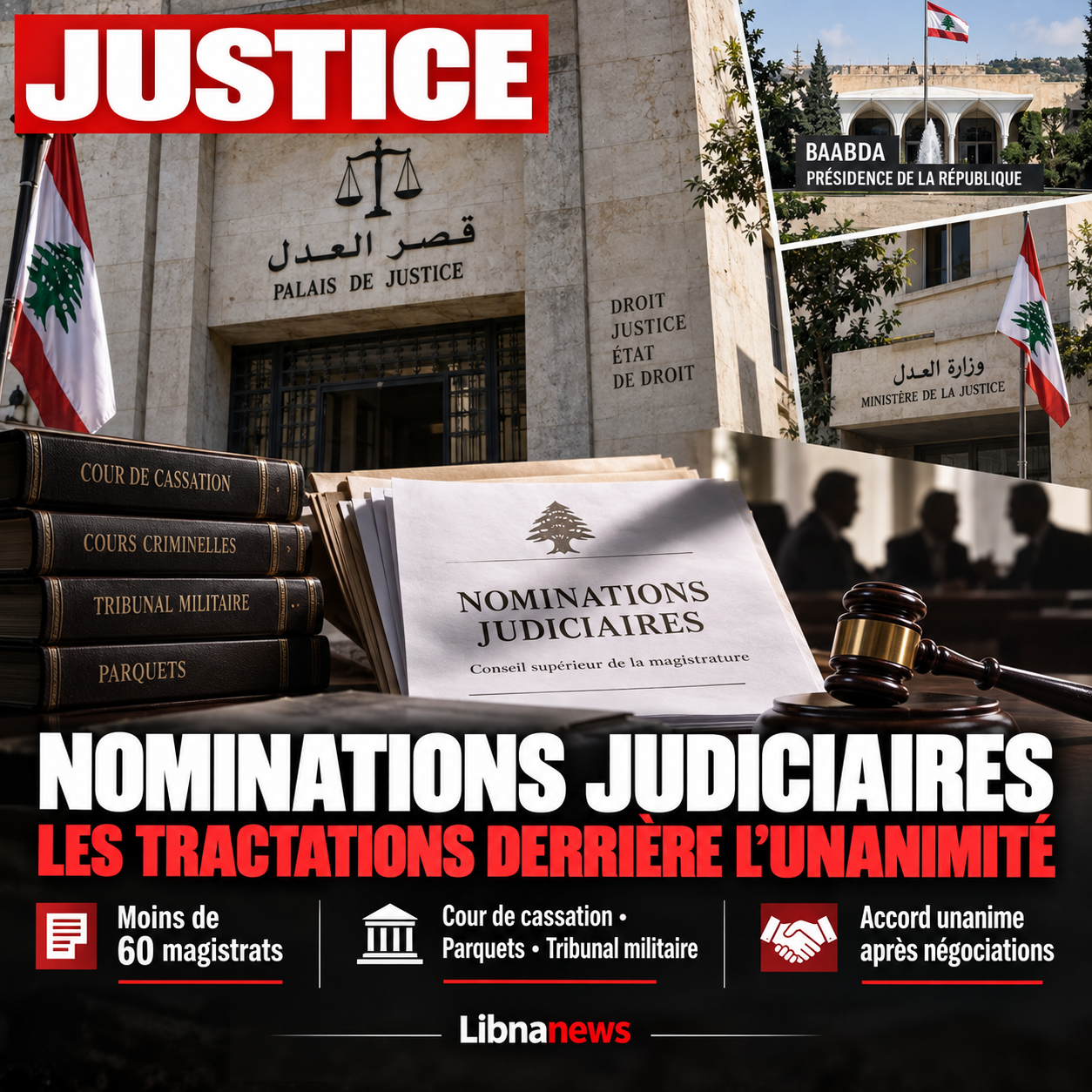
Unanimity masks difficult negotiations
The Supreme Council of the Judiciary unanimously approved a series of partial judicial appointments involving fewer than sixty judges. Behind this institutional agreement, however, a number of information gathered from the relevant circles refers to tight negotiations. They are said to have involved the principal officials of the judiciary, the Ministry of Justice and the President of the Republic. The issue was not just about the choice of judges. It also covered several strategic posts in the prosecution, criminal courts, the Court of Cassation and the Military Tribunal.
The final agreement was allegedly preceded by a disagreement between the President of the Supreme Council of the Judiciary, Souheil Abboud, and the Attorney General of the Court of Cassation, Jamal Hajjar. Nine out of ten Council members would have already supported a compromise formula. A mediation led by the Minister of Justice would then have brought the positions closer together and finally achieved unanimity. This process allows the image of a consensual process to be nuanced from its origin. Rather, unanimity seems to have been the outcome of the discussions.
Appointments remain partial. They do not upset the entire judicial hierarchy and therefore do not constitute a new complete set of appointments. Their scope is nevertheless important. Several positions are at the heart of the functioning of the judiciary. The Court of Cassation, the criminal courts, the military court and the prosecution services are among the institutions affected by these movements. The limited number of judges involved is therefore not sufficient to measure their real importance.
According to available information, the discussions would have gradually exceeded the question of individual competence. Initial reflections would have included the need to correct certain situations arising from previous appointments and to take into account the professional performance of judges. During the negotiations, this logic would have been confronted with the demands of the various institutional centres concerned. The formula finally approved would thus appear to be a compromise between several priorities rather than a simple administrative operation.
Strategic movements in several jurisdictions
The new map foresees several significant changes. Judge Samir Akiki is to preside over a chamber of the Court of Cassation to replace retired Judge Naji Eid. Judge Georges Mezher is to take over the presidency of the Beirut Criminal Court, a position held so far by Samir Akiki. Judge Tarek Tarabey must, in turn, become a judge of military investigation to replace Georges Mezher.
Other movements concern the Court of Cassation and the criminal courts. Judge Ali Araji is to preside over a chamber of the Court of Cassation to replace Judge Osama Mneimneh. Judge Ziad Daghedi is to assume the presidency of the Zahlé Criminal Court, previously occupied by Ali Araji. Justice Hanadi Jaber is to become Assistant Commissioner of the Government to the Military Tribunal. Judge Ryan Sadek must join this court as a civilian adviser.
These transfers produce a chain effect. The transfer of a magistrate to a higher post frees a post that must itself be filled. Therefore, the set cannot be analysed only through the most visible names. Successive movements must be followed to understand the new division of responsibilities.
Two appointments received more attention due to information on the negotiations that preceded them. The first concerns Judge Hani Abdel Moneim Hajjar, who is to join the Office of the Public Prosecutor at the Court of Cassation. The second concerns Judge Mona Hankir, who is to become a general lawyer at the Beirut Court of Appeal.
These two cases allow us to observe more precisely the balances which would have accompanied the preparation of the list.
Baabda’s role in the negotiations
Mona Hankir’s transfer is one of the most sensitive points on the file. She was previously the first investigating judge in South Lebanon. According to information from the judiciary, his visit to the General Prosecutor ‘ s Office at the Beirut Court of Appeal was one of the requests supported by the President of the Republic. She must replace Judge Janah Obeid.
This dimension remains behind the scenes. The appointment itself can be established through the formal process. On the other hand, the specific circumstances in which his name was chosen do not appear in a public decision. The two levels should therefore be clearly distinguished.
The case of Hani Abdel Moneim Hajjar is also carefully observed. His appointment as a General Counsel to the Court of Cassation led him to an important position in the Public Prosecutor’s Office. This position had previously been held by Jamal Hajjar prior to his appointment as Attorney General of the Court of Cassation.
According to the available information, these movements were part of a broader compromise between the principal judicial and institutional officials. The Presidency would have been satisfied with some requests, while other choices would have been in line with the priorities advocated in the Higher Council of the Judiciary and the General Prosecutor’s Office.
There is, however, no evidence to conclude that the judges concerned would be politically dependent on those who could support their appointment. An intervention in favour of a name and the future behaviour of a magistrate are two distinct issues. This distinction is indispensable in a case where the boundary between institutional negotiations and accusations of political division can quickly become blurred.
Nawaf Salam down in job distribution?
Another element of the behind-the-scenes information is that Prime Minister Nawaf Salam was said to have been less prominent in the negotiations than other power centres. Some sources describe a configuration in which Baabda would have had a greater influence on several choices, with a role also assigned to the Attorney General at the Court of Cassation.
However, this reading deserves careful consideration. There is no formal decision to allocate judicial appointments between the Presidency of the Republic, the Presidency of the Council of Ministers or the judiciary. This is therefore a reconstitution of the power ratios that accompanied the preparation of the list.
The stakes go beyond the presence or absence of the Prime Minister in the discussions. It concerns the actual preparation of judicial appointments in Lebanon. The Higher Council of the Judiciary has its institutional competence. The decree must then follow a political and administrative path before it comes into force. Between these two levels there is a negotiating space in which professional, institutional and sometimes political considerations may arise.
The central question is therefore less who has obtained the largest number of posts than to identify the criteria that led to successive amendments to the list. In order to respond, different versions of the project would be required. The comparison would indicate which judges were on the list from the outset, which were added and which disappeared during the discussions.
The Ministry of Justice in the position of mediator
The role of the Department of Justice is another important element. According to consistent information, his intervention had helped resolve the dispute between Souheil Abboud and Jamal Hajjar. The shift from nine out of ten members to unanimous approval shows that a compromise was reached before the final vote.
This mediation gives the process an institutional dimension. It may have prevented a disagreement between the two highest officials concerned from turning into an open crisis in the Higher Council of the Judiciary. At the same time, it raises the question of the content of the concessions granted to reach agreement.
The information available does not allow us to determine exactly which name or position has removed the last obstacle. It would therefore be excessive to assign a specific appointment to this mediation without further evidence. What emerges, however, is the existence of a negotiation phase before the final unanimity.
This situation is all the more important given that judicial appointments take place in a time when the Lebanese judiciary has to deal with several sensitive cases. Financial investigations, corruption-related cases, proceedings concerning the explosion of the port of Beirut, banking disputes and cases under the jurisdiction of the Military Tribunal keep the judiciary at the centre of many tensions. The appointment of officials in certain jurisdictions therefore takes on a scope that goes beyond the regular management of careers.
Partial appointments rather than a general overhaul
The formula finally adopted seems to favour limited intervention. Less than 60 judges are involved. The tops of the hierarchy are not entirely renewed and much of the existing structure remains in place. This caution can be explained by the desire to correct certain situations without immediately reopening the entire judicial file.
It can also be the effect of compromise. As the number of positions to be redistributed increases, institutional and professional interests become more difficult to reconcile. A partial list is used to treat the functions considered to be priorities while deferring the most complex arbitrations.
Nevertheless, the movements decided on remain significant. A Chamber Presidency in the Court of Cassation directly influences the organisation of the work of the highest judicial court. A criminal court presidency plays a major role in criminal cases. A military investigating judge intervenes in cases involving security and military institutions. The functions of the Public Prosecutor ‘ s Office also determine an important part of the functioning of the prosecution.
The impact of these appointments should therefore be observed over time. It cannot be inferred solely from the identity of the magistrates or from the support they receive.
The Order in Council as the final step in the process
The approval of the Supreme Council of the Judiciary is not yet sufficient to make all movements final. The project must follow the schedule for ministerial signatures before being forwarded to President Joseph Aoun and published in the form required.
This final phase will verify whether the approved formula remains intact until it comes into effect. Any further change would be particularly significant, since it would take place after unanimous agreement was reached in the Council.
The file thus shows three clearly distinct levels. The appointments announced are the first. The disagreements that preceded unanimity were the second and were supported by several converging information. The third concerns the supposed distribution of influences between Baabda, the judiciary and other institutional centres. It is on the latter ground that the elements remain the most sensitive and require the most precautions.
The real subject of inquiry is now in successive versions of the list. Their comparison would make it possible to reconstitute the negotiations much more precisely. In particular, it would help to determine whether the changes mainly meet professional criteria and the needs of the courts or whether institutional interventions have actually changed the final distribution of posts.