





An indiscretion that takes on another dimension
Discreet information published in Beirut on 23 September 2026 refers to proceedings initiated by an official financial institution against current and former financial sector officials and wealthy people. The file would not only be Lebanese. It would cross investigations or procedures conducted in several European countries.
Information does not give any names. It also does not specify the identity of the institution responsible for the process. This caution prohibits the formal association of proceedings with a particular case. However, it intervenes in a much more precise judicial context than it seems. Several cases involving the former governor of the Bank of Lebanon Riad Salamé, his brother Raja Salamé, the former head of Bank Audi Samir Hanna and various banking institutions are currently being dealt with in Lebanon and Europe.
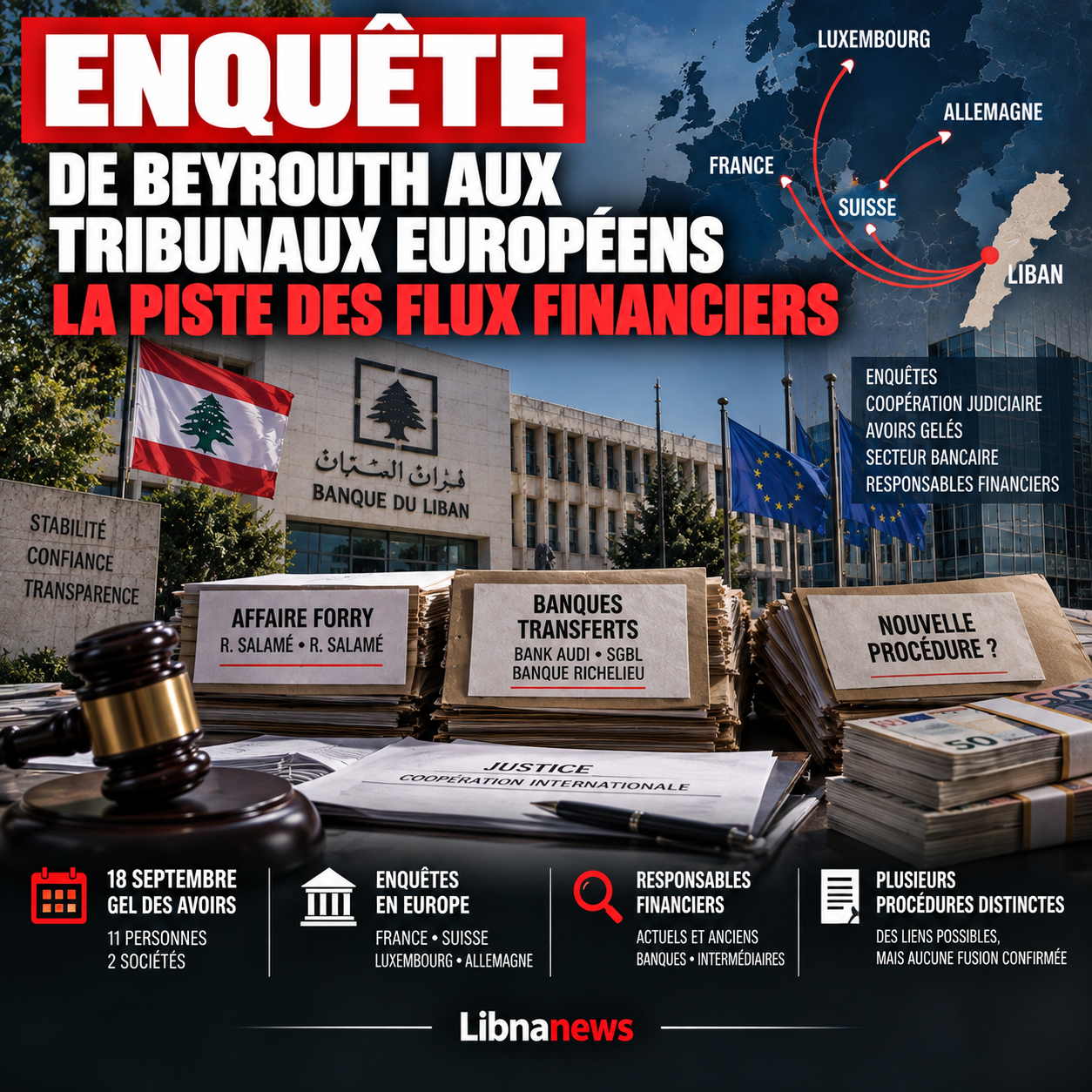
Another element reinforces the questions. A confidential decision of the Special Investigation Commission of the Bank of Lebanon, dated 18 September 2026, five days before this indiscretion, ordered Lebanese banks and financial institutions to freeze the accounts and assets of eleven persons and two companies. Bank secrecy was also lifted vis-à-vis the competent authorities.
The list includes Riad Salamé, Raja Salamé and Samir Hanna. It also includes Hassan Moukalled, André Mechantef, Bachir Mansour, Marianne Hoayek, Bassem Hout, Alaa Khawaja, Mohammad Hariri and Samara Kazzi. Two companies are also involved: CTEX and V Limited Investment Inc. However, they are individuals and entities linked to several separate files. Their presence on the same freezing decision therefore does not mean that they would be involved in the same case.
However, the chronological proximity of the two information should be noted. Does the procedure referred to on 23 September refer to this initiative of the Bank of Lebanon? To another action initiated by the institution? Or a separate court case? There is still no answer available.
Riad Salamé and Samir Hanna, a case that extends to the private banking sector
A first possible rapprochement concerns the case against Riad Salamé and Samir Hanna, former president of Bank Audi.
On 10 August 2026, the Lebanese judiciary initiated further proceedings against the two men in a tens of millions of dollars financial case. The charges included alleged acts of misappropriation, illicit enrichment, laundering and corruption.
According to the evidence made public in this procedure, investigations include operations carried out between 2010 and 2012. Structures established abroad appear in the file. The amounts reported by the investigators exceed $250 million for all transactions reviewed.
This procedure is important for another reason. It marks the entry of a former head of a large commercial bank into a financial file directly related to investigations against the former governor of the Bank of Lebanon.
For several years, Riad Salamé has been challenging the charges against him in the various proceedings. Samir Hanna also enjoys the presumption of innocence. He was released on bail under this procedure. There is therefore no final conviction to present the alleged facts as established.
But the file opens a new question. Investigations into the Lebanese financial crisis are no longer limited to the Bank of Lebanon and its former governor. They are beginning to examine more directly the relationship between the central bank and some commercial banking players.
This is precisely what could give special meaning to the wording referring to « current and old financial managers ».
Forry case, European investigation matrix
The most advanced case in Europe remains for Forry Associates. The company registered in the British Virgin Islands was controlled by Raja Salamé, brother of the former governor.
European investigators suspect that a mechanism established from 2002 onwards would have allowed the transit of more than $330 million and about €5 million from commissions linked to Bank of Lebanon operations.
The alleged mechanism was based on commissions paid when purchasing financial products from the central bank. These sums were then returned to Forry Associates, presented as an intermediary. European investigators have been seeking for several years to determine the final destination of these funds.
Riad Salame challenged the charges. In particular, his defence claims that his assets had been built up thanks to the substantial revenues he had received prior to his arrival as head of the Bank of Lebanon. Raja Salamé has also been involved in various proceedings related to this case without a final conviction being deduced from the ongoing investigations.
The European dimension is indisputable. By March 2022, judicial cooperation between France, Germany and Luxembourg had allowed the freezing of approximately EUR 120 million in assets related to the investigation.
In Germany, three properties in Hamburg and Munich were seized, as well as real estate and other assets. Their value was several tens of millions of euros. In France, two Paris real estate units had been seized, as well as bank accounts. Assets had also been frozen in Monaco. In Luxembourg, approximately EUR 11 million had been fixed in several accounts.
The European Judicial Cooperation Agency had then indicated that the main investigation concerned five suspects suspected of money laundering resulting from alleged misappropriation of Lebanese public funds.
It is precisely this cross-border character which makes it possible to reconcile with the indiscretion of 23 September. But this rapprochement remains a hypothesis.
HSBC Private Bank Switzerland enters the file
The year 2026 brought a major development to the Forry case. In France, HSBC Private Bank Switzerland was formally implicated in the investigation into the assets of Riad Salamé and his entourage.
French justice examines the role played by the Swiss bank in the financial circuits used by Forry. The bank has been charged with money laundering and criminal association for several alleged financial offences. A bond of EUR 80 million was imposed.
The French investigators believe that Forry’s account with the Swiss bank played an important role in the movement of funds. In particular, they examine hundreds of transfers and checks carried out by the institution.
HSBC reported cooperating with the investigation and was not found guilty of the facts examined.
This case shows above all that European procedures are changing in nature. They no longer seek only to determine the origin of the heritage of certain Lebanese officials. They are now examining the possible role of financial intermediaries that have processed the funds.
This extension could explain why Lebanese information now refers to financial leaders and wealthy people rather than just one personality.
Switzerland and Luxembourg: parallel procedures
The case is not limited to France. Switzerland is also conducting proceedings concerning HSBC Private Bank Switzerland. In particular, the authorities examine the institution’s internal controls and the behaviour of certain employees who have managed relations with Raja Salamé and Forry.
Luxembourg is another aspect. In particular, a former customer officer from Riad Salamé was involved. The investigators were interested in payments received personally from the former governor while the employee was working in the banking sector.
This shows that the Lebanese case has become a genuine European network investigation. The same flows can be examined in several jurisdictions because accounts, corporations, real estate and intermediaries were distributed among different countries.
Judicial cooperation then allows the funds to be re-established. This is precisely what an exclusively Lebanese investigation would have much more difficulty in carrying out.
The Bank of Lebanon itself was a civil party in the French proceedings. His governor Karim Souaid was heard in 2026. He announced the institution’s willingness to cooperate with French magistrates and to defend the interests of the central bank and depositors.
This development is important. It now places the Bank of Lebanon not only at the centre of the historical facts examined, but also among the actors seeking redress.
Bank Audi France and Banque Richelieu France: another separate investigation
A second European track must be distinguished from the Forry file.
The French courts opened an investigation against Bank Audi France and Banque Richelieu France, the latter being linked to Société Générale de Banque in Lebanon and banker Antoun Sehnaoui.
This procedure concerns suspicions of capital transfers outside Lebanon during the financial crisis. Investigators examine, inter alia, facts that may qualify as money laundering, abuse of trust, concealment and association of criminals.
This is not the same as the Forry case in the state of the information available.
This distinction is essential. The first set mainly concerns commissions, the Bank of Lebanon, Forry Associates and the assets of Riad and Raja Salamé. The second concerns the possible role of banking institutions in capital movements during the crisis, while Lebanese depositors were gradually losing access to their economies.
The institutions and persons concerned enjoy the presumption of innocence. The initiation of an investigation does not lead to the conclusion that illegal transfers have been made by the persons or institutions concerned.
But the existence of this second procedure considerably broadens the context in which the 23 September indiscretion must be read.
When it refers to investigations carried out in « many European countries », it could refer to the Salamé file. When she refers to financial leaders and great fortunes, she may also refer to investigations in the private banking sector. Finally, it could refer to a still different procedure.
SGBL and Antoun Sehnaoui in the field of French investigations
The name SGBL appears in this context because of the links between the Lebanese group and Banque Richelieu France.
The French investigators seek to determine the role played by different institutions in operations carried out during the critical period of the Lebanese crisis. The central question is the possible outflow of capital at a time when the restrictions imposed on depositors were becoming increasingly severe.
In particular, the judicial issue is whether certain transactions have received special treatment and, if so, under what conditions they have been authorised.
However, it would be incorrect to write that SGBL or Antoun Sehnaoui are responsible for an illegal capital flight. At this stage, there is an investigation. It must precisely determine the reality of the facts and the possible responsibilities.
The same precaution applies to Bank Audi France.
However, these investigations are becoming essential to understanding the new judicial phase of the Lebanese crisis. For several years, the debate focused on the losses of the banking system and the repayment of depositors. From now on, magistrates are also seeking to reconstruct certain individual flows.
The confidential freeze of 18 September changes the reading of the file
However, the decision taken in Lebanon five days before the indiscretion raised the most questions.
On 18 September, the Special Investigation Commission of the Bank of Lebanon ordered the freezing of accounts, assets, assets and safes held directly or indirectly by eleven persons and two companies. It also lifted bank secrecy for the benefit of the competent authorities.
These include Riad Salamé, Raja Salamé, Marianne Hoayek and Samir Hanna. Other names include Hassan Moukalled and several individuals or companies associated with financial affairs or international sanctions.
This diversity prevents the list from being considered as the protagonists of a single case.
However, it reveals a change of approach. The Bank of Lebanon is now using the Special Investigation Commission’s instruments to immobilize assets and facilitate access to financial information in several sensitive cases.
The proximity to the information of 23 September is striking: an official financial institution, current or former officials, wealthy people and files that may cross Lebanese borders.
However, it does not constitute proof of identity between the two proceedings.
The same question behind several investigations: where did the money go?
The different files have one thing in common: the rebuilding of financial flows.
In Forry, the issue is the origin and destination of hundreds of millions of dollars in commissions. In the case concerning Riad Salamé and Samir Hanna, magistrates examine other transactions between the central bank and financial structures. In the French investigations concerning Bank Audi France and Banque Richelieu France, the question relates to capital movements during the crisis.
These cases are legally separate. However, they are beginning to draw a much broader mapping of the relationship between the Bank of Lebanon, commercial banks, financial intermediaries, foreign companies and beneficiaries of certain transfers.
This mapping could become decisive for depositors.
Since 2019, the Lebanese debate regularly pits the State, the Bank of Lebanon, banks and depositors around the distribution of losses. European judicial proceedings add another question: can some of the sums be recovered and possibly recovered?
The approximately EUR 120 million of assets frozen in Europe in the Lebanon-related case show that this hypothesis is no longer only theoretical. The freeze does not, however, amount to a refund. The courts still have to establish the origin of the funds and the responsibilities before any recovery mechanism can be considered.
A new procedure or joining several cases?
The information of 23 September therefore remains surrounded by an essential ambiguity.
A first hypothesis would be that it directly relates to the Bank of Lebanon’s recent initiatives, including the decisions taken by the Special Inquiry Commission.
A second is that she refers to the new case involving Riad Salamé and Samir Hanna, some of whose ramifications can lead to foreign operations and structures.
A third line would be European procedures concerning banks and capital movements during the crisis.
Finally, it is still possible that the indiscretion concerns a procedure still unknown to the public.
There is currently no basis for choosing between these assumptions.
But the timetable is narrow enough to justify the issue. On 18 September, a confidential decision of the Special Investigation Commission struck 11 individuals and two companies. A few days later, behind-the-scenes information referred to a formal financial institution that had initiated proceedings against financial officials and wealthy people, with ramifications in several European countries.
Between the two is now the central question:is the Bank of Lebanon gathering in Lebanon several sons of financial investigations so far scattered between Beirut, Paris, Geneva, Munich and Luxembourg?
The answer will depend on the forthcoming judicial transmissions, the identity of the persons actually subject to the procedure referred to on 23 September and, above all, the precise financial transactions that investigators seek to reconstitute.