

The funding of municipal services is not included in the budget alone. Documents published for 2026 by Tripoli and Zahlé-Maalaka–Taanayel show very different circuits. Receipts received directly, expected payments and withdrawals from reserve contribute to local expenditure. The available accounts enable these mechanisms to be monitored, without establishing a ranking of rich or poor municipalities.
In Tripoli, the budget for 2026 is £1,339.77 billion. Zahlé’s budget document shows $1,058.9 billion. These envelopes are not bank balances. They add together revenue projections and resources already accumulated. This depends, inter alia, on local recovery and on the timing of the agencies responsible for returning certain revenues.
The issue appears in the most concrete positions: lighting, road maintenance, cleaning and compensation of staff. A municipality may make provision for an expenditure without its funding. Conversely, an accounting surplus does not demonstrate that all requirements are met or that each sum remains available.
Two budgets, several revenue channels
The Tripoli budget is based on a municipal decision of 10 November 2025, which was approved by the governorate on 25 November. Its revenue table distinguishes 640.25 billion pounds of direct collection and 623.5 billion pounds of indirect collection. It adds 7.78 billion in miscellaneous revenue. These three categories form the regular income forecast for 2026.
In Zahlé–Maalaka–Taanayel, the document published in the municipal library provides for 427.1 billion direct perceptions. Indirect collection accounts for 500.3 billion, and miscellaneous revenues for 121.5 billion. The annexed draft decision is not fully provided. The figures therefore describe the published budget document, without attesting to its final validation.
The distinction between direct and indirect perception counts more than the total volume. In the first case, the recipe goes through municipal collection. In the second, it depends on a reverse circuit. The municipality may enter a forecast, but this registration does not prove the payment by the collecting body or its date.
| Category | Tripoli | Zahlé–Maalaka–Taanayel |
|---|---|---|
| Direct perception | 640.25 | 427.10 |
| Indirect perception | 623.50 | 500.30 |
| Other income | 7.78 | 121.50 |
| Deduction on reserve | 68.23 | 10.00 |
| Total resources | 1 339.77 | 1 058,90 |
The amounts are rounded. They remain nominal forecasts, not recorded receipts. This comparison does not report resources to a homogeneous resident population. It therefore does not measure per capita financial capacity.
In Zahlé, the weight of electricity-related remittances
Zahlé’s detail shows in concrete terms what indirect perception means. The document records £75 billion under the Independent Municipal Fund. It also provides for 425.3 billion payments from other agencies. Electricity accounts for 350 billion of this second envelope, and telecommunications for 70 billion.
The electricity line is thus equivalent to about one third of the total planned resources. This report is the result of the published budget. It cannot be said that the municipality has already received this amount. Nor does it demonstrate that an organization has acknowledged a debt owing in this amount.
This weight nevertheless creates a specific question for financial monitoring. How much of this forecast actually entered the municipal fund during the year? The answer is conditional on the reading of expenditure financed by the overall envelope. Only the forecast tables do not allow for this.
Miscellaneous revenues require the same attention. In Zahlé, they include £80 billion in aid, donations and bequests. It would therefore be misleading to present all ordinary income as regular local taxes. An accounting category may raise resources with different frequency and predictability.
A reserve used is not a new recipe
Both municipalities record extraordinary resources. In Tripoli, the corresponding 68.23 billion comes from a reserve levy. In Zahlé, this levy reaches 10 billion. The borrowing lines of the tables concerned are zero. In these documents, therefore, the additional resource comes from accumulated money, not from a new credit.
The difference is essential to assess the duration of the funding. A reserve is used to cover a one-time expenditure or to supplement an annual envelope. Its use does not by itself produce a renewable resource. It may be replenished by later surpluses, but these should not be presumed.
Comparing budgets without isolating this levy amounts to mixing a flow and a stock. The flow is the revenue expected during the year. The stock is derived from previous years. Two municipalities with the same total can finance their services with very different balances.
This distinction does not condemn the use of the reservation. It allows us to ask the right question: does it finance sustainable equipment, exceptional expenditure or recurrent need? In order to respond, it was necessary to reconcile its use with the expenditure implemented, not only to see its inclusion in the budget.
Municipal Funding: Tracking Expenditure
The expenditure tables also reveal contrasting structures. Tripoli provides about £796.02 billion for allowances, wages and salaries. Zahlé recorded 185.57 billion in this chapter. The amounts are comparable by their accounting title, but not as a direct measure of the cost of a service.
A remuneration may finance an administrative, technical or operational function. Without breakdown by activity, there is no way to allocate the entire payroll to cleaning or administration. The number of staff members, their missions and delivery arrangements should be included in the comparison.
The same precautions apply to material credits. The second part A of the budgets reached £230.13 billion in Tripoli and £405 billion in Zahlé. It includes equipment and maintenance stations. Its budget classification is therefore not sufficient to equate each line with a new infrastructure creation.
The road maintenance line provides for 83 billion in Tripoli and 25 billion in Zahlé. The larger maintenance chapter is 120.45 billion and 109 billion respectively. These forecasts do not provide information on the kilometres actually treated or the initial condition of the carriageways. It is not possible to calculate a price comparable to one kilometre.
The documents thus give a solid first information: the place given to certain expenditures in programming. To know the service rendered, another set of pieces is missing. Contracts executed, payments, quantities and technical checks must complete the budget reading.
Lighting and cleaning: the apparent cost trap
Electricity for public lighting illustrates this difficulty. The corresponding line provides £200 billion in Zahlé, compared with £0.1 billion in Tripoli. Such a gap attracts attention. It does not mean that the inhabitants of Tripoli would benefit from two thousand times less expensive or less developed lighting.
The funded perimeter may differ. Another line, another organisation or specific equipment may participate in the service. The documents examined do not allow this whole chain to be reconstructed. The budget figure therefore describes an imputation, not a full cost per floor lamp or per hour.
It is also necessary to distinguish the purchase of electricity from the creation and maintenance of installations. Zahlé is planning $20 billion to create lighting facilities. Tripoli recorded 0.1 billion on this line. Electrical maintenance is shown separately. Automatic addition of these posts would not guarantee an identical perimeter between the two cities.
Cleaning has a nearby problem. The « service and cleaning » line reached £75 billion in Zahlé and £0.5 billion in Tripoli. It does not constitute a complete accounting of waste. Remuneration, vehicles, fuels or contributions to other structures may fall under other chapters.
A small amount on this line alone does not demonstrate a successful economy or a lack of service. To compare benefits, the actual expenditures associated with the same activity should be aggregated. The tonnages, collection frequencies and areas served should also be available.
Waste: $12 fee, not a full bill
A Zahlé municipal decision of 16 April 2026 provides another benchmark. It sets a per tonne charge for municipal waste using the treatment and landfill site. The tariff is set at $8 until 30 April, then $10 from May to August.
From 1 September to 31 December 2026, the decision provides for $12 per tonne. In particular, it refers to the rehabilitation and replacement of infrastructure and equipment. Their wear and tear and depreciation thus form part of the financial justification of the tariff.
This fee represents a step in the chain. It does not correspond to the total cost to a municipality for its waste. Collection in the streets and transportation to the site remain separate operations. They must be counted separately before talking about a full bill.
The mechanism links several communities. The municipality operating the site shall fix a recipe related to its use. The user municipalities record an expense to access this facility. The same payment therefore appears in two different budgets, without creating two independent economic costs.
No homogeneous tonnage was established here to calculate the annual burden of the municipalities concerned. Multiplying the tariff by an assumed quantity would give misleading accuracy. The published calendar ends on 31 December; It is not enough to announce the 2027 fee.
What 2025 cash changes when reading
Zahlé also publishes a 2025 account, separate from the 2026 forecast document. It shows £353.13 billion in cash, excluding a reserve levy. Paid spending amounts to $189.70 billion. The difference represents an actual surplus of 163.43 billion.
The document raised the reserve to £274.95 billion on 1 January 2026. He also mentions 75.58 billion outstanding. The latter amount represents uncollected revenue. It must not be added to the cash already received to present a higher cash flow.
These accounts shed light on a past reality. They do not allow the calculation of a 2026 budget implementation rate. Divide the 2025 payments by the 2026 appropriations would mix two fiscal years. The result would appear to be a specific indicator, but would not measure any consistent annual execution.
The surplus of 2025 also does not resolve the issue of services. The summary does not detail all outstanding obligations. It does not bring each expenditure closer to a measurable benefit. Without this information, calling the municipality « rich » on the reserve alone would exceed what the accounts establish.
National transfers are increasing, their timing counts
At the national level, the Ministry of Finance saw 8,482 billion pounds of municipal transfers in the first half of 2026. The amount was 5,196 billion a year earlier. The increase is 63.3%. Distributions linked to mobile telephony contribute to this increase.
However, the dynamics vary by quarter. Transfers increased by 129.3 per cent in the first quarter of the year and then decreased by 16.7 per cent in the second. Therefore, the half-yearly total does not mean that resources arrive on a regular basis. These cash data remain provisional and subject to reconciliation.
Another calendar appears in the Official Journal of 24 September 2026. Its summary mentions Decree 3849 of 11 September, devoted to the municipal revenues of the year 2023. This reference establishes a discrepancy between the financial year concerned and the distribution decision. It does not prove the date of receipt of each municipality.
To finance continuous service, the schedule counts as much as the annual envelope. A budget can be balanced on paper and be subject to a cash flow expectation. Conversely, a large one-time payment can improve accounts without becoming a regular monthly revenue.
Compare ways without inventing a list
Tripoli and Zahlé show why financial decentralization is not limited to the amount included in a local budget. The recipes go through several collectors. Reserves complement annual flows. Some services involve several posts or even several municipalities. These circuits determine who advances the money and who awaits a return.
However, the available documents do not make it possible to classify the municipalities according to their wealth or effectiveness. There is a lack of a comparable resident population, but also of harmonised data on equipment and benefits. The number of taxpayers does not replace that of users. A total amount does not replace a cost per service.
The next check is to bring forecast 2026 closer to receipts and payments in the same year. For Zahlé, it will have to specify the achievement of the 350 billion expected from electricity. For both cities, maintenance costs will have to be related to the work performed. This reconciliation will move from the announced budget to the actually funded service.
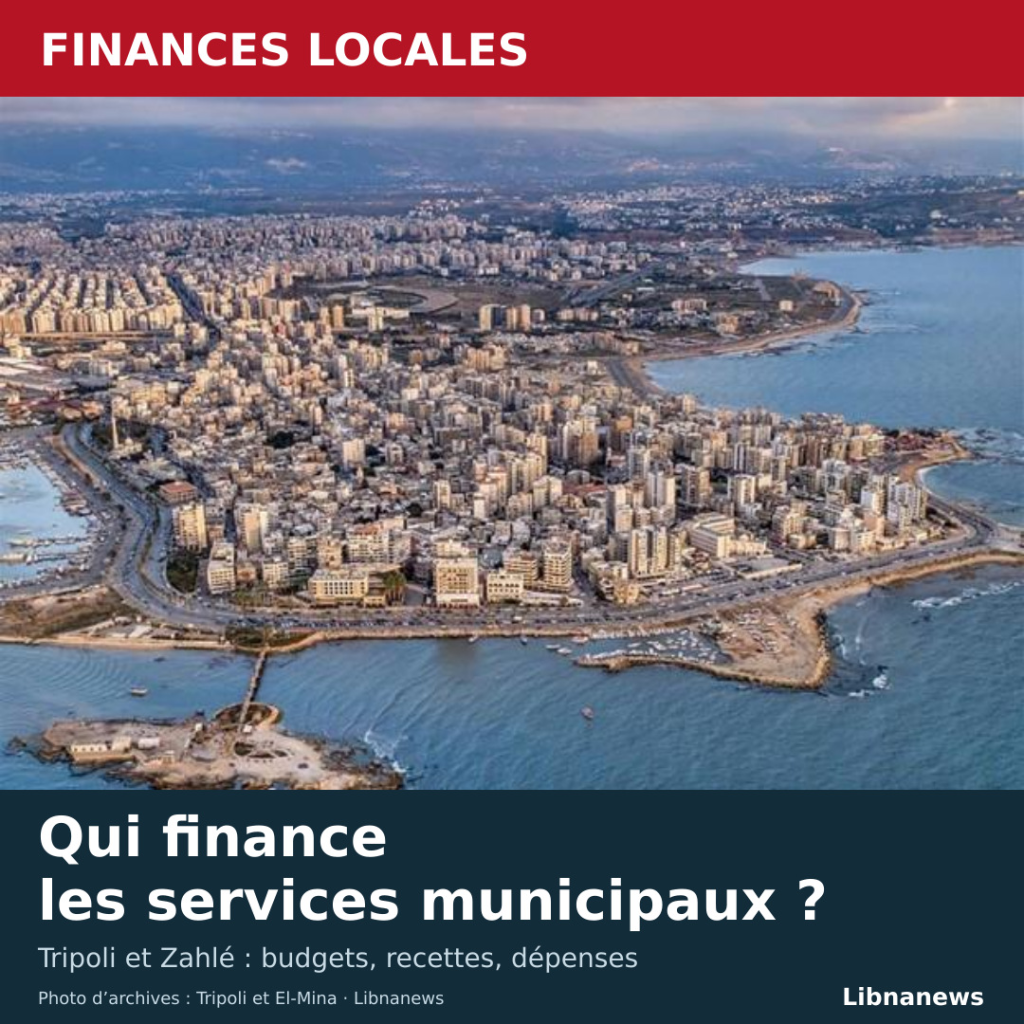
Cover photograph: aerial view of Tripoli and El-Mina, Libnanews archive published in December 2024. Illustration of the territory, unrelated to a municipal operation dated 2026. Photographer not provided. Editorial reuse authorized by the owner.





Comments