

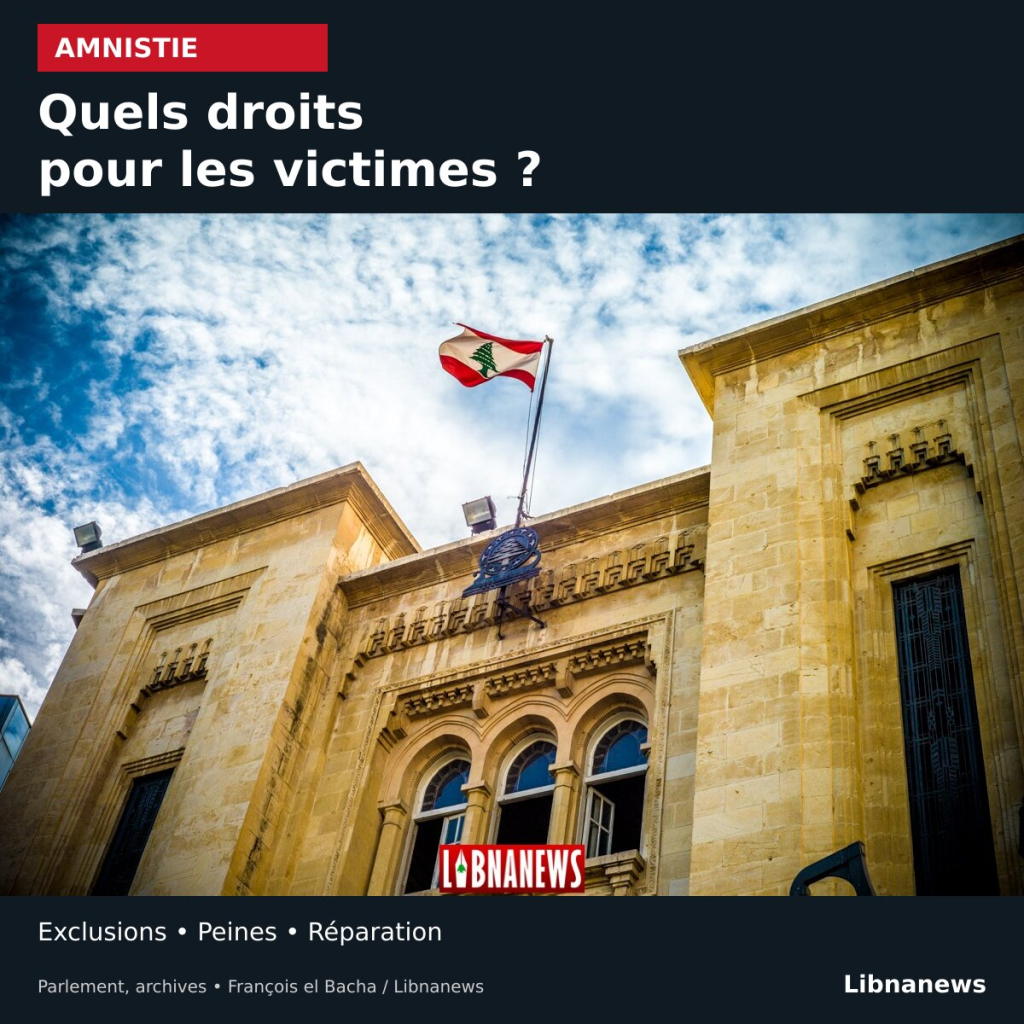
The general amnesty law in Lebanon does not indiscriminately eliminate sexual violence or trafficking. Law 70 of 4 September 2026 expressly excludes several categories of offences. Decision 12 of the Constitutional Council, issued on 12 October, further clarifies the guarantees surrounding its implementation. For victims, the decisive distinction remains between amnesty, reduction of sentence and maintenance of rights to reparation.
The fact that an offence occurred before March 1, 2026 is therefore not sufficient to conclude that it is amnestied. It is also necessary to examine its qualification and the planned exclusions. The nature of the facts, their constituent elements and the documents in the file remain decisive. A charge is not a conviction; Conversely, a request for amnesty does not remove the facts to be considered.
Violence expressly excluded from amnesty
Paragraph 12 of Article 2 excludes from amnesty rape, incest, human trafficking, domestic violence and sexual assault against minors. It also covers offences under the Law on the Punishment of Torture and the Law on Missing Persons or Victims of Enforced Disappearance.
This exclusion applies to the offences concerned whether or not a judgement has already been delivered. However, it does not mean that it is sufficient to use one of these terms to decide a case. The judicial authorities must assess the facts and verify the legal elements of the qualification.
In its decision of 12 October, the Constitutional Council also established an interpretative reservation that acts constituting a war crime, a crime against humanity, an act of torture or enforced disappearance remain outside the scope of amnesty. This clarification concerns specific legal qualifications, not any case described as serious in the public debate.
An exclusion is not an answer to all sentencing questions
Article 3 deals with another operation: the replacement or reduction of sanctions for offences not covered by the amnesty. Consolidating the two mechanisms would lead to promises to victims more than what the text says, or falsely announcing the elimination of remaining prosecutions.
The amnesty affects the public action and the criminal consequences it aims at. The reduction of the penalty modifies the penalty under the conditions prescribed by law. As for the victim’s personal rights, including his claims for reparation, they are governed by a third set of provisions. The examination of a case must therefore answer each of these questions separately.
Special case of aggravated homicide
The last part of article 3 makes certain benefits of reduction of sentence conditional on a waiver of the personal rights of the injured party. It covers intentional or premeditated homicides accompanied by aggravating circumstances, including rape or sexual assault, as well as other situations listed in the text.
The Constitutional Council clarified the scope of this condition by also referring to the provisions of the Criminal Code on homicides referred to in articles 547, 548 and 549. Most importantly, it removed the formula that required the victim to have filed a civil suit before 1 March 2026.
This censure shall prevent the date of the formation of a civil party from depriving certain persons entitled to the protection provided for. It does not delete the reference date of the amnesty itself. The two deadlines correspond to different subject-matters: one concerned the moment of the facts, the other concerned the procedural approach of the injured party.
This condition of waiver cannot be presented as a uniform rule applicable to all sexual offences. The relevant passage relates to homicides and their circumstances. Extending its regime to all cases of sexual violence would remove an essential distinction from the text.
Reparations that are not deleted
Article 4 maintains the examination of personal rights arising from the offences concerned. Depending on the stage of the proceedings and the nature of the case, such examination is the responsibility of the competent criminal, civil or administrative courts. The continuation of an action, however, does not guarantee compensation granted or its actual payment.
The application of the scheme remains discussed in the institutions. At the 27 October parliamentary meeting, Justice Minister Adel Nassar recalled that the constitutional decision could not be appealed. General Prosecutor Ahmad Rami Hajj stressed the binding nature of both the law and the decision, while several deputies criticized the scope of interpretative reservations.
For victims, therefore, protection is neither the word « exclusion » nor a promise of unchanged punishment. It depends on the qualification chosen, the separate treatment of the sentence and personal rights, and then on the decisions given in each procedure. The texts establish this framework; they cannot predict the outcome of an individual file without examining it.





Comments