

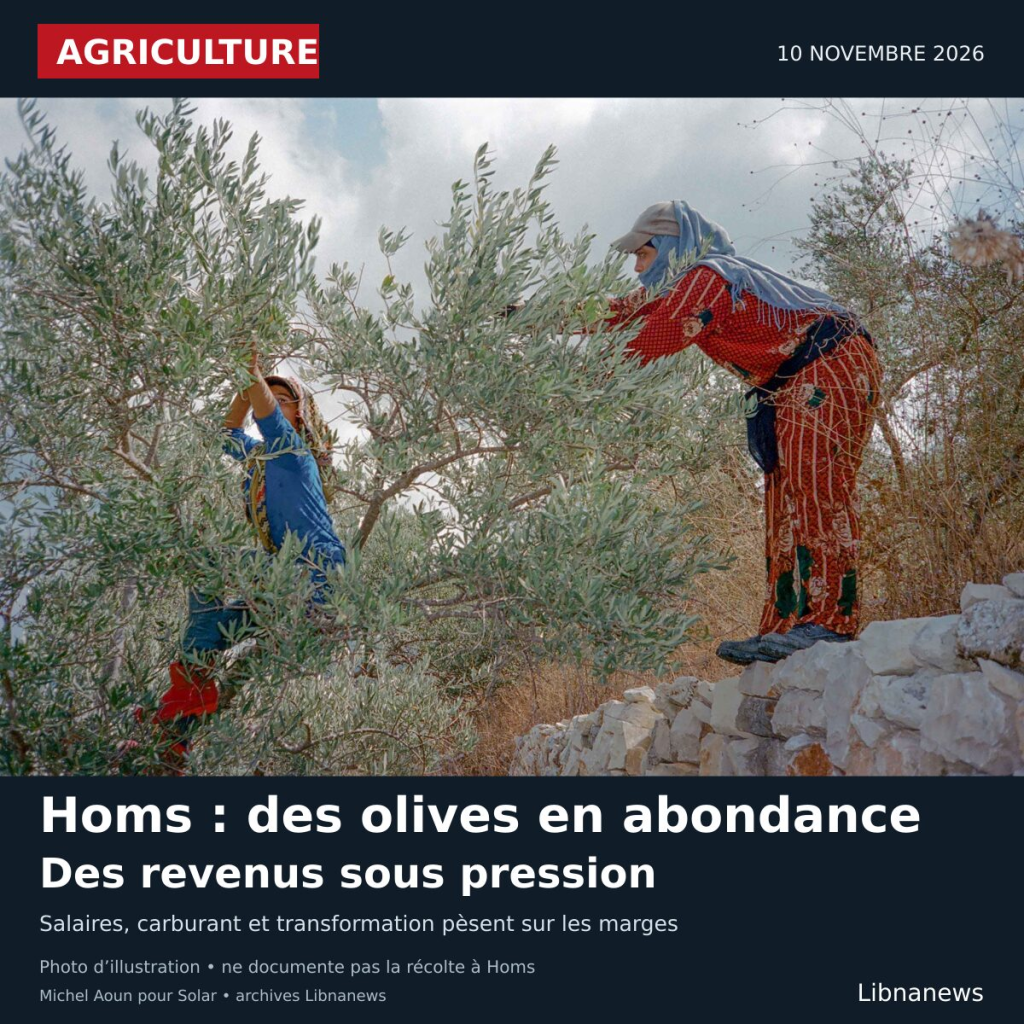
Around Homs, the olive harvest fills the baskets without guaranteeing an increase in agricultural income. Producers must pay for harvesting, fuel, and processing, while there is a high price burden. The agricultural management expects about 85,000 tons in the governorate this season, an estimate that does not prejudge the margin left to farmers.
Evidence gathered in local markets describes a significantly larger offer than the previous year. The merchant Firas Janniyat refers to volumes four to five times higher in its market observation. This trade assessment does not constitute a statistical balance sheet of Syrian production.
The same professional combines price pressure with insufficient external outlets and abundant supply in the Mediterranean basin. It also highlights the cost of fuel, labour and agricultural processing. For an operator, selling more fruit can therefore be accompanied by a lower unit revenue, without an equivalent reduction in expenditure.
Homs olives between volumes and harvesting costs
On 25 October, Mounira al-Ali, responsible for the olive sector at the Homs Agricultural Directorate, attributed the expected improvement of the harvest to the rains. It confirmed the estimate of 85,000 tonnes, while designating wages and fuels as major difficulties for farmers.
The producer Ahmad Mahdi al-Zein described a good harvest after tillage, fertilization and tree care since winter. But he explained that operating and harvesting costs, combined with lower oil prices than in previous years, limited the economic performance of the season.
The problem is thus on two calendars. The expenses start well before the sale, with the maintenance of the plots. Then the harvest imposes new money outings, to mobilize the workers and bring the fruits. Higher production increases the quantities to be handled and processed.
Prices vary according to fruit and uses
In the testimonies published on November 10, olive prices range from 70 to 130 Syrian pounds per kilo depending on the qualities. The merchant Mohammed Hawara indicates, for black olives, a range of 100 to 180 pounds. These local observations do not form a national scale and do not correspond to the price of one kilo oil.
This distinction is important to understand the income of operators. Olives sold for the table and fruit for the press do not follow exactly the same pattern. The quality, variety and destination of the harvest influence the value obtained; tonnage alone does not calculate the earnings.
Quality protects before switching to press
In early October, the Directorate of Internal Trade and Consumer Protection announced 56 presses ready to operate in the governorate. Its manager, Waël Bourghol, stated that the controls would include washing water, cleanliness of equipment, separation of healthy and damaged fruit, processing and packaging conditions.
The owner of the press Ahmad Khaddour pleaded for a competition based on oil quality rather than on the only reduction in pressing costs. The management of agriculture also recommended that olives be transported in suitable containers without mixing damaged fruit with healthy fruit.
For producers, preserving this quality is a way of defending the value of their harvest. This, however, requires an organization and means of transport at the very time when spending is accumulating. In Homs, the issue of the season therefore exceeds the abundance of fruit: it is to sell a valued production at a price that covers the costs incurred.





Comments