

An unusual alert north of Israel
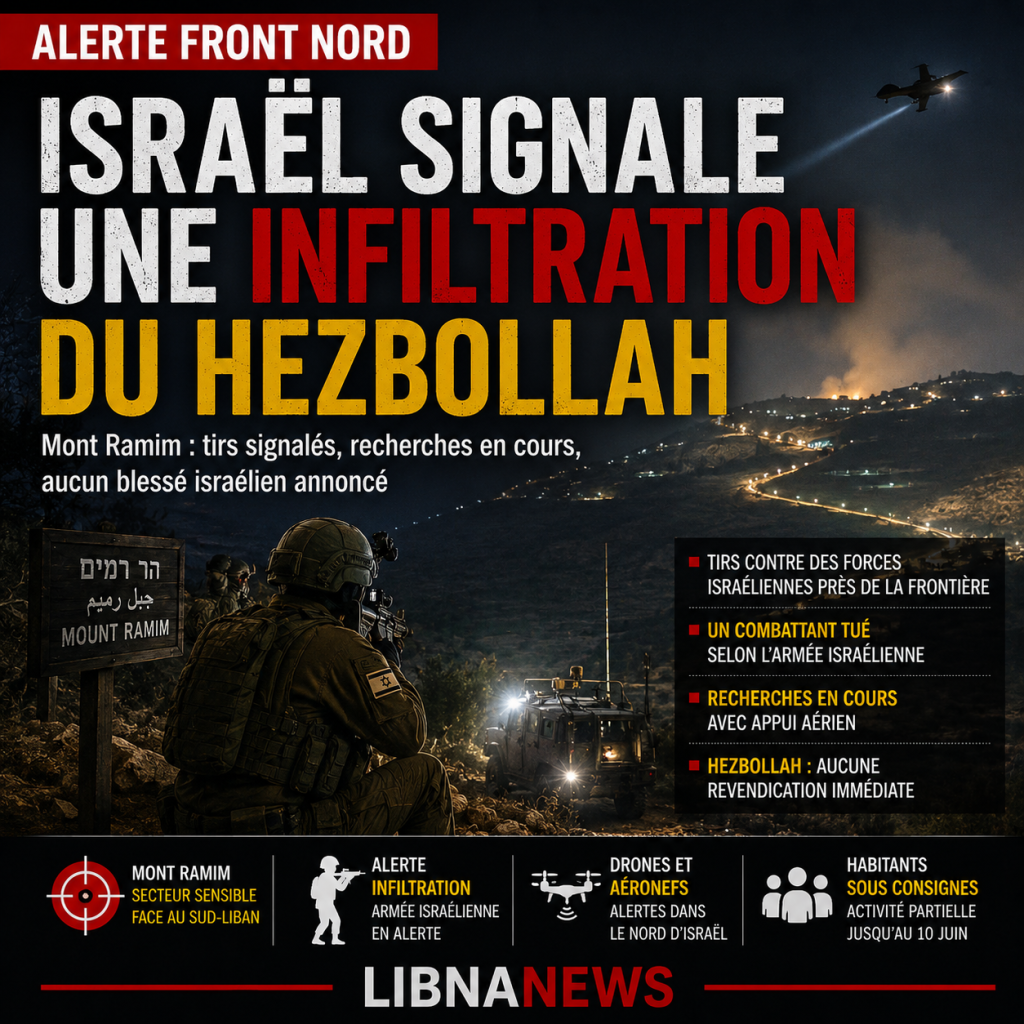
The Israeli media reported on Tuesday, June 9, 2026, a security incident reported as an infiltration of Hezbollah fighters into northern Israel. The Israeli army reported that there was a first report of firings against Israeli forces operating in the area of Mount Ramim, near the Lebanese border. According to this version, the soldiers responded and killed a fighter. No injuries were reported among Israeli forces.
The incident was described as exceptional by several Israeli media relayed in the region. According to watch reports from Israeli television and the Israeli army radio, a fighter was able to cross the border and open fire on Israeli soldiers stationed inside Israeli territory. These elements, attributed to Israeli media sources, were not all confirmed in detail by a full Israeli army communiqué at the time of the first announcements.
Hezbollah did not immediately publish a detailed claim corresponding to this specific episode. Caution therefore remains necessary. The information available is mainly based on Israeli army communications, Israeli media and pro-Lebanese relays citing these media. However, the incident attracted special attention as it intervened in an area where Israel claims to maintain a depth of security of several kilometres inside Lebanese territory, facing Ramim Ridge.
The area of Mount Ramim on alert
Mount Ramim dominates part of Upper Galilee, facing south Lebanon. The area is near border areas where warnings have been frequent since the resumption of fighting between Israel and Hezbollah. Israel maintains an important military apparatus, with ground units, observation facilities, patrols and surveillance systems.
According to the Israeli army, the incident began with firing at forces deployed in the area. The soldiers then opened fire and killed a fighter. The army announced research in the area, with the support of aircraft. It also reported that it remained in contact with the local authorities in northern Israel. These evidences show that the incident was not treated as a simple isolated alert, but as an operation requiring perimeter security.
Israeli media, citing sources of security, added that the armed man would have managed to enter Israeli territory before he opened fire. The Israeli army radio reported, according to regional relays, that the infiltration surprised the security establishment. The unusual nature of the event would be related to the fact that Israeli forces viewed the area as largely free from any Hezbollah combatant presence.
The Israeli military radio correspondent, according to the same relays, reportedly pointed out that the incident was all the more notable as Israel maintained a security zone deep on the Lebanese side, facing Ramim Ridge. If this reading is confirmed, the episode would ask an operational question for the Israeli army: how could a fighter reach the area and shoot Israeli forces despite the advanced device deployed in Lebanon?
Cell Hypothesis and Prolonged Research
Several dispatches relayed by pro-Lebanese watch accounts citing Israeli media evoke growing concern within the Israeli army. According to these messages, the armed man could have been hiding in the area for an extended period of time. Other unconfirmed elements suggest the possibility of a cell running around, or even passing through a tunnel. No full official confirmation of these assumptions was published in the first few hours.
These scenarios would explain the continuation of research after the death of the combatant reported by Israel. In this type of incident, Israeli forces must verify whether the person killed was acting alone or whether other combatants were still in the area. Research may involve infantry units, drones, helicopters, intelligence and, in some cases, special forces.
News reports in the area claimed that elements of Shayetet 13, an Israeli elite unit, were deployed in the infiltration area. This information should be treated as attributed to the Israeli media and not as directly confirmed in the available public statements. However, it reflects the level of attention given to the incident by the Israeli security apparatus, if proven.
According to the same sources, one of the most confusing points for Israeli officials is the absence of natural or artificial obstacles to easily conceal movements over several hundred metres from the front line. Israeli military radio reportedly evoked a state of shock within the security system, after the area had been considered clean of any combatant presence. These statements remain to be confirmed, but they fuel the perception of a serious incident.
An attempt to infiltrate in silence?
Israeli media, according to the pro-Lebanese relays, also reported an attempt by Hezbollah fighters to infiltrate settlements in northern Israel the previous night. These same relays claim that the Israeli authorities chose not to publish details at the time of the incident. Again, this information must be presented with caution. It is not established by the Israeli public statements mentioned directly, but it circulates in dispatches and extracts attributed to Israeli media.
If this nocturnal attempt is confirmed, the Mount Ramim incident would not be an isolated event. It would be part of a wider sequence of infiltration alerts, drones, fire and search in northern Israel. Israeli media had already reported on the night of 8-9 June alerts related to suspicious aircraft in several locations close to the border. The Israeli army reported that some incidents had ended without injury.
Confusion also comes from the use of the word « infiltration ». In Israeli press releases, it can identify different types of threats. Land infiltration means the passage of combatants across the border. Air infiltration may refer to a drone or hostile aircraft. In the case of Mount Ramim, the reported evidence relates to an armed man who opened fire against Israeli forces. The night alerts also concerned suspicious aerial objects.
Distinction is essential to establishing the facts. A successful ground infiltration to an Israeli position would have a military and symbolic reach stronger than a drone alert. It would show a Hezbollah capability, or a Hezbollah-related fighter, to cross or bypass surveillance lines. An aerial warning is part of the multiplication of drones and flying objects used on the northern front.
Reported strikes in South Lebanon
The incident was followed, or accompanied, by alerts and strikes reported in South Lebanon. Watchouts reported attacks on Ain Baal, Aytit and Habush. These localities are in an area already affected by repeated Israeli strikes since the escalation resumed. The Israeli authorities claim to be targeting Hezbollah infrastructure. The Lebanese authorities denounce attacks on inhabited areas and civilian infrastructure.
The day of 9 June was also marked by the Israeli evacuation order against Tyre, including its Christian neighbourhood, as well as subsequent strikes on the city. The Lebanese Ministry of Health reported deaths and injuries following the bombings. These events reinforced the general tension in southern Lebanon, while the Lebanese authorities were already denouncing damage near the archaeological sites in Tyre.
The Israeli army presents its operations as a response to Hezbollah’s activities. The Lebanese movement claims to target Israeli positions or forces in response to attacks in Lebanon. The incident on Mount Ramim is therefore part of a dynamic of action and response, where each border event can lead to wider strikes on the other side.
The relationship between the Mount Ramim incident and the reported strikes in southern Lebanon was not fully established in the early hours. But the timeline shows that the northern border has remained active throughout the day, with Israeli-side warnings and Lebanese-side strikes. This activity comes as mediators seek to maintain a negotiating path around the Lebanese front.
An embarrassing flaw for Israel
If the evidence reported by the Israeli media confirms itself, the incident would represent an embarrassing flaw for the Israeli army. For several weeks, Israel has claimed to have expanded or strengthened its security zone in southern Lebanon in order to remove Hizbullah fighters from the border. This strategy aims to prevent direct fire, incursions and threats against northern Israeli communities.
The fact that a fighter was able to approach, infiltrate or open fire against Israeli forces in the area of Mount Ramim would contradict the image of a fully controlled perimeter. The Israeli media itself, according to the excerpts relayed, insist on the exceptional nature of the incident. Mention of a possible prolonged passage or cache in the area adds to this concern.
Israel has already faced drone, rocket and anti-tank missile attacks from Lebanon. A terrestrial infiltration, even limited, has a different scope. It refers to the old fears of commando attacks against border localities or military positions. It also weighs on Israeli public opinion, particularly in the north, where people demand security guarantees and a return to normal life.
For the Israeli government, the incident can be used to justify the continuation of operations in Lebanon. For his internal criticism, he can also become proof that the current strategy is not enough to neutralize Hezbollah’s capabilities. The two readings may coexist: one push to hit more, the other question the effectiveness of the military device already deployed.
Hezbollah without immediate claim
Hezbollah did not immediately claim, in detail and publicly, the Mount Ramim incident in the elements available at the time of the first announcements. This absence of a claim does not lead to a definitive conclusion. The movement sometimes publishes its press releases several hours after the facts. It may also claim action under a different wording, such as firing an Israeli force, ambush or an operation against a military point.
However, the Israeli media reported the incident as related to Hezbollah. The Israeli army generally uses the term « terrorist » or « combatant » to refer to the man killed, without necessarily immediately publishing his identity. The lack of details about his name, unit, equipment or route feeds the wait around any subsequent releases.
Hezbollah, in its recent communications, has claimed responsibility for several attacks against Israeli positions, including in northern Israel and southern Lebanon. It claims to respond to Israeli strikes and violations of Lebanese sovereignty. Israel accuses the movement of using civilian areas and violating ceasefire arrangements. The 9 June incident thus became a new confrontation point in the battle of narratives.
For the Lebanese authorities, any action attributed to Hezbollah complicates the country’s diplomatic position. Beirut claims that only the state negotiates on behalf of Lebanon, while Hezbollah retains an autonomous military capability on the southern front. US mediators are seeking a stabilization framework, but field incidents continue to disrupt the sequence.
Restricted Israeli localities
After the 9 June warnings, the Israeli army maintained instructions for several northern localities. Educational and professional activities are limited in certain sectors, except where they may take place in the vicinity of shelters. The gatherings are also framed. These measures show that the army considers the threat to be persistent, even when incidents do not cause casualties.
The people of northern Israel have lived for months with sirens, closures, restrictions and departures. Many have been evacuated or are living in a situation of high uncertainty. The Mount Ramim incident reinforces this tension. Land infiltration, even limited, directly affects the perception of security among residents of border communities.
The Israeli army also uses patrols, drones and special forces to maintain control of the area. The research announced after the incident showed that the situation was not considered to be completely closed immediately after the reported fighter’s death. The hypothesis of a cell or tunnel passage, even if not confirmed, explains operational prudence.
These alerts have an internal political effect. The Israeli government is under pressure from the northerners, who are calling for the long-term removal of Hezbollah. Each incident serves as an argument to supporters of a wider operation in Lebanon. But each incident also shows that the operations already carried out have not yet produced complete security in the border area.
An incident in an open regional sequence
Reported infiltration occurs in a wider regional context. The previous days were marked by renewed tensions between Israel and Iran, missile attacks, strikes in Iran, Houthis attacks and American calls for a ceasefire. The Lebanese front remains one of the places where this regional crisis is most directly manifested. A strike in Beirut can provoke an Iranian reaction. An alert north of Israel may result in strikes in southern Lebanon. An evacuation order in Tyre may reopen the issue of civilians and heritage.
On 9 June, the chronology accumulated several elements: air alerts in northern Israel, armed incident at Mount Ramim, Israeli searches, strikes in southern Lebanon, evacuation order in Tyre and cross accusations between Israel and Hezbollah. This accumulation shows that the ceasefire referred to in the diplomatic discussions remains fragile or incomplete on the ground.
The United States claims to follow the Lebanese case closely and support the diplomatic path. The Lebanese authorities stress the role of the State in any negotiation. Israel affirms its desire to ensure the security of its north. Hezbollah maintains its armed role in the face of Israeli operations. Between these positions, incidents such as Mount Ramim recall that military actors retain a direct ability to influence negotiations.
Several points remain to be established: the identity of the killed fighter, his affiliation, his itinerary, the possible presence of other members of a cell, the possible role of a tunnel, the reason for the possible lack of immediate communication by Israel about the night incident mentioned by some media and the official position of Hezbollah. Pending these clarifications, the 9 June event sets itself as one of the most sensitive warnings on the northern front, precisely because it touches on the issue that the Israeli army wants to present as settled: Hezbollah’s ability to reach Israeli territory despite the security zones and operations in southern Lebanon.




