

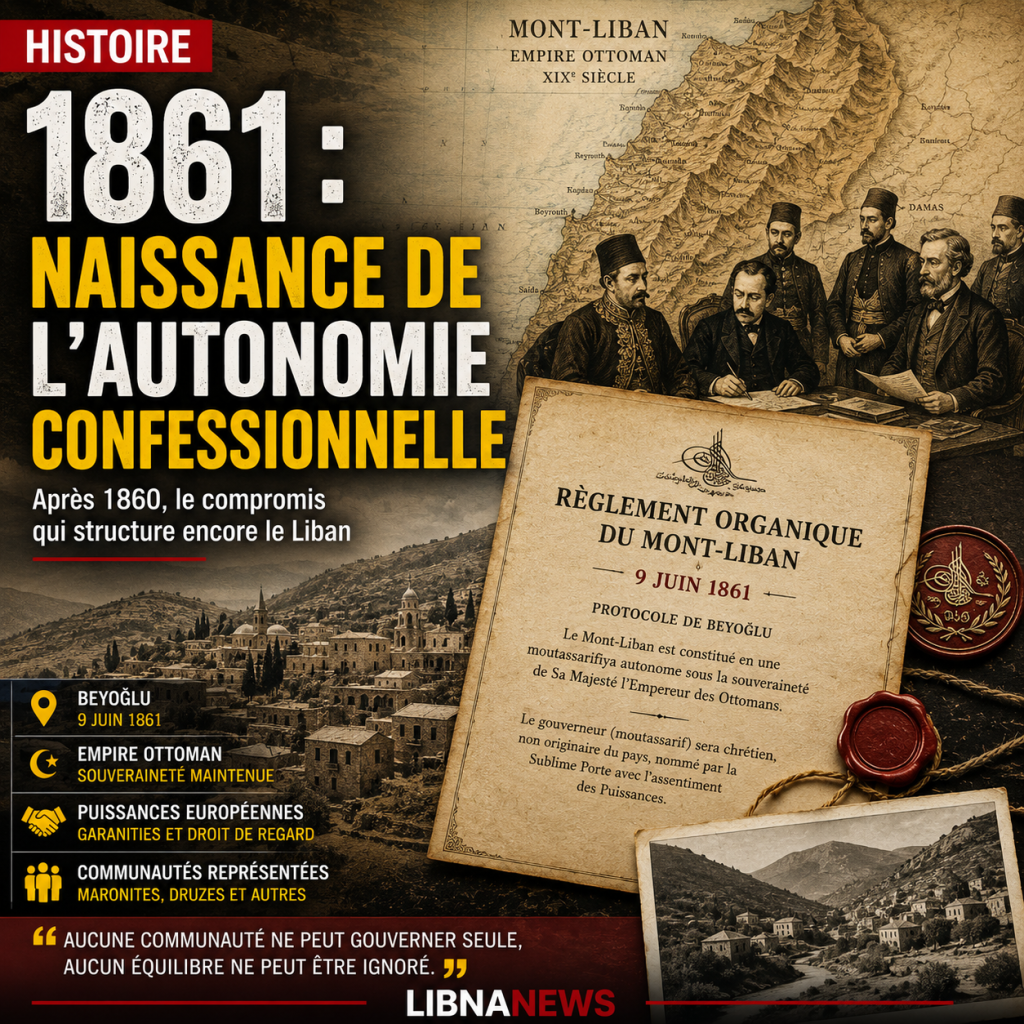
After the 1860 massacres, the Beyoğlu Protocol transformed the Mountain into an autonomous region of the Ottoman Empire. The organic regulations put an end to the old local order, but also lay the foundations for a political system structured by the communities.
June 9, 1861 marks a founding date in Lebanon’s modern political history. On that day, in Beyoğlu, in Ottoman Istanbul, the Sublime Gate and European powers endorsed a new status for Mount Lebanon. The text, known as the Organic Regulation, gives rise to the moutasarifiya of Mount Lebanon, an autonomous entity under Ottoman sovereignty but with a particular administrative organization.
This regulation comes after the confessional violence of 1860, which had bloodshed in Mount Lebanon and Damascus. The clashes between Druze and Christians, especially Maronites, had caused thousands of deaths and European diplomatic intervention, with a central role for France by Napoleon III. The stated objective is then to restore order, prevent further massacres and create an institutional mechanism to frame coexistence between communities.
Independence without independence
Mount Lebanon does not become an independent state. He remained integrated into the Ottoman Empire. But he gets a status separate from the Syrian administration. This administrative autonomy was central to the compromise of 1861.
The territory is now ruled by a governor, called moutassarif. He must be a Christian, a Ottoman subject, but not from Mount Lebanon. The rule aims to prevent a large local family, Maronite or Druze, from gaining power directly. The governor is appointed by the Sublime Porte, with the consent of the European powers.
This choice reflects the balance sought by negotiators. The Ottoman Empire retains its sovereignty. Europeans have a political right to see. Local communities, on the other hand, are integrated into an administrative system in which their representation becomes institutional data.
The religious turning point
The Organic Regulation does not create Lebanese confessionalism from scratch. Community membership already structured society, power relations and foreign protections. But the 1861 text gives them an administrative form.
Around the governor, an administrative council represents the main mountain communities. The logic is clear: organize power not only around a territory, but around a balance between denominational groups. This formula is then consolidated and adjusted by the 1864 Regulations.
The system gives more political weight to Christians, especially the Maronites, whose demographic place and European support weigh in the new architecture. But it does not suppress the Druze presence, nor that of other communities. Rather, it seeks to contain rivalries by transforming them into institutional representation.
Here lies the most lasting legacy of June 9, 1861. To avoid civil war, power is divided into denominational categories. What was supposed to stabilize the Mountain gradually becomes a political matrix.
A relative peace, but a lasting system
Moutassarifiya opens a period often described as more stable than in previous decades. Mount Lebanon enjoys a special regime, a clean administration and a framework guaranteed by the powers. This organization lasted until World War I, when the Ottoman order collapsed and regional balances were disrupted.
But this stability has a political price. It enshrines the idea that the management of Lebanon requires the official recognition of communities. Power is not just a matter of citizens and institutions. It also becomes a matter of shares, seats and denominational balances.
This model does not yet correspond to the contemporary Lebanese system. There is no President of the Republic, no Lebanese National Parliament, no National Pact. But the fundamental idea is already there: no community can govern alone, and no political reform can ignore internal balances.
From the Mountain to Modern Lebanon
The Organic Regulation of 1861 announced several features that would later mark Lebanese political life. First, local autonomy under external guarantee. Secondly, the role of powers in defining internal balances. Finally, the confessionalisation of institutions as a method of stabilization.
When Greater Lebanon was proclaimed in 1920 under French mandate, it did not leave a blank page. He inherits a political memory, an expanded territory, but also a community management method already experienced in Mount Lebanon. The Moutassarifiya thus becomes one of the historical precedents on which the modern Lebanese state is built, directly or indirectly.
9 June 1861 is therefore not just an administrative date. It’s a rocking moment. After the violence of 1860, Mount Lebanon entered a regulated autonomy regime. This regime eases some of the tensions, but it puts Lebanese policy on a long-term Community basis.
More than a century and a half later, this date remains one of the essential starting points for understanding contemporary Lebanon: a country born of compromise, mutual fears, foreign intervention and a permanent search for balance between its communities.




