

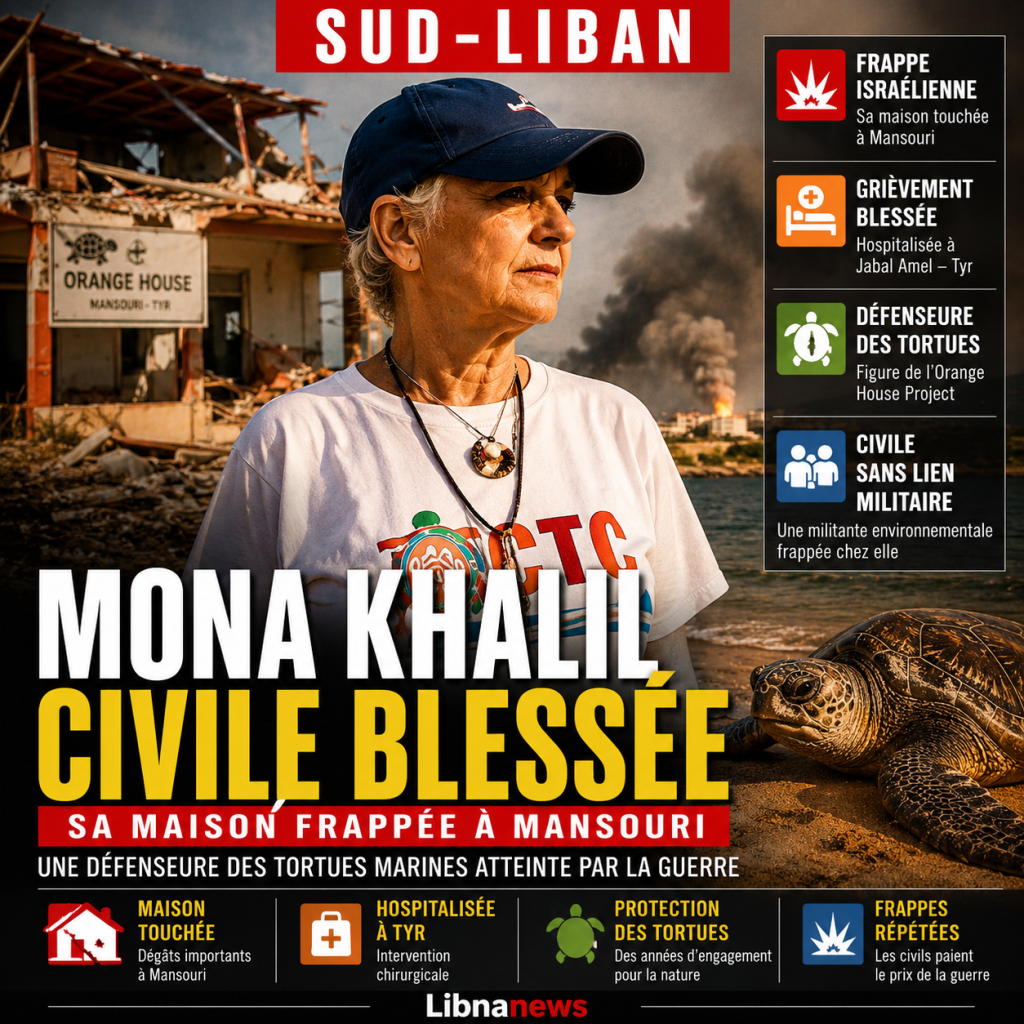
Mona Khalil, a civilian hit at home
Mona Khalil, a Lebanese civilian known for protecting sea turtles, was seriously injured by an Israeli strike on her home in Mansuri, Tyre District, southern Lebanon. This environmental defender, who has been associated for more than two decades with Orange House and the protection of a beach, was transported to Jabal Amel Hospital. Her assistant was also injured. Beyond one more war event, the attack is aimed at an identifiable civilian space, a home and a recognized ecological project, far from any known military role.
The case of Mona Khalil reveals a reality that Israeli military statements often circumvent by general formulas. The strikes in southern Lebanon do not only affect the alleged armed positions. They reach homes, roads, hospitals, agricultural land and civilians. Security rhetoric is not enough to erase this observation. A non-combatant woman was injured at home in a coastal village, while she was mainly defending a fragile natural site.
Since the beginning of the regional escalation in March, South Lebanon has been under continued military pressure. Israeli bombings have intensified in several areas, including around Tyre, Nabatiyah and villages close to the border. Evacuation orders have pushed thousands of people to safer areas, without always offering them a real refuge. In this context, Mansouri is not an isolated exception. It is one of the many villages where civilian life is compressed between drones, artillery, cut roads and fear of further strikes.
This strike against Mona Khalil’s house shockes all the more as her name refers to an ancient and precise public commitment. It did not build its reputation in the political or military field. It was built on a beach, protecting turtle nests, welcoming visitors and imposing simple rules: no plastic, no unnecessary noise, no night light on the sand. Mansouri has been a reference point for Lebanese ecotourism and for the protection of vulnerable species.
The civilian’s injury thus underscores a double failure. It first reveals the direct exposure of the inhabitants of southern Lebanon to Israeli operations in populated areas. It then reveals the abandonment of environmental spaces to the violence of a war that no longer sufficiently distinguishes the places of life from the fields of operation. The Orange House was not an anonymous building. It served as a support point for monitoring, education and conservation activities. It also weakens rare collective work in the country.
A life dedicated to Mansouri and turtles
In Mansouri, Mona Khalil had turned a former family home into a place of reception and awareness. Returning to the South after the end of the Israeli occupation in 2000, she chose not to convert this coastline into a traditional seaside project. She had made the opposite bet: to limit the human footprint, to preserve the beach and to finance the protection of turtles by a form of discreet ecotourism. This was followed by privatization of the Lebanese coast, pollution and often tolerated constructions without public vision.
The site is located between Tyre and Naqoura, in an area where the Mediterranean still retains portions of sand suitable for laying. Two species are observed: the green turtle and the turtle, also called Caretta caretta. The spawning season generally extends from spring to autumn. Every morning, the work involves identifying the traces left by females, identifying nests and protecting eggs from predators, human passages and waste. It is a patient, repetitive and essential task.
This work is not limited to biology. It involves neighbours, visitors, fishermen, volunteers and local authorities. We must convince, explain and sometimes oppose. Protection of turtles involves refusing certain practices, such as abandoned waste, night use or light nuisances. Mona Khalil held this line in a country where environmental protection often comes up against administrative indifference. It also fought against dynamite fishing and for the recognition of a reserve in Mansouri.
The Israeli attack on his house therefore comes at a time when the beach needs more surveillance. The turtles do not suspend their life cycle because the planes fly over southern Lebanon. Females continue to search for sand where they laid in previous years. The newborns continue to depend on darkness to reach the sea. When war prevents volunteers from accessing the site, it produces damage less visible than ruins, but lasting. It disorganizes an already fragile protective chain.
An Israeli strike at the heart of civilian territory
Israeli responsibility cannot be drowned in an abstract presentation of the conflict. An army that strikes a neighbouring territory must assess the risks to civilians before each operation. When these risks are repeated, when homes and civilian infrastructure are reached, the issue is no longer just that of the claimed target. It becomes that of a method. In southern Lebanon, this method creates permanent insecurity. It forces people to leave, destroys places of life and lets survivors manage the material and psychological consequences.
The Israeli authorities justify their operations through the fight against Hezbollah and the security of northern Israel. This justification does not reflect all the facts observed on the ground. It does not respond to the injury of a civilian identified for her environmental action. It does not respond to damaged hospitals, ambulances, evacuated villages or displaced families. Nor does it respond to the destruction of civilian spaces that cannot be reduced, for convenience, to collateral damage.
International humanitarian law imposes a distinction between civilians and combatants. It also imposes proportionality and precaution. These principles are not a matter of vague humanitarian rhetoric. They specifically address situations where military power acts in a inhabited environment. A house, beach, clinic or road does not become legitimate targets because they are in a conflict area. Mona Khalil’s injury is a brutal reminder of this principle, as Israeli operations in Lebanon spread and become commonplace.
The diplomatic sequence adds a layer of inconsistency. Discussions on a ceasefire took place as Israeli strikes continued in the South. For civilians, this simultaneity produces a brutal message. Negotiations are moving forward in capitals, but houses remain exposed. The inhabitants heard of truce, then saw the smoke columns rising above the villages. This contradiction feeds anger and fatigue. It makes it more difficult to trust promises of de-escalation, especially when operations reach known civilian figures and health infrastructure.
Southern hospitals under the same pressure
Current violence also affects the health care system in the South. The Jabal Amel hospital, where Mona Khalil was taken care of, had already been mentioned in recent days in the context of Israeli strikes in Tyre and damage to medical facilities. An international medical organization has denounced the impact of these attacks on the capacity of hospitals to treat the injured. The message is simple: knocking near medical structures amounts to weakening the entire emergency device. Civilians then pay the price of this disruption.
In the villages of the South, the inhabitants do not live the events as lines in a statement. They live waiting, rushed departures, blown windows, cracked houses, avoided roads, unanswered calls. They also live the fear of staying and the guilt of leaving. Older people don’t always want to leave their homes. Families fear losing their property. Farmers see their fields become inaccessible. Local project managers, such as Mona Khalil, know that a prolonged departure can mean the cessation of work years.
The Orange House, civil memory of the coast
This civil dimension must remain at the centre of the article. Mona Khalil is not anonymous damage in a military sequence. She is a woman, a resident of Mansouri, a defender of the living. His house was not a combat position known to the public. It was a place of reception, education and ecological watch. By striking it, Israel reached a civilian symbol of southern Lebanon. This symbol is important because it shows that war not only destroys infrastructure. It also attacks ordinary forms of care in the territory.
The Orange House also had a memory function. It recalled the end of the Israeli occupation, the return of the inhabitants to their villages and the possibility of rebuilding otherwise. The house was not designed as a luxurious refuge. She proposed another coastal experience, almost austere, based on respect for the place. Visitors found a beach without music, heavy commercial exploitation and aggressive consumption. In a country where the coast was often confiscated, this choice had both social and ecological significance.
This model was based on a daily presence. It depended on one person, a small team, neighbours and volunteers. This fragility gives the Israeli strike a concrete reach. Injuring Mona Khalil is weakening the centre of gravity of a project that does not have the means of a large organisation. Harming your place of life means reducing the ability to track a rare beach. In a country already exhausted by financial, political and security crises, civilian initiatives are not easily replaced.
South Lebanon now concentrates several forms of vulnerability. Civilians are being hit. Municipalities lack resources. Hospitals work under pressure. Agricultural land burns or remains inaccessible. Beaches often leave the media. Yet they are a valuable indicator of land degradation. Waste, pollution, night lighting and war add up. Mona Khalil’s injury brings this reality back to the news: environmental protection is not a luxury reserved for calm times. It becomes even more necessary when everything goes wrong.
The figures of the Lebanese crisis provide a measure of the context. The Lebanese authorities have recorded several thousand deaths since the beginning of the Israeli campaign in March, while humanitarian agencies are warning about the extent of displacement and food insecurity. These data do not dissolve individual cases. They enlighten them. Behind each balance sheet are faces, trades, houses and commitments. Mona Khalil’s point is that civilian victims are not just passersby caught in war. They are also people who held common spaces.
What the attack requires to document
The public treatment of this strike must therefore avoid two traps. The first would be to reduce it to an environmental emotion, as if the wound of a turtle protector was a peripheral cause. The second would be to absorb in the mass of the bombings, without naming the central fact: an Israeli strike seriously injured a civilian in his house. A journalistic article must hold these two elements together. He must say the military violence and the value of civilian work affected by this violence.
The case also raises a question with the Lebanese authorities. Documentation of civil and environmental damage must become systematic. Every home affected, every hospital damaged, every beach inaccessible, every informal reserve affected should be accurately identified. This task does not replace care or security emergency. However, it prevents the deletion of the facts. The South Lebanon has too often been treated as a theatre of operations, while it remains first inhabited, cultivated, cared for and transmitted.
For the inhabitants of Mansouri, the emergency remains immediate. Mona Khalil’s state of health must be monitored, people injured with her must be supported, the damage suffered by the house must be assessed and the beach must be monitored, if access permits. The Israeli military calendar does not take into account the turtle calendar. Nests already formed should be identified, protected and monitored. Volunteers will have to deal with risks, roads and safety instructions. In Mansouri, the next expected sign may be played on a hospital bed, then on a trace of turtle printed in the sand.




