

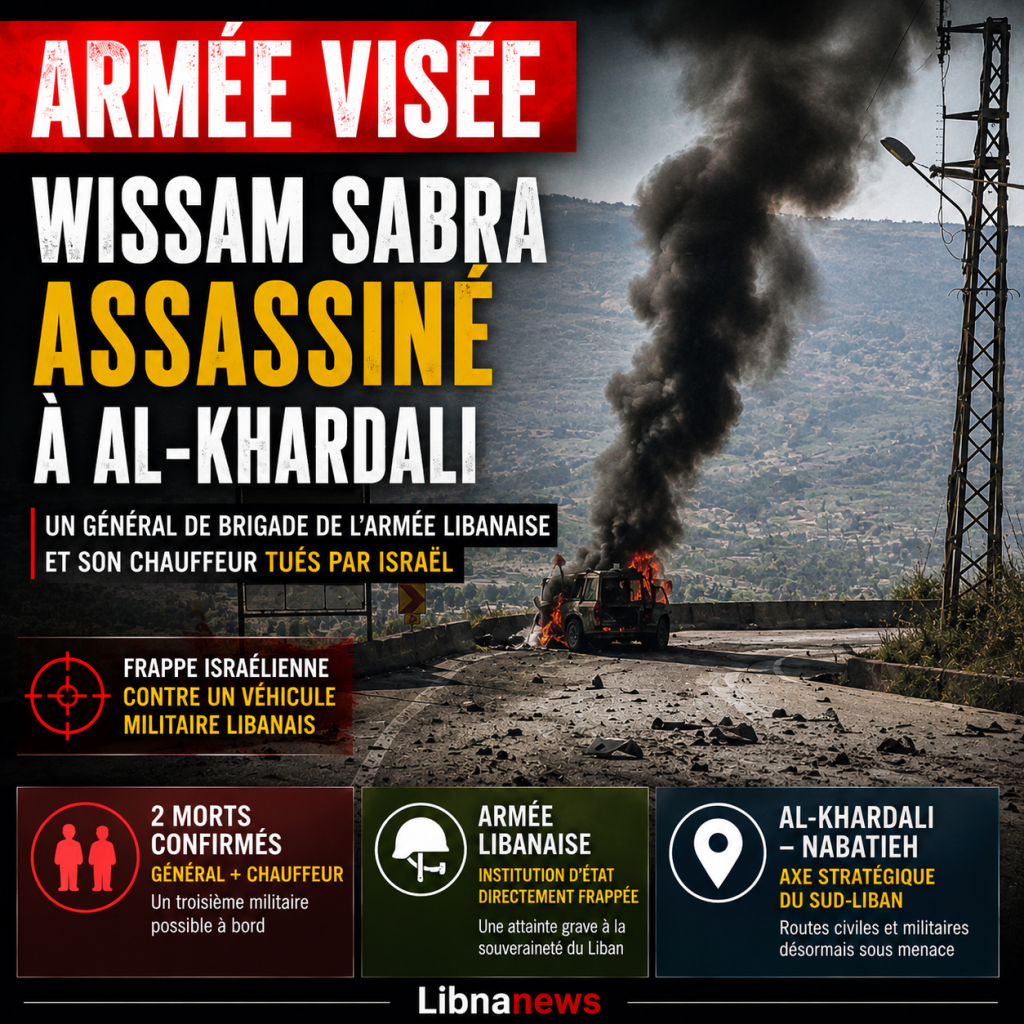
Brigadier General Wissam Sabra, a senior Lebanese army officer, was assassinated on Saturday, June 6, 2026 by an Israeli strike against a military vehicle on the Al-Khardali-Nabatiyah road in southern Lebanon. His driver was killed with him. The first elements transmitted by Lebanese sources also evoke the presence of a third soldier in the targeted vehicle, with a balance sheet likely to be raised to three martyrs. The Lebanese army has denounced a brutal Israeli hostile strike against its personnel, as Israeli attacks continue in several parts of the country.
The identity of the high officer gives the attack a national scope. Wissam Sabra was not an irregular fighter or a politician. He was a member of the Lebanese regular army and, according to media reports, served as head of the fourth section of the brigade command. His death struck a state institution, placed at the centre of all discourses on the stabilization of southern Lebanon. It also reveals the extent of the Israeli escalation against Lebanese official structures, even as international mediations repeat that the army must embody the return of public authority south of the Litani.
Wissam Sabra targeted on a southern road
The strike targeted a military vehicle on a known axis of southern Lebanon. The Al-Khardali – Nabatieh road is not a marginal point. It connects localities, post offices, agricultural areas and access to Litani. Civilians, first aid workers, military personnel and residents are still borrowing despite the destruction and overflights of drones. By targeting an army vehicle on this road, Israel is not limited to an action of war against a declared opponent. It attacks the military institution of a neighbouring State on its territory and makes any official movement in an already fragile region more dangerous.
The word murder is required in this case because the strike targeted an identified vehicle, in motion, and not an open combat front. Brigadier General Wissam Sabra and his driver were killed in an operation directed on a Lebanese road by the Israeli army. This method is part of a practice that has become recurrent in southern Lebanon: monitoring the axes, identifying vehicles, and then hitting by drone or missile. But the assassination of a Lebanese army general crossed a threshold. It is no longer just an attack on civilians or a village bombardment. This is a direct attack on a national chain of command.
Lebanese Army directly hit
The Lebanese army occupies a unique position in the current crisis. She’s not Hezbollah. It is not a faction. It is Lebanon’s official military institution. It holds posts, controls the axes, sometimes assists municipalities and participates in security operations in areas where the State tries to maintain a presence. In diplomatic discussions, it is often presented as the only force capable of assuming, in the long run, a central role in the South. Israel’s assassination of Wissam Sabra is a brutal contradiction to this discourse. We cannot ask the army to take over the ground while accepting that it be struck when it circulates.
This contradiction exposes Lebanon’s impasse. Mediators call for the strengthening of the Lebanese army, but Israeli strikes reach its soldiers, its vehicles and now one of its generals. Foreign capitals demand more state authority in the South, but this authority is targeted on its own roads. The message sent to officers is clear: their uniform does not protect them. The message sent to the population is equally clear: even State officials can be killed by Israel in an ordinary military displacement.
Wissam Sabra’s death came after several attacks on Lebanese soldiers. In recent weeks, soldiers have been killed or injured in Israeli strikes on southern axes, including around Nabatiyah and al-Khardali. Military vehicles were targeted. Posts were damaged. The Lebanese army has already denounced these attacks as attacks on its personnel. Saturday’s raid still raises the level of gravity. It shows that Israeli forces do not merely tolerate damage to the Lebanese army. They are now hitting senior executives in military vehicles.
A driver killed, a possible third martyr
For soldiers deployed to the South, the consequences are immediate. Each journey becomes an exhibition. Each patrol can be followed by a drone. Every road inspection, every shift of command, every coordination mission can turn into a target. This threat reduces the army’s freedom of action. It slows down its interventions and complicates its presence in villages. It also weighs on civilians, as an army prevented from moving can no longer effectively secure the axes, accompany returns, open roads or support relief.
The driver killed with the general also deserves to be placed at the centre of the story. In the balance sheets, military drivers often disappear behind the rank of officer they accompanied. Yet their role is essential. They drive on dangerous roads, follow mission orders, wait in exposed areas and share the risk of command. His death recalls that the so-called targeted strikes always carry more than a designated name. They kill men in the same vehicle, at the same minute, in regular military service.
The possibility of a third martyr in the vehicle further reinforces the gravity of the raid. The first elements evoked the presence of a third person on board. If this death is confirmed, the human impact of the attack will increase and highlight the brutality of the operation. In all cases, the essential thing is already established: an Israeli strike killed a Lebanese army Brigadier General and his driver on the Al-Khardali-Nabatiyah road. It targeted a military vehicle of a regular army and struck an official Lebanese institution.
Al-Khardali, strategic axis now targeted
The location of the attack adds a strategic dimension. Al-Khardali is not only an axis of passage. It is a south road lock, associated with links between Nabatieh, Marjayoun and the approaches to Litani. The repeated strikes create a geography of fear. Residents are reluctant to use some roads. Ambulances assess the risks before leaving. The military is changing their routes. Municipalities are losing time to reopen roads, see damage or organize evacuation of injured people. By hitting Al-Khardali, Israel is not just touching a vehicle. He disorganizes a whole territory.
The assassination of Wissam Sabra is taking place in a series of Israeli attacks that have already affected villages, houses, infrastructure, civilian sites and roads. South Lebanon lives under the constant surveillance of drones. Evacuation orders were issued in several locations. Families left their homes without knowing when they could come back. Southern hospitals work under pressure, while relief workers have to deal with dangerous roads. The raid on a Lebanese general falls within this framework, but it gives it an even more political dimension.
Israeli responsibility must be named. Israel cannot invoke indefinitely the security of its northern border to strike Lebanese soldiers on Lebanese territory. A regular army is not an available target. A senior officer of the Lebanese State is not a secondary damage. International humanitarian law imposes a distinction between engaged forces, civilians and institutions not directly involved in hostilities. By targeting a Lebanese military vehicle, Israel opens a front with the very institution that the international community says it wants to support.
An attack on Lebanese sovereignty
This attack therefore undermines the sovereignty of Lebanon. The country is weakened by a financial crisis, political divisions and the collapse of several public services. But its sovereignty does not disappear because it is fragile. The Lebanese army has the right to travel on Lebanese roads. His officers have the right to move south. Its vehicles cannot be treated as ordinary targets by a foreign power. Saturday’s raid puts this evidence at the centre of the national debate.
Beirut’s reaction will be carefully observed. A statement of conviction will not be sufficient to measure the seriousness of the event. The assassination of a Brigadier General calls for a firm diplomatic approach, accurate documentation of the raid and pressure on international bodies. It also calls for a response from the partners who finance or equip the Lebanese army. These countries cannot demand a strengthening of the military institution while remaining silent when one of its senior officers is killed by Israel.
This issue directly concerns the security arrangements under discussion. Any solution in South Lebanon is based, at least on paper, on a larger Lebanese army presence. But this presence becomes impossible if officers and soldiers are beaten when they move. The credibility of mediation therefore depends on a simple principle: the Lebanese army must be protected in the performance of its missions. Without this, stabilization plans remain untaken texts on the ground.
A precedent that cannot be trivialized
The emotion within the army will be strong. The death of a brigadier general reaches the morale of the units. She reminds soldiers that the risk is not limited to the front lines. It can touch a command, a convoy, an inspection, a journey between two positions. It also affects the families of the military, who have already suffered from the devalued wages, economic difficulties and the length of the security crisis. In a country where the army remains one of the few transcommunal institutions, the death of Wissam Sabra can take on a national scope beyond the usual divisions.
Lebanon will also have to appoint and honour the murdered driver with him, as well as any other military personnel whose death is confirmed in the vehicle. The dignity of the victims is not only ranked by rank. A Brigadier General embodies the institution, but the soldier who leads, accompanies or secures a mission also embodies military public service. The funeral and official press releases will have to make this reality visible. Each name will count in a war where the balance sheets risk reducing the deaths to numbers.
The institutional nature of the target also requires a distinction between this raid and a classic confrontation between Israel and Hezbollah. By striking a national army officer, Israel places the Lebanese state itself at the centre of the aggression. This distinction counts for the Lebanese who see their army as a last common framework, despite political and social crises. It also counts for the chancelleries that repeat that the stability of the South will pass through the regular forces. If this army is weakened, intimidated or prevented from acting, the security vacuum will widen and the people will pay the price.
The attack finally raises a question of method. For months, Israeli strikes on vehicles have increased in southern Lebanon. They install a logic of remote execution, driven from the air, which leaves little room for public verification. One car is hit, one balance is announced, and another strike follows. In the case of Wissam Sabra, this mechanism turns against a pillar of the state. It forces Lebanon to carefully document the attack, not only to honor its dead, but to prevent the assassination of a brigade general from becoming a trivialized precedent.
The attack on Al-Khardali finally reminds us that the roads of the South have become political places. They no longer serve only to connect villages. They reveal the balance of power between the Lebanese State, Israel, armed groups, mediators and people. When a road can be hit at any time, sovereignty becomes fragile. When a general is murdered, this fragility becomes manifest. The vehicle destroyed on the Al-Khardali – Nabatieh axis gives a brutal picture of the situation: a Lebanese territory under threat, a targeted army and a population forced to live under the eyes of the drones.
The next few hours will have to confirm the final results and identities of all the soldiers killed. They shall specify the circumstances of the displacement and the extent of the damage. But the essential thing is already fixed in Lebanese news: Brigadier General Wissam Sabra, head of the fourth section of the brigade command according to media reports, was murdered by Israel with his driver in a strike against a military vehicle. In Al-Khardali, Lebanon is now waiting to know whether the death of a high officer of its army will result in more than one conviction.




