

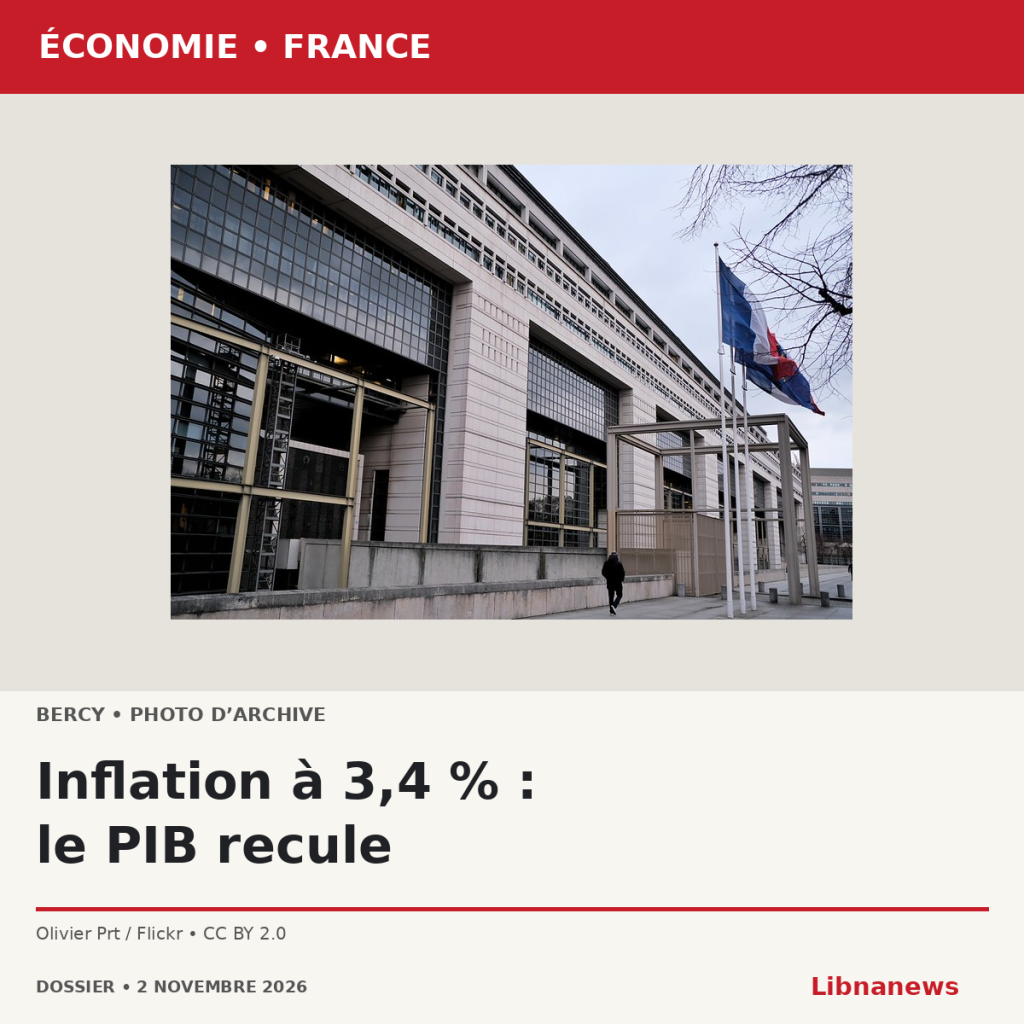
Inflation in France accelerates as activity declines slightly. The first estimates published on 30 October place the price increase at 3.4% over one year in October. Gross domestic product fell by 0.1 per cent in the third quarter. This double signal comes at a time when Parliament is considering the 2027 budget.
Both indicators do not measure the same period or phenomenon. Inflation compares prices in October with those of one year earlier. GDP here measures the evolution of activity between two quarters, by volume. However, their rapprochement describes a concrete difficulty: the increase in daily expenditure is not accompanied by an overall increase in production.
Inflation in France: energy pulls up
Annual price increases increased from 3.1 per cent in September to 3.4 per cent in October. Energy grew by 24.1% compared to 21.3% a month earlier. Services increase by 2.7% year-on-year. On the other hand, the power supply slowed slightly to 1.2% after 1.4%.
This dietary average masks significant differences. Fresh products remain 8% more expensive than a year ago. Other food products increase by 0.3%. Manufactured goods still show a slight annual decrease of 0.2%.
| Indicator | Last estimate | Comparative period |
|---|---|---|
| Consumer prices | +3.4 % | October 2026 over one year |
| Energy | +24.1% | October 2026 over one year |
| GDP volume | -0.1 per cent | Third quarter on previous |
These data do not mean that each household experiences an identical increase. The weight of heating, movement and feeding varies between households. They show above all the place of energy in the new price acceleration.
The decline in activity does not come from all sectors
GDP stagnated in the second quarter. Its slight decline to the third does not therefore correspond to two consecutive quarterly decreases. The latest data are not sufficient to retain this usual criterion of technical recession.
Household consumption increased by 0.4 per cent, after 0.2 per cent. On the other hand, investment fell by 0.6%, after a decline of 0.5%. Foreign trade also penalises activity: exports fall by 1.7%, while imports increase by 0.1%.
Changes in stocks make a positive contribution of 0.4 percentage points to growth. External trade is negative, at 0.6 points. The overall contraction must therefore not be equated with a uniform collapse of domestic demand.
More concerned households, shared enterprises
The survey published on 27 October sheds light on the feelings of the French. The household confidence indicator loses five points and falls to 80. It has reached its lowest level since June 2013. Its long-term average was 100.
This indicator reflects responses to a survey, not a direct measure of expenditure. Its deterioration may therefore coexist with consumption still increasing in the previous quarter. The observed periods also differ: morale in October comes after purchases from July to September.
On the business side, the October 22 survey presents a more contrasting situation. The business climate gains about one point, while remaining below its long-term average. Improvement affects industry and, more slightly, services. Retail trade and construction are deteriorating. The employment climate loses three points.
Gas increases at the entrance in November
The gas benchmark price increased by 6.6% TTC on November 1. It reaches 194.90 euros per megawatt hour. This benchmark applies in particular to indexed offers; suppliers are not obliged to apply it to all their contracts. Therefore, a fixed price offer does not automatically undergo this change.
This increase occurred after the month covered by the October inflation estimate. It should not be included retrospectively. The final results of the October prices are expected on 13 November. They may confirm or revise the first estimate.





Comments