

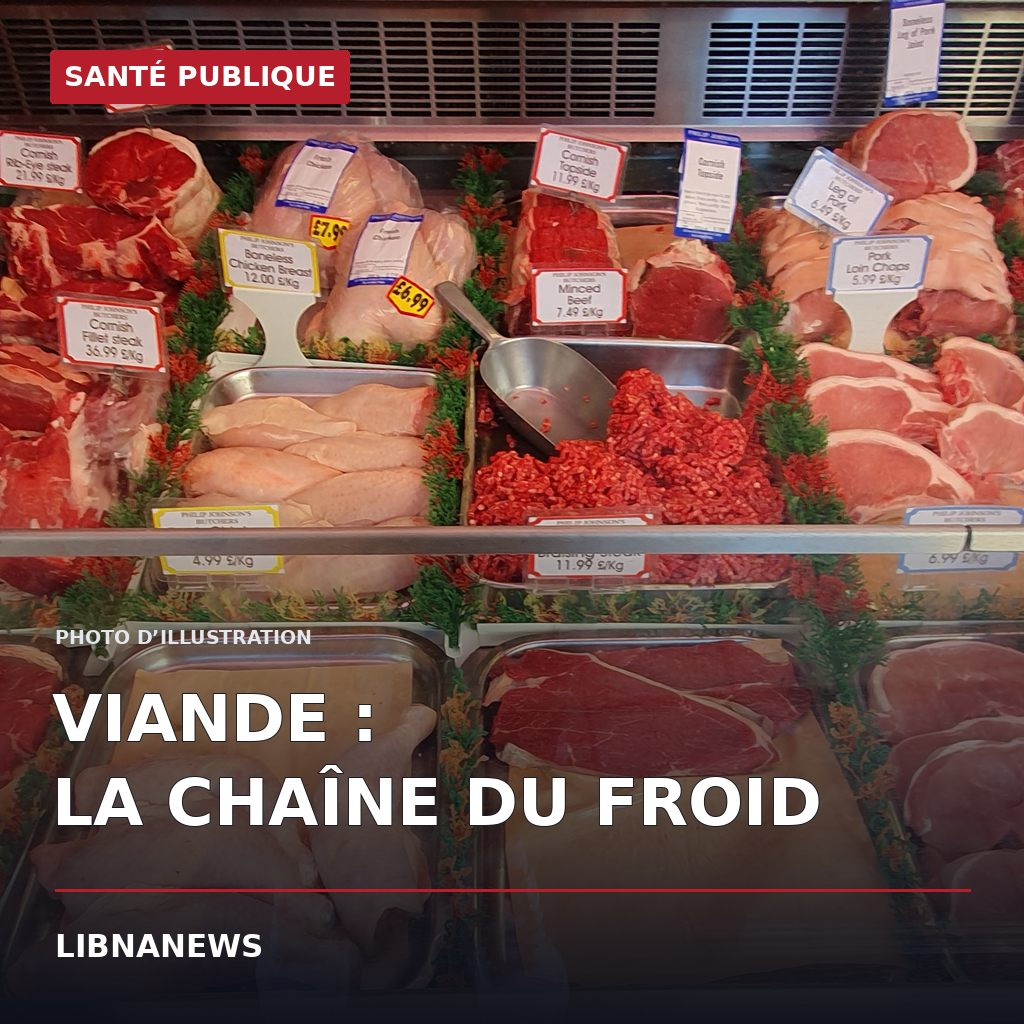
State Security announced the seizure of 250 kg of meat transported in an unequipped vehicle to ensure its conservation in the Marjayoun and Hasbaya sectors. The case shows why the checks must follow the lot to the points of sale, without assuming that all meat was passed or declared unfit after analysis.
Control started before arrival at the butcher shop
According to the State Security, the vehicle checked on 24 November was used to deliver butchers in both sectors. Two people were arrested and the authorities seized the meat and the vehicle on instructions from the competent prosecutor. The press release issued the following day did not identify any trade and did not state that a laboratory had identified any contamination. It also does not specify whether products from the lot have already reached consumers.
The problem is that of the means of transport. A properly cooled window does not restore the safety of a product that would have been badly stored before delivery. Conversely, this finding alone does not allow to know the actual temperature of the lot, the duration of exposure or the result of analyses that have not been announced.
Traceability links supplier, vehicle and seller
To determine whether the problem is limited to the vehicle or also concerns stocks already distributed, useful parts are delivery vouchers, lot identification and temperature records where they exist. These documents compare the quantity charged with the quantity seized and determine which businesses actually received the goods. An address served during a tour does not alone prove receipt of a non-compliant lot.
This work allows, where appropriate, to limit withdrawal or analysis to the right product. It protects both consumers and businesses who have not received the meat in question. The case of the South should therefore not be confused with other controls announced in recent weeks in butcheries elsewhere in Lebanon.
Multi-step controls
The Council of Ministers recently referred to inspections in warehouses and slaughterhouses as part of food security efforts. Control in Marjayoun and Hasbaya reminds us that delivery is also a decisive step. The continuation of the file will depend on whether the controllers can establish the origin of the products, their preservation and their possible distribution.





Comments