

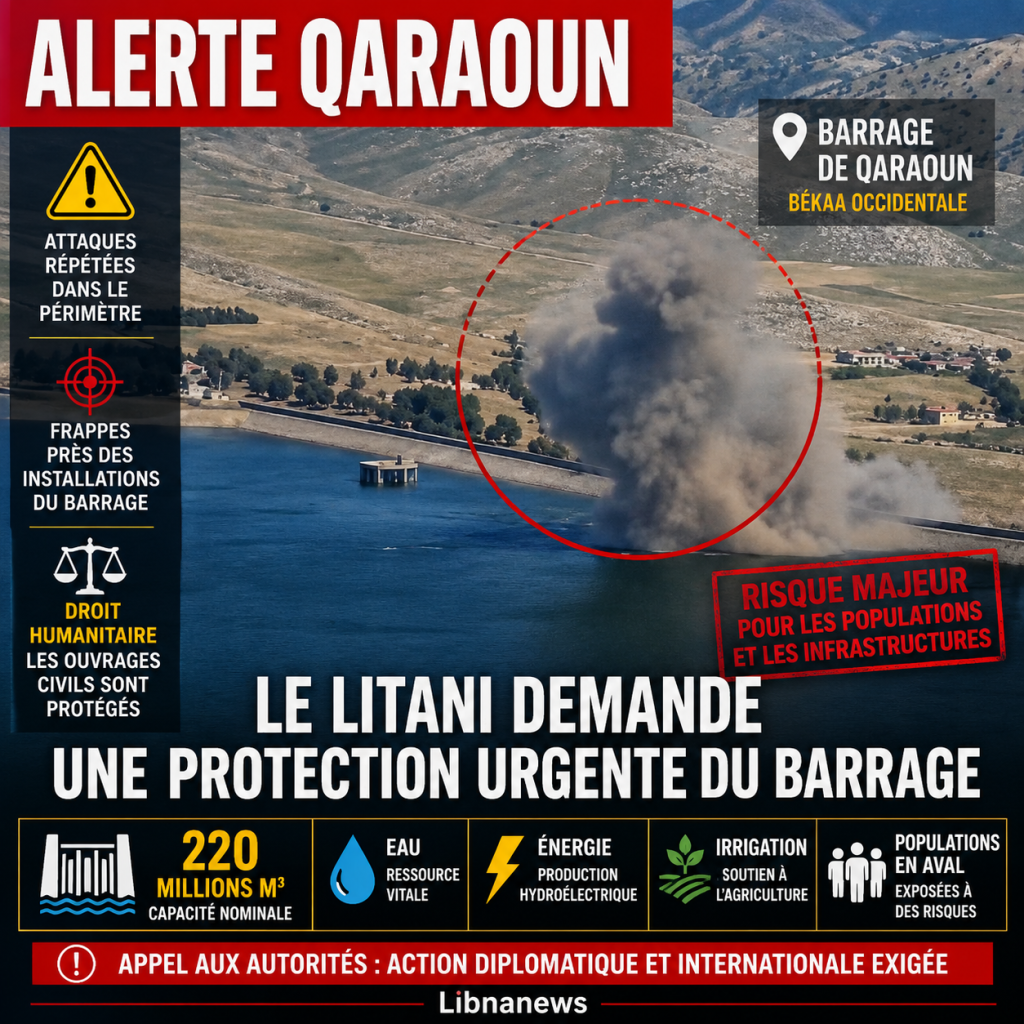
The Qaraoun Dam, Lebanon’s main water reservoir, is the subject of a public alert following repeated attacks on its perimeter and on the roads serving it. In a communiqué issued on 26 May, the Litani National Office called on the highest Lebanese authorities to undertake international and diplomatic efforts to put the work and its facilities away from attack. The message targets the President of the Republic, the Prime Minister and the ministers concerned. It presents the site as a strategic civilian infrastructure, linked to water, energy and irrigation, whose protection is a matter of public safety.
An alert centered on the Qaraoun dam
The Litani National Authority bases its alert on the proximity of impacts to the dam facilities. According to the press release, one of the roads concerned is part of the body of the dam and associated equipment. This precision gives a technical scope to the warning. It means that the concern is not only about a strike in a neighbouring sector, but about the operation and protection of the structure. The press release does not mention a break in the dam. However, it stresses the need for maximum vigilance and continuous technical monitoring.
The Qaraoun dam occupies a central position in the Lebanese hydraulic system. Located in Western Bekaa, on the course of the Litani, it retains the largest artificial lake in the country. Its nominal capacity is generally estimated at about 220 million cubic metres. It is used for water resources management, irrigation and hydroelectric production. Its immediate environment includes access roads, control structures, electrical equipment and ancillary installations. The protection of these elements conditions the safety of the dam itself.
The Agency’s appeal comes in the context of intensified strikes in the South Lebanon and the Bekaa. The Litani area has become one of the most sensitive areas of military escalation. The Lebanese authorities highlight the civilian nature of the infrastructure affected or threatened. Israel, for its part, asserts that it is targeting positions and means related to Hezbollah. In this context, the location of strikes near essential works raises particular concern. The Qaraoun Dam focuses this concern because a major incident would have effects beyond the point of impact.
Water, energy and irrigation facilities
The Litani National Authority warns that any direct or indirect targeting of the Qaraoun Dam or its facilities may expose downstream populations and infrastructure to major risks. The indirect term is important. It includes strikes that do not affect the main wall but that affect accesses, roads, associated structures or devices necessary to control the installation. A dam depends on a monitoring chain. The teams shall be able to inspect the slopes, check the valves, observe any cracks, check the flow and intervene on the equipment.
The mention of public safety places the file on an operational ground. After an attack near a hydraulic structure, the authorities must check the condition of the roads, the integrity of the equipment and the possibility of access to the site. They must also measure the impact of the explosion on slopes, protections, pipes and drainage areas. This phase is not limited to administration. It mobilizes engineering, risk management and civil protection skills. The Agency therefore requests that technical monitoring be maintained at a high level.
The communiqué stresses the vital nature of the dam for Lebanon. Qaraoun is not an isolated facility. It is part of the Litani Basin, the country’s main waterway, which is managed in several sectors. Water stored in the lake supports agricultural uses. It also contributes to the operation of a hydropower system whose production, even if limited by crises, remains significant in a country facing a sustainable shortage of electricity. In rural areas, Litani-related irrigation networks directly influence farm activity and the security of farm incomes.
Humanitarian law invoked by the Agency
The civil dimension of the site is the core of the argument developed by the Office. The dam, its equipment and Litani facilities are described as civilian and vital property, the targeting of which is prohibited by international humanitarian law. This reference is part of the rules applicable to structures containing dangerous forces, such as dams and dams. These structures enjoy special protection because an attack can cause massive water release and cause extensive civilian losses. The Lebanese demand therefore concerns the prevention of a risk with potentially uncontrollable consequences.
The Litani National Office attached to its alert a scenario prepared as part of a Litani Basin Management Support Program funded by the United States Agency for International Development. This document covers risk scenarios related to the collapse of the Qaraoun dam and areas exposed to possible flooding in the event of structural failure or the targeting of the structure. The aim of the report is to recall that the risk has already been modelled. It also identifies areas that could be affected by a rapid rise in water.
Such a scenario does not mean that a collapse is expected. It is used to organize prevention. The authorities are used to map vulnerable areas, prepare evacuation plans, identify roads to be kept open and define alert messages to the population. In the case of Qaraoun, this preparation takes on a particular dimension in times of conflict. The availability of roads, the ability of civil defence to move and the access of technical teams to the dam can be reduced by strikes. The document cited by the Office thus provides a practical basis for the diplomatic request.
Request to the Lebanese authorities
The request addressed to Lebanese officials covers several levels of action. The first concerns political contacts with States and organizations capable of intervening with the parties to the conflict. The second concerns diplomatic channels, in order to obtain a clear recognition of the civil status of the dam and its perimeter. The third is internal coordination between ministries, technical services, the army, civil defence and municipalities. The communiqué does not detail these steps, but it explicitly calls for the necessary international and diplomatic movements to neutralize the dam from any attack.
The concept of neutralisation must be understood in its sense of protection. The Agency does not request to remove the dam from civilian use. He asks that he be kept away from military operations. This requirement may apply to the dam wall, the roads along it, the control equipment, the electrical installations and the necessary access for technicians. In a war environment, the surroundings of a work are as important as the main work. If roads become impassable, an urgent inspection may be delayed. If ancillary equipment is damaged, monitoring becomes more difficult.
Downstream populations are the first to be affected by this alert. The communiqué does not name any localities, but covers all areas under the dam. In these sectors, official information plays an essential role. Residents need to know whether inspections have been carried out, whether damage has been found, whether roads remain open and whether safety instructions exist. In the absence of clear communication, rumours can amplify anxiety. A regular technical message would distinguish a potential risk, a preventive alert and a real emergency.
Downstream municipalities in the front line
Civil defence and municipalities also have a role to play. They must know the evacuation routes, the assembly points and the axes to be avoided. They must be able to relay verified information to families, schools, clinics and farmers. Older people, people with no means of transport and workers near irrigation canals require special attention. The protection of a dam is therefore not limited to its enclosure. It involves an alert, information flow and local coordination chain.
The Qaraoun case comes as Lebanon is undergoing a prolonged crisis of essential services. Electricity remains rationed. Water systems suffer from underinvestment. The Litani basin has been affected by pollution, droughts and resource pressures. In this context, any threat to the dam takes on an additional dimension. It is not just a flood risk. It can also disrupt daily uses, agricultural activities and already weakened electricity production. This is why the National Litani Office is talking about a facility related to the safety of water, energy and irrigation.
Recent data from the managing authority show that the dam remains an active part of the Litani system. At the end of April, Qaraoun Lake had a water stock of over 139 million cubic metres and a level of about 850 metres above sea level. The combined hydropower production of the power stations linked to the Authority was nearly 87 million kilowatt hours in the first months of the year. These figures give an order of magnitude of the stake. They also show that site security involves in-service infrastructure, not marginal equipment.
An immediate public safety issue
The Agency’s warning is part of a broader sequence of pressure on traffic and service infrastructure. Roads, bridges, accesses and areas close to civilian facilities have been affected in recent weeks. Every breach of access complicates relief interventions and the movement of residents. Near a dam, this constraint becomes more sensitive. Engineers must be able to get there quickly. Maintenance teams must reach the facilities. The authorities must maintain an observation capacity, particularly after an explosion in the immediate perimeter.
The appeal to the national authorities also reflects a request for political responsibility. The Litani National Office does not have the means to pursue an international approach alone. It can document the risk, monitor the work and report hazards. It then goes back to the executive to activate diplomatic channels. The President of the Republic, the Head of Government and the ministers concerned have the institutional levers to bring the matter to the United Nations, the ombudsman countries and the humanitarian agencies. This link between technical expertise and political action is one of the central points of the alert.
The reference to the Geneva Conventions gives the communiqué a legal scope. It recalls that armed conflicts are regulated by rules, even when fighting takes place in areas close to sensitive infrastructure. The protection of civilians and property essential for their survival imposes precautionary obligations. In the case of a dam, the risk is not only measured at the visible impact of the strike. It is also due to the possible effects of a failure, the water mass retained and the presence of downstream locations. This framework makes the case particularly serious for the Lebanese authorities.
Answers still awaited
The communiqué does not specify whether additional measures have already been decided on the ground. Nor does it detail the state of technical inspections following the attacks mentioned. These points should become a priority in future public communications. Comprehensive information should indicate the areas under review, possible damage, road conditions and measures taken to ensure access by specialized teams. It should also indicate whether diplomatic contacts had been initiated and with whom. For residents, these elements are more useful than general statements. Above all, it requires a timely, verifiable and monitored public response so that every new strike near the site is evaluated without delay.
The alert around the Qaraoun dam finally puts the authorities in front of a requirement of continuity. The protection of a hydraulic structure cannot depend on a single declaration. It requires daily monitoring, incident documentation, communication with the communes and a constant diplomatic approach. The Litani National Office set the framework by qualifying the dam and its installations as vital civilian property. The next step is now for the policy makers and the services concerned to turn this warning into verifiable measures.




