

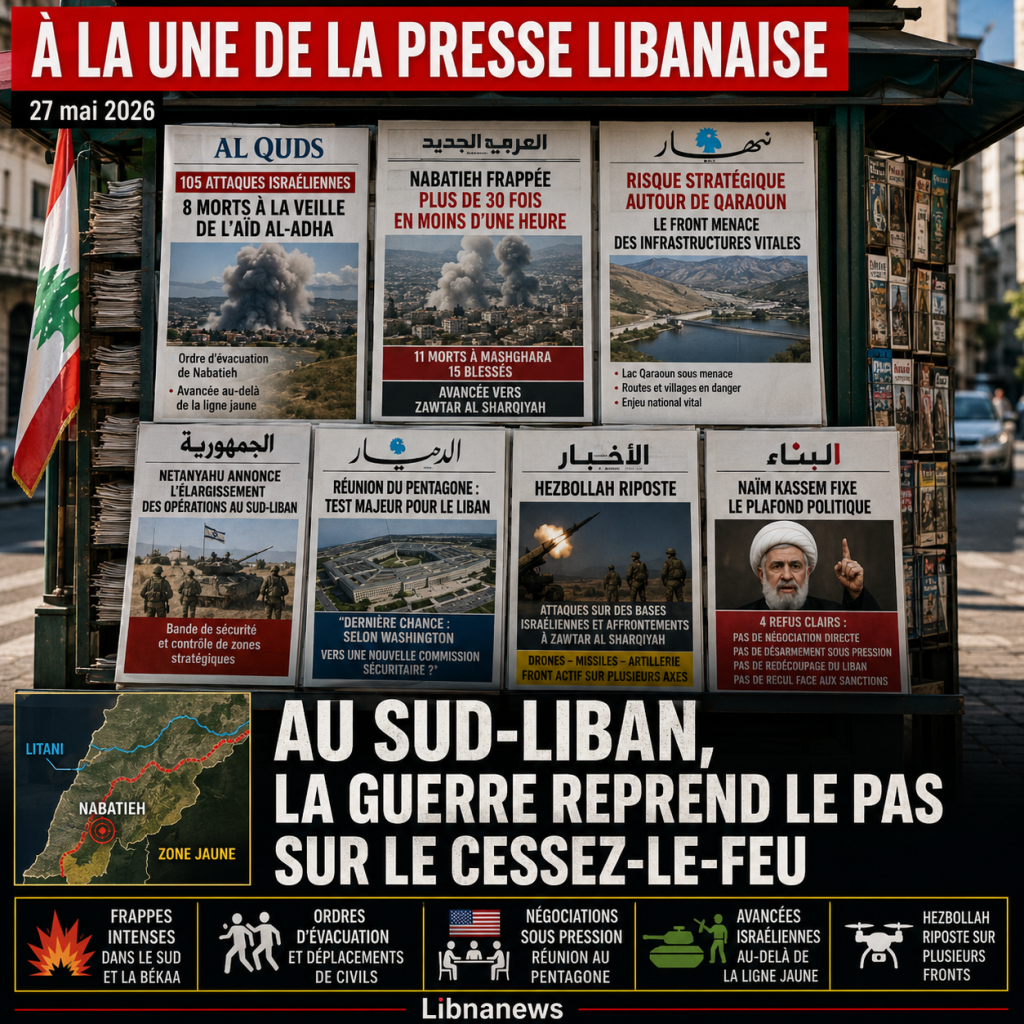
South Lebanon under military pressure
On May 27, 2026, Lebanon was in front of a series of strong tensions. The ceasefire seems to be empty of its content on the ground.Al Qudsdated 27 May 2026, reports that Israel killed eight people and carried out one hundred and five attacks on Lebanon on the eve of Eid al-Adha. The newspaper also reports that the strikes targeted Nabatieh after an unprecedented evacuation order from the entire city. At the same time, the Israeli army expanded its ground operations beyond the « yellow line » in the villages it occupies in southern Lebanon. This change marks a change of threshold. It is no longer limited to reminder strikes or targeted raids. It installs a wider power ratio, with the idea of a moving front.Al 3arabi Al Jadid, dated 27 May 2026, writes that the district of Nabatieh suffered more than thirty strikes in less than an hour. The same newspaper also notes an Israeli advance towards Zawtar Al Sharqiyah, on the northern shores of the Litani River, without full control. Thus, the front line is no longer confused with the fixed positions of the post-ceasefire. It slides to deeper, more populated and more sensitive areas.
This increase in intensity is weighing on civilians. The evacuation orders, the strikes in the southern localities and the attacks in the Bekaa place the inhabitants in a logic of flight.Al 3arabi Al Jadiddated 27 May 2026, refers to deaths in Srifa, Maharakah, Khirbet Selm, Kawthariyat Al Riz and Arab Salim. The same article also recalls the results of the Mashghara strike, with 11 dead and 15 wounded according to the Lebanese Ministry of Health. The bombing of Lake Qaraoun adds another challenge. It is no longer just a combat zone. It is also a vital space, with roads, villages and infrastructure.Nahar, dated 27 May 2026, stresses that the risk of reaching the Qaraoun dam gives the front a new strategic reach. The newspaper insists that this area had not been placed at this level of threat during the previous phases of the war. The war is therefore approaching points whose destruction could produce effects far beyond the military record alone.
Negotiations under fire
The diplomatic calendar makes the sequence more complex. The strikes took place before a Lebanese-Israeli military meeting planned in Washington, D.C., under American sponsorship.Al 3arabi Al Jadid, dated 27 May 2026, specifies that this meeting is to be held in the Pentagon, following three rounds of Lebanese-Israeli diplomatic discussions in Washington. The newspaper believes that the Israeli announcement is tantamount to bringing down the fragile truce established on 16 April, mainly because this truce was based on the freezing of combat positions. In other words, discussions are not being prepared in a climate of tension reduction. They are opening up in a context where Israel is expanding its strikes and land movements.Ad Diyardated 27 May 2026, describes the meeting of the Pentagon as a major test for Lebanon. According to the newspaper, Washington does not see this meeting as a technical detail. It is presented as a « last chance » to verify whether the Lebanese State can produce an authority capable of respecting long-term arrangements. The same text refers to the idea of a new commission, distinct from the existing mechanism, with strengthened US management in monitoring ceasefire violations.
The Lebanese position remains focused on establishing a cessation of hostilities.Al Quds, dated 27 May 2026, indicates that the departure of the Lebanese military group to Washington is under the direction of President Joseph Aoun. The group’s priority is to call for the consolidation of the ceasefire so that the Lebanese army can carry out its missions. The newspaper adds that Lebanon intends to expose what the army has already done south of the Litani to make the area an area without weapons. It must also request resources, equipment and techniques to extend State authority. This line seeks to place the army at the centre of the answer. But it faces reverse pressure.Nahar, dated 27 May 2026, states that Washington could push towards a Lebanese-American-Israeli security commission and ask the Lebanese army to form a special unit for the South. The newspaper adds that Lebanon remains committed to its constants, namely the ceasefire, the refusal of Israeli blackmail and the rejection of an escalation against Beirut. The dilemma becomes clear. Either Lebanon enters into a binding security framework. Either it faces a wider extension of the war.
Israeli pressure and the American border
Sources also describe a tension between Israeli objectives and Washington’s limits.Al Joumhouriyatdated 27 May 2026, reports that Israeli channel 12 claimed that Israel had informed the United States of the nature and purposes of its operation in Lebanon. The same newspaper reports that Washington warned Israel not to attack Beirut. This limit does not prevent the expansion of operations in the South. Rather, it means that the United States seeks to avoid a major shock in the capital, while allowing military pressure to continue on other areas.Al Joumhouriyatisrael’s chain 14 refers to estimates that the agreement with Iran would almost certainly include Lebanon, without it leading to an Israeli withdrawal from the « yellow zone ». This formulation reveals the core of the problem. The Lebanese issue seems to be linked to broader regional negotiations. But this affair does not guarantee a calming. It can also push Israel to consolidate positions before compromise.
The Israeli discourse goes in this direction.Al Joumhouriyat, dated 27 May 2026, reports that Benjamin Netanyahu claimed, at the opening of a meeting of the Israeli security cabinet, that the army was continuing to expand its operations in southern Lebanon. He added that these movements were under his direction and that of the Israeli Defense Minister. The newspaper also reports that Israeli forces operate with large ground units, control so-called strategic areas and seek to strengthen what Netanyahu describes as a « security band » within Lebanese territory.Al Sharq Al Awsat, dated 27 May 2026, describes an Israeli attempt to impose new geographical realities in southern Lebanon, with Zawtar and Yohmor Al Shaqif at the heart of the confrontation. The newspaper also reports that Netanyahu has given instructions to intensify operations against Hezbollah and increase the pace of strikes. This approach makes the geography of the South a subject of fait accompli negotiations.
Hezbollah between military and political resistance
Hezbollah’s response is part of the same hardening.Al 3arabi Al Jadiddated 27 May 2026, indicates that the party continued its attacks on Israeli sites, barracks and bases in the occupied Lebanese areas and in Galilee. He also mentioned the confrontation with Israeli forces in Zawtar Al Sharqiyah.Al Quds, dated 27 May 2026, reports that Hizbullah announced that it had targeted a mechanized Israeli force advancing towards Zawtar Al Sharqiyah after air strikes and an intense artillery bombardment. The newspaper also refers to the use of missiles, artillery, drones and direct engagement. According to these elements, the front is not only aerial. It involves close clashes, ambush and pressure on ground forces. This partly explains the Israeli concern about Hezbollah drones.Al Qudsalso reports that the Israeli media have spoken of a sudden tightening of protection orders in Galilee, with a sharp reduction in authorized rallies.
But Hezbollah is not just military. The Lebanese internal debate is also more tense.Al Bina, dated 27 May 2026, presents Naim Kassem’s speech as an attempt to set a new political ceiling. According to the newspaper, this ceiling is based on four refusals: no direct negotiation with Israel, no acceptance of a disarmament under pressure, no remodelling of Lebanon under American conditions, and no retreat from sanctions or wear and tear. This line increases the distance between the party and a part of the state.Al Quds, dated 27 May 2026, also notes that the threat attributed to Naim Kassem against the government provoked political reactions. The newspaper reports that US Secretary of State Marco Rubio condemned Hezbollah’s appeal to bring down the elected government, describing it as a campaign to destabilize the country and preserve the party’s influence. The military crisis is therefore coupled with an internal confrontation on the decision of war, the authority of the state and the place of arms.
Lebanon caught in the American-Iranian file
The Iranian file goes through the entire sequence.Ad Diyar, dated 27 May 2026, places Lebanon on the edge of a very dangerous phase, in a context where the American-Iranian agreement could succeed or fail. The newspaper notes that the region faces many issues related to the ability of Washington and Tehran to go beyond the details that block the agreement.Nahar, dated 27 May 2026, stresses that Doha entered into the negotiation process, with the presence of Iranian negotiator Mohammad Baqer Qalibaf, Iranian Foreign Minister Abbas Araghchi and governor of the Iranian central bank Abdolnaser Hemmati. The newspaper believes that this presence indicates that the issue of frozen Iranian funds is part of the discussion. He adds that Marco Rubio admitted that talks with Iran could take a few more days, while issuing a warning on the need to reopen the Strait of Ormuz. Thus, the Lebanese front does not appear isolated. It functions as a theatre where Israeli calculations, American demands, Iranian margins and Lebanese internal balances intersect.
Local politics: State authority over Hezbollah, the streets and negotiations
A threat to the government at the heart of the political crisis
Al Quds, dated 27 May 2026, places the threat of Naim Kassem against the government of Nawaf Salam at the centre of the local political scene. The newspaper reports that Hizbullah’s Secretary General’s remarks were perceived by several actors as a desire to overthrow the executive by the street and by the weight of force, rather than by the mechanisms provided for by the institutions. This reading gives the episode a wider scope than just a partisan statement. It comes at a time when Lebanon is under military pressure in the South, negotiations with Israel are being discussed in Washington, and the Lebanese army is seeking to defend its role in any ceasefire framework. So the debate is not just about the fate of the government. It affects the State’s ability to preserve its authority in a time of acute crisis.Al Quds, dated 27 May 2026, adds that US Secretary of State Marco Rubio condemned Hezbollah’s appeal, calling it an attempt to destabilize an elected government. This American reaction gives an external weight to a Lebanese crisis first. It shows that Washington observes the cohesion of the Salam government as part of security negotiations.
Ad Diyar, dated 27 May 2026, describes the same sequence with a more alarmist formula. The newspaper states that Hezbollah has exhausted its strategic patience with the government of Nawaf Salam, while recalling that the party participates in this government with the Amal movement. The newspaper also reports that Naim Kassem’s call to drop the cabinet in the street has fuelled the fear of internal clashes, either between demonstrators and the army, or between Hezbollah supporters and opposing political forces. This concern is important. It means that the political crisis is not confined to official trade shows. It can move to the street, so to a more difficult space to control.Ad Diyar, dated 27 May 2026, further recalls the 2006 precedent when Shiite ministers had left the government of Fouad Siniora before the occupation of central Beirut. The comparison refers to a period of sharp divide between the political camps. It serves as a warning. In today’s climate, external war can awaken internal blocking reflexes.
Party Response and Institution Defence
Al Qudsdated 27 May 2026, reports that the Kataeb party included Naim Kassem ‘ s comments as part of an Iranian desire to reduce the independence of the Lebanese decision. According to this position, Hezbollah should have withdrawn its ministers from the government if it challenged its line, rather than resorting to street mobilization. This reaction sets the angle of the political response. Hezbollah’s opponents do not only want to respond to a threat against Nawaf Salam. They seek to impose a simple rule. A party present in government must challenge from within or leave the executive. According to them, he cannot participate in the firm while threatening his existence from the street. This criticism also aims at the duality between institutional presence and extra-institutional pressure. It refers to an old debate in Lebanon. Does Hezbollah act as a party subject to common rules, or as a force capable of weighing above these rules by its weapons, social network and regional link.
Al Sharq, dated 27 May 2026, gives another example of this response through the position of MP Ghada Ayoub. She believes that Naim Kassem’s remarks are ill placed, as Hezbollah participates in the government. She claims that the party should first have withdrawn its ministers before aiming at the executive. It also sees this statement as a sign of a possible return of Hezbollah to the domestic front if the results of the negotiations in the United States do not go in its direction. This reading is more political than legal. She suggested that the party would seek to transform a possible diplomatic setback into internal pressure. Ghada Ayoub adds that the Lebanese official position, led by Joseph Aoun and Nawaf Salam, affirms that Lebanon’s decision belongs to Lebanon and that no one negotiates in its place. This sentence summarizes one of the major issues in the sequence. The political class is divided on whether Lebanon is an autonomous actor or a map in a larger regional game.
Joseph Aoun and Nawaf Salam in front of the authority test
In this crisis, President Joseph Aoun and Prime Minister Nawaf Salam seek to preserve a state line. This line is based on three ideas. The ceasefire must be consolidated. The Lebanese army must remain the legitimate security framework. The national decision must not be transferred to an external power or an armed party.Al Sharq, dated 27 May 2026, reports, in the words of Ghada Ayoub, that the official position defended by Joseph Aoun and Nawaf Salam is based on the refusal of any negotiation conducted in the name of Lebanon by another actor. This is crucial in the current context. The Lebanese issue seems to be involved in the discussions between the United States and Iran. The Government wants to avoid the ceasefire in Lebanon becoming a mere clause in a regional arrangement. He also wants to prevent Hezbollah from presenting Tehran as the real guarantor of the southern front.
The government’s margin remains narrow. It must respond to Israel, reassure Washington, contain Hezbollah, preserve the role of the army and prevent an internal rupture. It is a heavy burden for an executive still exposed to sectarian and partisan power relations.Al Sharq, dated 27 May 2026, also reports an institutional support position from Antoine Habib, President and CEO of the Habitat Bank. He welcomed the efforts of Joseph Aoun, Nawaf Salam and Nabih Berri to restore security, stability and a return to normal life. Although this declaration is part of a more consensual register, it shows that some economic and public circles expect a cohesion of the three presidencies. In a country hit by war, the financial crisis and political paralysis, this cohesion is seen as a vital minimum. The problem is that this image of unity faces the threat of the streets, the issue of arms and regional negotiations.
Nabih Berri, fragile mediator between the state and Hezbollah
Nabih Berri appears as a central actor in the sequence. He remains the main Shiite political relay in the institutions. He is also one of the few who can speak to both Hezbollah, the Presidency and diplomatic channels.Nahardated 27 May 2026, reports that the last ceasefire was linked to the role of Nabih Berri. According to the newspaper, a contact took place between Joseph Aoun and the Speaker of Parliament after a period of cold weather. Nabih Berri would then have indicated that Hizbullah would respect a complete ceasefire if the Lebanese delegation obtained an Israeli commitment. This information gives Berri a pivot. It can serve as a bridge between the state and Hezbollah. But this function also exposes. If the party does not respect the cessation of hostilities, or if Israel refuses any stable engagement, Berri’s role can be weakened.
Al Sharq, dated 27 May 2026, reports that MP Qassem Hashem, close to this line, sought to reduce the scope of Naim Kassem’s appeal. He states that the request to drop the government is an opinion, while adding that the situation does not support such an approach. He stressed the unity of the internal position, the maintenance of the link between Lebanese and the preservation of institutions. It also excludes the withdrawal of Hezbollah ministers from the government, on the grounds that the situation does not permit it. This position reveals the caution of the Nabih Berri camp. He’s not breaking up with Hezbollah. But it does not push the government to fall either. It seeks to avoid an open institutional crisis. In practice, this line consists of holding two difficult imperatives together. We have to keep the Shiite front unit. We must also prevent the government from collapsing at a time when Lebanon is negotiating under pressure.
Ceasefire as a national fracture point
The ceasefire has become more than just a military file. It is now an internal political test. For the government, it must allow the army to resume its role and stabilize the South. For Hezbollah’s opponents, it must lead to a clear restriction of weapons outside the state. For Hezbollah, it cannot become an instrument of disarmament under Israeli or American pressure.Al Sharq, dated 27 May 2026, reports that Qassem Hashem does not see the inclusion of the ceasefire in Lebanon in an agreement between Iran and the United States as interference or negotiation in place of Lebanon. According to him, any effort by friends or brotherly countries to help bring about a cessation of hostilities is a Lebanese priority. This position seeks to normalize the Iranian role in the case. It essentially says that external support is acceptable if it helps to stop the war.
This reading encounters another vision, carried by several sovereignist forces. For them, the risk is that Lebanon will become an annex to the American-Iranian negotiations.Al Quds, dated 27 May 2026, reports that Ghada Ayoub accuses Iran of seeking to reassure the Hezbollah public by implying that she will not abandon Lebanon. Most importantly, it believes that Tehran will not abandon Hezbollah as long as it remains a useful map in its regional project. This summarizes the political divide. Some Lebanese actors believe that Iran can help stop the fire. Another considers that Iran uses Lebanon as a lever in its negotiations. Between these two positions, the Salam government is trying to preserve an official formula. Lebanon accepts the support for the ceasefire. But he refuses to have his decision confiscated.
Arms at the centre of the state debate
The crisis finally refers to the issue of weapons.Al Sharqdated 27 May 2026, reports on the position of Dar Al Fatwa, who supports the presidential mandate and the government in implementing the nomination speech and ministerial declaration. The text states that weapons outside the State create an imbalance and weaken institutions. It also recalls that the Lebanese army has a responsibility to protect the country and its citizens. This position adds a religious and social dimension to the debate. It comes from a simple question asked by war-affected citizens. Until when the instability lasts. According to this reading, wars will remain possible until the decision on war and peace is in the hands of the State.
The debate is therefore deeper than the survival of the Salam government. It touches on the very architecture of Lebanese power. Who decides the war. Negotiating. Protecting the border. Who hires the country.Ad Diyar,Al Quds,Al SharqandNahar, all dated 27 May 2026, show a political scene crossed by the same tension. On one side, the state is trying to land as a decision centre, with Joseph Aoun, Nawaf Salam, the army and diplomatic channels. On the other hand, Hezbollah maintains military, social and political pressure. In between, Nabih Berri tries to keep a middle path. But this path remains fragile. War in the South, negotiations with Israel, Iran’s role and US pressure are reducing the space for compromise. Lebanese local politics is thus trapped in a paradox. It must restore state authority at a time when the levers of war far exceed the state.
Citation and speech by political figures: sovereignty, negotiation and street threat
Joseph Aoun placed the army at the centre of the State speech
Nahar, dated 27 May 2026, highlights a sentence by President Joseph Aoun that the Lebanese army will remain the sole guarantor of national security and territorial integrity. This formula has a direct bearing on the climate of war in southern Lebanon. It establishes a line of authority. She said that the protection of the country should not be shared among several decision-making centres. It also indicates that the Head of State is seeking to place the military institution at the heart of the public debate. The message targets both inside and outside. Inside, he answers the question of weapons and the pressure of Hezbollah. Outside, he tells the United States, Israel and the mediators that Lebanon wants to negotiate from an official institution, not from a partisan power relationship. The sentence therefore serves as a political framework. It claims that the State can only exist if its army retains the monopoly of national security.
This presidential insistence joins the discussions on the ceasefire.Al Qudsdated 27 May 2026, reports that the Lebanese military group must request support from the army in equipment and techniques in order to conduct its deployment and extend the authority of the State. So Joseph Aoun’s word is not symbolic. It is part of a concrete demand. The President wants to turn the sovereignty formula into operational means. This approach responds to a known weakness. The army is invoked as a solution, but it does not always have the necessary tools to control an area under military pressure. The presidential speech thus attempts to link three elements. There is sovereignty, military capacity and negotiation. Without these three elements, the military role formula would remain a slogan. With them, it becomes a line of work for power.
Naim Kassem chooses the register of internal confrontation
Al Qudsdated 27 May 2026, reports that the threat made by Naim Kassem against the government of Nawaf Salam caused a wave of political shock. Hezbollah’s secretary-general was accused of calling for the government to fall off the streets. This speech changed the centre of gravity of the crisis. It is no longer just a conflict with Israel or a debate on negotiation. Naim Kassem’s speech moved the tension inward. She raised the question of the legitimacy of the government and Hizbullah’s report to the institutions. It intervenes while the party sits in the executive. This contradiction feeds the critics. Several officials believe that a party present in government cannot, at the same time, threaten to overthrow it outside Parliament. The discourse thus becomes a test of political coherence.
Ad Diyardated 27 May 2026, gives this declaration a more serious scope. The newspaper states that Hezbollah has exhausted its strategic patience for the government of Nawaf Salam. It also stresses that the threat of a street movement can pave the way for clashes with the army or political opponents. In this reading, Naim Kassem’s words are not just words. They can produce a mobilization effect. They can also awaken the memory of older internal crises.Ad Diyar, dated 27 May 2026, recalls the precedent of 2006, when the Shiite ministers had left the government of Fouad Siniora. The reference aims to show that political speech can create a dynamic of lasting blocking. Hezbollah’s speech thus appears as a means of pressure on the government, but also as a warning to all those who support the state’s negotiation.
Abdel Latif Derian gives religious legitimacy to the negotiation
Al 3arabi Al Jadiddated 27 May 2026, reports the position of the mufti of the Lebanese Republic, Abdel Latif Derian, in favour of the State-led negotiation. In his message from Eid al-Adha, he believes that the State’s recourse to negotiation to stop the war and to secure the withdrawal of the occupier constitutes a political and religious act that deserves to be welcomed. This sentence has a special weight. It is not limited to a diplomatic opinion. It places negotiation in a moral setting. She claims that seeking the end of the war is not a weakness, but a responsibility. It also aims to respond to discourses that equate negotiation with a concession. In the current climate, mufti introduces another criterion. The priority becomes the protection of lives, land and stability.
Al Quds, dated 27 May 2026, publishes a wider passage of the message of Abdel Latif Derian. The mufti explains that every confrontation costs more land, lives, stability, dignity, security and sovereignty. He believes that the methods followed against the enemy no longer convince and that they eventually produce ruins before a new ceasefire. This is one of the strongest words in the corpus. It breaks with limitless endurance rhetoric. It asks to measure the real cost of war. It does not deny the Israeli occupation or threat. But it does not allow the response to lead constantly to the loss of lives and territories. The religious discourse here joins a political analysis. It defends the state as a policy space and negotiation as a means of reducing the human cost.
Nabih Berri speaks the language of ceasefire and internal balance
Nahardated 27 May 2026, presents the last ceasefire as linked to the role of Nabih Berri. The newspaper reports that the President of Parliament would have informed Joseph Aoun that Hezbollah would comply with a complete cessation of fire if the Lebanese group obtained an Israeli commitment. This sentence makes Berri an internal mediator. He does not only speak as head of an institution. He speaks as a responsible person capable of transmitting a Hezbollah position to the Presidency. This role is delicate. It can help stabilize the front. But he can also expose Berri if one of the parties fails to meet his commitments. His speech is therefore balanced. It seeks to offer an acceptable exit to Hezbollah, without weakening the state’s official position.
The same articleNahardated 27 May 2026, considers that this formula offered Hezbollah a way to reduce escalation without appearing as defeated. This analysis shows the political meaning of Berri’s words. He is trying to turn a military crisis into an institutional compromise. He does not ask Hezbollah for public accountability. He is looking for a drop in tension that can be presented as a reciprocal commitment. This path remains fragile. It depends on Israeli behaviour, American pressure and Iranian calculation. It also depends on Berri’s ability to maintain its political reference role within the Shia community. His speech therefore lies between two fields. He speaks to Hezbollah in the language of protection. He speaks to the state in the language of responsibility.
Youssef Raggi registers diplomacy in the register of international support
Al Sharq, dated 27 May 2026, reports that Foreign Minister Youssef Raggi called the Secretary General of the Gulf Cooperation Council, Jassem Mohammed Al Budaiwi. He expressed Lebanon’s gratitude for the positions of support for the Government and for the support given in this delicate phase. The choice of words is important. Raggi does not portray Gulf support as abstract aid. It connects it directly to the government and to the country’s critical period. The message aims to show that the executive of Nawaf Salam is not isolated. He also stated that Lebanese diplomacy sought Arab support points, while the country was caught between Israel, Iran and the United States.
The same articleAl Sharq, dated 27 May 2026, reports that Youssef Raggi received French MEP François-Xavier Bellamy. The Minister thanked the European Union for its continued support for Lebanon, stressing the importance of its role in the current phase. Bellamy presented her visit as a clear message that Lebanon is not alone and remains followed by Europe and France. This sequence shows a diplomatic speech built around solidarity. It does not go into military detail. Rather, it seeks to create a political environment favourable to the Lebanese State. In a time when Hezbollah is talking about the streets and Israel is talking about military pressure, Raggi is talking about support, international presence and European continuity. This difference in tone is notable. It reflects the government’s willingness to bring the debate back to official channels.
Marco Rubio transforms Hezbollah’s threat into an international issue
Nahardated 27 May 2026, highlights Marco Rubio’s quick and firm reaction to Naim Kassem’s comments. The newspaper believes that this reaction should be understood as a signal that the Lebanese path is distinct from the American negotiations with Iran. This reading focuses on the core of Hezbollah’s calculation. If the party believes it can link its future to the agreement between Washington and Tehran alone, it might be wrong. According toNahar, dated 27 May 2026, the current period is no longer that where Hezbollah could bet on the same margins as before. Rubio’s reaction thus turns an internal statement into a case followed by Washington. It means that the stability of the Salam government has become part of the American position.
This American intervention also gives a tougher dimension to the arms debate. It puts Hezbollah before a contradiction. The party wants to show that there remains a force capable of weighing on the national scene. But the more he threatens the government, the more he reinforces the argument of those who say that the Lebanese state must be protected from armed pressure.Al Quds, dated 27 May 2026, reports that Rubio’s conviction is aimed at attempting to destabilize the elected government. This American formula gives the Salam cabinet external support. But it also carries a risk. It can be used by Hezbollah to accuse its opponents of acting under American pressure. Thus, Rubio’s speech supports the state, while making the internal debate more tense.
Lebanese voices between warning against discord and criticism of double play
Al Sharqdated 27 May 2026, reports the position of Mufti Ahmad Qabalan, who warns the Lebanese authority against the loss of national unity. According to him, whoever wins Washington and Tel Aviv but loses consensus reference loses Lebanon. This sentence expresses the opposite fear of the sovereignist forces. It does not place the danger first in Hezbollah’s weapons. It places it in a possible state alignment with American and Israeli demands. Qabalan’s speech therefore aims to protect what he considers an internal balance. It is part of a logic of face-to-face refusal between the government and Hezbollah. He argues that any major decision must remain consensual.
In the same political space,Al Sharq, dated 27 May 2026, cites the warning of lawyer Maan Al Asaad against internal discord. It foresees an Israeli military escalation and fears that the issue of internally displaced persons will be used to create internal tension. He called for vigilance to prevent Lebanon from slipping to the unknown. This speech moves the debate. It does not focus solely on negotiations or weapons. She looks at the social effect of war. Evacuation, displacement and fear can become a ground of conflict between Lebanese. Political discourse then becomes a tool for prevention. It seeks to prevent external war from turning into a civil crisis. This warning joins, by another way, the calls to preserve institutions and national unity.
Diplomacy: Washington, Doha and Arab capitals at the heart of the Lebanese issue
The Pentagon as a diplomatic and military scene
Al Qudsdated 27 May 2026, reports that the Lebanese military group must travel to Washington to participate in security negotiations in the United States sponsored Pentagon on 29 May. This meeting gives the Lebanese-Israeli crisis a new diplomatic form. It is not limited to a technical discussion between the military. It becomes a test of the Lebanese state’s ability to present a clear line against Israel and the United States. The newspaper stated that the Lebanese group had received instructions from President Joseph Aoun. Its priority is to call for a full ceasefire so that the Lebanese army can carry out its missions in the South. The group must also expose what the army has accomplished south of the Litani to make the area an area without weapons outside the State. This presentation aims to convince Washington that the army can be the central tool of stabilization, provided that it receives the necessary equipment and techniques.
However, this sequence opens in an unfavourable climate.Nahardated 27 May 2026, indicates that the Lebanese group ‘ s departure to the United States takes place while Benjamin Netanyahu refuses any formula that would put an end to Israeli military operations in Lebanon. The same newspaper reports that the Israeli Prime Minister wants to maintain air and ground freedom within Lebanese territory. This greatly reduces the margin of diplomacy. Lebanon arrives in Washington with a demand for a stable ceasefire. Israel, according to this reading, comes with a desire to maintain military pressure. The American role is therefore becoming decisive. Washington must choose between a stabilization framework and crisis management that would allow Israel to continue its operations. The risk is clear. A meeting supposed to consolidate calm can take place while military events are already creating a new reality in South Lebanon.
The red lines of the Lebanese army
Al 3arabi Al Jadid, dated 27 May 2026, sheds significant light on the position of the Lebanese Army before the Pentagon meeting. The newspaper quotes a Lebanese military source that the main directions given to the group participating in the meeting are the complete and definitive cessation of the fire, as well as Israel’s withdrawal from the territories it occupies. The same source claims that the army refuses any plans to establish a special unit to disarm Hezbollah. It insists that the unit of the military institution remains a non-negotiable basis. It also refuses any joint security cooperation with Israel. According to this position, coordination must remain limited to the ceasefire monitoring mechanism, as has happened before. This line is very important. It shows that the army wants to avoid being placed in a direct internal confrontation for the benefit of an American or Israeli agenda.
The same newspaper indicates that American pressure is real.Al 3arabi Al Jadiddated 27 May 2026, writes that American sanctions against Lebanese political, parliamentary, military and security figures have been understood as messages of pressure. These messages would target on one side Nabih Berri, in order to push him to the direct negotiating table, and on the other, the Lebanese army, which refuses the American plan to involve a special unit in the confrontation with Hezbollah or in the disarmament of the party. American diplomacy thus appears in two forms. It proposes a framework for discussion, but it also exerts pressure. It speaks of stabilization, but it seeks to change the internal balances of Lebanese security. This tension can complicate the task of Joseph Aoun and Nawaf Salam. They must obtain international support, without giving the impression that the army becomes the tool of external demand.
Washington between mediation and pressure on Lebanese balances
Al Liwa, dated 27 May 2026, describes a very sensitive diplomatic phase, with a security meeting scheduled in the Pentagon on 29 May, followed by discussions on 2 and 3 June in the US State Department between the Lebanese and Israeli groups, in the presence of the American mediator. The American calendar gives the crisis a two-stage structure. The first phase is military and deals with security, deployment and ceasefire issues. The second stage is more political, because it involves the State Department and therefore a broader view of relations between Lebanon, Israel and the United States. This organization shows that Washington does not treat the southern front as an isolated file. It is part of a regional architecture that includes war with Iran, discussions on Israel’s security and the place of the Lebanese army.
This American mediation remains ambivalent. On the one hand, it offers Lebanon a channel to demand a halt to the strikes, Israeli withdrawal and support for the army. On the other hand, it intervenes as Washington imposes sanctions and pushes towards security arrangements that affect the internal structure of power.Al Quds, dated 27 May 2026, reports that the Lebanese group must request material and technical support to enable the army to extend the authority of the State. But the same framework can also be used to test the Lebanese will to reduce the military role of Hezbollah. Thus, American diplomacy functions as a dual-use lever. It can help the Lebanese State resume the initiative. It can also accentuate internal polarization if it gives the impression of wanting to impose a solution by pressure.
Doha, Tehran and the link between Lebanon and Iran
Regional diplomacy is not only played out in Washington.Nahar, dated 27 May 2026, reports that Doha entered the line of negotiations, with the presence of Iranian high negotiator Mohammad Baqer Qalibaf, Iranian foreign minister Abbas Araghchi and governor of the Iranian central bank Abdolnaser Hemmati. The latter’s presence indicates that the issue of Iranian assets frozen in Qatari banks is part of the discussion. This detail is central. It shows that negotiations are not only about weapons, military fronts or nuclear. They also cover money, sanctions and financial circuits. In this context, Lebanon can become a part of a broader arrangement between the United States and Iran.
Al Quds, dated 27 May 2026, also writes that the American-Iranian confrontations in the Strait of Ormuz have affected the Doha negotiations. According to the newspaper, Iran seeks to secure the release of twenty-four billion dollars of assets frozen abroad, and Iranian agency Fars presents this issue as the last serious point of disagreement before the conclusion of a memorandum of understanding. US Secretary of State Marco Rubio said that negotiations could still take a few days, but that the Ormuz Strait should be reopened in one way or another. This context goes directly beyond Lebanon. But he affects it. The more the Iranian case progresses, the more Lebanese actors seek to know whether the southern front will be part of a compromise. The more he blocks, the more Israel can be tempted to expand its action to improve its position before any agreement.
American-Iranian agreement as uncertain horizon
Al Sharq Al Awsat, dated 27 May 2026, reports that Marco Rubio still considers possible an agreement with Iran, but that it may take a few days due to discussions on specific clauses of the original document. The newspaper also writes that Iranian and American sources refer to progress on a memorandum of understanding, or preliminary agreement, which would stop the war, resume navigation in the Strait of Ormuz and allow negotiators 60 days to deal with the most complex issues, including Iran’s nuclear programme. This step-by-step approach gives diplomacy a front freeze function. She doesn’t fix everything. First, it seeks to prevent complete combustion.
This mechanism can have a direct impact on Lebanon. If the initial agreement concerns the end of the war in several areas, the Lebanese front can be included in the logic of appeasement. But this assumption remains uncertain. Israeli sources quoted in other newspapers point out that Tel Aviv wants to keep his freedom of action. American diplomacy could therefore lead to a partial arrangement. It would reduce tension between Washington and Tehran, without guaranteeing an Israeli withdrawal or real stabilization in South Lebanon. The danger to Beirut would then be to be treated as a secondary matter. In that case, Lebanon would obtain promises of calm, but not the guarantees necessary to restore sovereignty over the occupied areas. Lebanese diplomacy must therefore avoid relying solely on the American-Iranian agreement. It must defend its own demands in every open channel.
Arab support as a political net for Beirut
The Arab world is another diplomatic axis.Al Qudsdated 27 May 2026, reports that Lebanese Foreign Minister Youssef Raggi called the Secretary General of the Gulf Cooperation Council, Jassem Mohammed Al Budaiwi. He expressed Lebanon’s gratitude for the positions of support for the Government and for the support given in this delicate phase. This approach aims to consolidate Arab coverage around the government of Nawaf Salam. It is also intended to show that Lebanon does not depend solely on the American channel or on regional negotiations with Iran. Gulf support gives the government additional legitimacy in the face of internal pressures. He also said that Arab capitals wanted the Lebanese State to remain the centre of decision-making.
This Arab support is in a difficult situation. The Gulf countries support Lebanese institutions, but they also observe the role of Hezbollah, tensions with Israel and Iranian influence. For Beirut, statements of support must therefore be transformed into real resources. This can include support for the army, economic assistance, political support in international forums or diplomatic pressure to contain Israeli escalation. Youssef Raggi’s contact with the Gulf Cooperation Council then takes on practical value. He’s trying to open an Arab road next to the American canal. In a crisis dominated by Washington, Tehran and Tel Aviv, this path can help Lebanon not be reduced to a negotiating ground between powers.
Europe and France maintain their political presence
Al Sharq, dated 27 May 2026, reports that Youssef Raggi received French MEP François-Xavier Bellamy. During the meeting, the Lebanese Minister thanked the European Union for its continued support for Lebanon. He stressed the importance of the European role, especially in the delicate phase of the country. Bellamy explained that his visit to Beirut is part of a desire to observe directly the situation on the ground, particularly in the southern border villages. He claimed that his presence carries a clear message of support that Lebanon is not alone and continues to benefit from a constant European and French interest. This sequence gives Europe a distinct place. It does not conduct the main negotiation, but maintains a political and symbolic presence with Lebanese institutions.
This European presence can serve as a limited counterweight. It does not replace the American role, as Washington retains control of the security channel with Israel. It also does not replace regional mediation, as Doha deals directly with the Iranian case. But it can help Lebanon to internationalize its demands. Bellamy’s visit to border areas is important for this reason. It helps to anchor diplomatic discourse in the field. It recalls that the villages of the South are not mere lines on a map. They are inhabited, displaced, beaten and often captured in military calculations. European diplomacy, however limited, can therefore support the Lebanese story about civilians, the ceasefire and the role of the army.
Lebanese diplomacy caught between tables
Lebanese diplomacy is in front of several tables at the same time. There is the Pentagon table, where the ceasefire is being discussed with Israel under American sponsorship. There is the Doha table, where Iran’s file and frozen funds can weigh on regional fronts. There is the Arab table, where the Gulf Cooperation Council provides political support to the government. Finally, there is the European table, where France and the European Union seek to maintain a direct interest in Lebanon and its border areas. This dispersal can be a chance if Beirut manages to coordinate its messages. It can also become a risk if each external actor uses Lebanon for a different purpose.
The Lebanese line from the sources of 27 May 2026 is based on several constants. The ceasefire must be complete. Israel must withdraw from the occupied areas. The Lebanese army must remain unified. No joint security cooperation with Israel should be accepted. No internal disarmament should be imposed by a special military unit created under foreign pressure. At the same time, Lebanon is seeking assistance in equipment, technical and diplomatic support. This line is difficult because it seeks Washington’s support without accepting all its requests. It seeks to contain Israel without entering into unbalanced direct negotiations. She finally seeks to benefit from American-Iranian relaxation without letting Tehran speak in its place.
International policy: regional wars, US pressures and recompositions of power
Washington and Tehran between negotiation and limited war
Ad Diyar, dated 27 May 2026, presents the indirect negotiations between Washington and Tehran as a more sensitive phase, despite the idea of progress in drafting an initial framework. The newspaper reports that Marco Rubio believes that an agreement with Iran can still ask for a few days. This caution contrasts with the more optimistic announcements of the previous days. It shows that the Iranian file remains trapped in several locks. The first concerns enriched uranium. Donald Trump says this material will have to be transferred to the United States to be destroyed, or destroyed elsewhere. The second concerns frozen assets. Iran’s sources quoted in several newspapers refer to twenty-four billion dollars that Tehran is demanding for release. The third is the Ormuz Strait, which remains a vital axis for the global economy. Thus, the agreement sought does not only concern nuclear energy. It combines security, money, energy and political prestige.
Al Quds, dated 27 May 2026, reports that confrontations in the Strait of Ormuz have affected the Doha negotiations. The newspaper states that Iran considers the release of frozen funds as the last serious point of disagreement before a memorandum of understanding. He also reports that Marco Rubio claims that the strait must reopen in one way or another. This formula summarizes the American pressure. Washington wants to show that negotiations remain open, but also that the closure of Ormuz cannot last. On the other hand, Tehran seeks to transform its nuisance capacity into financial and political gain. The tension therefore remains controlled, but it is not resolved. Each side tries to avoid a total war, while maintaining a threat strong enough to weigh on the final text.
Gaza, Eid under humanitarian strikes and wear and tear
Al Qudsdated 27 May 2026, describes a dark Eid al-Adha for the Palestinians. The newspaper reports that Israel intensified its destruction and death operations in Gaza and the West Bank on the eve of the celebration. He also states that Benjamin Netanyahu and Israel’s Defense Minister Israel Katz announced that they had targeted Mohammad Aouda, who was presented as the new leader of the Al Qassam Brigades. This announcement is part of a targeted assassination strategy. But it takes place in a context where civilians also suffer the direct consequences of war. The newspaper evokes strikes, injuries and a ruin scene in Khan Yunes. The religious time of Eid, supposed to be a time of family reunion, thus becomes a marker of the humanitarian crisis. Families live under bombardment, with an economy destroyed and essential goods out of reach.
The same newspaper, dated 27 May 2026, also devotes an article to the people of Gaza who seek modest forms of solidarity in the face of the impossibility of respecting the usual rituals of Eid. Animal sacrifices are becoming inaccessible to many families due to rising prices and falling incomes. People are therefore trying to find limited alternatives based on mutual assistance in neighbourhoods. This social scene completes the military scene. It shows that war is not only measured in terms of strikes and human balances. It is also measured in the disappearance of ordinary gestures. Meal, visit, party, sharing and family memory are reached. In this context, Palestinian international news remains dominated by a dual movement. Israel is continuing its military operations. Palestinians seek to preserve signs of collective life in a destroyed space.
Syria: chemical weapons, Sueida and new state challenge
Al Sharq Al Awsat, dated 27 May 2026, reports that a Syrian official confirmed the discovery of remnants of the secret chemical weapons program led by the former regime of Bashar Al Assad. The newspaper quotes Syria’s Permanent Representative to the Organization for the Prohibition of Chemical Weapons, Mohammad Qtoub. According to him, the authorities found materials and ammunition similar to those used in gas attacks during the Syrian war. Eighteen persons were arrested, including former military, political and technical officials. More than 70 rockets and bombs that could be used for chemical weapons were also reportedly recovered. This case has an international scope. It concerns the memory of war crimes, but also regional security. Chemical weapons are not just a trace of the past. They remain a risk if they are not controlled by the new authorities.
Al Quds, dated 27 May 2026, specifies that Mohammad Qotub presents the security of these materials as a measure that protects both Syrian security and global security. The newspaper recalls that investigations conducted by the United Nations and the Organisation for the Prohibition of Chemical Weapons had already concluded that Assad had repeatedly used sarin gas, chlorine and mustard gas. This precision places the discovery in a chain of responsibility. The Syrian problem is therefore not limited to the political transition. It also covers evidence, hidden stocks, old units and control mechanisms. In parallel,Al 3arabi Al Jadid, dated 27 May 2026, describes the province of Sueida as a space still worked by fear and community divisions. A civilian activist explains that confidence between Syrian components declined after the events of July. New Syria must therefore deal with two emergencies at the same time. It must disarm the remnants of the old repressive apparatus. It must also rebuild social trust.
Iraq: militias, Iran and the test of sovereignty
Al Sharq Al Awsatdated 27 May 2026, reports very harsh statements by the British Ambassador to Iraq, Irfan Siddiq. The newspaper reports that it accuses armed factions linked to Iran of using mafia-like methods. He also referred to the takeover of a contract from a British company working with the Iraqi government. According to the diplomat, the silence of the authorities would have allowed these groups to strengthen their grip on the economy. This word is unusual in its sharpness. It moves the debate on militias from the only security domain to that of the economy. Armed groups are not only accused of violating State military sovereignty. They are also accused of capturing markets, weighing on businesses and weakening the investment climate.
The same newspaper, dated 27 May 2026, reports that Irfan Siddiq does not close the door to a dialogue with Al Hashd Al Shaabi, provided that this force is placed under the real control of the government. On the other hand, he criticizes Iranian influence, which he considers to be broad and illegitimate in Iraqi affairs. This speech puts the new Iraqi government before a clear test. It must show whether it controls weapons, contracts and strategic decisions. The Iraqi case thus joins the Lebanese case in certain respects. In both cases, the central issue is that of the State in the face of armed forces linked to regional networks. But Iraq adds a more direct economic dimension. The power of militias also depends on contracts, resources and services. Sovereignty is therefore not limited to borders. It requires the government’s ability to prevent private State ownership by armed groups.
Ukraine and Russia: the threat rises around Kiev
Al Sharq Al Awsat, dated 27 May 2026, reports that Marco Rubio asserts the United States ‘ readiness to mediate between Moscow and Kiev. This offer comes after an intensification of the Russian strikes against Ukraine during the weekend. She also followed a telephone call between Rubio and Sergei Lavrov. But the same article points out that Russia is raising pressure. Viacheslav Volodin, president of the Duma, threatens to use weapons of mass destruction if attacks are directed against civilians in Russia. This formulation gives war a more dangerous tone. It does not mean an immediate passage to the act. But it points to an increased use of the extreme threat in Russian official discourse.
Al Qudsdated 27 May 2026, reports that Russia has called on foreign diplomats to leave Kiev, citing the possibility of large-scale strikes. The newspaper notes that several Western representations refused to leave. The European Union described these threats as unacceptable escalation, while affirming that its mission would remain in the Ukrainian capital. This diplomatic arm gives another reading of the war. Embassies themselves become an object of pressure. Moscow seeks to produce a climate of fear around Kiev. Europeans want to show that they will not give in to this pressure. Thus, the military front and the symbolic front join together. The presence of diplomats becomes a political message. It means that Ukraine is not abandoned, even when Moscow brandishes the threat of a new phase of strikes.
Two wars: Ukraine and Iran
Al Joumhouriyat, dated 27 May 2026, proposes a comparative reading between the war in Ukraine and the war with Iran. The newspaper notes that the two conflicts seem very different in their form. One rests on trenches, heavy artillery and land war. The other relates more to air strikes, the sea and pressure on energy routes. Yet, the newspaper believes that similarities become more visible. The two wars mobilize the same questions of power, alliances, energy and Western fatigue. They also require Washington to divide its attention between two theatres. This creates indirect effects. When American attention moves towards the Middle East, the peace process between Moscow and Kiev slows down.
The same articleAl Joumhouriyatdated 27 May 2026, stresses that the war against Iran has also prompted Ukraine to develop new partnerships with Gulf countries. Kiev seeks to transform the crisis into a diplomatic opportunity. The security agreements with Qatar, Saudi Arabia and the United Arab Emirates illustrate this development. Ukraine can offer its experience in drones and training. In return, it seeks diplomatic support, energy agreements and defence systems. This recomposition shows that conflicts do not remain within their borders. The war in Ukraine influences the Gulf’s choices. War with Iran influences Kiev’s strategy. Alliances become more mobile, more practical and less ideological. In this landscape, the international policy of 27 May 2026 appears as a tangle of fronts. No theatre works alone. Each crisis changes the calculation of others.
Economy: stable books, banks under construction and state fragility
The stability of the book does not remove the risks
Al Sharqdated 27 May 2026, presents the stability of the Lebanese pound as a phenomenon that should not be read as a sign of force. The newspaper points out that the economic debate focuses on a simple question. Should the currency have fallen after two heavy wars and losses close to twenty billion dollars. According to the published analysis, the response is not in a new solidity of the Lebanese model. Rather, it reflects the profound change in the two exchange-rate balances, namely public finances and the current account. The newspaper recalls that the collapse of 2019 was the result of a double classic deficit. The state needed currency to finance its expenses. It attracted external funds through high rates, in a model that became unsustainable. Today, the context is different. The economy is much more dollarized. Money supply in pounds is more controlled. The old channels of currency depletion have been reduced, not by full reform, but by the brutal effect of the crisis.
Al Sharq, dated 27 May 2026, identifies three major channels that once weighed on public finances. The first was the mass of public sector wages, which became very heavy after the 2017 wage grid. The second was debt servicing, which had reached a peak before the 2020 payment stoppage. The third was public support for Electricité du Liban, which absorbed large sums of money each year. The newspaper believes that these channels have been largely closed or reduced. The collapse of the pound reduced the real value of public wages. External debt servicing has been suspended since March 2020. The electricity bill has been less charged by the State budget since the rise in tariffs and the cessation of some direct fuel support. This stability is therefore paradoxical. It is based on a contraction of the model, not on its revival.
A currency under surveillance after the war
The main threat would come from the post-war period.Al Sharqdated 27 May 2026, notes that the Bank of Lebanon ‘ s foreign currency assets increased by approximately thirty-two million dollars in the first half of May, to over eleven billion four hundred and sixty million dollars. The newspaper notes, however, that this result remains difficult to explain in a context where natural foreign exchange resources have declined. The transfer of expatriates, especially those from the Gulf, is affected by the effects of the American-Israeli war against Iran and the disruptions of travel. Less visible resources, including external aid or loans from international institutions, could offset part of the decline. But this compensation does not provide a stable basis for a sustainable recovery. It gives time. It does not address the need for growth, investment and confidence.
Al Sharq, dated 27 May 2026, warns that the pressure on the book could manifest itself mainly after the calculation of the losses and the beginning of the reconstruction. At that time, the country would have to import materials, finance repairs, support displaced persons, reopen activities and replace destroyed stocks. If the external aid does not cover the import invoice, the demand in dollars could return. The newspaper adds that the risk can come from two sources. The first would be an increase in public expenditure on books, which would increase the money supply and thus the demand for foreign exchange. The second would be an increase in the import bill, which would weigh on the balance of payments. The same article states that the money supply in pounds declined at the beginning of the month and is at a low level compared to the Bank of Lebanon’s foreign currency reserves. This data helps to understand the current stability. But it also shows that this stability depends on strong discipline.
The Bank of Lebanon audit as a transparency test
Al Sharq, dated 27 May 2026, reports that the Bank of Lebanon, in coordination with the Ministries of Finance and Justice, has completed the process of awarding a forensic financial audit to Alvarez and Marsal Middle East Limited. The mandate covers certain operations related to the Bank of Lebanon’s foreign currency assets between 1 October 2019 and 31 December 2023. This period is central. It covers the most sensitive years of the crisis, with massive interventions for both public and private actors. The audit should examine the support programme decided by successive governments, the funds made available to public institutions and transfers made to commercial banks through international transfers to their accounts abroad. The scope of control is therefore broad. It affects policy choices, banking and the effects of reserve-funded support.
Al Liwa, dated 27 May 2026, takes up the same elements and specifies that the audit must verify whether the payments and transfers, in particular those relating to the support programmes, were carried out on the basis of legal authorisations and in accordance with the rules. The newspaper adds that it must check whether the funds have been received by authorized and clearly defined beneficiaries. This mission therefore goes beyond a simple accounting balance sheet. It seeks to establish responsibilities. It can answer a central question of the Lebanese crisis. Who benefited from the foreign exchange interventions. Were households really protected. Have banks received transfers under justified conditions. Have public institutions used the funds according to their purpose. In a country where the banking crisis has destroyed confidence, this investigation can become a political tool. It can also become a source of tension, as it affects decisions taken by governments, the Bank of Lebanon and commercial banks.
Banking reform remains unstable
Al Joumhouriyat, dated 27 May 2026, devotes a dossier to the new draft amendment of the banking reform framework. The newspaper recalls that Parliament passed in July 2025 the number 23 law on the reform of the situation of banks and their reorganization, under pressure from the International Monetary Fund. But he adds that the government then sent two broad amendments, one in December 2025 and the other in May 2026. This rapid succession gives the image of an unstable construction site. It reflects the difficulty of reconciling international requirements, bank interests, depositor rights and State choices. According to the newspaper, the third amendment represents a limited advance, but is still far from the demands of the International Monetary Fund and international standards.
The same newspaper, dated 27 May 2026, notes several sensitive points in the composition of the higher banking authority.Al Joumhouriyatexplains that the appointment of certain members by the Council of Ministers, on the proposal of the Minister of Economy, reduces the direct influence of the Association of Banks, but increases that of political power. The newspaper also notes that the third amendment withdrew the presence of a representative of the deposit guarantee institution, replaced by a Vice-Governor of the Bank of Lebanon chosen by the Central Council. ForAl JoumhouriyatThis weakens the representation of small depositors, who are the main victims of the crisis. The newspaper adds that five of the seven members of the future body would be linked to the Bank of Lebanon or the Ministry of Finance. This concentration of power was concerned, as the old model had already suffered from excessive centralisation around the Bank of Lebanon.
Banks defend the theory of a systemic crisis
Al Sharq, dated 27 May 2026, also publishes the position of Fadi Khalaf, Secretary General of the Lebanese Banking Association. He argues that the crisis cannot be reduced to a simple « bank crisis ». It describes it as a systemic crisis, affecting the entire financial, monetary and economic structure of the State, the Bank of Lebanon and the banking sector. This reading is intended to shift responsibility. It claims that banks were not alone in producing the collapse. Public finances, sovereign debt, monetary policies, the exchange rate and the state financing model would all have contributed to the shock. This position joins part of the technical debate, but it also remains a political message. Banks want to avoid the reform being based on the elimination of their capital without a wider distribution of losses.
Al Sharq, dated 27 May 2026, reports that Fadi Khalaf considers that a solution based solely on the cancellation of capital without dealing with the causes of the collapse would prolong the crisis. He argued that the protection of depositor rights should remain the central goal, but that such protection could not be achieved by destroying the banking sector, which was supposed to become a tool of trust, finance and growth. According to this approach, a systemic crisis requires a systemic response. It requires a realistic and fair distribution of losses, a real contribution from the State, gradual recapitalisation and the maintenance of a viable sector. This position defends the banks. But it also raises an essential question. If the whole system has failed, the reform cannot be purely accounting. It must reorganize the relationship between the State, the Bank of Lebanon, banks and depositors.
The port of Beirut as a lever for recovery
The economy is not limited to money and banks.Al Sharq, dated 27 May 2026, reports the signing of a Memorandum of Understanding between the Beirut Port Administration and the Basil Fuleihan Finance Institute in order to strengthen cooperation in the area of institutional development. The newspaper quotes an official who points out that the Ministry of Finance, led by Yassine Jaber, encourages such cooperation to support public administrations, strengthen financial health and improve institutional performance. She adds that good public money management is the backbone of any reform and adjustment. This declaration places the port in a logic of governance, not only in a logic of trade. The message is clear. Recovery requires infrastructure, but also institutions capable of managing, monitoring and planning.
Al Sharq, dated 27 May 2026, also states that this cooperation is in line with Prime Minister Nawaf Salam, for whom the restoration of economic life begins with the development of the port of Beirut. The port is presented as Lebanon’s main gateway to the global economy and as a reconnection axis with regional and international trade and investment networks. This vision is important because it gives the real economy a role in the exit from crisis. Banks need to be reformed. The currency must remain stable. But the country also needs a reliable logistics tool. The port can support imports, exports, government revenues and investor confidence. Its reform is therefore linked to the reconstruction of the State. It can also become a symbol of a transition from a survival economy to an economy capable of producing regular flows.
Electricity in Lebanon and the hidden cost of mismanagement
Nahar, dated 27 May 2026, devotes a file to the disappearance of approximately 500 tons of copper in the electricity warehouses of Lebanon. The newspaper writes that the case is not limited to a robbery. It reveals a chain of faults, blankets and lack of control. Materials worth millions of dollars would have disappeared for years, without any real inventory or clear financial audit. According toNaharfictitious vouchers and falsified documents would have been used to cover replacement, sales and stock handling operations. The newspaper adds that no serious inventory of warehouses has been made since 2014. This information gives the case a strong economic impact. It shows how a public institution can lose assets, not by lack of resources alone, but by lack of internal control.
Nahar, dated 27 May 2026, indicates that the world price of the ton of copper is between twelve thousand and sixteen thousand dollars, while the ton of iron is worth about thousand dollars. This differential shows the possible extent of losses. According to published evidence, copper cables were classified as unusable scrap, which would have facilitated their exit from warehouses and their sale. The newspaper mentions millions of dollars of public money disappeared without effective surveillance.Al Liwa, dated 27 May 2026, reports that financial attorney-general Maher Chaito maintained the general manager of Electricity of Lebanon, Kamal Hayek, under investigation after his hearing in the file. Investigations must be expanded to include other senior employees of the institution. This case sheds light on one of the dead spots of the Lebanese crisis. Recovery is not only through the major laws. It also includes stock protection, inventory maintenance and administrative responsibility.
Society: Eid without celebration, between displacement, social fatigue and invisible suffering
Southern villages deprived of the joy of Eid
Al Quds, dated 27 May 2026, describes an Eid al-Adha marked by the absence of a party in most villages and localities in Arkub, South Lebanon. The newspaper points out that the bombings, the threat of evacuation and the inability of many displaced persons to return home have turned the party into a pale memory. In these villages of Hasbaya District, Eid no longer presents itself as a moment of visits, shared meals and reunion. It becomes a painful date. The inhabitants live between fear of a strike, waiting for a return and the loss of ordinary gestures that give meaning to the celebration.Al Quds, dated 27 May 2026, also reports that the Israeli army issued almost daily evacuation warnings before striking civilian houses and buildings. This mechanics creates permanent pressure on families. It prevents them from reconstructing a routine, even minimal. Social time is suspended. We’re not planning the party anymore. We’re looking for the next alert.
This disappearance of the signs of celebration first affects the displaced.Al Qudsdated 27 May 2026, cites official data according to which the Israeli offensive launched on 2 March resulted in three thousand and eighty-five deaths, nine thousand and six hundred and thirty-three injuries and more than one million displaced persons. In the localities of Chebaa, Kfar Hamam and Marj Al Zouhour, schools have been transformed into reception centres. The newspaper notes that the traditions of Eid have changed. Instead of cake smells and family visits, dominate absence, waiting and uncertainty. However, some families try to preserve a sign of normality. They prepare cakes or keep a short visit. But these gestures remain fragile. They do not mask the loss of the home, the remoteness of relatives and the fatigue of displacement. Eid then becomes a social marker. It shows the distance between those who can still celebrate and those who have more than one mattress in a school.
Displaced people between memory of the home and daily survival
Al Liwa, dated 27 May 2026, gives another picture of this social divide by collecting the words of displaced persons before Eid. The newspaper reports a recurring response, expressed in the form of painful questioning: how to talk about a party when you live away from your land and home. This speech summarizes the condition of the displaced. It does not only refer to a material lack. It expresses the loss of a place, a neighbourhood, a room, a kitchen, a family ritual. The house is not just a shelter. It is the space where the habits of the party are transmitted. When it disappears or becomes inaccessible, the religious calendar itself loses its form. Families no longer know where to receive, what to prepare, who to visit, or how to preserve the dignity of children.
The same articleAl Liwa, dated 27 May 2026, links this pain to a broader social context. The newspaper describes Lebanese caught in a series of crises that worsen day after day. The political crisis and the fear of a security deterioration add a severe economic crisis. Traders, particularly in pastries and shops related to the Eid preparations, complain of a sharp decline in sales. They talk about a customer disinterest in many products associated with the party. This decline not only reflects financial prudence. It shows that families reduce symbolic expenses, those that usually maintain an appearance of normality. When cakes, gifts and visits become scarce, it is all the sociability of Eid that contracts. The war and the economic crisis are thus in common in everyday life. They don’t just damage houses. They also damage bonds.
Official message stresses solidarity and protection of children
In this climate, official speeches seek to give social meaning to the celebration.Al Quds, dated 27 May 2026, reports that President Joseph Aoun addressed his vows to the Lebanese and Muslims wishing that Eid would bring inner peace, hope and better days. He presents Eid al-Adha as a festival that recalls a common sense among religions. He adds that the lesson of this account is not to sacrifice children or waste their blood, but to save them and make them a life. This formulation is directly applicable in a country where families pay the price of war. It contrasts the protection of life with the logic of endless sacrifice. It turns the religious message into a social call. The President also links the celebration with solidarity, mutual aid and national cohesion, stressing that these values are even more necessary under the difficult conditions that Lebanon is going through.
Al Joumhouriyatdated 27 May 2026, echoes the same tone by quoting the presidential message. The newspaper reports that Joseph Aoun associates Eid with a step towards strengthening national unity, values of responsibility, solidarity and love. He called for faith in the common ability to overcome the trials and build a future worthy of Lebanon and the Lebanese. This speech does not directly address the mechanisms of assistance to internally displaced persons. But it seeks to contain the risk of social breakdown. In times of war, words of unity may seem general. Yet they respond to real fear. Displacement, poverty, loss and political tensions can be between groups. The presidential message tries to maintain the idea that the country still forms a community of destiny.
Psychological suffering becomes a social issue
The social crisis is not limited to housing, income and travel.Ad Diyar, dated 27 May 2026, devotes a file to the disorders that the newspaper calls « psychosomatic », i.e. physical pain whose roots are related to stress, anxiety or trauma. The journal describes symptoms that are repeated in offices and hospitals: persistent headache, stomach pain, palpitations, difficulty breathing, chronic fatigue and muscle pain. Medical examinations often appear normal, which does not make suffering less real. This description speaks strongly of the current Lebanon. After years of economic crisis, war, the collapse of landmarks and fear, the body becomes a place where social pressure lies. The disease not only comes from a virus or an affected organ. It can come from an entire life under tension.
Ad Diyar, dated 27 May 2026, adds that Lebanon is ranked sixth for depression rates according to world rankings. The newspaper presents this data as an indication of the extent of the psychic collapse experienced by the Lebanese. He also cites mental health experts who believe that the connection between body and mind is a scientific reality. Continuous stress acts on the nervous, immune and hormonal system and eventually turns into physical symptoms. This analysis is essential for a corporate section. It shows that the Lebanese crisis does not only produce visible effects, such as queues, houses destroyed or shelters. It also produces a more discreet suffering. People consult for pain, but sometimes they carry an accumulation of fear, mourning, frustration and exhaustion. Care must therefore go beyond mere medical prescription. It must integrate listening, mental health and social recognition of suffering.
The role of religious and social institutions in responding to requests for assistance
Al Quds, dated 27 May 2026, reports a statement by Mufti Abdel Latif Derian who also sheds light on the social aspect of the crisis. He claims that religious leaders are not political or military leaders, but are confronted with the demands of those who come to seek help, help or listening. This sentence is important. It shows that religious institutions remain places of appeal for citizens who no longer know who to turn to. When the state seems weak or slow, people knock at the door of religious authorities, associations and community networks. They do not always demand a political solution. They require practical assistance, mediation or simply recognition of their distress.
This pressure on social institutions joins the action of certain associations.Al Sharq, dated 27 May 2026, reports that Joseph Aoun received the president of the association Nourj, Fouad Abu Nader, who had come to inform him of the humanitarian and social activities carried out by the association. The same newspaper also reports that the President was informed of security measures in Beirut by the Director General of the Internal Security Forces, General Raed Abdallah, with an emphasis on the need to strengthen their implementation. These two elements may seem distant. They say the same thing. Lebanese society needs both aid and security. Displaced, impoverished or weakened families need support networks. But they also need a stable public space, especially during the holidays. In a country where military tension can quickly turn into an internal disorder, social action and public order become two sides of the same need for protection.
Eid as a mirror of an exhausted but still united society
Al Sharq, dated 27 May 2026, publishes a text on the values of Eid al-Adha, emphasizing prayer, aid to the poor, moderation and rejection of excess. The newspaper recalls that Eid must be an opportunity to spread good, mercy and mutual aid, rather than a moment of ostentatious spending. In the Lebanese context, this reminder is of direct social significance. Families do not have all the means to celebrate. Many reduce their purchases. Others live far from home. The value of the feast therefore moves from the external sign to the useful gesture. Giving a meal, helping a neighbour, visiting a displaced person or supporting a loved one becomes more important than maintaining a festive appearance. This evolution reflects a impoverished society, but it also reveals resilience.
The same textAl Sharq, dated 27 May 2026, stresses that Eid brings people together, regardless of their conditions, and that the poorest can feel the joy of the feast through donations, gifts and sharing. This idea joins the scenes reported in other newspapers. Even in accommodation centers, some try to make a cake. Even in threatened villages, families are looking for a sign of normal life. Even under the weight of mental disorders, citizens continue to ask for help rather than disappear in silence. Thus, Lebanese society appears to be a lifeless society, but not without respite. Eid 27 May 2026 does not look like a full party. It reveals an injured, displaced, worried and tired country. But it also shows that close ties remain one of the last bulwarks against social breakdown.
Technology: robots, artificial intelligence and digital control
China Gives Administrative Identity to Humanoid Robots
Ad Diyar, dated 27 May 2026, reports that China is beginning to assign official identities to humanoid robots. The experiment is conducted in Hubei province, where some robots become the first in the country to receive unique identity card numbers. The goal is to monitor their activities throughout their life cycle. This is an important step. The robot is no longer just a machine sold, used and repaired. It becomes an object followed by administration, linked to a brand, model, factory, technical characteristics and a level of intelligence. According to the newspaper, the assigned code is twenty-nine characters. It includes the nationality of the brand, manufacturer’s name, model, serial number, hardware specifications, level of intelligence and production data. China is therefore introducing a form of industrial civil status, not to give rights to machines, but to strengthen traceability and accountability around a rapidly expanding sector.
The economic scope of this development is clear.Ad Diyardated 27 May 2026, indicates that these systems are already used in industrial production, commercial services and training demonstrations. The newspaper adds that global deliveries of humanoid robots reached about seventeen thousand units in 2025, for a market estimated at two billion eight hundred and eighty million yuan. China dominates the sector, with more than one hundred and forty manufacturers and approximately fourteen thousand four hundred units delivered, or nearly eighty-four decimal seven percent of world production. This figure explains the need for regulation. When a country concentrates such a large share of production, it must avoid the development of the market without common standards. The digital identity of robots thus becomes an industrial management tool. It can be used to identify faults, monitor usages, frame responsibilities and prepare for wider integration of machines in factories, services and public places.
Traceability becomes a safety issue
The Chinese decision must not be read only as technical progress. It also answers a question of security. The closer humanoid robots come to workspaces, shops and training places, the more difficult it becomes to manage possible incidents without precise follow-up. A robot can cause an accident, fail to perform a task, record data, transmit information or be modified after it is removed from the factory. In this context, administrative identity allows for the reconstruction of a chain. It links the manufacturer, model, software, use and maintenance data.Ad Diyar, dated 27 May 2026, cites several Hubei companies already engaged in this coding and recording procedure. This shows that regulation does not remain at the theoretical level. It is part of industrial practices.
This logic can become a model for other countries. The humanoid robot sector is moving faster than the laws. Governments must therefore choose between two paths. They can wait for use to spread and then intervene after the first crises. Or they can now create registers, standards and reporting obligations. China seems to choose the second way. It links its productive advance to an administrative control capacity. The subject goes beyond mere innovation. It raises the question of technological sovereignty. The manufacturer of robots also sets, in part, the rules for their circulation, use and traceability. For importing States, this may create dependency. They will have to decide whether they accept the standards from Beijing or whether they are setting up their own monitoring systems.
Artificial intelligence between literary creation and suspicion
Ad Diyar, dated 27 May 2026, also deals with another technological front: the use of artificial intelligence in literary creation. The newspaper reports that the results of the Commonwealth News Prize for 2026 were controversial, following accusations that some of the winning works were written in whole or in part with the help of artificial intelligence. The case broke out after the publication of the award-winning texts by the journalGranta. Readers and researchers have found similarities between certain writing styles and the forms produced by the generic models. Researcher Nabil Qureshi reported on Platform X the presence of language fingerprints often associated with texts generated by artificial intelligence. This controversy shows that the boundary between human creation and assisted production becomes more difficult to establish.
The same articleAd Diyar, dated 27 May 2026, specifies that the Pangram detection tool classified a new one as entirely generated by artificial intelligence, while other texts would have been deemed suspicious to varying degrees. On the other hand, some works were considered fully human. But the central problem is not just which text is suspicious. It is to know how a cultural institution can evaluate works without exposing manuscripts to new risks. The award foundation acknowledged that it did not use detection tools during the evaluation. One official also recalled that submitting unpublished texts to artificial intelligence tools raises issues of intellectual property and copyright. The journalGrantaused the Claude model to try to identify plagiarism or automatic production, but the results were not considered conclusive. Thus, doubt remains at the heart of the debate.
Literary prices in the face of a crisis of confidence
The crisis surrounding this literary prize goes beyond a competition. It affects confidence in all creative circuits. Juries, publishers, journals and universities must now deal with an unprecedented problem. Texts can be written, corrected, rewritten or partially produced by tools that mimic human styles. But the sensors remain imperfect. They can wrongly accuse an author. They can also let through a well-worked artificial production.Ad Diyardated 27 May 2026, stresses that the institutions do not have a clear solution to this dilemma. The paper also states that one can no longer simply trust the author’s own honesty, which leads some universities and institutions to review their assessment methods.
This evolution changes the relationship to writing. In the past, plagiarism consisted mainly of copying an existing text. Today, an author can produce a new text, without an identifiable source, but with a machine. So the debate is not just about theft. It focuses on the very nature of the creative act. Should a work assisted by artificial intelligence be declared. Is correction aid comparable to composition aid. Does an idea generated by a machine belong to the author who works it again. These questions are not abstract. They concern prices, contracts, training, education and the symbolic value of creation. Technology therefore creates a crisis of transparency. It obliges cultural institutions to define new rules, while avoiding a search for suspicions that would weaken the authors.
Media seeks rules in the face of generated content
Al Sharq Al Awsat, dated 27 May 2026, addresses the same issue from the media perspective. The newspaper reports that Saudi Information Minister Salman Al Dosari has launched a charter of ethical principles for the use of artificial intelligence in the media, in partnership with the Saudi authority for data and artificial intelligence. The text presented at the Saudi media forum seeks to frame a domain that has become central. According to the newspaper, artificial intelligence has become a tool for producing, disseminating and analysing content. It helps to improve efficiency, speed up the processing of information and improve distribution of content. But it also creates significant risks to the truth, privacy and rights of people.
Al Sharq Al Awsatdated 27 May 2026, stresses that the main danger lies in the confusion between the true and the false. High-precision fake images can even deceive professionals. The newspaper adds that innovations related to these tools can produce misleading or harmful content. That is why the new Saudi charter requires the public and private actors concerned to take concrete measures to identify, limit and declare the use of artificial intelligence. This reporting obligation is a key issue. It does not block the use of tools. She asks the public to know when they are used. Regulation is therefore not just about punishing abuses. It wants to establish a clearer relationship between the media and their audience.
Digital regulation between protection and control
The debate on regulation is not just about the media and creation. It also affects social networks.Al 3arabi Al Jadiddated 27 May 2026, reports that the Pakistani government has launched a growing campaign in recent months to control digital space. This campaign targets content creators and influencers. The newspaper explains that social platforms have become a major source of influence on young people and public opinion. The authorities say they want to protect society and young people from harmful content. Critics see these measures as an increasing restriction of digital freedoms. The conflict thus contrasts two accounts. The first talks about social security. The second talks about censorship and political control.
Al 3arabi Al Jadid, dated 27 May 2026, quotes social media journalist Mohammad Nadeem Bhatti, according to which this law responds to the military institution’s desire to control networks after having already dominated traditional media. It describes a progressive method. The authorities begin by promoting the propaganda of the military institution and then apply the Electronic Crimes Act through fines and prohibitions against certain second or third rank influencers. Then they attack the most famous personalities, some of whom have left the country. This analysis shows that digital control has become a major political issue. Influencers are no longer mere entertainment producers. They are perceived as actors capable of influencing opinion, especially among young people.
Social platforms become a political ground
The Pakistani case reveals a wider trend. States are seeking to regain control of a space that has long developed with great freedom. Social networks have enabled new voices to emerge, but they have also facilitated disinformation, hate campaigns, political manipulation and privacy abuses.Al 3arabi Al Jadid, dated 27 May 2026, reports that Pakistani journalists ‘ unions and media institutions have protested the new law, believing that it gives the government a very broad influence on digital content, influencers and online journalists. Despite these criticisms, the authorities continued to implement it. Several activists and influencers left the country, while others received fines.
This situation shows the difficulty of any supervision. Regulation may be necessary to combat calls for violence, false information or fraud. But it can also become a means of reducing criticism. The border depends on judicial guarantees, transparency of procedures and the independence of the supervisory authorities.Al 3arabi Al Jadid, dated 27 May 2026, notes that advertising agencies become more cautious with influencers associated with sensitive content. So the pressure is not just from the state. It also comes from the market. Brands avoid risk profiles. The digital ecosystem thus hardens by two ways. The law governs. Advertisers are filtering. The influencers must then adapt their tone, their themes and sometimes their place of life.
Digital payments win businesses
Technology is also transforming economic uses.Al 3arabi Al Jadid, dated 27 May 2026, reports that the Spanish Bizum platform is about to enter into direct in-store payments. So far, it was mainly related to transfers of money between friends and families. Starting the following month, it must become a daily payment tool in supermarkets, pharmacies, restaurants and clothing stores. The newspaper states that Bizum was launched in 2016 by a joint initiative of the Spanish banks. She has simplified instant transfers with the mobile phone number, without having to use long account numbers. In less than 10 years, it has exceeded thirty-one million users in a country of about 49 million inhabitants.
The same newspaper reports that Bizum is preparing two systems for in-store payments. The first will go directly through banking applications. The second will be based on a new solution called Bizum Pay, a digital portfolio that operates on smart phones and allows payment by near-field communication, approaching the phone of a terminal.Al 3arabi Al Jadid, dated 27 May 2026, also reports that the new economic model will be based on commissions levied by traders, but which should be lower than those of conventional credit cards. This can seduce small and medium-sized businesses. Competition between banks could also intensify, as a user can only activate Bizum by one bank. Digital payment therefore becomes a means of loyalty to customers and of capturing daily usage.
Critical minerals put technology back into geopolitics
Advanced technologies also depend on resources.Al 3arabi Al Jadid, dated 27 May 2026, reports that the United States, India, Australia and Japan have announced new cooperation in maritime safety and critical minerals within the Quad Group. This revival comes after war-related differences with Iran and in a context of doubt about American engagement with its allies. The newspaper points out that Marco Rubio called on the group to cooperate to secure supplies of essential minerals. This demand is part of the American fear of China’s domination over the resources needed for advanced technologies. Critical minerals are no longer purely industrial. They become a matter of national security, supply chains and balance between powers.
This dimension gives another meaning to the other technological dossiers of the day. Chinese humanoid robots, European digital payments, charters for the use of artificial intelligence, laws on social networks and critical minerals are part of the same movement. Technology is no longer a separate sector from policy. It organizes trade, security, culture, media, labour and sovereignty. States want to gain from it, but they also seek to reduce its risks. China is tracking robots. Saudi Arabia oversees the media enhanced by artificial intelligence. Pakistan controls the influencers. Spain is transforming current payments. The United States and its allies seek to secure the resources that make all these technologies possible.




