

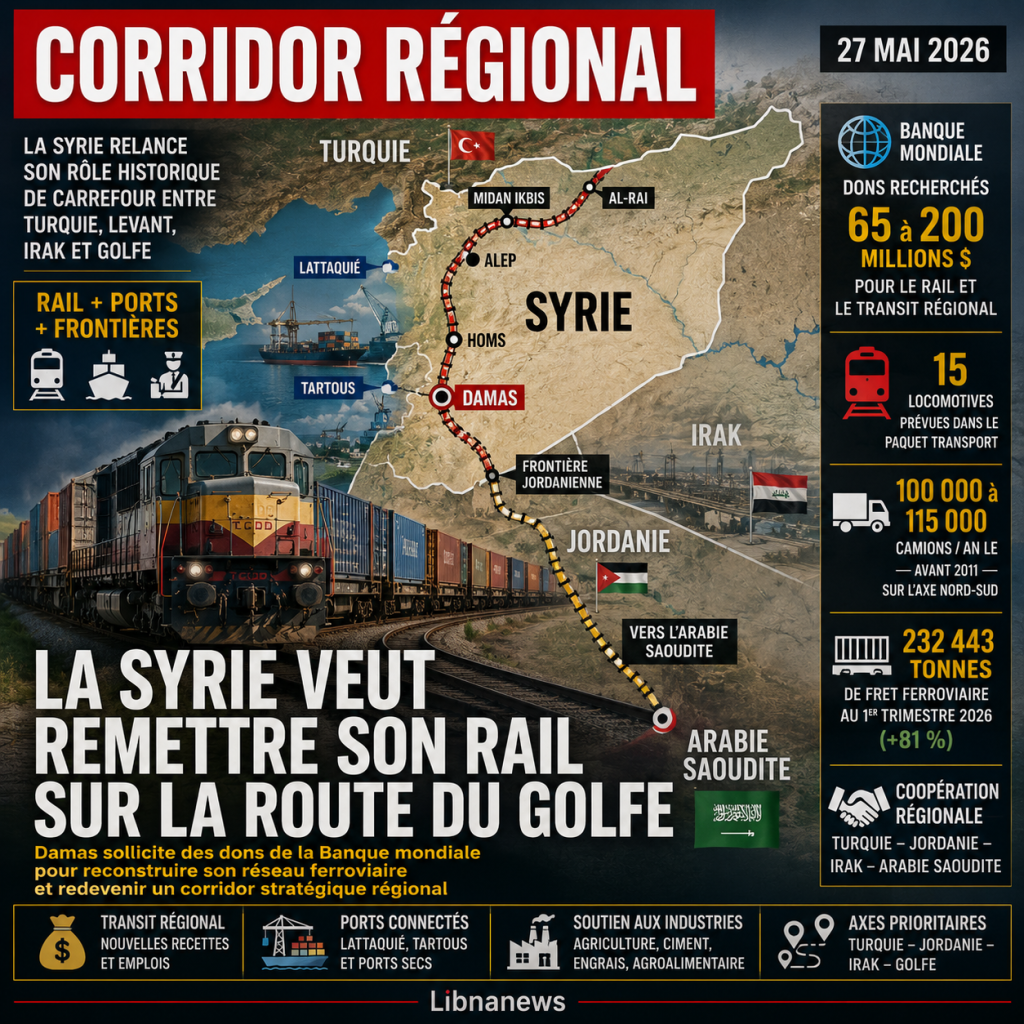
Damascus is seeking to put the Syrian railway at the centre of its economic reconstruction. The Syrian Ministry of Transport has indicated that it is seeking funding from the World Bank, in the form of grants, between $65 million and $200 million. These funds would cover the rehabilitation of a railway network heavily damaged by thirteen years of war, but also the revival of an old role: making Syria a transit corridor between Turkey, the Levant, Iraq and the Gulf countries.
A project between rail, road and regional diplomacy
The question of the link between Turkey and Saudi Arabia appears at the heart of the case, but it must be distinguished according to the modes of transport. The Syrian authorities refer to a rapid resumption of road transit between Turkish and Jordanian borders, with coordination including Turkey, Jordan and Saudi Arabia. On the rail, the announcements are more cautious. The immediate priorities relate to links with Turkey, the return to service of sections to Jordan and the study of a modern axis between Damascus, the Jordanian border and eventually Saudi territory.
The Syrian Minister of Transport, Yarub Badr, presents this programme as a step towards economic normalization. Prior to 2011, Syrian territory occupied an important place in land flows between Turkey, Arab countries and Europe. Roads connecting the north and south of the country saw between 100,000 and 115,000 trucks in both directions each year. This function collapsed with war, the destruction of infrastructure, the closure of borders, the fragmentation of the territory and the suspension of several cross-border rail links.
The current project, therefore, is not just to repair railway tracks. It aims to rebuild a complete transport chain. This chain includes the ports of Latakia and Tartous, the industrial areas of Aleppo, Homs and Damascus, border crossings with Turkey, Jordan and Iraq, and future connections to the Gulf. The World Bank is requested to provide financial and technical support. Damascus insists on the form of financing sought: grants rather than loans, in order to limit the burden on already very weakened public finances.
Syrian Railway Seeks Donations
The amount mentioned, between $65 million and $200 million, gives the measure of a first phase more than complete reconstruction. A national railway system requires much higher investment in the repair of tracks, bridges, stations, signalling systems, workshops and rolling stock. The amounts discussed can fund studies, locomotive purchases, priority repairs and strategic segments. They alone are not enough to recreate a modern corridor between the Mediterranean, Turkey, Iraq, Jordan and Saudi Arabia.
Available figures show a gradual rise in the backrest. In February, discussions between Damascus and the World Bank focused on $50 million for transport. This package was intended to allow the purchase of 15 locomotives and a technical evaluation of the engines already available. In April, the Syrian authorities referred to an envelope of approximately $200 million for railway projects. At the end of May, the Minister of Transport put this amount in a broader range, from $65 million to $200 million, talking about rail support and regional transit.
This succession of announcements requires careful reading. Some amounts relate to discussions, other announced funding or projects under structuring. The World Bank has resumed its engagement in Syria after the settlement of arrears that blocked its operations. It also approved donations to other sectors, such as electricity, water and health. For rail, the file seems to be moving forward in stages, with studies, technical priorities and discussions on implementation conditions. No comprehensive national reconstruction schedule has been published.
Priority axes: Turkey, Jordan, Iraq
The regional dimension explains the attention paid to the project. Syria occupies a rare geographical position. To the north, it opens towards Turkey, then Europe. To the west, it has Mediterranean ports. In the east, she can join Iraq. In the south, it provides access to Jordan and beyond to Saudi Arabia and Gulf markets. This map explains why Damascus is seeking to become a country of transition. Transit earns fees, creates jobs, supports ports, feeds logistics areas and reduces costs for exporters.
The first axis concerns Turkey. Two railway points are mentioned by the Syrian authorities: Midan Ikbis and Al-Rai. These passages must be rehabilitated before they can become useful again for freight. Their return to service would be economic and political in scope. It would allow Aleppo and northern Syria to reconnect to Turkey. It could also offer an alternative to saturated or expensive road routes. However, this project involves repairing damaged sections, securing roads, harmonizing customs procedures and an operational agreement between the administrations concerned.
The second axis concerns Jordan. The historic Hedjaz line, which linked Syria to Jordan, has been at a standstill since 2011. The Syrian authorities claim that it could resume service before the end of 2026 if the promised support materializes. This deadline remains conditional. It depends on the real state of the tracks, bridges, stations and border facilities. It also depends on the willingness of neighbours to coordinate controls, schedules, security and tariffs. A cross-border line only works if both sides move forward together.
Until Saudi Arabia, a horizon still open
Saudi Arabia has a broader horizon. The Syrian Minister spoke of a modern road linking Damascus to the Jordanian border and then an extension to Saudi territory. In this case, Syria would no longer be merely a country of passage to Jordan. It would become a link in an axis from Turkey to the Gulf. However, the precise route, cost, donors, timelines and shared responsibilities were not detailed. At this stage, this is a strategic direction rather than an already funded project.
Caution is required especially as rail and road are not progressing at the same pace. The Syrian Minister believes that road transit could restart faster, once the customs and border agreements have been finalized. Rail rehabilitation will take longer. Railways require extensive diagnostics, specialized teams, rails, ties, signalling systems and available locomotives. A road can be reopened in stages with localized repairs. A railway line requires strict technical continuity throughout the route.
The port flap is another piece of the device. The Syrian authorities want to improve the transport of containers between the coast and the interior. A memorandum of understanding was reported between the Syrian Railway Establishment and the operator of the Latakia container terminal. The objective is to better link the ports to the dry ports of Adra, Homs and Aleppo. This choice corresponds to a simple economic logic. Rail becomes more competitive when it transports heavy volumes over medium or long distances, linked to industrial and logistical areas.
A lever for ports and industries
The productive sectors are directly concerned. Syrian officials cite agriculture, cement, fertilizer, food industry and raw materials. In a country where transport costs have increased, rail freight can reduce company bills. It may also limit dependence on trucks, whose operation remains exposed to fuel prices, roadside checks, crossing taxes and the status of the routes. For exporters, a regular line to a port or border can improve delays and make prices more predictable.
The phosphate corridor project illustrates this approach. Discussions with the World Bank included an economic reassessment of a corridor to transport phosphate from the Mahin mines in the Homs region to the port of Tartous. This type of goods fits the rail. These are massive volumes, which are not suitable for long-distance road transport where rail infrastructure exists. A credible return to service would support export revenues, provided all mines, tracks and port facilities are operational.
The resumption of international financing remains linked to the change in Syria’s financial framework. Syrian arrears to the World Bank were settled in 2025 through payments by Saudi Arabia and Qatar. This regulation reopened the possibility of new programmes, subject to the institution’s operational policies. Since then, the World Bank has confirmed a re-engagement approach, focusing on basic services, institution building and infrastructure. Transport falls into the latter category, although immediate priorities have first concerned electricity, water and health.
Persistent technical and financial barriers
However, the political and legal environment remains complex. The Syrian reconstruction still depends on internal stability, the administrative capacity of the State, the transparency of tenders and sanctions regimes. Even where exemptions or flexibilities exist, banks, engineering companies, insurers and suppliers can proceed cautiously. Rail projects also require international purchases, spare parts, locomotives and signalling equipment. Each stage requires compliance guarantees and functional financial channels.
Syria’s neighbours have their own interests. Turkey can gain more direct access to Arab markets. Jordan can strengthen its role as a gateway between the Levant and the Gulf. Iraq can benefit from additional routes to the Mediterranean. Saudi Arabia can be part of a broader land connection logic, without necessarily immediately committing rail financing. These interests are not identical, but they can converge if customs procedures, the safety of goods and tariffs become legible for carriers.
For Damascus, the return of transit is also an issue of economic sovereignty. Transit revenues, the re-starting of freight stations, the activity of dry ports and the creation of logistical jobs can support a very weakened economy. Rail also offers an environmental argument, as it consumes less energy per tonne transported than road when the volumes are sufficient. But these gains will only be possible if the lines are reliable. The shippers will not return to the train if the delays remain uncertain, if the insurances refuse to cover the journeys or if the terminals lack equipment.
Turkey-Saudi Arabia: confirmed
The file finally reveals a clear hierarchy. In the short term, Syria is seeking to reactivate road transit, particularly between Turkey and Jordan, with discussions that include Saudi Arabia to facilitate the movement of goods to the Gulf. In the medium term, it wants to repair rail links with Turkey and Jordan, and then strengthen connections to ports and industrial areas. In the longer term, it evokes a modern line that would extend the Damascus axis towards the Jordanian border and then Saudi Arabia.
The answer to the question of a corridor between Turkey and Saudi Arabia is therefore nuanced. On the road, Damascus wants to restore a north-south corridor linking Turkish flows to Jordanian and Saudi markets. On the rail, the project exists as a regional ambition, but it is not yet presented as a fully funded, dated and ready-to-build line. The donations sought from the World Bank can launch priority segments. They are not enough to confirm, alone, a direct train between Turkey and Saudi Arabia.
The next indications will come from the technical agreements expected with neighbouring countries, the exact content of World Bank financing and the possible publication of a work schedule. The points to follow will be the fate of the passages from Midan Ikbis and from Al-Rai, the possible return to service of the Hedjaz railway, the Jordanian border Damascus project and the port connections to Latakia, Tartous, Homs, Aleppo and Adra. It is on these sections that the reality of the Syrian railway return will be measured.
Figures
| Element | Number announced | Scope |
|---|---|---|
| Wanted Rail Donations | $65 to $200 million | Rail rehabilitation and regional transit |
| Transport financing mentioned in February | $50 million | Locomotives and equipment diagnosis |
| Locomotives provided for in this package | 15 | Strengthening the railway fleet |
| Road transit before 2011 | 100,000 to 115,000 trucks per year | Axis between Turkish and Jordanian borders |
| Rail freight 1st quarter 2026 | 232 443 tonnes | 81% increase |
| Gifts World Bank Water and Health | $225 million | Essential utilities |




