





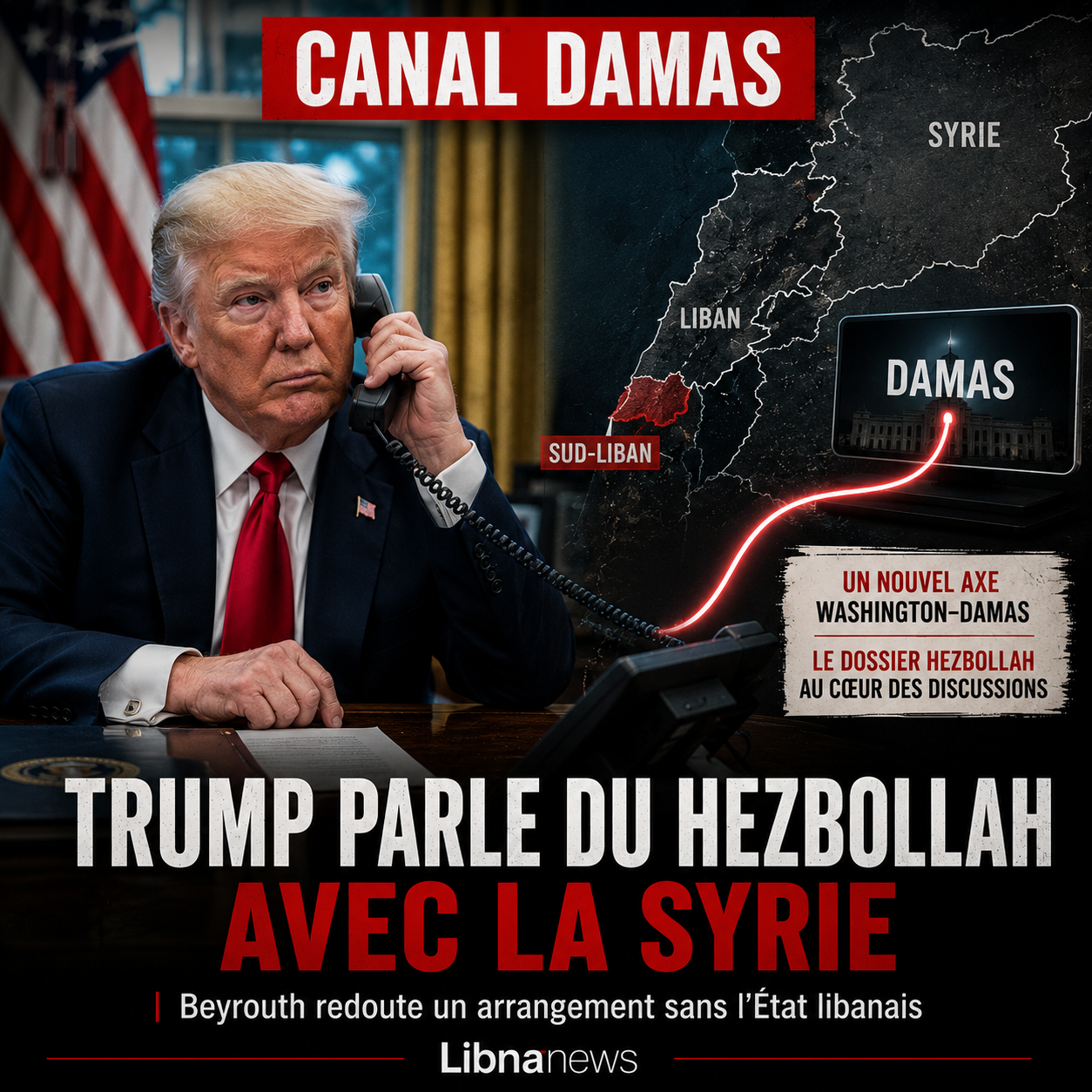
Donald Trump claims to have spoken with Syrian President Ahmed al-Charaa about the confrontation with Hezbollah, according to Reuters. This declaration focuses the Lebanese crisis around a new Washington-Damasian axis. For Beirut, the stake is sensitive: de-escalation in southern Lebanon cannot become a regional arrangement discussed without the Lebanese state.
According to Reuters, Donald Trump claims to have spoken with Syrian President Ahmed al-Charaa about the confrontation with Hezbollah. The statement appears brief. Yet it moves the Lebanese equation. After criticizing Israeli methods in Lebanon, the US President no longer merely asked Benjamin Netanyahu to act with greater restraint. He introduced Damascus to the most sensitive issue of the regional sequence opened by the agreement in preparation between Washington and Tehran.
This conversation, if confirmed in its political contours, places Syria in a role that Lebanon knows too well: that of an external actor consulted on its own territory. Hezbollah is a Lebanese party, a Lebanese armed force and a regional actor linked to Iran. The confrontation with Israel takes place mainly in southern Lebanon. Civilians killed, houses destroyed, empty villages and threatened roads are Lebanese. Yet the White House is now speaking with Damascus about how to deal with this confrontation.
Seen from Beirut, the question is not only safe. It is also political and sovereign. Why does Donald Trump talk about Hezbollah with the Syrian President, instead of first placing the Lebanese state at the centre of the scheme? Why does de-escalation seem to go through Washington, Tehran, Tel-Aviv and Damascus, when the terrain is Lebanese? This question dominates the local reading of the exchange reported by the news agency.
Trump Talks to Syrian Hezbollah President
The sentence reported by Reuters comes in a already loaded sequence. Donald Trump had just publicly criticized Israeli military methods in Lebanon. He had denounced the destruction of residential buildings to reach Hezbollah members, stressing that not all the inhabitants of these buildings were members of the movement. He also asked Benjamin Netanyahu to be more responsible for the conduct of operations in Lebanon.
The following day, the reference to a discussion with the Syrian President gave another relief to this criticism. Trump isn’t just saying that Israel hits too hard. He suggests that another path might exist, with Syrian involvement in the management of Hezbollah. This track is not formulated as a detailed plan. It remains a political indication. But it suffices to install Damascus in an equation where Lebanon risks, once again, being treated as a space rather than as a State.
The choice to speak to the Syrian President is not an insignificant one. Ahmed al-Charaa tries to consolidate his power after years of Syrian war and fragmentation of the country. Washington may see him as an interlocutor able to control borders, monitor roads and limit certain networks. But Syria did not have the legitimacy, neutrality or history necessary to become the arbiter of the Lebanese case. The memory of Syrian tutelage remains alive in Lebanon. It cannot be erased by a diplomatic formula.
American Diplomacy Seeking Relays
The White House is obviously trying to avoid two pitfalls. The first would be an uncontrolled continuation of the Israeli strikes in Lebanon, which could cause the agreement with Iran to fail. The second would be an Israeli withdrawal without a visible guarantee for the security of northern Israel, a politically difficult scenario for Netanyahu. Between these two constraints, Trump is looking for a regional relay. Syria appears as a possible lever, but also as a dangerous bet.
This approach responds to American logic. Hezbollah is not limited to its positions in southern Lebanon. It has regional depth, border networks and long-standing ties with Syria. Controlling certain routes between Syria and Lebanon could weaken its ability to reorganize. Washington may therefore think that pressure from Damascus would complement Israeli military pressure, while reducing the most visible strikes against inhabited areas.
But this external logic ignores an essential fact. Lebanon cannot be stabilized by an arrangement that bypasses its institutions. If Syria controls its border further, this can help to reduce some flows. If it acts on behalf of an American or Israeli mandate, it can instead revive Lebanese tensions. The Lebanese-Syrian border is a legitimate subject. She must be treated with Beirut, not in Beirut’s place.
The United States wants to go fast. The agreement with Iran must open a period of de-escalation. Trump is looking for an identifiable diplomatic victory. It wants to show that its administration can stop a regional war, limit nuclear risk and lower pressure on energy markets. In this emergency, there is a strong temptation to talk with actors who seem to have real levers. The problem is that the Syrian lever carries a historical burden that Washington often underestimates.
Syria, a useful actor or a political trap?
For Ahmed al-Charaa, the conversation with Trump can be an opportunity. It gives it international visibility. It shows that Syria is once again becoming an interlocutor sought by Washington. It can also offer prospects for political, economic or diplomatic relief in Damascus. After years of war and isolation, any direct channel with the White House has value.
But the Hezbollah file is dangerous for Syria. Damascus cannot afford to open a direct front with an organisation that has networks, allies and regional nuisance capacity. Overly visible Syrian action against Hezbollah could lead to internal tensions, reprisals or community fractures. It could also complicate Damascus’s relations with Iran, even though the Syrian balance has changed in recent years.
Syria should therefore remain cautious. It can promise better control of some roads. It can say that it does not want its territory to be used to fuel a new war. It can work quietly with mediators. But direct intervention in Lebanon would be another matter. It would immediately awaken the spectre of a Syrian return to Lebanese affairs. It would provide Hezbollah with a powerful argument to denounce a hostile coalition.
The distinction between border coordination and political involvement is central. Technical cooperation among States can be acceptable if it is channelled through the Lebanese authorities. An implicit Syrian mission against Hezbollah in Lebanon would be explosive. It would move confrontation rather than resolve it. It would transform American de-escalation into a new rivalry of sovereignty.
Lebanon may still be bypassed
The Lebanese perception of Trump’s statement is marked by an old concern. Lebanon has often been placed at the centre of crises without being placed at the centre of decisions. Wars take place there, but compromises are negotiated elsewhere. Villages are bombed, but guarantees are being discussed between foreign capitals. Hezbollah acts on Lebanese territory, but its fate is being debated with Iran, Israel, the United States and now Syria.
This marginalization feeds a particular anger. Many Lebanese challenge Hezbollah’s monopoly on war and peace. They refuse the party to engage the country in regional confrontations. But they also refuse that the solution goes through Damascus or Tel Aviv without a central role of the Lebanese State. Sovereignty cannot be restored by an arrangement that bypasses it.
The Lebanese government, however, has a clear basis. He called for the cessation of Israeli strikes, the withdrawal of Israeli forces from southern Lebanon, the return of displaced persons, the strengthening of the army and respect for existing international mechanisms. This roadmap can be discussed, enriched and controlled. It should be the heart of any serious mediation. If Washington chooses to speak with Damascus first, it weakens the message he claims to defend.
In the southern villages, the urgency is even simpler. The locals want to know if they can go home. They want to know if drones will stop flying over roofs. They want to know if the roads between Nabatiyah, Bint Jbeil, Khiam, Mifdoun, Choukine or Kfar Tebnit will remain exposed. The Trump-Charaa conversation does not yet answer these questions. It adds a diplomatic layer to an already daily insecurity.
Israel’s Watching a Path That Can Clear
Israel can see this conversation as a useful exit. If Syria agrees to play a role against Hezbollah networks, Netanyahu can claim that military pressure has produced a regional result. He may say to his opinion that Hezbollah is not only pushed south, but also forced east. He can reduce some strikes while presenting this reduction as a success, not as a concession to Trump.
This perspective can seduce part of the Israeli apparatus. It provides a means of maintaining pressure on Hezbollah without alone bearing the political cost of destruction in Lebanon. It also responds to American criticism. Israel could say that its operations are declining because a regional arrangement is in place. It could require verifiable safeguards on border crossings, arms depots and movements of combatants in exchange.
But Israel can also use this trail to extend its freedom of action. As long as Syrian guarantees are not visible, the Israeli army can continue to strike. As long as Hezbollah retains its capabilities, Netanyahu can say that the danger remains. The discussion between Trump and the Syrian President could then become a diplomatic alibi, not a mechanism for protecting Lebanese civilians.
That is why the American criticism of the day before remains essential. Trump has set a clear reproach: it is not acceptable to destroy entire residential buildings to reach a fighter. If this criticism remains without consequence, it will not change anything. If accompanied by real pressure on Israel, then the Syrian runway could be part of a wider de-escalation. The test will be visible in the field, not in the press releases.
Agreement with Iran in the background
The conversation with the Syrian President cannot be separated from the agreement being prepared between the United States and Iran. Washington wants a signature, then opens a longer negotiation phase. Tehran wants economic and political guarantees, but it also wants its allies not to emerge weakened by a regional arrangement. Lebanon thus becomes a point of direct friction.
Hezbollah has already indicated that it considers the Israeli withdrawal from southern Lebanon as a central issue for the future. Iran also linked regional peace to the end of the Israeli occupation in Lebanon. In this context, if Trump discusses Hezbollah with Damascus, Tehran can see it as an attempt to create a Syrian counterweight. This perception may complicate the next phase of discussions.
Washington is probably trying to balance several messages. In Israel, Trump means that his security will remain taken into account. In Iran, it means that the deal can produce a de-escalation. In Syria, it offers a regional role. In Lebanon, he should say that his sovereignty will be respected. This last message remains the least audible. This is precisely what worries Beirut.
The success of the agreement will depend on the consistency between these messages. One cannot promise peace to Iran, security to Israel, a role to Syria and leave Lebanon in uncertainty. The war is taking place on its territory. There are human casualties in its towns and villages. Any solution that neglects this reality will bring in it the next crisis.
Syrian memory weighs on Lebanese reaction
In Lebanon, Syria is not an ordinary neighbour. It is linked to decades of intervention, military presence, political guardianship and internal divisions. Although the regional context has changed, this memory remains present. It structures reactions as soon as Damascus is associated with a sensitive Lebanese case. Hezbollah itself has long been linked to Syrian space. Hezbollah’s opponents have often experienced the Syrian presence as a domination.
That is why Trump’s statement must be read with caution. It may appear in Washington as a pragmatic idea. It resonates in Lebanon as a painful reminder. The country does not want to replace an Israeli occupation with Syrian influence. He does not want the settlement of Hezbollah to become the pretext for a return from Damascus in its internal balances. Nor does it want its sovereignty to be used as a currency of exchange in the agreement with Iran.
This Lebanese reaction does not prevent one from recognizing a reality: the border with Syria must be controlled. Trafficking, weapons and informal passages are a serious problem. But the response must strengthen the Lebanese state. It must not consecrate its circumvention. Coordination between Beirut and Damascus, under international supervision, would be one thing. A direct conversation between Washington and Damascus about Lebanese Hezbollah would be another.
The shade is decisive. It will determine whether the track mentioned by Trump will be seen as a contribution to stability or as a new denial of sovereignty. For now, the US President’s words open up more questions than they provide answers.
The real test will be the role given to Beirut
The follow-up will depend on one simple point: will Lebanon be associated as a central actor, or treated as a case to be managed? If Trump speaks with the Syrian President to obtain border cooperation in agreement with Beirut, this discussion can be useful. If it aims to delegate part of the treatment of Hezbollah to Damascus without a clear Lebanese mandate, it will be politically toxic.
The same applies to Israel. The United States cannot ask Syria to act against Hezbollah while tolerating Israeli strikes against residential areas. They cannot talk about regional peace while allowing the Israeli army to occupy parts of southern Lebanon. They cannot ask the Lebanese State to take over if, at the same time, they negotiate over it.
The exchange between Trump and Ahmed al-Charaa thus reveals the new phase of the crisis. The war is no longer only in the southern villages. It is in the very definition of legitimate interlocutors. Who speaks for the security of Lebanon? Who decides where Hezbollah belongs? Who guarantees Israeli withdrawal? Who controls the borders? Who’s protecting civilians?
For the Lebanese, the answer cannot only come from Damascus, Tel Aviv, Tehran or Washington. It must go through Beirut, the Lebanese army, the institutions and a mechanism that is accountable to the people concerned. The conversation between Trump and the Syrian President will therefore not be judged on his formula or on his announcement effect. It will be on what it will change in practice in South Lebanon, where the inhabitants are still waiting for the silence of the drones and the withdrawal of Israeli forces.