

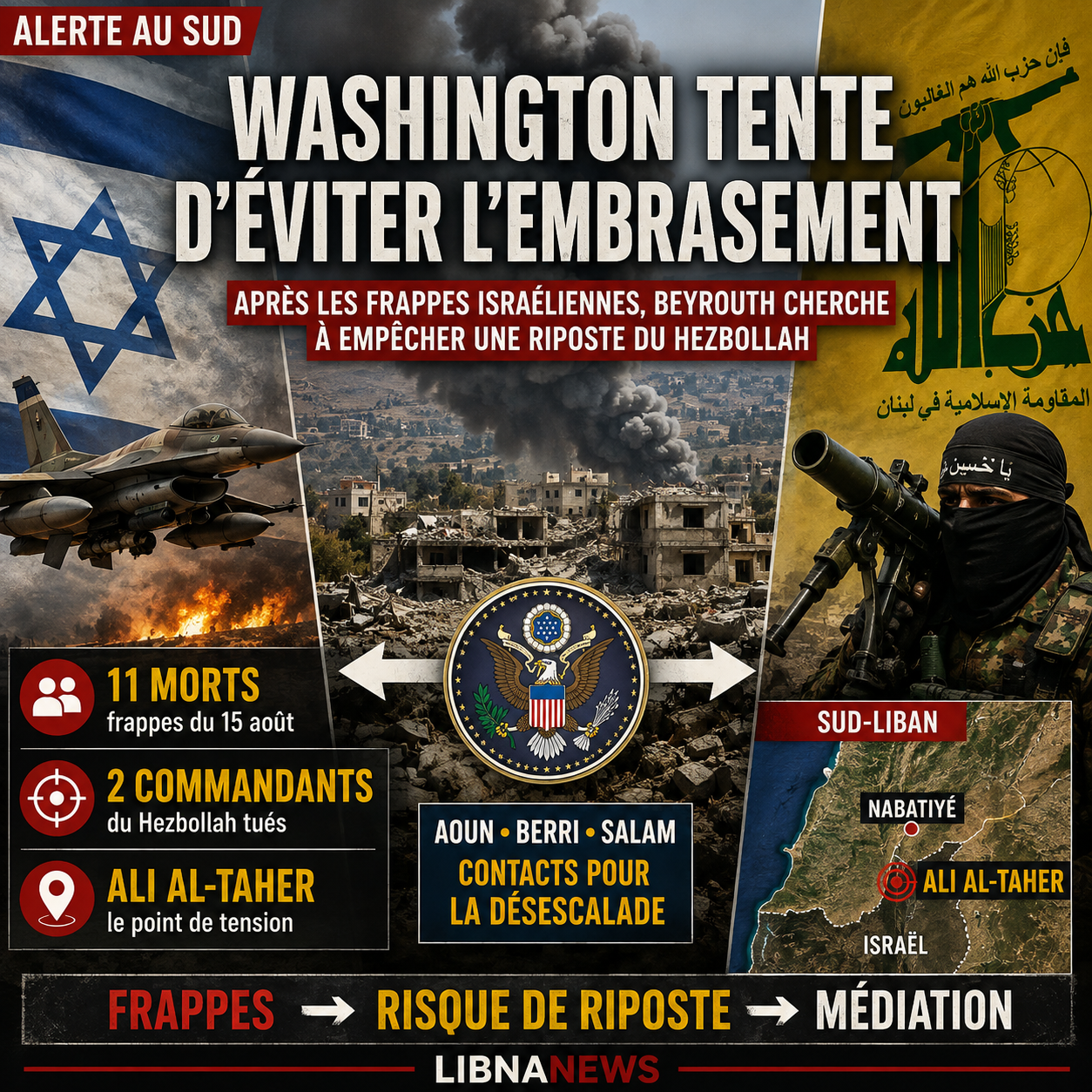
The Israeli strikes that killed two Hezbollah commanders in southern Lebanon are, according to a diplomatic source quoted on Monday, 17 August, a particularly severe warning to the Shiite movement. This source claims that they were preceded by a security operation about a week earlier and that Hezbollah did not claim. In the hours following the strikes, Beirut and Washington reportedly increased contacts to prevent an open response and confrontation. This sequence comes after the death of eleven people in the Israeli bombings of 15 August and while the strategic area of Ali al-Taher, near Nabatiyah, is crystallising a confrontation which Lebanese officials now fear enlargement.
Israeli « hard warning » in Hezbollah
The sharp escalation in southern Lebanon would not be limited to the Israeli strikes on Saturday, 15 August. According to a diplomatic source quoted by the Lebanese press on Monday, the latest events would be part of a more discreet security confrontation between Israel and Hezbollah. It would now combine unclaimed operations, targeted assassinations and indirectly transmitted messages in order to avoid, for the moment, a general resumption of fighting.
The diplomatic source presents the elimination of two Hezbollah commanders as a « hard warning » to the movement. The Israeli army claimed to have targeted two officials during its operations in the south of the country. The 15 August strikes resulted in the deaths of eleven Lebanese authorities, including civilians and children, and at least nineteen injured. They are one of the most deadly episodes since the June entry into force of the mechanism to reduce hostilities between Israel and Hezbollah.
Israel presented these bombings as a response to a Hezbollah operation in the Ali al-Taher area. Three Israeli soldiers were seriously injured following the activation of explosive drones or IEDs, according to the Israeli version. One of the commanders targeted by Israel was identified by the Israeli army as Ali Samir al-Hajj Hassan, who was presented as a military leader of Hezbollah. The Israeli authorities acknowledged that civilians had also died in the attack against him.
But diplomatic information that appeared on Monday adds an additional dimension to this chronology. They report another « security operation », which was allegedly conducted about a week before the strikes and which Hezbollah would keep secret. Its exact nature, location and consequences have not been publicly established. The source considers that this transaction may never be claimed.
It is therefore necessary to distinguish between the confirmed elements and the information reported under cover of anonymity. Israeli strikes and casualties are documented. The incident injuring three Israeli soldiers was also claimed in the Israeli communication as the immediate trigger for the response. On the other hand, the existence and nature of the secret operation referred to by the diplomatic source remain, at this stage, an information reported and not officially confirmed by Hezbollah.
A confrontation of unclaimed messages
This shadow zone illustrates the evolution of the confrontation between Israel and Hezbollah. Both sides can seek to act militarily while avoiding public endorsement of each operation. This ambiguity leaves them a margin for calibrating their response and limits, in certain circumstances, the political pressure for an immediate response.
According to the same diplomatic source, relations between Israel on one side and Hezbollah, supported by Iran, on the other side are said to have entered a phase of « complex and coded security messages ». In this context, a serious incident announced in Israel can be interpreted as a consequence of an unclaimed operation. Conversely, a strike or explosion in Lebanon can be understood by Hezbollah as an Israeli warning whose scope exceeds the officially announced target.
This reading does not mean that every unexplained incident can be attributed to Hezbollah or Israel. Rather, it reflects the level of mistrust currently prevailing on the ground. Visible military actions represent only one part of the confrontation, while intelligence, infiltration, clandestine operations and indirect signals are becoming increasingly important.
The strikes against the two commanders were thus interpreted in diplomatic circles as a particularly strong response to this sequence. The immediate challenge, after the bombings, was therefore to prevent Hezbollah from responding in its turn and triggering a new chain of reprisals.
Washington and Beirut tried to prevent a response
It was in this context that high-level contacts were reportedly initiated between Beirut and Washington. According to reports on Monday, their aim was to quickly contain the escalation after the assassinations of the two leaders of Hezbollah.
These steps would have resulted in a de-escalation formula: Israel would stick to the operations already carried out while Hezbollah would give up responding to the assassinations. This is not a new political agreement or a formal ceasefire announced by the parties. The mechanism described is more like a one-time arrangement to interrupt the cycle of retaliation.
Such a formula remains fragile. It depends on the ability of each actor to consider that the accounts are temporarily closed and assumes above all that no new major incident alters the military calculation. However, the situation around Ali al-Taher remains particularly unstable.
Washington is already playing a central role in negotiating mechanisms between Lebanon and Israel. The United States participated in the efforts leading up to the June framework, which combines the issue of Israeli withdrawal from Lebanese territory with that of the disarmament of Hezbollah and the deployment of the Lebanese army. However, differences over the order and conditions for implementing these commitments remain profound.
Israel claims that withdrawal depends on the effective disarmament of Hezbollah. The Shiite movement rejects the idea of laying down its arms as long as Israeli forces remain present on Lebanese territory. Beirut is trying to preserve a diplomatic process that simultaneously restores its sovereignty to the South and avoids a new war.
Aoun, Berri and Salam mobilized for de-escalation
The efforts with Washington reportedly led to intense consultations at the Lebanese state summit. According to the diplomatic source, the three main constitutional authorities were directly involved: the President of the Republic Joseph Aoun, the President of the Chamber Nabih Berri and the President of the Council Nawaf Salam.
These contacts would have led to a commitment to de-escalation. This coordination is of particular importance because of the different relationships between the three officials with the Hezbollah file and with international negotiations.
Joseph Aoun has been defending the principle of the state monopoly of arms and the role of the Lebanese army in restoring national sovereignty since his arrival in the presidency. Nabih Berri, for his part, remains a key political interlocutor in the Hezbollah cases. Nawaf Salam is leading a government under strong pressure to implement Beirut’s security commitments.
The Prime Minister condemned the strikes of 15 August and warned that they threatened stabilization efforts. President Aoun had also denounced an escalation that could jeopardize the negotiating process. For the Lebanese authorities, therefore, the immediate objective is to prevent the recent events from destroying the laborious diplomatic framework built since June.
However, the restraint sought in Beirut did not address any of the causes of the confrontation. The Israeli military presence, the future of the Hezbollah arsenal and effective control of the South remain at the centre of the dispute.
Ali al-Taher, fixing point of confrontation
The main danger now concentrates around the heights ofAli al-Taherin the Nabatiyah region. This sector occupies a strategic position which explains the intensity of the operations carried out for several months.
The heights dominate a significant part of the surrounding territory and offer observation capabilities on several axes in southern Lebanon. Israel also claims that Hezbollah has underground infrastructure and military positions. The Israeli army has repeatedly conducted strikes and operations in this area.
As early as June, Israeli movements around Kfar Tebnit and surrounding heights had fuelled concerns about an attempt to advance towards Ali al-Taher. Lebanese security information then indicated a particular Israeli interest in tunnels and installations attributed to Hezbollah.
The confrontation has intensified in recent days. Israel accuses Hezbollah of using the area to conduct the operation that injured three of its soldiers. Israeli forces then struck installations which they attributed to the movement.
Hezbollah fighters are also reported to be present in underground infrastructure in the area. The Israeli press reported that the Israeli army refused to allow members of the movement in those tunnels to leave the area freely. This information illustrates the risk of local confrontation becoming the trigger for a much wider confrontation.
Netanyahu would seek victory at Ali al-Taher
The diplomatic source cited on Monday also links Israeli military pressure with Benjamin Netanyahu’s political calendar. According to his analysis, the weeks leading up to the Israeli elections could be « extremely difficult » in security and military terms.
According to this source, the Israeli Prime Minister would seek a political and symbolic victory by definitively settling the battle of Ali al-Taher. This assessment is a diplomatic analysis and not a publicly announced intention by Benjamin Netanyahu. It should therefore be presented with caution.
However, the Israeli electoral context is an additional parameter. Benjamin Netanyahu’s government maintains a hard line on the disarmament of Hezbollah and the conditions for a withdrawal from southern Lebanon. Israel’s Defense Minister, Israel Katz, has said in recent days that Israeli forces will not leave the areas they control until Hezbollah is disarmed.
This position places Israel and Hezbollah directly in a logic of contradictory conditions. Israel demands disarmament before its withdrawal. Hezbollah considers the Israeli withdrawal as a prerequisite for any serious discussion of its weapons.
The Lebanese army is at the centre of this equation. The negotiated arrangements provide that it gradually takes control of the sectors concerned and becomes the only legitimate armed force in those areas. But its deployment also depends on security conditions and progress in negotiations.
The risk of geographical extension
The main concern expressed by the diplomatic source now concerns the possibility that the fighting could no longer remain confined to Ali al-Taher. An open battle to control these heights could quickly affect Nabatiyah and several surrounding localities.
This perspective explains the intensity of de-escalation efforts. The strikes of 15 August have already shown that reprisals can extend beyond the site of a military incident. In particular, the bombings affected Ansar and Deir al-Zahrani, where civilians were killed, as well as other areas of Nabatiyah governorate.
The results of eleven deaths in one day revived the memory of the previous phases of war. The Lebanese authorities are seeking to avoid a scenario in which a Hezbollah operation leads to targeted Israeli assassinations, followed by a new response by the movement and subsequent deeper strikes in Lebanon.
The difficulty also lies in the proximity of civilian areas. Several locations in the South remain exposed to strikes, displacements and destruction of infrastructure as operations intensify. An extension of the fighting around Nabatiyah would therefore have consequences quickly beyond the scope of a confrontation between combatants.
A de-escalation achieved, but without conflict resolution
Contacts between Washington, Beirut and Lebanese officials seem to have as a priority to prevent this mechanism. If Hezbollah effectively maintains its lack of response after the death of the two commanders and Israel suspends further major operations, the 15 August sequence could remain contained.
But this restraint is not a regulation. Fundamental positions remain incompatible and the ground continues to produce incidents that could undermine diplomatic arrangements.
The seventh negotiating meeting held in Rome had already failed to enable Beirut to achieve the expected progress on the Israeli withdrawal. An eighth round of Washington-supported discussions was expected in early September. The events of 15 and 16 August now place this deadline under additional pressure.
Ali al-Taher’s question may occupy a central place. For Israel, the sector is presented as a military infrastructure of Hezbollah and a threat to its forces. For Lebanon, any further Israeli expansion or installation represents a sovereignty problem and complicates the deployment of the Lebanese army.
In the immediate future, the restraint attributed to Hezbollah after the assassinations and the contacts led by the three Presidencies prevent an automatic response. But the diplomatic source warns that this lull could be misleading. It considers the possibility of maintaining the confrontation around Ali al-Taher geographically uncertain if a new battle breaks out.
The next test will therefore be less the scope of public statements than the concrete evolution of the field. A new murderous incident against Israeli soldiers, a strike against a major Hizbullah official or a progression around the heights of Ali al-Taher would be sufficient to challenge the de-escalation achieved by the contacts of the last few hours.




