

Editorial Libnanews · Newsdesk
By selling the charm of Lebanon without treating the price of its access, one ends up confusing tourism policy with advertising. A comparison of tickets provided to our editorial staff raises a legitimate question: what is the place of stay when transport already absorbs a decisive part of the budget? The MEA must respond to its offers. The State must reply throughout the service.
On this capture, a round trip to Paris-Charles-de-Gaulle–Beirut appears at C$1,673 per traveller. Paris–Tel-Aviv is posted at 726 Canadian dollars, Paris–Larnaca at 690. The three routes presented are direct, with announced times from 4:15 a.m. to 4:25 a.m. The amount for Beirut is 2,30 times that of Tel Aviv and 2,42 times that of Larnaca.
These figures deserve to be looked at, not overinterpreted. The departure and return dates, baggage and fare conditions are not included in the transmission. This image therefore does not establish a comparison with identical services or the current average price of these destinations. It shows a posted offer, not a statistical survey of the market. But the political question that it raises does not disappear with this reservation: how to make a destination attractive if its access becomes, for the traveller, the first obstacle?
| From Paris-CDG | R/A per passenger |
|---|---|
| Beirut MEA, operated by Air France Direct, 4:15 a.m |
1 673 CAD |
| Tel Aviv El Al Direct, 4.25 a.m |
726 CAD |
| Larnaca Air France, operated by Cyprus Airways Direct, 4:15 a.m |
690 CAD |
The logo doesn’t say everything about the ticket
A detail forbids the expeditious trial. The flight to Beirut is called Middle East Airlines, but the capture specifies that it is operated by Air France. The one to Larnaca is marketed as Air France and operated by Cyprus Airways. This is not a simple confrontation between three companies carrying their own passengers in their own aircraft.
Code sharing is part of the operation of air networks. Air France announced on 20 July 2026 an agreement with Cyprus Airways, its code being affixed since 7 July on its partner’s Paris–Larnaca flights. This organization can expand commercial access to a link. It does not allow, from a capture, to identify who fixed each component of the amount displayed or which other offer remained available for the same seat.
The criticism of the MEA must therefore be fair. The company does not necessarily fix all price components to Lebanon. However, it is accountable to travellers for offers marketed under its name and for their transparency. Code-sharing is not a sufficient response to the question of why it costs to come to Beirut. A national airline must be able to explain its availabilities, its fare ranges and the interest of its agreements for travellers, not only for its network.
A destination is judged at the cost of the entire stay
The traveller does not reserve a slogan. It adds up the ticket, luggage, accommodation, travel and what it can spend on the spot. For those who hesitate between several destinations, an extra air cost can cancel the interest of a cheaper hotel or an attractive restaurant. It may also reduce the length of stay, the number of people leaving or the expenditure on activities. These are economic mechanisms, not quantified losses that could be measured.
Nor should the diaspora be seen as an acquired demand. Family attachment can make travel particularly important; it does not make the budget unlimited. To present the return to the country as an emotional evidence while leaving its cost out of the debate is to ask families to solve, with their savings, a difficulty of access that concerns all the tourist economy.
However, it is necessary to compare honestly. An offer without a suitcase in the hold is not automatically worth an offer that includes one. Transavia states, for example, that its large cabin baggage option is paid and that its price varies according to destination, flight and time of booking. Modification conditions, schedules and correspondence also count. A serious debate must oppose equivalent baskets, not select the most expensive ticket on one side and a call rate on the other.
The stakes are not limited to major hotels. In the presentation of its assessment of Lebanese tourism published on 26 October 2026, the International Labour Organization identifies a potential in cultural, rural and ecological tourism, coupled with needs for skills and better working conditions. The link with the plane ticket is economical: these activities need visitors who can keep a budget once they arrive, not just from a destination present in the communication campaigns.
The profitability of a company is not the whole tourism policy
The question of liability is all the less abstract because MEA is not a company without any connection with public authorities. In its diagnosis published in April 2026, the International Monetary Fund presents the Bank of Lebanon as its controlling shareholder and notes that the audited accounts of the company are not public. This does not establish any illegality. This, on the other hand, makes a requirement of transparency on the strategy of a company whose access to the country is partly dependent.
Without detailed data on the costs and revenues of these offers, it is impossible to calculate the margins.
The problem therefore goes beyond the MEA and directly affects it. The State has a responsibility for market access conditions and the coherence of its tourism policy. Carriers have theirs on the commercial offer. Distributors must make the services legible and the operator effective. The MEA must respond to its offers; The State must make alternatives accessible.
Less slogans, more accountability
A first step would be to publish a transparent observatory of the cost of access to Lebanon: the same cities of departure, the same dates of stay, the same booking times, direct flights distinguished from the connections, luggage and conditions included in the comparison. A monthly table could follow identical stays purchased at thirty, sixty and ninety days of departure and then distinguish between school holidays and off-peak periods. The proposed frequencies and seats should be counted per actual flight, not by number of commercial codes displayed. Several price levels should be followed, rather than a single promotional minimum. It would be a useful public policy proposal, not a preliminary verdict against a carrier.
From this base, the government must make available real alternatives: to identify the obstacles to supply, to compare the announced capacities with the seats actually marketed and to publish the results of its discussions with the companies. The results should be judged on verifiable indicators: availability of seats, full cost to the traveller and regular service. Public money and energy should be used to make travel possible, not to finance slogans that leave the arrival bill intact.
Lebanon does not need to promise that it will always be the cheapest destination. It must stop treating accessibility as a secondary subject. We cannot invite the world to discover the country and then consider the price to enter it as a matter that no one would have to answer.
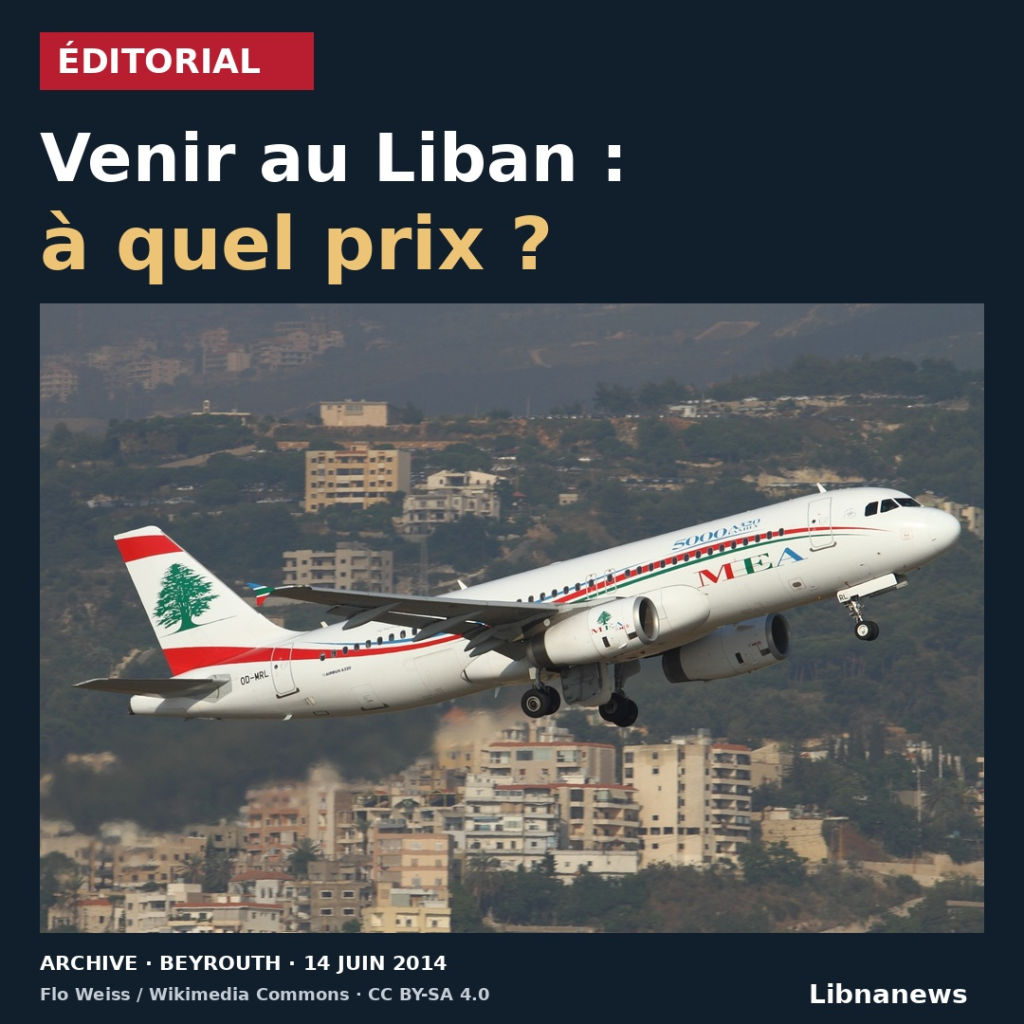
Cover photograph: Airbus A320 MEA at take-off from Beirut, June 14, 2014.Flo Weiss,CC BY-SA 4.0. Composition Libnanews under the same license: proportional reduction, whole photo and titles off image.






Comments