

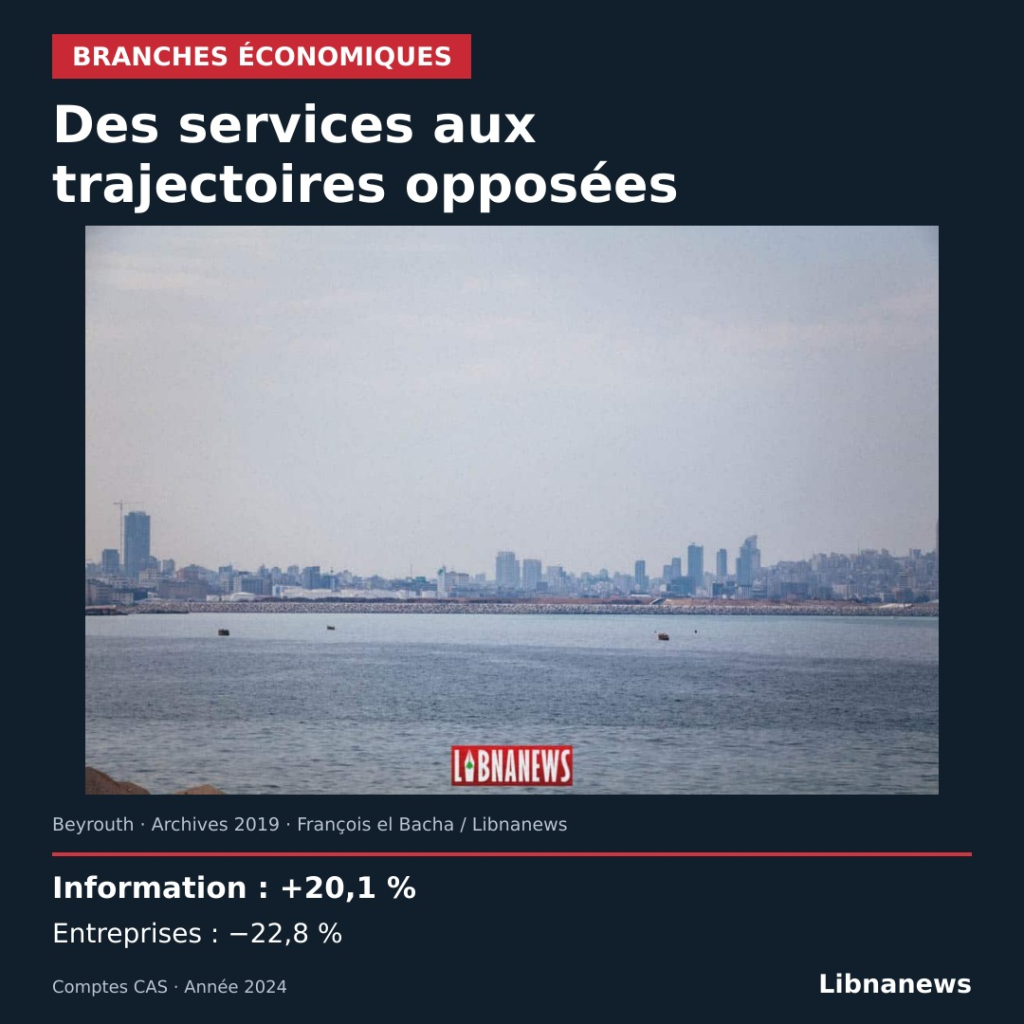
Lebanese information and communication grew by 20.1 per cent in volume in 2024, while business services fell by 22.8 per cent. The revised accounts of the Central Statistical Office (CAS) thus show two opposite trajectories within a shrinking 5.2% economy. However, the contrast is not sufficient to conclude that there has been a general recovery in digital technology or a uniform collapse of all consulting professions.
The categories are broad. « Information and communication » refers to branch J. Business services consist of branches M and N, which cover professional, scientific and technical activities as well as administrative and support services. The table does not provide a separate result for each trade or enterprise.
Lebanese information and communication: the return to 2019 level
The value added of information and communication reached 57,461 billion daily books in 2024, compared with 37,092 billion in 2023. This represents a nominal increase of 54.9%. Part comes from prices: the deflator increases by around 29%. After correction, the increase in activity is 20.1%.
The calculation uses £44,535 billion of value added of 2024 at 2023 prices. It avoids the direct comparison of current amounts subject to different prices. The rate of 20% published in rounded form should therefore not be read as simply an increase in telephone rates.
The trajectory since 2019 remains irregular. At 2019 reference prices, value added rose from 1,628 billion that year to 762 billion in 2020 and then to 688 billion in 2021. It then amounted to 1,179 billion in 2022, 1,407 billion in 2023 and 1,689 billion in 2024. The last level is about 3.7% higher than in 2019.
Business services fall despite nominal increase
Business services have a reverse result. Their current value added increased from £267,941 billion in 2023 to £275,449 billion in 2024. The nominal increase is 2.8%. However, the amount of 2024 at 2023 prices is only 206 724 billion. The decrease in volume is 22.8%.
The deflator in this branch increases by about 33%. This explains why a significantly reduced activity can produce a slightly higher current value. Relying on the nominal amount alone would therefore have reversed the diagnosis on production.
| Branch, year 2024 | Current value added | Price changes, rounded | Recalculated volume change |
|---|---|---|---|
| Information and communication | LL 57 461 billion | +29% | +20,1 % |
| Business services | LL 275 449 billion | +33 % | -22.8% |
The business services industry remains much larger in current value. It represents 10.8% of total value added at basic prices in 2024. Information and communication account for 2.3%. The denominators here are identical: total value added, not GDP at market prices, which also includes net taxes on products.
The weight of branches changes the national result
The table of contributions illustrates this difference in size. Information and communication bring about 0.3 percentage points to GDP growth in 2024. Business services take away about 2.7 points. The sharp rise in the first branch therefore compensates only a small part of the fall in the second.
This decomposition explains why a recession can coexist with expanding activities. Sectoral rates do not average directly. Their weight in the economy counts as much as their variation. A limited branch that increases by 20% may have less effect on the total than a large branch that decreases by a comparable rate.
Business services had not recovered to pre-crisis levels. Their value added at reference prices reached £3,532 billion in 2024, compared to £5,474 billion in 2019. This corresponds to about 64.5% of the starting level. The decrease of 2024 occurred after a 2% increase in 2023 in the rounded CAS series.
Neither job count nor telecommunications alone
Value added measures the wealth created after deduction of intermediate consumption. It does not represent the gross turnover of enterprises. A variation may therefore depend on both the output sold and the goods or services used to produce it.
It also does not measure employment directly. A 20.1% increase in volume does not mean an equivalent increase in the number of employees. A labour survey or comparable administrative data would be necessary to determine the evolution of the workforce. The production accounts do not provide this information.
Reducing branch J to telephone operators would be just as misleading. It includes various information and communication activities. The aggregated table does not allow for the distribution of the result between telecommunications, computer, media or other relevant services. Nor does it allow the progression to be attributed to a particular investment announced after 2024.
Two markets that do not coincide with exports
Business services can be sold to Lebanese or foreign customers. Their decline is therefore not synonymous with an identical decline in services exports. Conversely, the services exported include other activities such as travel and transportation. Both sets have different perimeters.
The CAS file provides an annual measure of 2024, revised with previous years. It does not propose a sectoral forecast for 2026. The contrast between these branches now calls for finer data on their customers, sub-activities and staff, in order to understand what is behind the two national averages.





Comments