





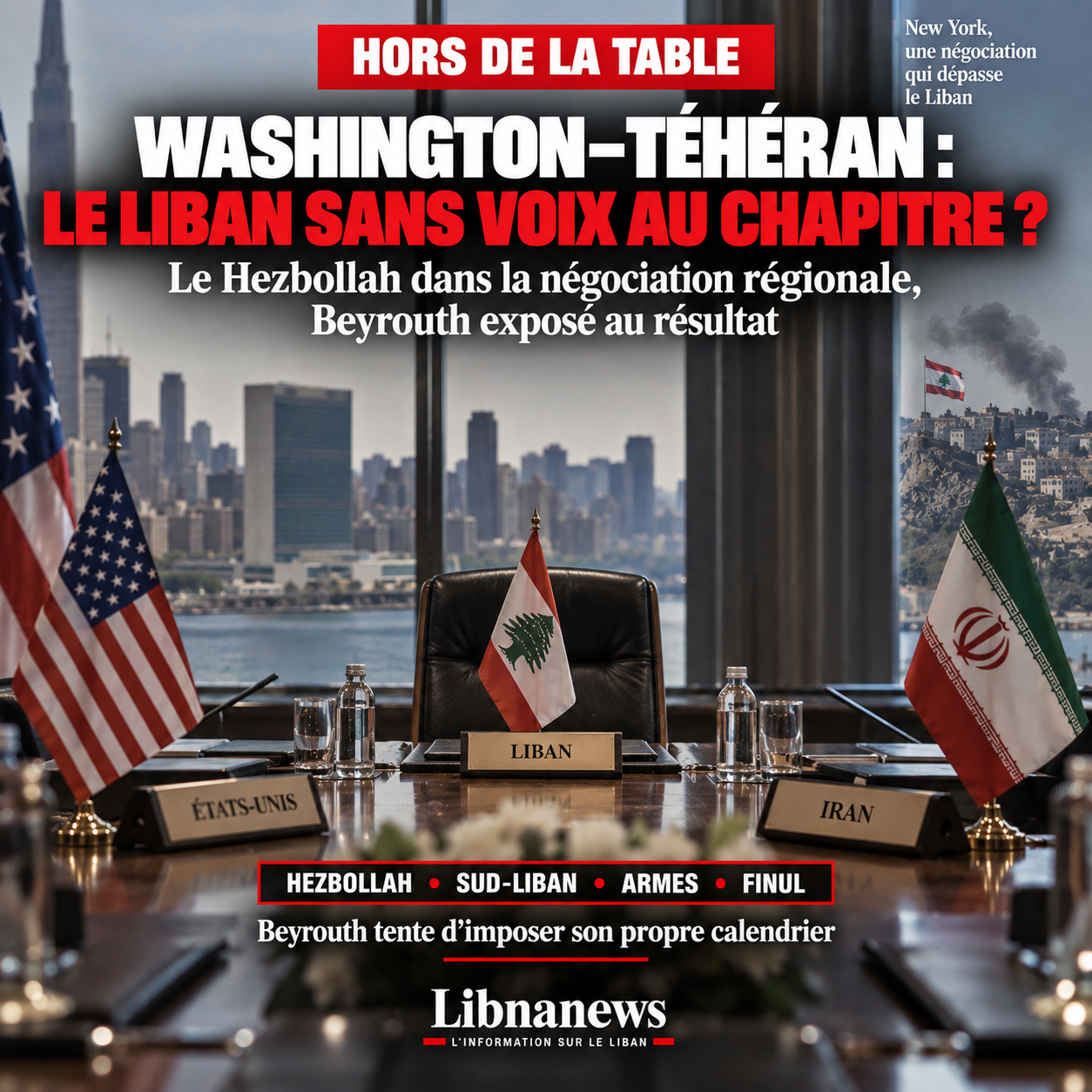
Lebanon is not an official party to the discussions in New York between the United States and Iran. No Lebanese negotiator participates in the exchanges transmitted by the mediators, and there is no evidence to suggest that a formal chapter on Hezbollah has already been compromised. Yet Beirut is following these discussions with particular attention. The content of Iranian demands, the American response and the expansion of dialogue to the various regional fronts can have direct consequences for South Lebanon, Hezbollah’s weapons and the State’s margin for re-establishing its authority.
The first thing to remember is precisely this shift. Lebanon is not sitting at the table, but is exposed to the result. According to Lebanese presidential circles, official officials closely follow speeches and information from New York to identify what is actually being negotiated between Washington and Tehran. This vigilance partly explains the intensity of Nawaf Salam’s activity in the United States. The Prime Minister simultaneously seeks to prevent an international vacuum in the South after the Final and to obtain external support for the government’s decisions on state authority and the decision on war and peace.
This simultaneousity is the real starting point. Beirut is trying to move forward on its own cases while Washington and Tehran are discussing a much wider exit from war.
The first battle was on a photograph that never finally existed
The New York contacts first produced a controversy about their form. Donald Trump presented them as a substantial exchange with Iranian officials. Initial information even suggested that a meeting of about three hours had been held between the two parties. This presentation provoked a reaction in Tehran, where the instructions given to the Iranian delegation specifically excluded a face-to-face with the Americans.
Steve Witkoff then gave a decisive clarification: the discussions took place through mediators who were circulating between the two delegations. The Qatari channel played a central role in the transmission of messages. A senior Iranian official subsequently confirmed that Tehran had received an American response and that it was under examination.
The correction may seem protocolary. It actually reveals the political fragility of the process. Iran agrees to negotiate, but still refuses to give the image of forced power to a face-to-face with Washington after seven months of war. The United States, on the other hand, has an interest in presenting diplomatic openness as a result of pressure on Tehran.
The disagreement over staging should not, however, mask the essential: the two opponents now exchange proposals sufficiently precise to require an answer.
The process has therefore gone beyond mere public statements.
What Iran really asked the Americans
Iranian requirements reported in the various documents converge on several points.
Tehran first calls for a lasting cessation of hostilities. He then called for the lifting of the American maritime arrangements which were weighing on his trade. The Strait of Ormuz is logically central to this negotiation. Massoud Pezeshkian himself insisted in New York on the impossibility, according to him, of allowing other States to benefit freely from this sea route while Iran would be subject to simultaneously restrictions.
This position is not just a matter of foreign policy. It directly affects Iranian economic capacity.
The US sanctions against the air sector illustrate the same strategy of pressure. Washington has placed 27 Iranian airlines under sanctions. Foreign suppliers who continue to provide certain services would in turn expose them to measures excluding them from the dollar-based financial system. Iraq has reportedly already informed its airports of restrictions on Iranian aircraft, while flights to Baghdad and Muscat have been affected.
At the same time, Iranian flights continued to be observed to China, Turkey and the United Arab Emirates.
Beijing has publicly rejected unilateral sanctions that are not based on a Security Council decision.
This confrontation around aviation shows why Tehran insists so much on lifting the blockade and economic restrictions. Iran does not just want to stop the strikes. It seeks an exit from war that restores its capacity for circulation, trade and financing.
It is in this architecture that regional fronts take on their importance.
The decisive word is « fronts », because it prevents the reduction of negotiations in Iran
According to available information, Tehran does not want the cessation of hostilities to be considered exclusively as a bilateral arrangement between the United States and Iran. The question of the end of fighting on the different regional fronts is one of the topics transmitted by the mediators.
This formulation is crucial for Lebanon.
It does not mean that Iran would have asked the United States for a special agreement guaranteeing Hezbollah weapons. There is no evidence of this. It means, however, that Tehran seeks to avoid a situation in which it would gain a lull on its own territory while military pressure would continue against its allies elsewhere in the region.
Washington sees this as a point of disagreement.
Information from American circles indicates that the administration considers the Iranian formula on the end of the war in different theatres as an attempt to protect Tehran’s regional allies. Hezbollah is entering this reading, along with the Houthis in Yemen and the armed groups close to Iran in Iraq.
Lebanon therefore appears in the negotiations without necessarily being named as an autonomous file.
It appears through Hezbollah.
This difference is fundamental. It means that Lebanon can be affected by a regional compromise whose legal and diplomatic purpose is not Lebanon itself.
Washington wants much more than a new nuclear agreement
One mistake would be to read the current discussions as a simple new version of the nuclear dispute.
The American requirements are much broader.
Washington wants to deal with Iran’s nuclear programme, but also ballistic missiles, threats against navigation and the regional network around Tehran. Hezbollah is part of the latter.
This approach profoundly alters the Lebanese equation.
For years, Hezbollah’s weapons have been debated in Lebanon as a problem of national defence, conflict with Israel and internal balance. They are now becoming one of the elements of a much wider power ratio between Washington and Tehran.
This does not detract from the competence of Lebanese institutions. This simply means that outside actors do not view the case in the same way as Beirut.
For the United States, Hezbollah belongs to the Iranian regional architecture.
For the Lebanese Government, the issue is the monopoly of legitimate force and the State’s recovery of the decision on war and peace.
These two readings may lead to the same practical objective on certain points, but they are based on very different logics.
This difference explains why Beirut seeks to prevent an external calendar from being imposed on it.
Iran has little reason to sell a Lebanese card before knowing the US price
On the Iranian side, the value of Hezbollah increases precisely because Washington integrates with its demands.
Tehran does not negotiate after a normal period of diplomatic relations. It negotiates after seven months of war, under sanctions, with direct pressure on its air and sea routes. His former guide Ali Khamenei was killed at the beginning of the conflict. Military officials were also eliminated. The country has suffered United States and Israeli strikes and is still facing an economic mechanism to reduce its room for manoeuvre.
In these circumstances, Iran seeks to preserve what it considers to be its negotiating cards.
This does not allow us to conclude that he is directly negotiating the future of Hezbollah’s weapons. This, on the other hand, makes it possible to understand why he refuses to leave the Iranian territory alone.
If Tehran accepts an agreement, it will logically seek to know what it gets on sanctions, Ormuz, trade and regional fronts.
Washington seeks exactly the opposite: to prevent a cessation of hostilities from simply allowing Iran to preserve all its regional arrangements without modification.
This is where the heart of negotiations lies.
And that is where Lebanon becomes vulnerable to the results of a discussion in which it does not participate.
Lebanon is therefore trying to build its own timetable before a regional agreement exceeds it
The Lebanese official community has clearly identified this risk.
Nawaf Salam uses his presence in New York to increase meetings. There are two clear objectives.
The first one concerns the Finul. If its mission ends at the end of the year, Beirut wants to prevent an international vacuum in the South. Discussions on a replacement force, a European presence or another international formula must therefore proceed independently of the outcome of the American-Iranian negotiations.
The second objective concerns State authority.
The government seeks international support for its decisions on the deployment of the army, the arms monopoly and the recovery of the decision on war and peace.
The logic is important: Beirut is trying to transform a regional diplomatic window into strengthening its own institutions.
She can’t wait to know whether Washington and Tehran will make an agreement.
The calendar of the South, the Final and the American pressure on the Lebanese government are already under way.
Trump brought regional leaders together while the Iranian Canal was operating a few kilometers away
The American method also shows that Washington does not rely on a single negotiation.
Donald Trump gathered in New York several Arab and Muslim leaders and leaders. Nawaf Salam attended the meeting.
The details are politically important. Lebanon was therefore integrated into the Washington regional consultation at the same time as US emissaries were trading indirectly with Iranians.
Beirut was not in the US-Iranian negotiating room. However, it was present in the other circle: that of the states of the region consulted by the American President.
This configuration gives Lebanon a capacity for expression, but not a veto.
Nawaf Salam can outline Lebanese priorities. He can insist on Israeli withdrawal, the role of the army, reconstruction and the need to avoid a vacuum in the South.
He cannot determine what concessions Washington will ask for in Tehran or what Tehran will accept.
This is the whole difference between participating in a consultation and participating in a negotiation.
Beijing builds another exit from war
China is also trying to influence the content of the regulation.
Several trips in September show that this mediation is not improvised. Prime Minister and Qatari Minister of Foreign Affairs Mohammed bin Abdelrahmane Al-Thani visited Beijing on 8 September. Iranian Foreign Minister Abbas Araghchi arrived there on 16 September.
Beijing highlighted the Islamabad memorandum as a possible framework for returning to negotiations.
The Chinese position is based on a specific idea: Iran must emerge from the war by maintaining its capacity to act as China’s political, economic and scientific power and strategic partner. Beijing rejects a regional architecture built on Tehran’s sustainable exclusion or bottlenecks.
This position gained weight when Saudi Arabia, Egypt, Pakistan and Turkey called in New York to retain the Islamabad memorandum as a reference for peace and stability.
The balance of power is therefore not limited to Washington and Tehran.
China wants to influence the post-war conditions. Qatar serves as a mediator. Several regional powers support a negotiating framework. The United States consults separately with its Middle East partners.
Lebanon finds itself in the middle of this architecture without the necessary weight to shape it alone.
Regional negotiations do not exempt Washington from pressure directly on Beirut
However, it would be misleading to think that the United States is waiting for an agreement with Iran before acting in Lebanon.
Pressure on Beirut is already under way.
Visitors to Washington report that American officials want a concrete translation of Lebanese decisions on the arms monopoly. They ask questions about the South, military sites and the presence of weapons in other parts of the country.
The American reasoning is simple: the Lebanese state has made commitments, Washington now wants to measure their implementation.
This pressure is therefore advancing independently of the dialogue with Tehran.
This is an essential point in understanding the American strategy.
Washington works on two levels simultaneously. It negotiates with Iran on the regional environment. It directs Lebanese institutions to change the internal situation.
A possible agreement with Tehran could facilitate this policy. His absence does not prevent him from continuing.
The risk of a « large market » exists in imaginations, not yet in the facts available
In Beirut, any American-Iranian negotiations naturally revive the scenario of a great regional compromise in which the cases would be exchanged against each other.
This hypothesis should be treated with caution.
The available documents do not show the existence of an agreement in which Iran would have promised a specific concession on Hezbollah in exchange for lifting a US sanction or guarantee.
They do not provide any disarmament timetable negotiated between Washington and Tehran.
Nor does they demonstrate that the United States would agree to leave Iran with a particular influence in Lebanon in exchange for a nuclear concession.
To present one of these scenarios as information would therefore be incorrect.
What is documented is both more limited and stronger.
Iran calls for an exit from war that takes into account regional fronts. The United States wants to deal with allied organizations in Tehran as part of a broader settlement. Hezbollah belongs to this equation. The Lebanese authorities know that they are concerned and seek to advance their own priorities before regional parameters are agreed.
It’s already considerable.
For Beirut, the real challenge is to prevent « Hizbullah file » from replacing « Lebanon file »
The distinction may seem semantic. It is in reality strategic.
If Washington and Tehran speak of Hezbollah only as part of the Iranian regional network, the interests of the Lebanese state may become secondary.
But Beirut has its own files.
She wants the end of Israeli operations. She wants to get the areas still occupied. It must organize the return of the inhabitants. She wants to avoid a vacuum after the Finul. It needs to finance the army and reconstruction. It must also resolve the issue of arms without causing an internal crisis.
None of these issues is perfectly limited to the relationship between Iran and Hezbollah.
Therefore, Lebanese diplomatic activity in New York is more important than a mere protocol presence.
The government is trying to recall that Lebanon is a State with its own interests, not just the territory in which Tehran’s main Arab ally is located.
The shade will determine part of the sequence.
If the Lebanese issue is absorbed by the American-Iranian negotiations, Beirut risks suffering from the calendar of others.
If it is able to impose its own priorities alongside the regional dialogue, the government will have a greater margin to turn a possible relaxation into a consolidation of the state.
For the time being, no breakthroughs can be made on which of these two trajectories will prevail. But the New York negotiations have already made one thing visible:lebanon is not officially at the table between Washington and Tehran, while one of the main subjects of their regional confrontation is on its territory.It is less a place in negotiation than a position of exposure to its result.