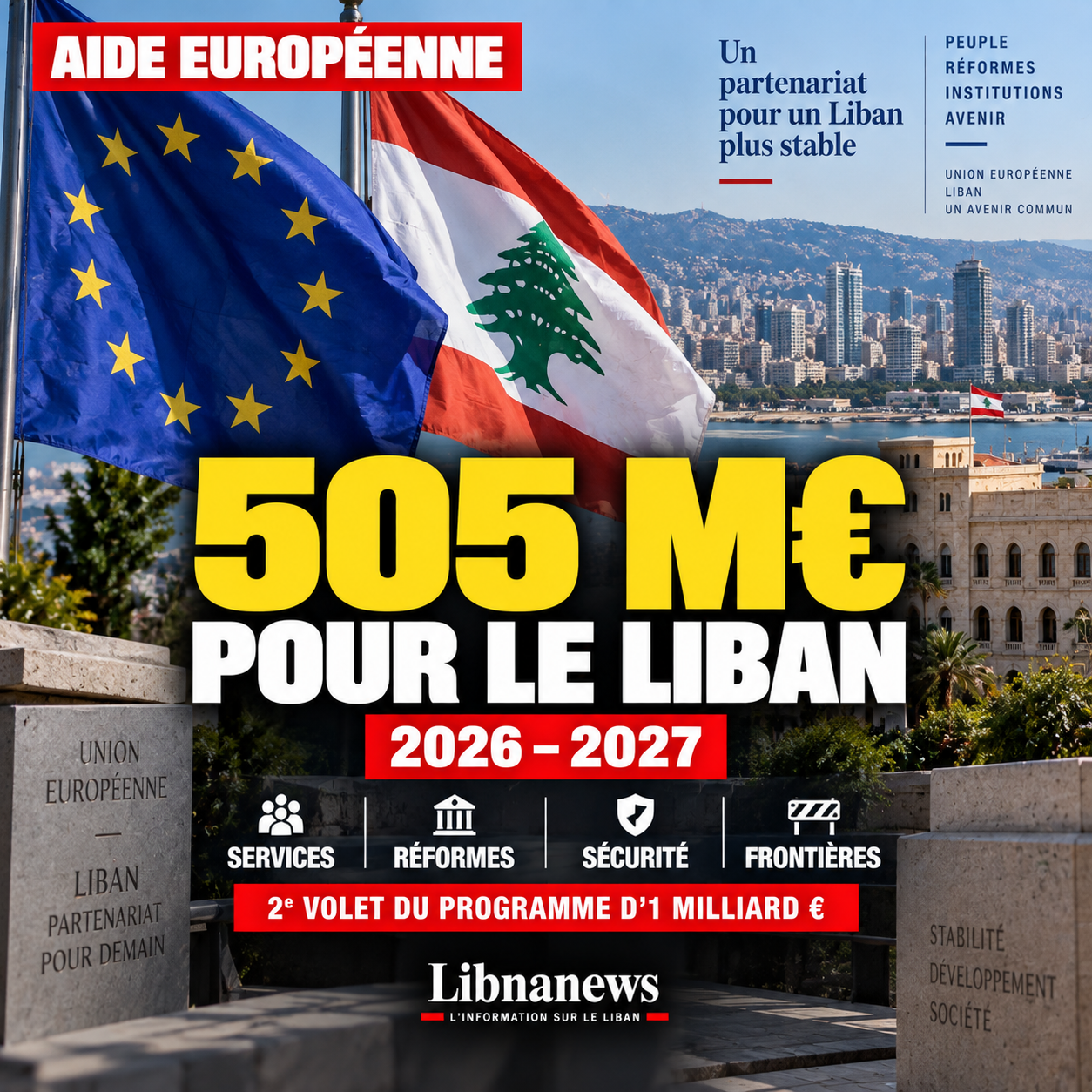
The European Union has adopted a new financial envelope of EUR 505 million for Lebanon for 2026 and 2027. Announced in New York on the margins of the 81st General Assembly of the United Nations, this aid must finance essential services, accompany reforms and economic recovery, strengthen security and border management, but also support the most vulnerable populations. It is the second part of the EUR 1 billion programme announced in May 2024 by the President of the European Commission, Ursula von der Leyen.
EUR 505 million for Lebanon in 2026 and 2027
The new European envelope must be deployed over two years. It comes at a time when Lebanon must simultaneously face the consequences of the conflict, displacement, a fragile economic situation and the need to pursue several institutional reforms.
The €505 million aid will be divided into three main areas: essential services and vulnerable populations, economic recovery associated with reforms and security, and support for civil society and culture.
European Commissioner for the Mediterranean, Dubravka Šuica, announced funding in New York on the margins of the 81st UN General Assembly.
This new envelope represents just over half of the EUR 1 billion European programme announced in Beirut in May 2024. A first tranche of EUR 500 million had been adopted in August 2024 to cover the years 2024 and 2025.
Financing for 2026 and 2027 therefore extends a scheme already committed rather than constituting a new, independent envelope of EUR 1 billion.
Health, education, water and social protection
A significant part of European aid will be devoted to maintaining essential services. The programme includes education, health, social protection and access to water.
Financial support must be provided to the most vulnerable families and to persons with disabilities. Funding must also facilitate access to primary health care.
This axis responds to a structural difficulty in Lebanon. After several years of economic crisis, the financial capacity of the State remains limited while social needs have increased. The consequences of clashes and population displacement have further increased pressure on infrastructure and public services.
At the same time, the European Union plans to support the Lebanese authorities so that they can gradually assume more responsibility for the management and financing of these services.
This dimension is important in the new programming. The stated objective is not only to finance emergency measures, but also to gradually increase the capacity of Lebanese institutions to maintain essential services.
Syrian refugees also concerned
The issue of Syrian refugees occupies a place in the programme. The European Union plans to support what it calls durable solutions for refugees from Syria.
The scheme explicitly mentions safe, voluntary and dignified returns.
This formulation comes as the Syrian refugee issue remains one of the main topics for discussion between Beirut and its European partners. Lebanon continues to host a large Syrian population after more than a decade of conflict in Syria.
European funding must therefore take place at two levels. It will continue to support vulnerable populations in Lebanon while supporting solutions for the return of refugees when the necessary conditions are met.
At the same time, the Lebanese authorities must be helped to gradually resume the management of essential services now supported by international partners.
EU aid linked to Lebanese reforms
The second major part of the envelope directly concerns institutional and economic reforms.
The European Union plans to support the justice sector, supervisory bodies and regulatory authorities. The Lebanese Parliament is also among the institutions concerned.
The programmes must also address human rights.
This approach is part of the cooperation between Lebanon and the European Union for several years. Reforms of governance and institutions are one of the main axes of this relationship.
The envelope must also strengthen the capacity of the private sector to withstand shocks and accompany economic recovery, particularly in regions directly affected by the conflict.
This support comes in a context where reconstruction and the revival of activity are major challenges for several Lebanese regions. The destruction, displacement and disruption of activity have weakened businesses and reduced the incomes of many households.
However, EUR 505 million is not presented as a fund exclusively for reconstruction. The envelope covers a much wider scope, from social services to public institutions, security, borders and civil society.
Border and security priorities
Strengthening the security sector is another aspect of European aid.
The European Union includes support for border management. This was already one of the objectives of the EUR 1 billion programme announced in 2024.
The issue of borders is at the crossroads of several European and Lebanese priorities: territorial security, combating trafficking and managing population movements.
Aid must also contribute to the broader strengthening of the Lebanese security sector.
This aspect became more important in 2026, given the consequences of the conflict and the challenges of territorial control. The European Union is also preparing a mission to advise and train the Lebanese armed forces.
The financing of EUR 505 million and this future mission are, however, two distinct elements of the European commitment to Lebanon.
An envelope also for civil society
The third area concerns civil society and culture.
The European Union plans to support organisations active in the rights of women, young people, minorities and persons with disabilities.
Initiatives related to democratic participation, transparency and the fight against corruption must also be funded.
Part of the aid will be devoted to social cohesion. This issue takes on a particular dimension in a country facing a prolonged economic crisis, displacement and the consequences of several episodes of conflict.
Finally, Lebanese cultural heritage is one of the areas covered by the European programme. Funding can be mobilised to help protect it.
The second component of the billion announced in 2024
The envelope announced this week is part of a commitment made more than two years earlier.
In May 2024 Ursula von der Leyen had visited Beirut and had announced EUR 1 billion in European aid to Lebanon for the period 2024-2027.
The programme was intended to contribute to the socio-economic stability of the country, the maintenance of essential services, reforms and economic recovery. Border security and management were also among the priorities.
A first tranche of EUR 500 million covering 2024 and 2025 had been adopted in August 2024.
The 505 million announced for 2026 and 2027 are now the second phase of this programme. All two strands thus reached slightly more than EUR 1 billion.
This support is in addition to other European funding for Lebanon. Since 2011, the European Union reports that it has mobilized more than €3.5 billion in assistance to the country, particularly for vulnerable Lebanese and Syrian refugees.
eur 100 million for humanitarian aid in 2026
The new envelope must also be distinguished from emergency humanitarian aid.
In 2026, the European Union mobilized EUR 100 million in humanitarian aid to Lebanon. This funding responds in particular to the needs caused by massive population displacements.
Humanitarian programmes cover emergency medical care, accommodation, basic needs, protection and education.
More than one million people have been displaced within Lebanon since the escalation of the conflict in March 2026. This situation has greatly increased humanitarian needs, particularly in areas affected by the clashes and among populations forced to leave their homes.
The €505 million announced for 2026 and 2027 have a different logic. They combine social assistance, economic recovery and institutional support over a longer period.
Implementation with Lebanese authorities
European funding must be implemented with several categories of partners.
The Lebanese authorities will be directly involved in the programmes. United Nations agencies, international organisations and civil society actors will also participate in their implementation.
This organisation means that the €505 million does not correspond to a single direct payment to the Lebanese government. The funds will be distributed among different programmes and mechanisms according to the areas concerned and their implementation modalities.
The European Commission had already adopted funding decisions in July 2026 on support for vulnerable Lebanese and Syrian refugees, as well as on recovery, reforms, civil society and culture.
The announcement made in New York now formalizes the second part of the financial commitment made in 2024. The next steps will concern the concrete deployment of the various programmes in 2026 and 2027, as well as their articulation with the reforms and needs for reconstruction and economic recovery in Lebanon.