

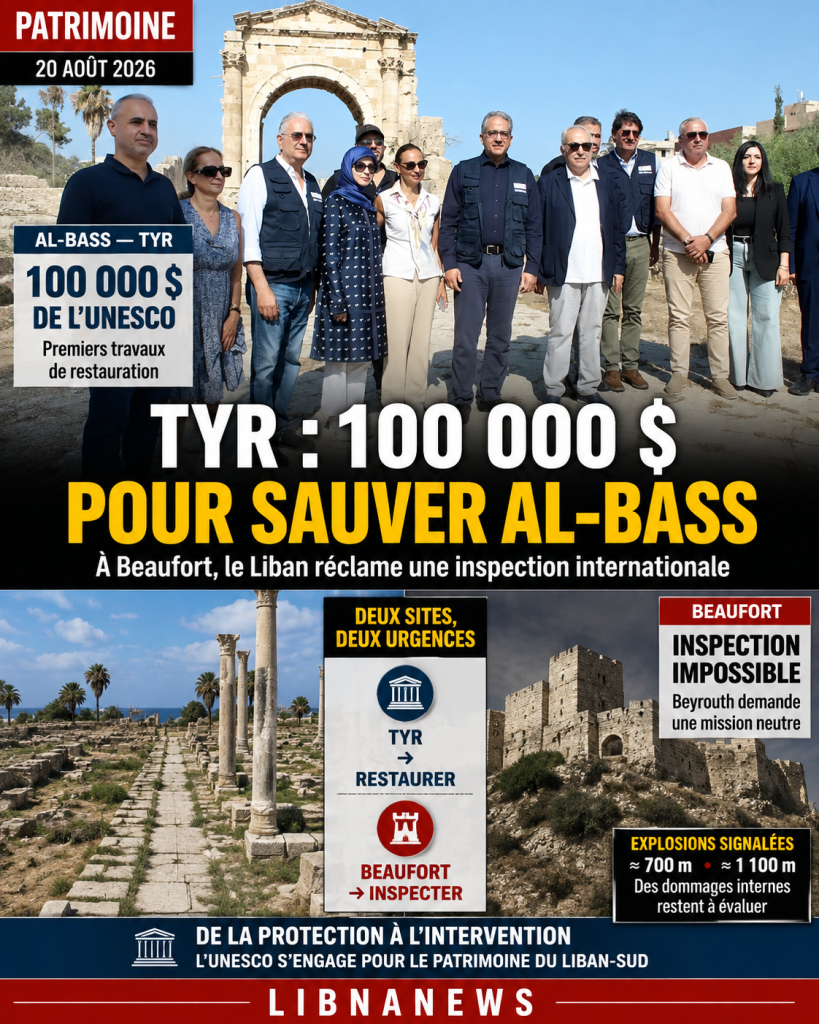
The Director General of Unesco, Khaled El-Enany, completed his visit to Lebanon on Thursday 20 August with an inspection of the archaeological site of Al-Bass, in Tyre, where the organization is expected to contribute $100,000 to start restoration work. But the visit highlighted the difficulties encountered in protecting the heritage of South Lebanon: at the Beaufort fortress, the Lebanese authorities said they could not inspect any internal damage while Israeli forces were present on the site. Beirut now asks Unesco to help send a neutral mission to establish the state of the monument.
Khaled El-Enany’s visit to Tyre gives a concrete translation to the international mobilization committed to Lebanese heritage. Accompanied by the Minister of Culture Ghassan Salamé, the Director-General of the United Nations Educational, Scientific and Cultural Organization visited the site of Al-Bass with officials of the General Directorate of Antiquities, local representatives and heritage specialists.
The delegation included MP Inaya Ezzeddine, the Permanent Representative of Lebanon to Unesco, Hind Darwish, the Director of the organization’s regional office in Lebanon, Paolo Fontani, and the Director General of Antiquities, Sarkis Khoury.
The visit follows several international decisions concerning Lebanese heritage exposed to the consequences of Israeli military operations. Tyre has been placed on the World Heritage List at risk, while the five forts of Jabal Amel have obtained their World Heritage designation. For Beirut, the next step is to move from international recognition to damage assessment and early backup operations.
$100,000 to start restoration of Al-Bass
Ghassan Salamé announced that Unesco had granted$100,000 to the city of Tyreto help launch the restoration process of the archaeological site.
This amount is a first aid. It does not correspond to the financing of a complete restoration of Al-Bass and the Ministry has not announced the overall cost of the necessary works. Unesco also regularly provides other forms of assistance related to the Lebanese archaeological heritage.
Khaled El-Enany’s presence was intended to enable him to see directly the state of the sites whose protection Lebanon is seeking. Ghassan Salamé explained that he wished this visit after the recent strengthening of the safeguard measures for several heritage estates, from South Lebanon to Baalbeck and Akkar.
The Al-Bass site belongs to the archaeological complex of Tyre, which has been a World Heritage Site since 1984. It includes a vast necropolis, a monumental arch and a Roman hippodrome. Its value therefore far exceeds the local heritage of the city.
However, the recent situation has led the Lebanese authorities to call for a strengthening of its international protection.
Tyre affected by Israeli strikes
Ghassan Salamé recalled that Tyre had been placed on the World Heritage List at risk after the strikes that affected its archaeological environment. According to the Minister, some attacks have resulted in the fall of architectural elements and damage.
The minister insisted on the excessive proximity of destruction to heritage areas. In his view, the visit of the Director General of Unesco was to show that the Lebanese request for classification at risk was based on a concrete threat.
MP Inaya Ezzeddine also presented Tyre as one of the examples of heritage sites affected by Israeli operations. She stressed that South Lebanon concentrated a cultural heritage of international importance and requested additional expertise to enable its conservation.
The threat is not only about the monuments directly hit. Proximity explosions can cause vibrations, structural displacements or already weakened elements to fall. In an ancient archaeological complex, these effects must be examined by specialists before determining the nature of the necessary interventions.
It is precisely this capacity of expertise that Lebanon is seeking today from Unesco.
In Beaufort, Lebanese authorities cannot inspect inside
The casebeaufort fortress, or Qalaat al-Shaqif, further illustrates the limitations of heritage protection during military operations.
Ghassan Salamé reported that, according to archaeologists of the Directorate General of Antiquities,no tunnel is inside the fortress. This clarification responds directly to questions raised by the destruction or explosion of tunnels reported in its environment.
According to the Minister, one of these tunnels is located at about700 metresof the fortress and another to about1,100 metres.
The problem is the effects that the explosions could have on the monument. The Lebanese authorities are currently using satellite imagery to attempt to assess the damage. From the outside, these would not show any apparent major destruction of the fortress.
However, this observation does not determine the state of internal structures.
Ghassan Salamé explained that Lebanese specialists could not visit the site while Israeli forces were in the fortress. They are therefore unable to examine any cracks, displacements or other damage caused by vibrations associated with nearby explosions.
The situation creates an unusual problem: Lebanon has a monument now recognized as a World Heritage Site, but its own specialists cannot carry out the necessary inspection to determine its real state.
Beirut calls for a neutral mission at Unesco
In the face of this impossibility of access, the Ministry of Culture asked Unesco to contribute to the sending of aneutral missionbeaufort.
The aim would be to allow experts able to access the site to determine what happened inside the fortress and to transmit their findings to the Lebanese authorities.
The request was made during Khaled El-Enany’s visit to Beirut. No calendar has yet been announced for such a mission and Unesco has not confirmed that a team could actually access the monument.
However, the proposal shows how an international organization can intervene when a State cannot directly inspect its own heritage because of a military situation.
An independent mission could document the state of the structures, investigate possible damage caused by explosions and establish the need for consolidation. However, it could only intervene if it had the necessary guarantees to access the site and work safely there.
International protection is reaching its most concrete limit. Classification can strengthen legal obligations and supervision. The expertise can be used to detect damage. But access to the monument remains determined by the military situation on the ground.
The five fortresses, the result of a diplomatic battle
Ghassan Salamé also detailed the efforts that led to the collective inclusion of the five Jabal Amel fortresses in the world heritage.
The Minister described the process as a « diplomatic battle » carried out jointly by the Ministry, the General Directorate of Antiquities, the Permanent Representation of Lebanon to Unesco and the heads of the organization.
Beirut chose to present the five fortresses as a whole in order to avoid having to conduct five separate procedures. The folderBeaufort, Tebnine, Chakra, Deir Kifa and Chamaa.
According to Ghassan Salamé, the candidacy had met oppositions. The Lebanese delegation continued its diplomatic efforts until it reached a consensus at the meeting in South Korea.
This inscription enhances the international visibility of the five monuments as their environment remains exposed to the consequences of the conflict. It also facilitates the mobilization of expertise and documentation of possible damage.
The Beaufort case, however, shows that registration does not address the issue of access.
The destroyed heritage is not limited to monuments
Inaya Ezzeddine took advantage of the visit to draw attention to another dimension of destruction:intangible heritagesouth Lebanon.
According to the MP, earth-moving operations, destruction, fires and environmental damage have also affected elements related to village history, traditions and social practices.
This question goes beyond the classical field of archaeological restoration. A fortress or column can be photographed, measured and consolidated. The intangible heritage depends more on the continuity of the communities that transmit it.
The prolonged displacement of a population can weaken local practices, traditions, agricultural or craft activities and the relationship of the inhabitants with their landscape.
The available information does not allow for a comprehensive inventory of these losses in the South. Inaya Ezzeddine specifically requested that specialized skills be mobilized to identify what can still be preserved or restored.
This dimension gives additional scope to reconstruction. Repairing housing and infrastructure allows residents to return. Preserving the tangible and intangible heritage aims to prevent the territory found from being cut off from its history.
Unesco moves from protection to intervention
Khaled El-Enany’s visit marks a new stage. In recent months, Lebanon has mainly sought additional international protection for its threatened sites. In Tyre, this approach is beginning to produce a first concrete funding with the $100,000 announced for Al-Bass.
Khaled El-Enany assured the present officials of Unesco’s support for the conservation of Lebanese monuments and those of Tyre in particular.
The next step will be more difficult. Rankings, expertise and first aids will have to be transformed into restoration programs that can function in the field.
In Tyre, the process can begin with the assessment of damage and the announced help. In Beaufort, the situation remains much more complex: before talking about restoration, you still have to know what happened inside the monument.
The Ministry of Culture therefore now awaits a response to its request for a neutral mission. As long as Lebanese specialists are unable to access the fortress, satellite images will allow them to observe the outside, but not to determine whether the explosions at 700 and 1,100 metres have weakened its internal structures.
The next step in protecting the heritage of the South thus depends less on a new classification than on a very concrete question: whether an independent team can enter Beaufort, examine its walls and establish for the first time the real extent of the damage.




