






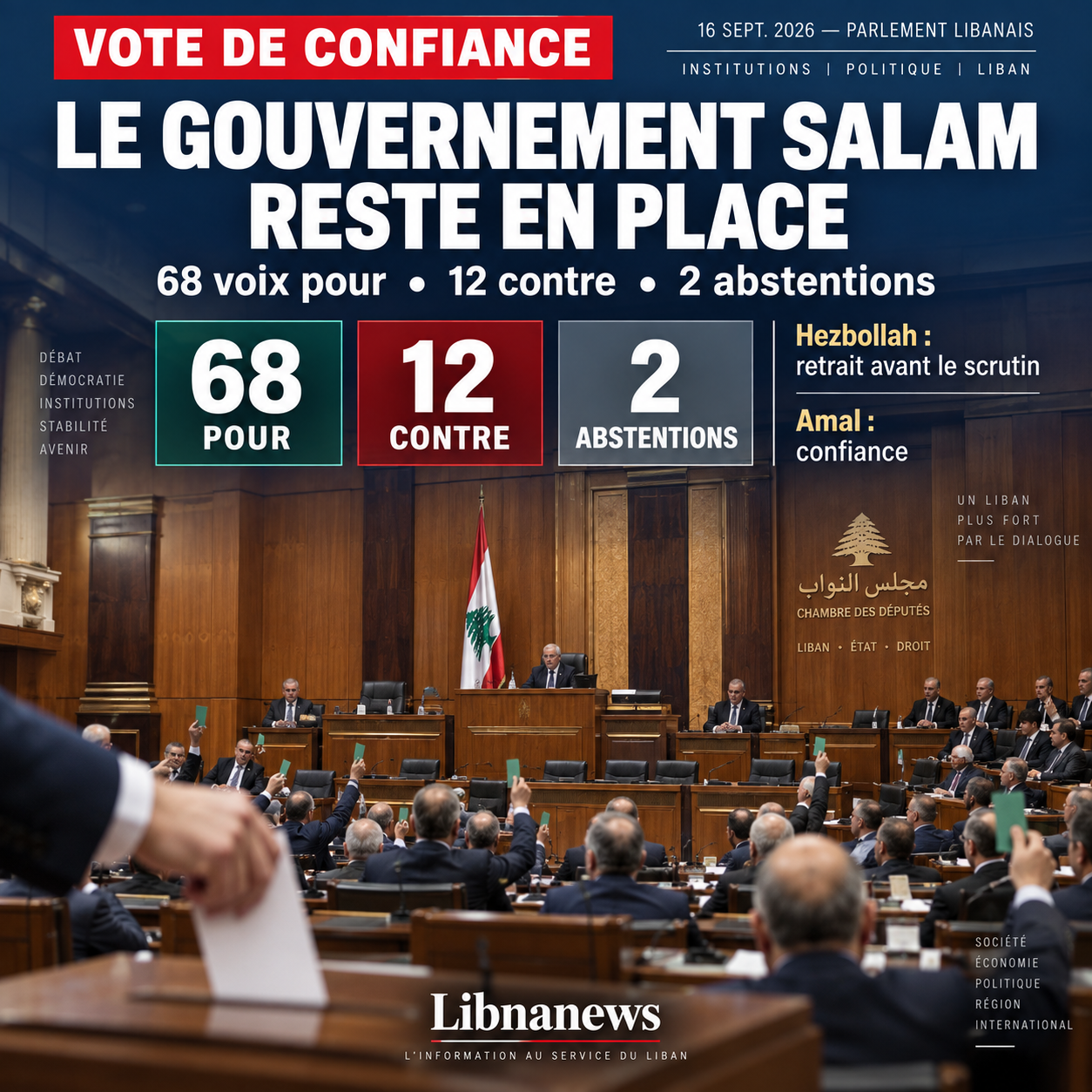
The Lebanese Parliament renewed on Wednesday 16 September 2026 its confidence in the government of Nawaf Salam by 68 votes to 12, with two abstentions, following two days of debate in Beirut. The vote kept the cabinet in office after a session marked by strong differences between parliamentary groups. Hezbollah deputies left the Chamber before the election. The free Patriotic Current voted against the government, while the deputies of the Amal movement gave it their confidence.
The result concludes a parliamentary sequence dedicated to government action. Despite the criticisms expressed during the discussions, the demand for confidence did not lead to a challenge from the firm. The Salam government retains the necessary support to continue its mandate.
Salam government gets 68 votes
The vote ended with 68 votes in favour of the Government, 12 against and two abstentions. He spoke on Wednesday evening after two days of discussions on the cabinet’s policy and action.
Voting was the main institutional issue of the session. Some of the MPs questioned several aspects of government action during the interventions. These criticisms eventually led to a request for a vote on confidence.
The majority of parliamentarians who participated in the election chose to maintain their support for the cabinet. The 12 votes against were therefore not enough to challenge the government led by Nawaf Salam.
The result allows the Council of Ministers to continue its action without a government crisis caused by this meeting. However, it does not put an end to the differences which have arisen in Parliament during the two days of discussions.
The vote reflects several distinct political attitudes. Some groups have explicitly renewed their confidence. Others refused. Two Members abstained, while Hezbollah chose to leave the Chamber before the election.
Hezbollah leaves the Chamber before the vote
Members of the Resistance Loyalty bloc, which represents Hezbollah in Parliament, did not participate in the final vote. They left the room shortly before confidence in the government was submitted to the MPs.
This withdrawal is one of the main political facts surrounding the election. Hezbollah did not add its votes to the 12 MPs who formally voted against the government. His parliamentary group chose not to take part in the count.
This distinction is important to read the result. The 68 votes in favour, 12 against and two abstentions correspond to the votes actually recorded. Hezbollah deputies, who left before the election, are not included in any of these three categories.
The start of the bloc came after two days of tense debates. Exchanges had revealed differences between several parliamentary groups and the government on its actions and directions.
The vote of confidence thus gave an institutional translation to part of these disagreements, without causing the cabinet to fall.
The free Patriotic Current votes against
The Free Patriotic Movement, for its part, participated in the election and chose not to renew its confidence in the Salam government.
His deputies were among the 12 parliamentarians who voted against the cabinet. Their position therefore constitutes an explicit refusal of confidence, contrary to Hezbollah’s choice to leave the meeting before the election.
The position of the Free Patriotic Current was particularly monitored since the two days of debate had given rise to numerous criticisms addressed to the executive. The move to the vote allowed the various groups to transform these positions into a formal parliamentary choice.
Despite this opposition, the balance of power resulting from the election remained in favour of the government. The 68 votes granted to the cabinet ensured that parliamentary confidence was maintained.
However, the vote does not mean the disappearance of criticism of the executive. It means, institutionally, that the House did not withdraw its confidence in the government.
Amal renews its trust in the firm
The deputies of the Amal movement took a different position than Hezbollah. They remained in the Chamber and voted in favour of renewed confidence in the government.
The Development and Liberation bloc contributed to the 68 votes obtained by Salam.
This difference between the two Shiite formations is a notable element of the electoral process. Hezbollah and Amal, allies on many political issues, did not adopt the same attitude at the time of the vote. The former left the session, while the latter took part in the election and supported the government.
This divergence concerns the parliamentary behaviour observed during the vote. It alone does not make it possible to draw more general conclusions on the relationship between the two formations.
The final result, however, remains clear: Amal gave his confidence to the government, while Hezbollah MPs did not participate in the vote.
A vote after two days of debate
The vote on 16 September came after two days of general political debate. This procedure allowed MPs to question the government, criticize its action and present their positions before the executive’s response.
The discussions were particularly lively. They dealt with a number of issues facing Lebanon, but their immediate institutional consequence was the voice of trust in the cabinet.
The result confirmed the government’s continued existence. Of the registered votes, 68 MPs chose confidence, against 12 who refused and two who abstained.
This sequence comes about a year and a half after the first vote of confidence obtained by the firm of Nawaf Salam. By February 2025, after the presentation of its ministerial declaration, the government had obtained the confidence of Parliament.
The September 2026 vote takes place in a different context. It was not a question of allowing the newly formed government to take office, but of determining, after a debate on its action, whether the House continued to give it its confidence.
The institutional response given on Wednesday is positive. The firm remains in place and can continue its work.
68 votes in favour to continue the mandate
The vote is above all a parliamentary confirmation for Nawaf Salam and his government. Despite two days of criticism and political confrontation, the cabinet did not lose the confidence of the House.
The figures summarize the balance of power observed at the time of the vote: 68 votes for confidence, 12 against and two abstentions, plus the withdrawal of Hezbollah deputies before the vote.
The session also clearly distinguished the positions of the main groups concerned. The Free Patriotic Current opposed the government. Amal supported it. Hezbollah did not vote.
For Nawaf Salam, the immediate consequence is government continuity. There was no change of cabinet as a result of the vote and the executive remained in charge of the current cases.
The renewal of confidence, however, does not resolve the differences that have gone through the two days of debate. The criticisms expressed in Parliament will continue to accompany the work of the cabinet, while the deputies will retain their constitutional means of executive control.
The vote on 16 September thus fixed the parliamentary power report at that moment: the Salam government maintained confidence with 68 votes, while political differences that had arisen during the debates remained open the day after the vote.