





Paris places the army at the centre of the new balance
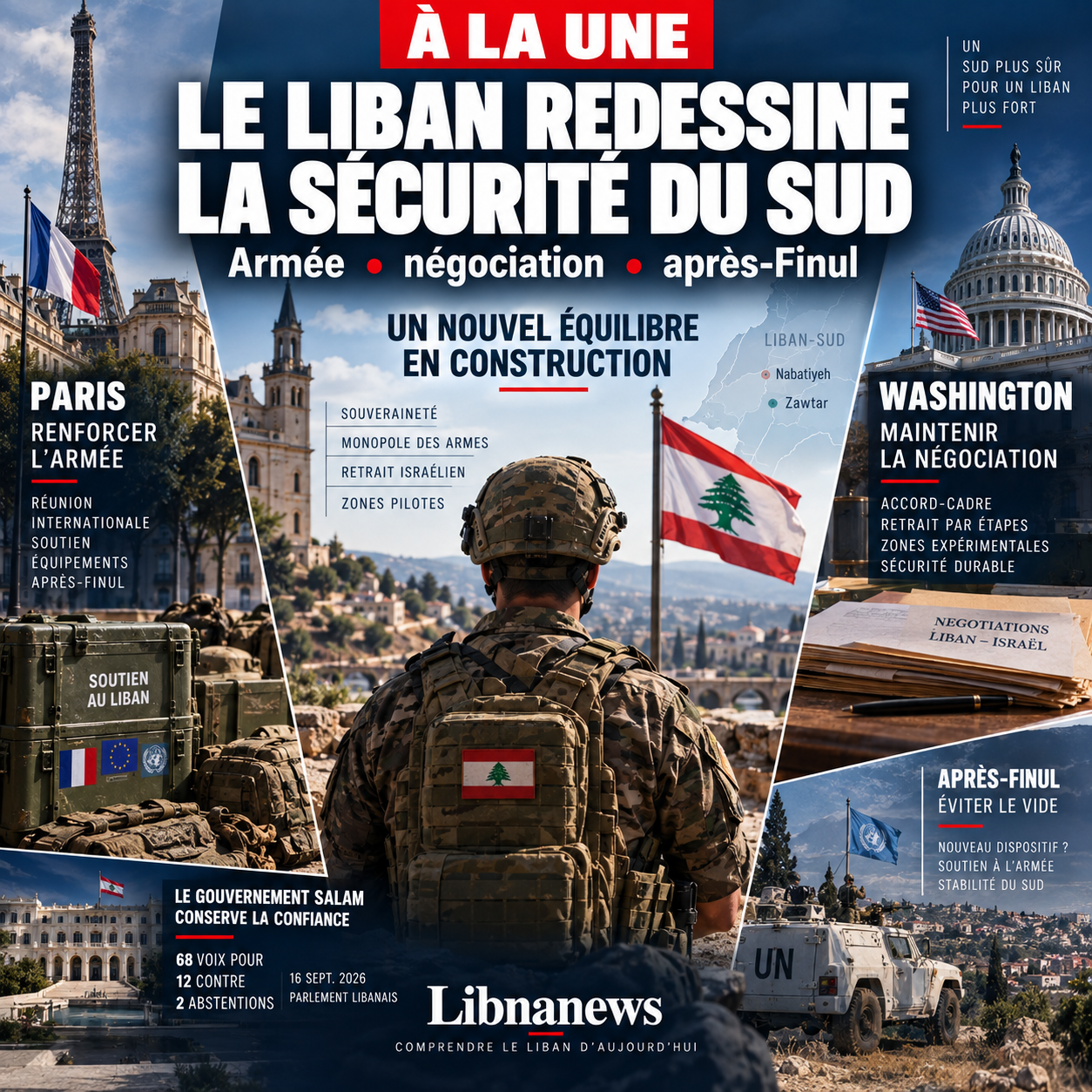
Support for the Lebanese army, negotiations with Israel and preparations for the post-Final period clearly dominate the Lebanese pages of 17 September 2026. These three files are no longer dealt with separately. They converge on the same question: how can the State resume a greater share of the security of the South Lebanon as Israeli operations continue, the Hezbollah weapons file remains open and the current international presence approaches its end? The Paris meeting gave this issue its international dimension. Nahar of 17 September 2026 stresses that the meeting is preparatory. It should not be confused with a conference to announce aid amounts immediately. Its objective is to determine precisely the needs of the army in the new phase. The Chief of Staff of the French Armed Forces, Fabien Mandon, explains daily that the sovereignty of the state and the exclusive use of force are at the heart of the reflection. However, it advocates a gradual approach based on trust and capacity-building in Lebanon. France seeks to link two processes: to give the army more resources and gradually increase the responsibilities it assumes on the ground. Al Joumhouriyat of 17 September 2026 also describes the meeting in Paris as a step to establish military and security needs before wider mobilization of partners. The newspaper insists on urgency. The army must maintain internal security, deploy to the South and prepare for a new situation once the Final has completed its mission. The question is therefore no longer just the number of vehicles, equipment or training. It concerns the political and security function that the international community wishes the army to perform.
Joseph Aoun places this institution at the centre of his own strategy. In his opinion, the army, the Internal Security Forces and other services guaranteed the protection of the country, its sovereignty and the security of citizens. The President called for sustainable international support. It also links the consolidation of institutions to the decision of the State to concentrate weapons in the hands of legal authority. Al Quds of 17 September 2026 reports the same line. Joseph Aoun states that Lebanon is determined to deal with Hezbollah’s weapons file, but that he intends to do so peacefully. He refuses to drag the country into an internal confrontation or civil war. The dialogue must accompany the decision of the State. This caution shows the difficulty of the equation. Foreign partners are asking for results on weapons and state authority. The Lebanese government seeks to achieve this objective without turning the army into a protagonist of an internal conflict. Ad Diyar of September 17, 2026 places this tension at the heart of the Paris meeting. The newspaper points out that the missions requested from the army are increasing while its resources remain limited. At the same time, Israel criticizes its actions and questions its ability to prevent the return of Hezbollah to certain areas. International support therefore becomes both an operational necessity and a political issue.
Washington maintains a negotiation without decisive results
The second major sequence of the day takes place in Washington. The Lebanese representative and the Israeli ambassador met for about two hours in the US State Department. Al Akhbar of 17 September 2026 states that discussions focused on the modalities for the implementation of the framework agreement, the Lebanese demand for the cessation of Israeli operations and withdrawal, and the possibility of extending the experimental zones. No major compromises were announced. The daily believes that the immediate function of the meeting is primarily to preserve the channel and prepare for the next negotiating session. The main disagreement concerns the order of commitments. Beirut first calls for visible Israeli measures. Israel links its own movements to progress on Hezbollah weapons and the extension of state authority. Washington is trying to prevent this divergence from failing the process. Al Quds of 17 September 2026 confirms that the meeting was completed without a joint communiqué or announcement of a new agreement. The negotiations therefore continue without having yet produced the general withdrawal or cessation of operations claimed by Beirut.
This lack of results feeds internal critics. Yet Nawaf Salam continues to defend diplomatic choice. Al Joumhouriyat of 17 September 2026 reports that the Prime Minister has acknowledged before the MPs that the desired objectives have not yet been achieved. Attacks have not stopped, Israeli withdrawal is not complete, prisoners remain detained and residents cannot yet return to their villages. However, he refused to conclude that negotiations should be abandoned. For Nawaf Salam, those who propose another way must explain how to stop the attacks, get the prisoners back and allow the inhabitants to return home at a lower cost to Lebanon. Al Akhbar of 17 September 2026 adopts a much more critical reading of the same process. The newspaper considers that the gradual expansion of the negotiated cases may increase the commitments requested in Lebanon without guaranteeing an equivalent Israeli counterpart. It notes that the process is no longer limited to a ceasefire or withdrawal. Weapons, the deployment of the army, future security arrangements and even the nature of the relationship with Israel are now emerging in the debate.
Joseph Aoun’s statements do indeed give wider scope to negotiations. On 17 September 2026 the President reported that he wanted a security agreement to end the state of hostility and deploy the army on the border. In his view, such an agreement could be a step towards a peace agreement at a later stage. He pointed out, however, that Lebanon could not proceed directly to the latter phase and that progress should be made step by step. Al Quds of 17 September 2026 resumes this orientation. The negotiations to stabilize the South thus begin to touch on a broader issue: the future form of relations between Lebanon and Israel. This development does not mean that a peace treaty is imminent. On the other hand, it shows that the Presidency is now considering a continuum from security to the end of the hostile state, and possibly to another form of relationship.
The end of the Finul opens a battle over its successor
The deadline of December 2026 is the third major feature of the political pages. Joseph Aoun asserts that Lebanon does not want a vacuum after the end of the Finul mission. It accepts the principle of another international presence, provided that it has a legal framework respecting State sovereignty and supports rather than replaces the army. Nahar of 17 September 2026 presents the post-Final as one of the central dossiers of the Paris meeting. France is already working with Italy on several hypotheses. Fabien Mandon confirms daily that reflections are under way, without presenting a fixed formula. Al Joumhouriyat of 17 September 2026 also insists on uncertainties. Paris wants to avoid a vacuum in the South, while the Israeli opposition to maintaining the current formula complicates the discussions. The newspaper reports that Lebanon continues to defend resolution 1701 and considers the international presence an important element of its implementation.
Al Akhbar of 17 September 2026 provides the most detailed information on this file. The daily newspaper reveals the existence of a three-year European civilian and military mission. A note was reportedly sent to Prime Minister Nawaf Salam on 5 August by the European Union delegation. European teams visited Lebanon in May and August to examine the needs of the army and the Internal Security Forces. The proposed mission would include training, surveillance, intelligence, maritime security, borders and port management. It would not be officially conceived as the replacement of Finul. Its appearance at a time when the international force was preparing for its departure nevertheless gave it special importance. At the same time, Al Akhbar reports that European representatives have conducted discreet contacts with several Lebanese actors, including Hezbollah. According to the newspaper’s sources, the party had set three lines: to maintain a reference to the UN and Resolution 1701, to the agreement of 27 November 2024 and to refuse to consider the latest framework agreement as the basis for the work of a new international force. The battle for the post-Finul period thus covered both the legal mandate and the composition of the future presence.
Parliament exposes fractures without overthrowing government
The government’s challenge session is the other major domestic event on September 17. It ended with a new vote of confidence in favour of Nawaf Salam’s cabinet. Nahar of 17 September 2026 reports that the government obtained 68 votes, against 12 votes of distrust and two abstentions. The role of the voices of the Development and Liberation bloc in this outcome is highlighted by Al Bina on 17 September 2026. The newspaper believes that the support of the deputies of Amal prevented the session from turning into a government crisis. Al Joumhouriyat of 17 September 2026 insists less on arithmetic than on the violence of exchanges. The daily describes a session dominated by clashes between Hezbollah deputies, Lebanese Forces, Kataëb, elected from the protest and representatives of the Free Patriotic Movement. The Speaker of the Parliament Nabih Berri intervened several times to interrupt the altercations.
The weapons file concentrates most of the confrontation. Members of Parliament favouring a faster application of the state monopoly ask the government what has actually been achieved since its decisions. Hezbollah MPs and their allies place greater emphasis on Israeli operations, unfinished withdrawal and the still limited results of negotiations. Al Sharq of 17 September 2026 reports the particularly tense exchanges between Michel Moawad, Ziad Hawat, Waddah Sadek and several Hezbollah deputies. Charges of responsibility for the arrival of the Israeli army in Lebanon and accusations of proximity to Israel provoke shouts and compel Nabih Berri to intervene. The government thus largely survives the vote, but the session exposes a deep divide on how to define sovereignty. For some Members, it starts with the arms monopoly. For others, it cannot be separated from the Israeli withdrawal and the end of military operations.
Israeli critics against the army complicate Lebanese strategy
The debate takes on an additional dimension with Israeli statements on the army. Al Akhbar of 17 September 2026 reports the statement of Chief of Staff Eyal Zamir that the Lebanese army does not appear ready or capable of disarming Hezbollah. Ad Diyar of 17 September 2026 refers, for his part, to reports of Israeli reports transmitted to Washington and criticizing the action of the military institution. The daily also mentions pressure in American circles against his command. This information is attributed by Ad Diyar to its sources and is of particular importance when Paris is trying to mobilize international support for the army.
The dispute arises in particular in the experimental areas of the South. Ad Diyar of 17 September 2026 devotes special attention to Zawtar al-Gharbiyah, visited by American Ambassador Michel Issa. The newspaper presents the locality as a laboratory for testing a model based on the presence of the army, the return of the inhabitants and the resumption of civilian life. Israeli objections were reported, however, to the indirect return of Hezbollah’s influence. The debate then goes beyond the issue of arms. It concerns the presence of social organizations linked to the party and that of inhabitants considered to be close to it. This divergence can become decisive if the experimental zone model is extended. Joseph Aoun wants precisely to move on to new areas in order to obtain successive withdrawals and allow the return of the inhabitants. If Israeli criteria expand beyond the military presence, each new step may become a negotiation itself.
Thus, the main titles of 17 September 2026 describe less a series of separate events than a single transformation in progress. Paris seeks to strengthen the army. Washington is trying to maintain negotiations with Israel. Beirut prepares the post-Final. Joseph Aoun defends the arms monopoly while refusing an internal confrontation. Parliament renews its confidence in the government without reducing political divides. Israel continues to condition its movements to results concerning Hezbollah. The central issue of the day is therefore the gradual construction of a new security system in South Lebanon, while the rules, timetable and guarantees of this system remain deeply disputed.
Local politics: government saves majority, but battle over state authority breaks parliament
A third confidence that masks a composite majority
The government of Nawaf Salam came out of two days of parliamentary debate with new confidence, but the meeting on 16 September mainly exposed the political fragility of the consensus that allowed it to govern. Nahar of 17 September 2026 reports that 68 MPs gave their confidence to the cabinet, against 12 who withdrew it and two abstentions. The vote was taken after a request by Gebran Bassil. Hezbollah deputies had left the Chamber before the election. The session thus ended with a numerical victory of the government, without removing the differences that had arisen during the debates.
Al Bina, 17 September 2026, insists on the role played by the Development and Liberation Unit of Nabih Berri. The daily reports that Amal’s votes enabled the government to reach 68 votes. He believed that, without them, the parliamentary base on which Nawaf Salam could rely would be significantly reduced. The newspaper therefore presents Amal as an actor capable of supporting the government while noting its reservations. This ambiguity appears at the time of the vote when MP Kabalan Kabalan gives his confidence « with regret ». The gesture sums up part of the political situation: the government is still needed in the eyes of several forces that are critical of its action.
Al Sharq of 17 September 2026 also highlights this contradiction. The newspaper reports that MPs severely criticized the government’s results before renewing their confidence. The meeting therefore did not oppose a homogeneous government bloc to a unified opposition. Rather, it revealed several levels of support. Some Members defend Nawaf Salam and its directions. Others want to maintain their government while contesting their decisions or their pace of action. A third category explicitly removes his confidence.
The free Patriotic Current was placed in this last camp. Gebran Bassil’s request for a vote enabled the balance of forces to be measured. But it did not cause the cabinet to fall. The Government thus has a sufficient majority to continue, without being able to consider the result as a general approval of its balance sheet.
This situation explains the tone of Nawaf Salam’s response. Nahar of 17 September 2026 reports that the Prime Minister thanked the MPs for the constructive criticism and acknowledged the very high expectations raised by the formation of his government. He acknowledged that the country’s difficulties and war had limited results. However, it refused to allow the recognition of these obstacles to become a permanent justification for inaction. The government seeks to maintain an intermediate line: to recognize shortcomings while defending the chosen political direction.
The debate on arms turns the session into a confrontation
The issue of the state monopoly on arms largely dominated the political confrontation. It provoked the most violent exchanges between the deputies of Hezbollah and those of the Lebanese Forces, Kataeb and some of the elected representatives who had emerged from the dispute. Nahar of 17 September 2026 describes a particularly high level of tension during Michel Moawad’s intervention. The interruptions soon led to an exchange between the MP and several Hezbollah representatives, before Ziad Hawat and Waddah Sadek in turn intervened.
Al Sharq of 17 September 2026 returns several of these exchanges. Michel Moawad defended a line based on sovereignty, peace and reform. It requested that the State authority be extended without further delay. Hezbollah MP Ihab Hamadeh responded by accusing his opponents of lying. Waddah Sadek told him that the charges could be turned against the party. Ziad Hawat then asked the Hezbollah deputies to stop, in his words, seeking to intimidate their opponents. Trade continued until the intervention of Nabih Berri.
The President of Parliament has tried several times to bring the Members to order. Al Joumhouriyat of 17 September 2026 reports his exasperation at insults, personal attacks and clashes. The session, which was supposed to allow for an assessment of government action, has on several occasions been transformed into a direct confrontation on responsibilities in the war and the Israeli presence in Lebanon.
MEPs favouring a faster application of the state monopoly sought to shift the debate on decisions towards enforcement. Ghassan Hasbani, quoted by Al Sharq on 17 September 2026, acknowledges that the government has taken important decisions on the arms monopoly. However, he asked what had actually been achieved. It refers to border and crossing control, the entry and storage of weapons and the reform of military justice. His argument was that sovereignty could no longer remain at the declaration stage.
Antoine Habchi adopts a close line. It links the success or failure of the government to the implementation of its decisions on weapons. Other Members are asking for a timetable and measurable results. Michel Douaihy claims to support the government when it makes decisions, but wants to judge it on their execution.
In front of them, several deputies of Hezbollah and Amal place the issue in the context of the Israeli presence and operations. Hani Kobeissi believes that the negotiations have not produced the expected results and calls on the State to review its attitude. Kassem Hashem calls for a sustainable national policy for the South and wonders about the meaning of sovereignty when Israeli operations continue.
The fracture is thus less about the abstract principle of the State than about the order of priorities. Part of Parliament considers that the strengthening of the state begins with a monopoly on arms. Another believes that it is impossible to deal with this issue without placing Israeli withdrawal and protection of the South at the same level.
Nawaf Salam defends diplomacy and refuses to return to the wars imposed
The Prime Minister devoted an important part of his response to the Israeli strategy. Al Joumhouriyat of 17 September 2026 reports that he defended the choice of diplomacy and negotiation. He rejected the idea that the framework agreement would have removed Lebanon from its national and international references. On the contrary, he claims that the process provides for a step-by-step Israeli withdrawal and the extension of the exclusive authority of the State.
Nawaf Salam acknowledges that the results are incomplete. Israeli operations continued. The withdrawal is not completed. Prisoners were still detained and some of the inhabitants of the South could not return to their villages. The Prime Minister refuses, however, that this situation should serve as an argument for abandoning negotiations.
His political argument is direct. Lebanon, according to him, was repeatedly drawn into wars he had not chosen, before the State was then entrusted with bearing the consequences. He called on those who rejected the diplomatic route to present a solution capable of stopping operations, recovering prisoners and allowing the return of the inhabitants at a lower cost to the country.
This position is one of the government’s political markers. Nawaf Salam wants to restore the state’s decision on war and peace while focusing on negotiations with Israel. It rejects both the maintenance of a situation where non-State actors alone determine the entry into war and an internal confrontation designed to resolve the arms issue immediately.
Joseph Aoun defends a similar approach. On 17 September 2026 the President reported that the strengthening of the army and security institutions was the condition for the restoration of the State’s decision. He claims that the arms monopoly is a fixed orientation, but insists on the need to avoid confrontation with Hezbollah. The issue must move forward through dialogue.
This convergence between Baabda and the Great Serail is one of the most important elements of local politics. The President and the Prime Minister share the objective of a state with a military decision alone. However, they seek to achieve it progressively and without internal conflict. Parliamentary criticisms focus specifically on the speed and effectiveness of this method.
Electricity, administration and living standards bring the government back to its internal balance sheet
The violence of the arms debate did not completely erase the daily dossiers. Several Members reminded the government that its credibility is also played on electricity, public finances, services and living standards.
Al Sharq of 17 September 2026 reports the intervention of Sajiih Attieh, who criticizes the low ministerial presence during part of the session and places electricity among the main criteria for judging the cabinet. Paula Yacoubian also reviews the management of the sector and the suspicions related to fuel oil. She asked whether the interests around the fuel and generators continued to prevent a lasting solution.
Adib Abdel Massih calls for a short-term plan allowing citizens to quickly see an improvement in power supply. Simon Abi Ramia expands responsibility. He refuses to attribute the entire collapse to the current government and believes that the institutions, Parliament and political forces share responsibility for the situation.
The budgetary question also arises. Farid Boustany calls for financial programming beyond one year and public sector restructuring. Alain Aoun insists on the need to attract investment and not just wait for solutions from abroad.
Al Joumhouriyat of 17 September 2026 describes an always difficult economic environment, marked by the deterioration of living conditions, poverty, the cost of electricity and concerns about the financing of possible wage increases in the public sector. The newspaper refers to experts’ reserves in the face of an increase in expenditure financed by monetary creation, but also the social risk of financing by new taxes.
The parliamentary session therefore shows that the government is subject to two forms of pressure. The first concerns strategic decisions on weapons, Israel and sovereignty. The second concerns its ability to produce concrete results in everyday life.
The South also becomes a test of the relationship between the state and citizens
Several interventions place the population of the South at the centre of the debate. MP Nasser Jaber, quoted by Al Sharq on September 17, 2026, claims that the inhabitants of Nabatiyah need not only statements of solidarity, but a government present when they are exposed to danger. Kassem Hashem calls for an emergency policy and a sustainable strategy to keep people on their land.
This issue goes beyond material reconstruction. It affects the capacity of the State to protect populations, provide services and make possible economic activity in the affected areas.
The discussions on experimental areas illustrate this development. The return of the inhabitants must accompany the deployment of the army. Reconstruction and development projects thus become a component of security policy. The government will have to demonstrate that the extension of state authority really improves living conditions.
Local policy is thus directly linked to the outcome of the external negotiations. An Israeli withdrawal would allow the army to progress and the inhabitants to return. A lack of results weakens Nawaf Salam’s strategy and gives more arguments to forces who consider negotiations insufficient.
The relationship with Syria returns through borders and bilateral agreements
Another internal issue appears more discreetly in the newspapers of 17 September 2026: the redefinition of relations with Syria. Al Sharq reports on the meeting between former President Michel Sleiman and Syrian business officer Iyad al-Hazzaa. Michel Sleiman calls for the development of relations between the two countries with respect for their sovereignty. In particular, it calls for cooperation between security institutions to prevent the trafficking of arms and ammunition across the border.
He also called for the establishment of the international boundary and for a review of the agreements concluded between Beirut and Damascus when they did not guarantee a balance between the interests of the two countries. This position occurs in a context where the new Syrian leadership seeks to rebuild its relations with Lebanon after the war years.
A further dimension of this normalization is highlighted by Al Liwa on 17 September 2026 through a Lebanese-Syrian trade union meeting devoted in particular to transport. Participants considered the linkages between the two countries as strategic and welcomed recent agreements between Governments. Border security, transport and economic traffic issues are therefore beginning to form a new bilateral agenda.
These developments remain less present than the debate on arms or the vote of confidence. However, they show that local policy is no longer limited to managing the internal crisis. The new regional balance also obliges the Lebanese authorities and political forces to redefine the relationship with Damascus, particularly on the respective borders and competences of the two States.
At the end of the parliamentary session, Nawaf Salam therefore retained his government and a numerical majority. But the vote does not resolve any of the great tensions that arose during the debates. The cabinet must simultaneously demonstrate the effectiveness of negotiations with Israel, advance on the arms monopoly without causing confrontation, meet the needs of the South and improve public services that remain at the heart of discontent. The confidence in Parliament gives him time. It does not constitute a white-seing, as the critics who came to the ranks who finally chose to keep it in office showed.
Citation and speech by political figures: sovereignty, negotiation and weapons at the heart of speeches
Joseph Aoun links the return of the state to the strengthening of the army
The statements of President Joseph Aoun occupy a central place in the press of 17 September 2026. They draw up a doctrine based on three priorities: strengthening the army, restoring the state monopoly on weapons and continuing negotiations with Israel without causing internal confrontation. This line is on display in Paris, where the Head of State participates in the preparations for the international conference on the Army and the Internal Security Forces.
Al Binas of 17 September 2026 reports that Joseph Aoun regards the army, the Internal Security Forces and other security services as « the only guarantee » to protect the country, its sovereignty and its citizens. It presents strengthening their human and logistical capabilities as a national priority. His trip to Paris is directly linked to this objective. The President wants to obtain international support that is sustainable enough to enable state institutions to assume greater responsibilities.
The point goes beyond the question of equipment. Joseph Aoun explicitly links the strengthening of the army to the arms monopoly. According to Al Bina It thus links the building of a strong State with its capacity to protect its citizens and contribute to regional stability.
Al Akhbar of 17 September 2026 reports a formulation that clarifies this doctrine. Joseph Aoun states that « the principle of the restoration of the state and the restoration of the decision of war and peace rests on the strengthening of state institutions », in particular military and security institutions. He doesn’t want temporary help. It calls for a long-term programme.
However, the President sets an important limit on the application of the arms monopoly. He refuses to allow it to lead to an internal confrontation. Al Quds of 17 September 2026 reports that he is determined to resolve the Hezbollah case « in a peaceful manner ». The country must not be led to civil strife or war. The dialogue should make it possible to implement a decision which the Presidency considers to be already taken.
This distinction is politically essential. Joseph Aoun does not question the objective of the state monopoly. On the other hand, he refuses a method that would immediately transform the army into a military opponent of Hezbollah. The strengthening of the institution must therefore precede or accompany a negotiated evolution of internal equilibrium.
From Israeli withdrawal to a security agreement
Joseph Aoun also developed his vision of negotiations with Israel. It no longer limits them to the implementation of a ceasefire. On 17 September 2026 the President reported that he wanted to reach a security agreement that would end the state of hostility and allow the army to deploy on the border.
He added that such an agreement could later be a step towards a peace agreement. However, it avoids any immediate transition from confrontation to formal peace. Its formula is that of a step by step progression.
Ad Diyar of 17 September 2026 places this orientation in a more concrete sequence. Joseph Aoun first wants the Israeli withdrawal from the areas concerned. The army must then deploy. Residents must be able to return to their communities and the question of detainees must be resolved. The negotiation is thus presented as a means of achieving territorial and human results before any broader evolution of the relationship with Israel.
The President also defends experimental areas. He hoped that the mechanism would be extended to new sectors in the South. This method should allow local progress when the general regulation remains blocked. An Israeli withdrawal to a specific area would be followed by the deployment of the army and the return of the inhabitants.
On the post-Finul side, Joseph Aoun took a pragmatic position. Al Quds of 17 September 2026 reports that he refused a vacuum after December 2026. Lebanon is open to another international force, but it must have a legal framework. For the President, « the fundamental principle in the legal framework is state sovereignty ». He adds that the mission of such a force must be to help the army and strengthen the state, not to replace it.
These different statements form the same line. The Presidency wants to gradually replace the State with competing military arrangements, but it intends to secure Israeli withdrawal, international support for the army and a foreign presence that remains at the service of Lebanese institutions.
Nawaf Salam defends the negotiation before its critics
Nawaf Salam’s speech before Parliament complements that of the President. The Prime Minister focuses more on justifying diplomatic choice in the face of MPs’ criticism.
Al Joumhouriyat of 17 September 2026 reports that Nawaf Salam acknowledges the shortcomings of the results achieved. Israeli attacks continued. The withdrawal is not complete. Lebanese detainees remain in Israel and residents still cannot return to their villages. The Head of Government, therefore, does not seek to portray the negotiation as a successful outcome.
However, he refused to conclude that the process should be abandoned. He recalls that Lebanon was drawn « over and again into wars that we have not chosen », before the State was charged with bearing the consequences. This sentence is one of its most clear political positions. It directly addresses the issue of the decision on war and peace.
Nawaf Salam then asked opponents of his strategy to propose an alternative solution. According to Al Jumhouriyat of 17 September 2026, he claims that if someone has another way to stop the attacks, recover the prisoners and bring the inhabitants back to their villages at a lower cost for Lebanon, the government is ready to follow him.
The Prime Minister also defends the framework agreement. He claims that he is planning a phased Israeli withdrawal and the restoration of the exclusive sovereignty of the Lebanese State. He therefore rejected the accusations that the government had abandoned Lebanon’s traditional references.
His argument is both institutional and diplomatic. The State must become again the one negotiating, the one deciding and the one bearing responsibility for the commitments. Nawaf Salam thus seeks to emerge from a logic in which military decisions taken outside institutions then produce consequences that the government must manage.
At the same time, the Prime Minister recognizes internal dissatisfaction. Al Joumhouriyat reports that the citizen who claims the presence of the State is right, as is the person who complains about his absence. He admits that expectations for his government were important and that reality, aggravated by war, limited his ability to act.
Nabih Berri recalls the limits of parliamentary confrontation
Nabih Berri appears less in a great speech than in his repeated speeches during the parliamentary sitting. Faced with the proliferation of insults and accusations, the Speaker of the House tries to contain a confrontation that gradually goes beyond the debate on government action.
Al Joumhouriyat of 17 September 2026 reports his exclamation » ya aib al-choum », which can be rendered in French by a severe condemnation of the spectacle given by the deputies. She intervened as the exchanges between Hezbollah representatives and MPs opposed to the party became particularly aggressive.
The role of Nabih Berri is also political at the time of the vote of confidence. Its Development and Liberation bloc votes in favour of the government, even though some of its members have their reservations. Al Binas of 17 September 2026 points out that the voices of the bloc played a decisive role in the result of 68 votes.
This attitude allows Nabih Berri to maintain an intermediate position. His camp is critical of several government directions, including negotiations and treatment of the South, but he does not want to provoke a government crisis. Institutional continuity is therefore preserved despite political disagreement.
Gebran Bassil turns critics into a vote of confidence
The leader of the Free Patriotic Movement, Gebran Bassil, chose to translate the political opposition into parliamentary procedure. At the end of the meeting, he requested a vote on confidence.
Nahar of 17 September 2026 reports that this initiative led to the result of 68 votes in favour of the government, 12 against and two abstentions. The free Patriotic Current is thus found among the forces that withdraw their trust in the cabinet.
Gebran Bassil’s approach comes after two days of criticism of government action, negotiations, public services and the implementation of decisions. It helps clarify the position of its block. The government remains in place, but the Courant refuses to give it new political legitimacy.
The strategy also presents an arithmetical limit. The vote shows that the opposition to the cabinet is not large enough to overthrow it. However, it reveals that its majority depends on actors who do not necessarily share all its orientations.
Hezbollah MPs tighten up on sovereignty and negotiations
The interventions of Hezbollah MPs are among the most virulent of the session. They seek to turn against their opponents the accusation of responsibility in weakening sovereignty.
Al Sharq of 17 September 2026 reports the exchanges between Ihab Hamadeh, Michel Moawad, Waddah Sadek and Ziad Hawaii. Ihab Hamadeh accuses his opponents of lying and reproaches them for their speech about the events of the South. The answers are just as violent. MPs against Hezbollah accuse the party of having helped create conditions for Israeli intervention.
Hussein Hajj Hassan also intervenes on the framework agreement. According to Al Sharq of 17 September 2026, he finds his results invalid and criticises the fact that the Lebanese were invited to wait for its effects. The MP thus challenged the government’s main defence: the idea that negotiations should be judged over time.
This line joins that of other elected members close to the party. Hani Kobeissi believes that the negotiations have not worked and calls for a different position from the state. Kassem Hashem insists on Israeli attacks and asks how to talk about sovereignty when they continue.
The speech of Hezbollah and its allies is therefore not limited to defending the party’s weapons. It seeks to impose another hierarchy: before judging the relationship between the State and resistance, it is necessary to measure the capacity of the State to end the Israeli occupation and operations.
Opponents of Hezbollah now demand measurable results
In the face of this speech, several Members stress the implementation of decisions already taken.
Ghassan Hasbani, quoted by Al Sharq on 17 September 2026, believes that the government has made historic decisions on the arms monopoly. However, it refuses to consider the advertisement sufficient. He asked what had been achieved with regard to border control, passages, the entry of weapons and their storage.
Antoine Habchi also links the government’s judgment to the enforcement of its decisions. Michel Moawad defends a line based on sovereignty, peace and reform. Michel Douaihy claims to support the government when it decides, but wants to judge him when he does not execute.
These interventions show a shift in the debate. The question is no longer just whether the government affirms the principle of arms monopoly. He did. His most demanding supporters now want to know the timing and results.
It is precisely there that the speeches of Joseph Aoun and Nawaf Salam face their main political difficulty. Both claim that direction is fixed. Both also refuse an internal confrontation. They must therefore demonstrate that a gradual method can produce concrete changes.
The speeches of 17 September 2026 draw three competing speeches. The Presidency and the government defend a gradual restoration of state authority through the army, diplomacy and dialogue. Hezbollah and its allies place Israeli withdrawal and the end of attacks at the forefront of the conditions of sovereignty. The party’s opponents are calling for a faster and measurable application of the arms monopoly. The Lebanese political debate is now structured around these three readings, with the army, negotiations and the timetable for implementation as the main points of confrontation.
Diplomacy: Paris, Washington and Arab capitals re-design Lebanon’s margin of manoeuvre
Paris transforms military support into an international diplomatic record
Lebanese diplomacy focused on 17 September 2026 in Paris, where Joseph Aoun participated in the preparatory meeting on support for the army and the Internal Security Forces. Behind its military object, the meeting brings together several diplomatic issues: the future of South Lebanon, the end of the Finul mission, negotiations with Israel, the arms monopoly and the State’s ability to gradually regain control of its territory.
Al Joumhouriyat of 17 September 2026 reports that France gathers around the table an important set of Lebanese partners. Representatives of Germany, Italy, the United Kingdom and Ireland were announced, as well as a delegation from the European Union. The Arab component includes Saudi Arabia, Egypt, Kuwait, Qatar and the United Arab Emirates. The United States also participated in the meeting, along with other international partners. The United Nations is represented while the future of its presence in the South is one of the topics for discussion.
France wants first to establish the needs of the army. Nahar of 17 September 2026 stresses that the meeting is not yet a donor conference. The Chief of Staff of the French Armed Forces, Fabien Mandon, explains that it is about identifying the necessary capabilities in a profoundly changed environment. The announced end of the Finul obliges us to reflect now on the division of responsibilities in the South.
This approach gives Paris a special diplomatic function. France is not just looking for funding. It attempts to bring together countries that do not necessarily have the same reading of the Lebanese situation. The United States places strong emphasis on Hezbollah weapons. European countries are seeking to avoid a vacuum in the South. The Arab States want to consolidate the Lebanese state. Beirut calls for the strengthening of the army to accompany concrete Israeli measures.
Joseph Aoun wrote his presence in this logic. Al Bina He states that the historical relationship between the two countries is of particular importance in the present period. However, the President is not asking for limited emergency assistance. It wants a sustainable programme enabling the military and security services to assume progressively more responsibility.
The meeting thus became a diplomatic test. Lebanon seeks to transform broad political support for its army into concrete commitments, while avoiding conditions that cannot be met immediately.
Joseph Aoun and Emmanuel Macron facing the post-Finul
The future of the international presence in South Lebanon is one of the most sensitive issues in Franco-Lebanese trade. Joseph Aoun claims that Beirut does not want a vacuum after the end of the Finul in December 2026. It declares itself open to another force, provided that it has a legal framework and respects Lebanese sovereignty.
Al Binas of 17 September 2026 reports that the President must discuss with Emmanuel Macron the general situation in Lebanon, but especially in the South, Israeli operations, the post-Final period and the negotiating process. The Franco-Lebanese meeting cannot therefore be separated from the search for a new security architecture.
Nahar of 17 September 2026 brings an additional element. Fabien Mandon confirms that France is working with Italy on several tracks for the post-Final period. It does not present a definitive solution and stresses the need to involve the parties concerned.
Paris thus tries to preserve a European role in the South while recognizing that the current formula is coming to an end. This position meets Lebanese concerns. For Beirut, the disappearance of any international presence would leave the army facing a considerably increased burden while Israeli withdrawal remains incomplete.
Al Akhbar of 17 September 2026 also reveals the existence of a proposal for a three-year European civilian and military mission. The project aims to strengthen the army, the Internal Security Forces, surveillance, intelligence, borders and ports. The proposal does not formally replace the Finul. However, it shows that Europeans are already preparing a presence adapted to the new phase.
French diplomacy is therefore at the junction of several scenarios. It defends the maintenance of international support. She works with Rome. It supports an upsurge in the army. It also participates in the European reflection on strengthening Lebanese institutions.
The axis with Amman consolidates around the army
The presence of King Abdullah II in Paris gives the meeting a special Arab dimension. Jordanian involvement does not start with the meeting of 17 September. Support for the army is part of the « Aqaba process », launched in Jordan several years earlier.
Al Joumhouriyat of 17 September 2026 reports that Joseph Aoun met the Jordanian sovereign as soon as he arrived in Paris. The Lebanese President thanked him for Amman’s support to the army and for his efforts in favour of the international meeting.
The bilateral dimension of the interview is also highlighted by Al Bina on 17 September 2026. Both leaders review the Lebanese-Jordanian relations after the signing of 21 agreements and memoranda of understanding at the meeting of the High Joint Commission in January 2026. Joseph Aoun called for these agreements to be effectively implemented.
The dialogue with Amman is therefore not limited to the military component. It includes cooperation between the two States. But security is now the driving force behind the relationship. Jordan has an important military and security experience and maintains close relations with several Western and Arab partners committed to supporting Lebanon.
The simultaneous presence of Joseph Aoun, Emmanuel Macron and Abdullah II makes it possible to link the European and Arab dimensions of support to the Lebanese state.
Washington remains indispensable, but differences persist
American diplomacy is equally central. Washington is both a partner of the army, a mediator between Lebanon and Israel, and a major player in the reflection on the future mechanism of the South.
The meeting between the Lebanese representative and the Israeli ambassador in Washington shows the importance of this channel. Al Akhbar of 17 September 2026 reports that the discussions concern the application of the framework agreement, the Israeli withdrawal, the cessation of operations and the extension of the experimental zones. No decisive results are announced.
The diplomatic difficulty lies in the order of measures. Beirut wants Israeli actions. Israel demands more results on Hezbollah weapons. The United States seeks to maintain negotiations despite this disagreement.
Al Joumhouriyat of 17 September 2026 describes in parallel a divergence between Washington and Paris on support for the army. The Americans would ask for concrete progress on the arms monopoly issue before releasing some aid. The newspaper refers to an envelope of $150 million. Paris defends a more simultaneous approach: strengthening the army while demanding progress on the ground.
This difference is important for Lebanese diplomacy. Beirut must convince Washington that lack of capacity is itself an obstacle to the implementation of State decisions. The Lebanese authorities are therefore seeking to avoid an equation in which aid would only be paid after the fulfilment of specific missions requiring such aid.
The role of American Ambassador Michel Issa is part of this sequence. Ad Diyar of 17 September 2026 describes a very active diplomat who goes directly to the South and follows the experimental areas. Its travel must allow Washington to have a direct reading of progress and obstacles.
Lebanon seeks to preserve its relationship with Riyadh in a tense regional context
Saudi Arabia also occupies an important place in the Lebanese diplomacy of the day. His participation in the Paris process comes at a time when the attempt to attack Mecca provokes a large wave of condemnations.
The main Lebanese authorities responded rapidly. Al Sharq Al Awsat of 17 September 2026 reports that Nawaf Salam condemns the attempted attack and affirms Lebanon’s total solidarity with the kingdom, its leadership and its people. The Department of Foreign Affairs takes a similar position.
Joseph Aoun also condemned the attempt. Al Sharq of 17 September 2026 reports that he considers the attack on holy places as an attack beyond Saudi sovereignty and affecting a central place for Muslims. It calls for a common Arab and Islamic position.
This institutional convergence is diplomatically significant. Lebanon has been seeking for several years to restore more stable relations with the Gulf countries, particularly with Riyadh. Saudi support for the Lebanese army, reconstruction and economy remains potentially important.
A further element concerning this relationship is Al Liwas of 17 September 2026. The daily presents Michel Issa’s recent visit to the vice-president of the Shiite Islamic Higher Council, Ali al-Khatib, as an American approach inspired by an initiative previously led by Saudi Ambassador Walid Bukhari. The newspaper sees these contacts as an attempt to maintain a dialogue with the Lebanese Shia environment in a period dominated by the issue of arms.
This reading highlights a more discreet aspect of regional diplomacy. Riyadh and Washington are not only interested in official institutions. They also seek to maintain channels with social and religious components that can play a role in internal stabilization.
Beirut and Damascus seek the basis for a more balanced relationship
The relationship with Syria appears less spectacular, but it is another diplomatic project. Al Sharq of 17 September 2026 reports the meeting of former President Michel Sleiman with the Syrian Chargé d’affaires Iyad al-Hazzaa.
Michel Sleiman called for relations between the two countries to be developed on the basis of mutual interest and respect for sovereignty. It insists on coordination between security institutions to prevent arms and ammunition trafficking across the border. He also called for the beginning of the delimitation of the international border.
The question of the old bilateral agreements also comes up. Michel Sleiman considers it necessary to review the texts concluded in the past in order to maintain a balance between the interests of the two States.
This position comes as the new Syrian leadership attempts to rebuild its relations with Lebanon. The years of war have profoundly altered the relationship between Beirut and Damascus. Border issues, trafficking, detainees, displacement and economic agreements are now all issues to be dealt with in a more traditional inter-State framework.
The border becomes particularly important as Lebanon engages in the arms monopoly debate. Controlling arms flows also means strengthening cooperation with Damascus.
Lebanese diplomacy attempts to convert the regional context into state support
The multiplication of diplomatic channels finally reveals the same priority. Beirut seeks to place the State at the centre of its external relations.
With Paris, the aim is to strengthen the army and prepare the post-Final. With Amman, consolidate Arab support to the institutions. With Washington, to secure progress in negotiations with Israel while preserving military aid. With Riyadh, to consolidate a relationship that has become strategic again. With Damascus, rebuild a report based on borders, security and bilateral interests.
However, this diplomacy remains subject to the regional force report. The war with Iran, the tensions in the straits, the crisis in Yemen and Israeli operations in Lebanon reduce Beirut’s room for manoeuvre.
The choice of Joseph Aoun and Nawaf Salam is precisely to multiply the support so as not to allow Lebanon to depend on a single channel. Paris provides European coverage. Washington owns some of the levers on Israel. Arab States can provide political, financial and military assistance. The United Nations remains important for the international legitimacy of the South.
The Lebanese diplomacy of 17 September 2026 thus appears less as a succession of protocol meetings than as the search for a new external architecture. Its aim is to bring international partners together on the basis of a principle: to strengthen the State and its army while obtaining the Israeli measures necessary to ensure that this rise in power can be translated into reality on the ground.
International policy: war against Iran, battle of straits and extension of the conflict to the Red Sea
Washington seeks a way out as the war enters its seventh month
The war against Iran and its extension to the major sea routes largely dominate international politics in the newspapers of 17 September 2026. The conflict is no longer limited to strikes between the United States, Israel and Iran. It now affects the Straits of Ormuz, Yemen, Bab al-Mandeb, Saudi Arabia and global supply chains. Several publications describe a war that is changing in nature. Military operations remain intense, but diplomacy simultaneously seeks a formula to avoid further expansion.
Al Sharq Al Awsat of 17 September 2026 reports the statements of US Vice-President J.D. Vance, who announces a « completely different phase » of the conflict within two months. It does not specify what this means at the military or diplomatic level. However, he confirmed Donald Trump’s earlier statement that the war should undergo a major change after the Congress renewal elections scheduled for November.
This American temporality attracts attention. The White House suggests that a change to the strategy is being considered, without indicating whether it will be a reduction in operations, a new military phase or a stronger return to negotiation. J.D. Vance recalls that Donald Trump, as Commander-in-Chief, decides when the conflicts begin and end. It also recognizes the American population’s impatience with the duration of the war.
This statement was reiterated by Al Liwa, on 17 September 2026, and stressed that the Vice-President, too, refused to define precisely the new phase. This lack of detail maintains several readings. Washington can seek to prepare opinion for a change of strategy. It can also use this deadline as a means of pressure on Tehran.
At the same time, the war produced an internal American debate. Al Quds of 17 September 2026 reports that the House of Representatives adopted a text on the powers of war aimed at ending the American attacks against Iran and calling for the withdrawal of American military forces from the region. The text obtained 220 votes against 204, with the support of seven Republican elected representatives.
This decision reveals a political challenge that goes beyond the traditional opposition between the two parties. The presence of Republicans among the supporters of the text shows that part of the presidential camp also questions the duration and extent of military engagement.
The Iranian conflict therefore faces two timetables. The former is military and depends on the situation on the ground. The second is political and leads directly to the November American elections.
The Strait of Ormuz becomes Beijing’s priority
China is also seeking to place diplomacy at the centre of the case. Its main immediate objective is the reopening of the Strait of Ormuz and the protection of energy flows.
Al Bina The Chinese official calls on Tehran and Washington to exercise restraint and return to the Islamabad memorandum. It calls on the parties to resume substantial consultations on this basis.
Wang Yi also calls for rapid measures to reopen the Strait of Ormuz. China directly links this demand to the stability of energy transport and global supply chains.
Al Sharq Al Awsat of 17 September 2026 insists on this dimension. Beijing does not want the regional crisis to spread further to Yemen and the Red Sea. Chinese diplomacy considers that the situation reveals the shortcomings of the current security architecture in the Middle East and calls for its strengthening.
Beijing’s position is based on a clear economic interest. Ormuz is a major transition for energy exports. Any lasting disruption increases transport costs, puts pressure on prices and threatens supplies to large importing economies.
But China also seeks to maintain a specific diplomatic position. It maintains relations with Tehran while calling on Iran to contribute to the reopening of the Strait. Wang Yi reaffirms the stability of Chinese policy towards Iran, but stresses the need to return to a negotiated path.
Abbas Araghchi replied that Iran remained ready to defend its sovereignty and territory, while welcoming diplomatic solutions guaranteeing the rights of the Iranian nation. The Iranian message therefore combines military firmness and conditional availability for negotiation.
The meeting took place before an appointment announced between Xi Jinping and Donald Trump in Washington. This calendar reinforces the possibility that Beijing will try to turn its dialogue with Tehran into a lever in its discussions with the United States.
US stocks themselves become a strategic topic
Another effect of the war was the pressure on American ammunition stockpiles. The newspaper reports the findings of a report by the Inspector General of the U.S. Department of Defense alleging a strategic shortage and industrial difficulties in quickly replacing the ammunition used.
In particular, the document referred to problems relating to solid fuel engines, explosives, propellant materials and specialized industrial labour. The cost of the ammunition involved is also presented as very high.
The debate focuses on interception and strike missiles used during the conflict. Al Bina.
This situation opens up a broader strategic question. The United States must simultaneously support several theatres. The Iranian conflict adds to the commitments related to Ukraine and the American presence in the Indo-Pacific region. A very large use of missiles in the Middle East can therefore have consequences for military planning in other regions.
Al Bina, in particular, highlights the concerns about a possible confrontation with China. The problem is not just financial. Increasing a budget does not immediately increase production when industrial capacity, supply chains and specialized skills are limited.
The war against Iran is thus beginning to produce a debate on the sustainability of the US military effort. This question may also explain the multiplication of signals concerning a « new phase » of the conflict.
Yemen transforms strait war
The second major regional theatre is now Yemen. The battle for Bab al-Mandeb directly links the Iranian conflict with the Red Sea and Saudi Arabia.
Al Quds of 17 September 2026 reports that Saudi Arabia accuses the Houthis of having attempted to target Mecca with a drone. Saudi air defences claim to have intercepted and destroyed the aircraft prior to its entry into the prohibited airspace surrounding the city. Coalition spokesman Turki al-Maliki presents this attempt as the second attack on Mecca after the July 2017 attack.
The Houthis dispute this version. Al Quds reports that Mohammed al-Farah, a member of their political bureau, calls the accusation a lie and denies any targeting of Mecca.
At the same time, the Houthis claim further operations against Saudi Arabia. Their military spokesman Yahya Saree announces strikes on Aramco’s Yanbu facilities and on Khamis Mushait air base. The movement claims to have used ballistic missiles and drones and presents these operations as a response to the intensification of Saudi strikes in Yemen.
The confrontation also spreads over Yemeni terrain. Al Quds of 17 September 2026 reports operations by government forces in several areas of Taez, with attacks on positions attributed to the Houthis. Fighting around the coast and the roads leading to Bab al-Mandeb is of particular importance.
Al Binas of 17 September 2026 presents this battle as directly related to the war against Iran. According to the daily analysis, Bab al-Mandeb’s control determines the strategic value of alternative routes when the navigation in Ormuz is disrupted. While the Red Sea ports and Yanbu terminal should serve as an alternative to the Gulf routes, the Houthis’ ability to threaten Bab el-Mandeb greatly reduces the effectiveness of this solution.
Yemen thus became an essential part of the strait war.
Saudi Arabia mobilizes broad regional solidarity
The alleged attempt against Mecca provokes a wave of convictions. Al Sharq Al Awsat of 17 September 2026 records the reactions of many Arab and Muslim States, including Jordan, Qatar, Kuwait, Egypt, Bahrain, the United Arab Emirates, Yemen and Pakistan. The Gulf Cooperation Council, the Organization of Islamic Cooperation and the Arab League also condemn the attack.
The file quickly exceeds Saudi security alone. The symbolism of Mecca gives the incident a particular religious and diplomatic dimension.
Al Sharq Al Awsat also devotes legal analysis to targeting places of worship. The newspaper recalls the protections granted to religious buildings under international humanitarian law when they are not military objectives. The experts cited consider that a deliberate attack on a protected religious place may constitute a serious violation and, depending on the circumstances, a war crime.
At the same time, the Security Council is considering escalation in Yemen and Bab al-Mandeb. Al Sharq Al Awsat of 17 September 2026 reports that the Yemeni government now presents the situation as a threat beyond the internal framework. Freedom of navigation, energy supplies and world trade are directly affected.
The United States, the United Kingdom, France and other countries focus on attacks against navigation and infrastructure. The question of Iranian support for the Houthis was also raised in the speeches.
The battle of Bab al-Mandeb thus became an international maritime security problem.
Israel and Saudi Arabia indirectly face the same opponent
The rise in power of the Houthis also produces unexpected indirect approximations. Al Quds of 17 September 2026 reports, quoting the Israeli channel Kan, that Israel began to transmit to the Saudis, through the United States, information concerning the Houthis.
Such cooperation would remain indirect and pass through Washington. It is said to be linked to the experience of Israel in its confrontations with the Yemeni movement since October 2023.
The same newspaper reports concern about the Israeli port of Eilat. Houthi domination over Bab al-Mandeb directly threatens its activity. Port officials fear full closure if the situation persists.
The convergence of interests is therefore clear. Riyadh wants to protect its cities, energy facilities and sea lanes. Israel wants to preserve access to Eilat and navigation in the Red Sea. Washington wants to maintain freedom of movement in one of the main global trade corridors.
This convergence does not mean the appearance of a formal alliance on the file. It nevertheless shows how the extension of the Iranian war alters regional calculations.
Sudan remains trapped in a war fed from the outside
The Sudanese crisis is another important international issue, even though it remains behind Iran and Yemen. Al Bina.
Guterres describes the humanitarian situation as unbearable. The war that began in April 2023 between the army and the Rapid Support Forces caused the displacement of more than 14 million people.
The Secretary-General insists on the responsibility of external actors. Weapons, military technologies, combatants and logistics networks provided from abroad contribute to prolonging the conflict. A United Nations fact-finding mission stresses, inter alia, that these means allow belligerents to strike remote civilian areas using drones.
Al Quds of 17 September 2026 also reports a disaster in western Kordofan. The collapse of a gold mine near Nahud resulted in at least 82 deaths according to a local administration linked to the Rapid Support Forces. Relief operations are complicated by the lack of heavy equipment and the nature of the terrain.
The mining disaster indirectly illustrates the effects of a conflict that weakens institutions and capacities for relief. It operates in an area controlled by one of the two camps where public structures are deeply fragmented.
The international policy of 17 September 2026 is thus dominated by the same dynamic expansion. The war against Iran has reached the straits. The Battle of Ormuz pushed China to intervene diplomatically. The conflict continued towards Bab al-Mandeb and transformed Yemen into a major strategic theatre. Saudi Arabia faces further attacks, while the United States is beginning to measure the military and political cost of its engagement. In Sudan, the UN recalls that another regional war also continues to be fueled by external interventions.
Economy: rising US rates rekindles risks for Lebanon, while energy and public finances remain under pressure
The Federal Reserve tightens its policy against persistent inflation
The decision of the U.S. Federal Reserve to raise its interest rates for the first time since 2023 is the main international economic event dealt with by the newspapers of 17 September 2026. Its importance for Lebanon is due in particular to the importance of the dollar in the economy, as the country continues its financial restructuring and seeks to restore the necessary conditions for the return of investment. Several publications, however, first focus on the US reasons for the decision: the persistence of inflation and rising energy prices in an unstable geopolitical environment.
Al Bina The target range thus increases to 3.75% – 4%. This is the first increase since 2023. The institution justifies its choice by the need to bring inflation back faster to its 2% target. She also stressed that uncertainty remained high, partly due to geopolitical developments.
Al Liwa The daily reports that the markets had largely anticipated this increase. The change is no less politically sensitive, as Donald Trump is calling for a rapid reduction in the cost of credit.
Al Sharq Al Awsat of September 17, 2026 presents this decision as the first real test of the relationship between Federal Reserve President Kevin Warsh and Donald Trump. The US President defends a much lower rate policy. He states that they should be reduced to 1% or even below. On the contrary, the central bank favours price stability.
Kevin Warsh explains that summer data do not show sufficient improvement in fundamental inflation trends. The rise in energy costs, linked to regional tensions and the war against Iran, weighs on prices. The central bank thus faces a classic dilemma: to support activity with lower rates or to maintain a restrictive policy to prevent inflation from settling.
The political conflict between the White House and the US central bank is observed beyond the United States. A more restrictive monetary policy generally supports the return on dollar-denominated assets and increases international financing. For a country such as Lebanon, which seeks to emerge from a prolonged financial crisis and restore its access to capital, the external environment is therefore becoming less favourable.
Lebanon is still looking for the conditions for a real restart
The Lebanese situation appears much more fragmented in the newspapers. No single indicator dominates the day. Rather, the publications highlight several persistent obstacles: energy costs, weak public services, budgetary uncertainties, purchasing power and difficulties in attracting investment.
Al Joumhouriyat of 17 September 2026 gives a particularly critical picture. The newspaper evokes a sharp economic deterioration and a decline in the quality of life. He stressed poverty and the continued inability of the Government to provide rapid solutions to daily crises.
The electricity sector remains one of the main symbols of this incapacity. Several Members of Parliament have been at the centre of their interventions during the government challenge session. Al Sharq of 17 September 2026 reports that Sajiih Attieh considers electricity as a fundamental criterion for judging government action. Adib Abdel Massih asks for a short-term plan allowing the citizen to see a concrete improvement in food.
For his part, Paula Yacoubian raised the question of the cost of fuel oil and the economic interests surrounding the sector. She goes back to accusations about buying fuel at low prices and then billing at higher levels. She also wondered about the role of oil and private generators networks in maintaining the crisis.
The question therefore exceeds the number of hours of current. The price of electricity directly affects production costs. Companies dependent on generators or private solutions bear additional burdens. These expenses then affect the prices of goods and services.
Al Joumhouriyat of 17 September 2026 stresses precisely that electricity continues to affect households and productive capacities. The return of investment therefore requires not only financial reforms but also infrastructure capable of reducing the costs incurred by the real economy.
Renewable energy is growing despite blockages
In this context, private initiatives in renewable energy are of particular importance. Nahar of 17 September 2026 devotes its economy to the backlog accumulated by several alternative energy contracts, some of which have remained suspended since 2017. The newspaper illustrates this situation with solar panels installed over the Beirut River, an ambitious project that remains unfinished.
This slow pace contrasts with some private initiatives. Nahar reports that Coral is accelerating its investments in the energy transition through its specialized company Energy. The company is developing projects for the private and industrial sectors and local authorities.
An agreement was reached with Green Me and the municipality of Jbeil to build a solar installation on municipal land. Funding must be provided by Cnergies and implementation by Green Me. The announced objective is to reduce the energy cost borne by the local community.
The model is based on long-term electricity purchase contracts. The customer does not have to bear the full cost of the investment immediately. The company finances the infrastructure and then operates and maintains the system for the duration of the contract.
Nahar already cites applications in a hotel in Chtaura and in a Zahlé hospital. The newspaper reports that the installation of Chtaura would allow an economy that could approach 60% during the high season.
The economic interest of these projects is twofold. They reduce dependence on traditional sources and give companies more visibility on their energy costs. In a country where public supply is still insufficient, renewable energy becomes less an environmental choice than an element of competitiveness.
But the contrast between the dynamism of some private initiatives and the delay in public projects remains important. The Lebanese energy transition is moving forward without any real uniform framework, with scattered projects and a strong dependence on individual financial capacities of businesses, municipalities and households.
Public wages: between purchasing power and inflationary financing risk
The issue of public sector wages is another point of economic tension. Al Joumhouriyat of 17 September 2026 reported the concerns of the financial community regarding the financing of further increases for civil servants and retirees.
The problem is twofold. On the one hand, the deterioration of purchasing power is fuelling social pressure to improve wages. On the other hand, the available solutions are limited.
The use of monetary creation raises fears of a return to inflation and a new pressure on the currency. The increase in taxes can lead to a strong social challenge and a fragile economy.
The debate is therefore not just about the desirable level of wages. It concerns the capacity of the State to finance its expenditure on a sustainable basis.
Farid Boustany, quoted by Al Sharq on 17 September 2026, calls for three-year budget programming rather than a one-year approach. He also called for a restructuring of the public sector and stressed the need for accounts to assess budget implementation.
This issue joins the broader scope of financial reforms. Lebanon must restore the capacity of the State to plan its revenues and expenditures. The one-off increases decided under social pressure cannot replace a sustainable wage policy.
The difficulty is reinforced by the cost of living. As long as essential services such as electricity, transport, health and education remain expensive, nominal wage increases can be quickly absorbed by daily spending.
Depositors remain at the heart of the financial crisis
The banking issue also remains in the parliamentary debate. Al Sharq of 17 September 2026 reports the intervention of deputy Taha Naji, who summarizes one of the central concerns of the depositors: will their funds be returned to them or will they be transferred as receivables to their heirs?
This formulation recalls that the banking crisis remains unresolved despite other political emergencies.
The restoration of economic confidence depends largely on the treatment of losses in the financial system. Depositors are still awaiting a response on the mechanisms for returning their assets. Banks, the State and the Bank of Lebanon continue to face the distribution of losses accumulated since the crisis.
Discussions with the International Monetary Fund are therefore an important element of the economic calendar. Al Liwa The government must also review several economic and financial issues at its meetings.
The Governor of the Bank of Lebanon, Karim Suaid, is in this context at the centre of an institution called upon to accompany monetary stabilisation while taking part in the treatment of the consequences of the banking crisis. However, the newspapers of the 17 September corpus do not provide sufficient precise new figures on the reserves, deposits or balance sheet of the Bank of Lebanon to provide a complete photograph of the situation at that date.
The debate therefore remains mainly political and structural: how can losses be distributed, as far as possible protect depositors and rebuild a banking sector capable of financing the economy?
Investments now depend as much on security as on reforms
Several parliamentary interventions establish a direct link between sovereignty, stability and the return of capital. Ghassan Hasbani, quoted by Al Sharq on 17 September 2026, summarizes this relationship by stating that there can be no stability without a monopoly on arms, investment and recovery without stability.
This reading is widely present in the Lebanese economic debate. Financial reforms are essential, but they are not enough if investors continue to perceive a high military risk.
In this regard, South Lebanon is both an economic and a security issue. Destruction, displacement and uncertainty about the future of border communities delay investment and reconstruction. The continuation of Israeli operations also increases the risk to infrastructure and businesses.
The Paris conference on the army therefore has an indirect economic dimension. A State capable of ensuring greater stability can reduce the risk associated with investment. Conversely, an extension of security uncertainty can neutralize some of the effects of reforms.
Alain Aoun, quoted by Al Sharq on 17 September 2026, calls precisely for creating the conditions for attracting financing and investment instead of waiting for external solutions only. Its intervention places responsibility on Lebanese institutions: the return of capital also depends on the quality of governance and the predictability of the economic framework.
Higher energy prices add external constraint
The international context further complicates this equation. The war against Iran and the disruptions in the straits have led to higher energy costs. It is precisely this development that contributes to the inflationary concerns of the US Federal Reserve.
For Lebanon, which is heavily dependent on energy imports, this situation is a direct vulnerability.
A sustainable increase in oil affects fuel, transport, private electricity production and business costs. It can also increase import bills and put pressure on households.
Al Joumhouriyat of 17 September 2026 already mentions the increase in gasoline prices and the weight of electricity on budgets. The global energy crisis may therefore make it even more difficult to restore purchasing power.
The situation illustrates the strategic importance of investments in renewable energy. The more businesses and communities reduce their dependence on imported fuel, the less they are exposed to external shocks.
The Lebanese economy of 17 September 2026 thus remains caught between two sets of constraints. Inside, it must solve the problems of electricity, public wages, bank deposits, state finances and investment. Outside, it is experiencing rising energy costs and US monetary tightening. The signs of energy transition and the continuation of discussions with the Monetary Fund show that work is progressing. But today’s press focuses on an economy whose recovery still depends on the ability of the authorities to transform the announced reforms into sustainable mechanisms and simultaneously reduce the security risk that continues to weigh on activity.
Justice: investigation into Beirut port caught up in a leak and a new procedural battle
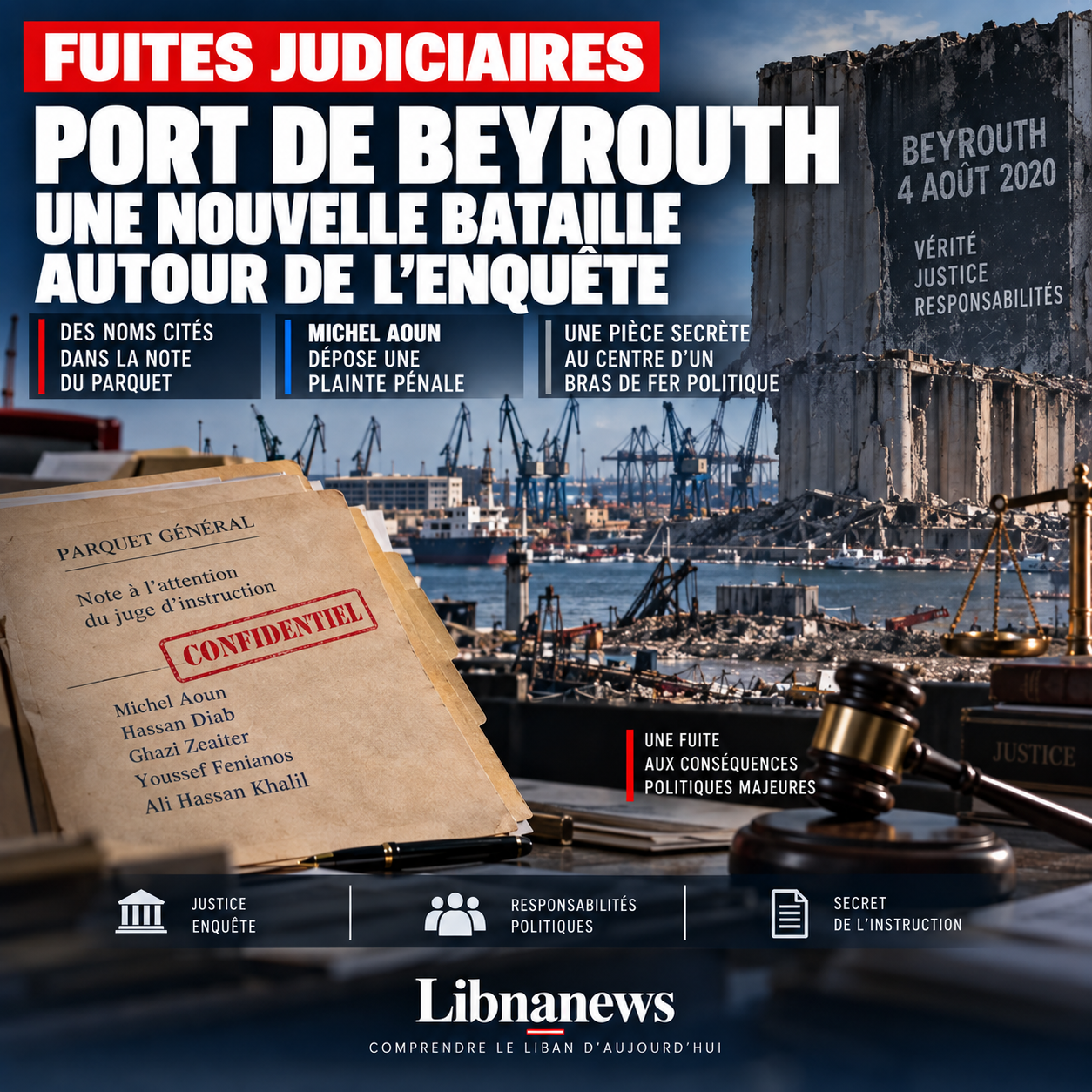
A note from the Public Prosecutor’s Office raises the file of 4 August
The investigation into the explosion of the port of Beirut returned to the forefront on 17 September 2026. This time, the actuality is not the result of a final decision by the investigating judge Tarek Bitar, but of the disclosure of information attributed to a note from the Attorney General’s Office. Several names of former politicians are circulating. The reaction of former President Michel Aoun immediately opens a second front: that of the secrecy of the investigation and the origin of the flight.
Nahar of 17 September 2026 reports that Michel Aoun announced the filing of a criminal complaint after the publication of information concerning the supposed contents of the note of the Attorney General in the port file. The former President refers in particular to the dissemination of false information, defamation and violation of the secrecy of the investigation. He presents his approach as a defence of truth and justice, but also of respect for the victims.
Al Quds of 17 September 2026 provides more information on the content attributed to this note. According to reports from a judicial source cited by the daily newspaper, the prosecution has reportedly requested criminal liability for several former perpetrators. The names of former Prime Minister Hassan Diab and former ministers Ghazi Zeaiter, Ali Hassan Khalil and Youssef Fenianos appear in this information. Michel Aoun’s name was also mentioned with regard to possible liability for negligence.
The distribution of these names takes place before Tarek Bitar has rendered the act which must determine the judicial follow-up of the case. This chronology immediately feeds controversy. Public opinion discovers a supposed part of the prosecutor’s findings while the judge retains his discretion.
Ad Diyar of 17 September 2026 reports the explanations of the former Minister Salim Jreissati. He recalls that the note transmitted by the Public Prosecutor to the investigating judge constitutes a legal assessment and not a binding decision. According to him, she remains covered by secrecy. The judge may take account of its content, but he is not obliged to repeat its conclusions.
The port file is thus in a unique situation. Responsibilities are already being discussed publicly while the procedure for establishing them legally has not been completed.
Michel Aoun opens a second file about the leak
Michel Aoun’s complaint displaces some of the attention. The question is no longer just what the prosecutor would have recommended to the judge. It is also necessary to determine how information presented as confidential has left the judicial file.
Nahar of 17 September 2026 reports that the former president explicitly refers to the violation of the secrecy of the investigation. His approach comes after the circulation of accounts concerning the contents of the note of the Attorney General’s Office.
Ad Diyar of 17 September 2026 gives this question an institutional dimension. Salim Jreissati refers to the possibility of a complaint against unknown in order to identify the person responsible for the disclosure. If the investigation were to lead to a magistrate, he also mentioned any intervention by the judicial inspectorate.
The problem directly affects the credibility of the investigation. The port file has already experienced long periods of blocking, jurisdictional challenges, appeals and political confrontations. A leak on an important exhibit can now feed the accusations that the procedure would be used in partisan debate.
Salim Jreissati also draws attention to the calendar. He noted that the information had emerged when Parliament was debating the government’s action. This is reflected in some political reactions. It feeds the hypothesis of using leakage to influence political news.
However, there is no public identification of the author of the disclosure on 17 September. The complaint can therefore open a real investigation into the investigation: the justice responsible for determining the responsibilities in the explosion may have to simultaneously look for responsibilities in disseminating its own documents.
Responsibility of former leaders revives constitutional debate
The circulation of the names of Hassan Diab and former ministers reactivates another conflict that has accompanied the investigation for several years: that of the competent court to prosecute politicians for acts related to their functions.
Al Quds of 17 September 2026 highlights this dimension by reporting the information attributed to the prosecutor’s note. The problem is not only the possible existence of fault or negligence. It also concerns its legal qualification.
The Lebanese Constitution provides a special mechanism for certain responsibilities of the Presidents and Ministers. However, ordinary justice may intervene when it considers that the acts charged constitute ordinary offences which are not confused with the normal exercise of a ministerial function.
It is precisely on this border that the port file has already produced numerous disputes.
The alleged presence of Michel Aoun’s name adds a new difficulty. The former president did not hold ministerial office at the time of the explosion. The question of its possible responsibility must therefore be examined in accordance with the rules applicable to the Presidency of the Republic and to acts carried out during the mandate.
Al Sharq of 17 September 2026 devotes a separate legal analysis to the responsibility and immunity of the President of the Republic. The newspaper recalls the tension between two principles: no public official should be placed above the law, but the presidential function enjoys guarantees to prevent judicial proceedings from becoming a means of blocking the functioning of institutions.
The return of the name of a former Head of State in the port case therefore gives this theoretical question a very concrete scope.
Political reactions divide without following exactly the usual divisions
Disclosure prompts political reactions, but they are not limited to a confrontation between supporters and opponents of Michel Aoun.
Al Quds of 17 September 2026 reports that former MP Amal Abu Zeid is questioning the risk of selective justice. He referred to the possibility of political treatment of the case under judicial procedure.
Farès Souhaid chooses another approach. He asked that attention should remain focused on the nature of the explosion and on fundamental responsibilities. For him, the accumulation of names must not make forget the questions that remain at the heart of the investigation.
Eli Mahfoud, a political opponent of Michel Aoun, also took a cautious position. Al Quds reports that he refuses to transform the appearance of the former president’s name into an occasion of political revenge. Justice must move forward without partisan jubilation.
These reactions show the particular sensitivity of the port file. Even personalities opposed to Michel Aoun fear that the politicization of new information will jeopardize the search for truth.
The challenge also lies in the expectations of the victims ‘ families. Since the explosion, they have been calling for responses on the chain of responsibility for the storage of dangerous materials, on those responsible who knew about them and on decisions that could have prevented the disaster.
The premature dissemination of a list of names can give the impression of progress. It can also shift attention to political confrontations around each mentioned personality.
The Higher Council of the Judiciary responds to another controversy
At the same time, the judicial system faces another controversy, this time around the recruitment of judges.
Nahar of 17 September 2026 publishes a right of reply from the secretariat of the Higher Council of the Judiciary concerning the competition of entry to the Institute of Judicial Studies. The Commission responds to information published the previous day in a confidential section of the newspaper.
He requested that information on the competition be verified before publication. He claims that the procedure is organised according to high scientific criteria and in a framework of transparency. The Council presents the competition as an attempt to provide a model of recruitment for state institutions despite the difficulties facing the country.
He also states that his doors remain open to any request for information or verification of the process.
This episode appears to be secondary to the port file. Yet it touches on the same fundamental problem: trust in justice. The renewal of the judiciary, the appointments, the transparency of competitions and the independence of judges determine the capacity of the system to deal with politically sensitive cases.
Al Joumhouriyat of 17 September 2026 also reports, in his behind-the-scenes information, that legal experts consider that the next challenge is not only to appoint members of new regulatory authorities. Their ability to work away from policy interventions will have to be demonstrated. The same question applies to justice.
Prisons and amnesty law remain a judicial emergency
The parliamentary debate also highlights the prison situation and the issue of amnesty.
Al Sharq of 17 September 2026 reports the intervention of MP Marwan Hamadeh on the prison in Roumieh. He claims that detainees die regularly there and asks the Constitutional Council to rule promptly on the general amnesty law. At the same time, he called on prisoners to suspend their hunger strike, stressing that the decision was no longer in the hands of Members.
The prison situation is thus described as a human and judicial emergency. Slow procedures, overcrowding and detention conditions continue to fuel reform requests.
The amnesty issue remains politically sensitive. A general measure may address the situation of prisoners whose procedures are prolonged or whose conditions of detention are very poor. At the same time, it raises questions about the offences concerned, the necessary exclusions and equality before the law.
The appeal to the Constitutional Council therefore keeps the case pending.
This expectation fuels tension in prisons. It also illustrates the State’s difficulties in dealing quickly with judicial problems whose social consequences are becoming increasingly severe.
The case of Riad Salamé remains present in the judicial news
Al Sharq of 17 September 2026 also reports a new step in the defence of the former Governor of the Bank of Lebanon Riad Salamé. His lawyer asked for his release on legal arguments.
The former governor’s case remains linked to the financial investigations that accompanied the banking and monetary collapse. It retains a strong public dimension because of the central role held by Riad Salamé for several decades at the head of the Bank of Lebanon.
The request for release does not mean the closure of proceedings. It deals with the conditions of detention and legal arguments allowing the defence to request that his client be released during the continuation of the case.
This news reminds us that major financial affairs remain open alongside the port’s file. Lebanese justice must therefore simultaneously manage investigations involving former politicians, financial leaders and corruption or public management cases.
The challenge remains to protect the investigation from the political battle
However, the port case concentrates most of the judicial attention of 17 September. The reason is not just the names mentioned. It is at the risk of the procedure losing its centre again.
The main issue remains responsibility in the explosion. Who knew the danger? Which authorities were alerted? What decisions have been made or omitted? What facts can be criminally attributed to each person responsible?
The Prosecutor ‘ s note is a step in this process. It does not replace the work of Judge Tarek Bitar.
The leak now complicates this distinction. It allows the political battle to begin before the judicial decision. The supporters of the persons mentioned denounce a targeted operation. Their opponents may be tempted to consider the information published as an already acquired conviction.
Between these two readings, the judge must preserve his autonomy.
Michel Aoun’s complaint adds additional pressure. It may require justice to examine the internal functioning of the procedure and the circuit of a document submitted as confidential.
The port file is therefore entering a particularly delicate phase. After the years of blockade, his advance was supposed to put the facts and responsibilities back at the centre. Premature disclosure of the score may, on the contrary, rekindle confrontations over competence, immunity, political motivation and flight.
The immediate judicial challenge now is to prevent the search for the author of the disclosure and the confrontation around names from taking precedence over the objective expected since 4 August 2020: to establish, in a reasoned and legally defensible decision, individual responsibilities in the explosion of the port of Beirut.
Society: Back to school under pressure, food aid and persistent fragility of public services
Public school tries to recover lost learning
Education is the main Lebanese society file sufficiently developed in the press of 17 September 2026. After several years of economic crises, conflicts and closures, school attendance was disrupted. The government is now seeking to overcome the only reopening of institutions. The stated objective is to measure learning losses and consolidate a public system under increasing pressure.
Al Sharq of 17 September 2026 reports the third meeting of the strategic board responsible for managing the Education Trust Fund. The meeting was hosted by Prime Minister Nawaf Salam, with the participation of the Government, the financial partners and the United Nations Children’s Fund. It must prepare the school year 2026-2027 and define priorities for the following years.
Nawaf Salam presents education as one of the pillars of Lebanon’s recovery. He acknowledged that successive crises had interrupted learning and placed considerable pressure on schools. The government now wants to ensure that the children recover what they have lost. He also stressed the continuity of the school system during the most difficult periods. According to him, teachers, directorates and the ministry continued to maintain a link between students and their schools.
The Minister of Education and Higher Education, Rima Karami, places the recovery of learning at the top of the agenda. Its aim is not only to bring the children back to the classrooms. She wants this return to be an effective learning. At the same time, the Ministry is seeking to continue the reforms necessary to strengthen public education.
The challenge is important. A normal administrative resumption of courses is not enough when several cohorts of students have experienced successive interruptions. Gaps accumulate from year to year. Children whose families have less means to finance private lessons, digital equipment or additional support are more severely affected.
The representative of the United Nations Children’s Fund in Lebanon, Marco Luigi Corsi, specifically highlights this risk in Al Sharq on 17 September 2026. In his view, any further interruption could widen the gap and push the most vulnerable children even further behind others. International support must therefore be used to speed up the recovery of learning, but also to rehabilitate schools and continue reforms.
Public schools must absorb new students
Another development appeared in Nahar on 17 September 2026. The newspaper reports that many students in private schools have reportedly joined public schools, as their families are no longer able to cope with the increase in tuition fees.
The phenomenon remains difficult to quantify. Nahar states that it is still too early to have official statistics from the Ministry to measure the extent of the problem. However, it reveals significant social pressure. The public school no longer welcomes only families who traditionally chose it. It can also become a back-up solution for part of the middle classes weakened by the cost of private education.
This movement can profoundly change the needs of the sector.
An increase in enrolment requires more teachers, rooms, equipment and means of operation. However, it is taking place in a context where the State must already resolve the situation of contract workers and the disparities between institutions.
Al Liwa This work must identify the needs and any surplus of staff. The department stated that it wanted to respect both administrative and human considerations.
The approach responds to an old difficulty. Teacher needs are not evenly distributed. Some institutions may lack staff, while others may have a higher number of contractors than the actual needs. Accurate mapping should allow for better allocation of resources.
However, the Ministry must manage this process without aggravating the precariousness of contract teachers. Al Liwa The State must therefore find other sources to ensure remuneration.
The educational problem also becomes a budgetary problem. The recovery of learning requires additional resources at a time when public finances remain limited.
International partners remain essential to the education system
External funding continues to play an important role. Al Sharq of 17 September 2026 reports that the European Union reaffirms its commitment to public education and the ministry’s strategy.
European representative Sami Saadi stressed that the sector had paid a high price during the last conflict. Courses were interrupted and many facilities were damaged. The Education Trust Fund should help restore safe school environments and ensure access to quality education.
This aid is not limited to the reconstruction of buildings. It also accompanies system reform and learning recovery programmes.
Nawaf Salam places these efforts in the « Vision 2040 » of the education sector. The Government is committed to pursuing the necessary reforms and domestic investments, with the support of foreign partners.
However, dependence on external financing raises a question of sustainability. International programs can repair schools, support projects and support reforms. The day-to-day functioning of the system remains the responsibility of the State.
The case of contract teachers illustrates this limitation. Donors can finance some interventions, but regular remuneration must be integrated into a stable public architecture.
The re-entry thus becomes a test of the government’s ability to move from crisis management logic to sustainable education policy.
Food aid comes back with the social consequences of war
Social vulnerability also appears in the food sector. On 17 September 2026, Al Liwa.
This flour must be intended for Palestinian refugees and displaced Lebanese affected by recent developments. The donation shows that the consequences of the security situation continue to produce direct humanitarian needs.
Food aid is of particular importance in a country where a part of the population has already suffered a sharp reduction in purchasing power. For displaced families, the loss of housing or economic activity adds to the overall cost-of-living difficulties.
Support for Palestinian refugees was another aspect. Their economic situation remains fragile and depends in part on assistance programmes. The arrival of flour is aimed at a basic product: bread.
The choice of aid also recalls Lebanon’s special sensitivity to food security issues. The country depends heavily on imports for its cereals. Any disruption of international supply chains, ports or prices can quickly affect households.
Regional war and the disruptions of major sea routes add additional uncertainty. Conflict around straits can increase transport and energy costs, with indirect consequences for food products.
The South remains confronted with return, housing and services
The social consequences of military operations also appear behind the major diplomatic issues. The return of the inhabitants to southern localities is not only dependent on Israeli withdrawal and the deployment of the army. It involves living accommodation, roads, schools, health services and economic activity.
Ad Diyar of 17 September 2026 gives this question a special dimension through the case of Zawtar al-Gharbiyah. The visit of American Ambassador Michel Issa is not just about security conditions. The presence of a delegation from the Development and Reconstruction Council shows that infrastructure and development are also part of the reflection.
According to daily reports, an old proposal for Zawtar even envisaged the creation of an industrial area financed by an Arab country. The idea therefore associated security, population return and economic development.
The model illustrates one of the major post-war problems. A village can be secured without becoming immediately habitable again. People must be able to work and access essential services.
MP Nasser Jaber, quoted by Al Sharq on September 17, 2026, summarizes this expectation by saying that the inhabitants of Nabatiyah do not only want statements of solidarity. They want a government present when they are exposed to danger.
Kassem Hashem, for his part, calls for a comprehensive emergency plan and a sustainable national policy for the South so that the inhabitants can stay on their land.
The social dimension therefore becomes inseparable from the debate on sovereignty. The return of the State must be visible in safety, but also in the services.
The environment becomes a subject of public safety
Environmental concerns also appear in the 17 September information. Nahar reports a controversy in Zahlé about materials presented as toxic and intended for landfill in the caza.
The municipality claims to have so far refused their burial. Exchanges of press releases are increasing, but the exact fate of these subjects remains at the centre of local queries.
This case illustrates a recurring difficulty in waste management: the lack of trust between communities, operators and residents. When a product is presented as dangerous, lack of clear information about its origin, composition and destination quickly feeds into concerns.
The question goes beyond Zahlé. Lebanon has experienced several waste and landfill crises. The ability of authorities to provide transparent information on hazardous materials is therefore a public as well as environmental health issue.
The South faces another form of environmental risk. Al Sharq Al Awsat of 17 September 2026 reports the warnings of Environment Minister Tamara El Zein after the Israeli explosion on Ali al-Taher hill.
According to the National Geophysical Centre data cited by the Minister, the explosion of about 1,100 tons of explosives would have produced land waves comparable to a magnitude quake 4.2. The site is close to major geological faults.
The Minister therefore warns about consequences that could exceed immediate destruction. The use of massive quantities of explosives can affect the soil, infrastructure and safety of surrounding areas.
This concern adds an environmental dimension to war. The consequences are no longer measured solely in buildings destroyed or land rendered inaccessible. They also concern soil and geological balances.
Cost of living continues to weaken households
Finally, the social situation remains closely linked to economic difficulties. Al Jumhouriyat of 17 September 2026 refers to the rise in prices, the weight of electricity and the rise in poverty. Households continue to bear the cost of public service failures directly.
Electricity is the most visible example. When public food is insufficient, families must finance private solutions. Energy spending then reduces the resources available for food, education and health.
The rise in school fees in the private sector adds new pressure. The alleged transfer of students to the public described by Nahar is one of the signs of this weakening.
The issue of salaries for the public sector and pensioners is also related to this situation. Increase requests are a result of a real loss of purchasing power. But funding difficulties limit government opportunities.
The social dossiers of 17 September 2026 thus show a society still organised around crisis mechanisms. Donors finance part of education. Foreign aid provides flour to vulnerable populations. Families are looking for less expensive solutions for schooling. The people of the South are simultaneously waiting for security and reconstruction. Municipalities must address environmental concerns with limited means.
The challenge for the State is now to turn these ad hoc responses into sustainable services. In education as in aid to displaced populations, the challenge is no longer just to go through an additional emergency. It is to rebuild institutions capable of functioning without permanently dependent on a new exceptional programme or new external assistance.
Culture: Lebanese theatre questions artificial intelligence, while Arab creation questions its memory and its future
In Beirut, « Not for everyone » imagines a humanity under the control of the machine
Lebanese creation provides the cultural subject most directly related to the country in the press of 17 September 2026. Al Quds devoted a broad review to the play « Not for everyone », presented at the Monnot Theatre in Beirut. The show uses artificial intelligence not as a mere technological setting, but as the organizing principle of a future society. The question asked is freedom of decision when the machine acquires the power to select, evaluate and ultimately authorize human choices.
The play is written and directed by Sarah Abdo and Karim Chebli. Nour Hajjar, Elie Mitri and Sarah Abdo interpret it. Al Quds of 17 September 2026 describes a device in which a system of artificial intelligence evaluates two men in order to determine which one possesses the qualifications required to become a father. The two candidates gradually discover that they are participating in a competition from which one will come out qualified and the other excluded. Parenthood, normally linked to private and individual decision-making, thus becomes an authorisation granted by a system.
The exhibit quickly expands this situation to question the future of society. Will individuals retain the ability to decide for themselves? Will artificial intelligence determine who is capable of becoming a parent, a profession or some personal decisions? The show transforms these questions into theatrical rather than abstract debate.
Al Quds stresses that humour plays an important role. The audience laughs at situations that are gradually becoming disturbing. Every laugh, however, refers to one possibility: that of a future in which algorithmic evaluation is introduced into areas hitherto reserved for human judgment.
The system subjects the characters to medical, psychological and educational examinations. Their family history and the traces left by their past become evaluable data. The machine is therefore not content to examine their present behaviour. She claims to measure their overall ability to parent.
This omnipresence is reinforced by the staging. Al Quds of 17 September 2026 describes a cold, deliberately neutral scenography. Space reproduces the absence of emotion attributed to the system. Lighting, sometimes brutal, contributes to the impression of an environment in which characters are constantly observed.
The role of the robot woman imposes a particular constraint on interpretation. The character must keep a frozen expression and a controlled gesture. Coldness here becomes a dramatic element: it contrasts the allegedly perfect rationality of the machine with the contradictions of the two human candidates.
However, the piece does not only present technology as an external threat. It also questions the ease with which individuals can agree to delegate their freedom in exchange for a promise of efficiency. The system becomes powerful because the characters accept its rules.
The title itself then takes on several meanings. Not everything is accessible to everyone in this future society. The machine decides who has the required qualities. Access to a fundamental dimension of human life becomes conditional.
The play remains on display at the Monnot theatre until the end of September, according to Al Quds of September 17, 2026. It is thus the main Lebanese cultural event clearly announced in today’s newspapers.
Theatre uses technology to talk about the present
The reflection proposed in Beirut goes beyond anticipation. The show refers to technologies already present in everyday life. Artificial intelligence systems select content, classify profiles and contribute to decisions in ever-increasing areas. The theatre pushes this logic to parenthood in order to make visible the question of the power entrusted to algorithms.
Al Quds also brings the military use of artificial intelligence closer together. The newspaper recalls that data processing and identification technologies are already used in conflicts. This reference gives a regional dimension to the show. In both Lebanon and Gaza, technology is no longer only associated with economic innovation. It is also perceived through surveillance and military capabilities.
The choice of theatre is significant. In the face of automation-based technology, the scene relies on the physical presence of actors and the public. The show thus confronts two forms of relationship: immediate human interaction and a system that transforms people into data to be analyzed.
This opposition allows Lebanese creation to address a global issue without abandoning its own environment. The play does not attempt to explain artificial intelligence technically. It examines what its development could change in individual freedom.
The issue is all the more relevant as the international debate on the regulation of these technologies is intensifying. Culture thus joins, by another way, the political and social concerns of the moment.
The « Shir » magazine revives a debate on Arabic poetic modernity
Al Quds of 17 September 2026 also devotes an important cultural page to a controversy around the magazine « Shi The debate focuses on the relationship between literary creation, cultural cold war and international funding networks.
The published text responds to a previous article by Rassoul Adnan on poetic modernity and the links between the magazine and the political context of the Cold War. The new contribution challenges certain conclusions drawn from these reconciliations.
The discussion is important for Lebanese and Arab cultural history. The magazine « Shir », founded in Beirut in 1957 by Youssef al-Khal with several poets and intellectuals, played a major role in the transformation of contemporary Arab poetry. It is associated with debates on the free verse, the poem in prose and the opening of Arab literature to international currents.
The controversy does not concern the existence of a political context. It deals with how to move from this context to a conclusion on creation itself.
Al Quds of 17 September 2026 warns against a reading that would reduce literary innovations to their funding networks or to the cultural strategies of the Cold War. The existence of institutional ties or political influences is not sufficient, according to this analysis, to demonstrate that the whole of a poetic movement was responding to an organised operation.
This discussion joins a broader debate on the writing of Arab cultural history. Should works be analysed first for their aesthetic value and literary influence? Or should they be placed in the political, editorial and financial networks that have enabled their dissemination?
Beirut occupies a central place in this history. The city was one of the main meeting places between Arab writers, publishing houses, journals and intellectual currents. The controversy surrounding « Shir » thus also reactivates a question about the cultural function of Lebanon in the twentieth century.
Morocco returns to the trauma of the Covid by the scene
The theatre is also the main non-Lebanon cultural subject developed by Al Quds on 17 September 2026. The paper presents the work of Moroccan playwright and critic Abdelrahman Ben Zidan around the Covid-19 pandemic.
His project goes back to a collective experience that continues to feed creation six years after the confinement period. The pandemic is not only treated as a health crisis. It is described as a rupture in human relations.
Containment has removed the most ordinary gestures of proximity: meeting, touching, accompanying the sick or gathering around the dead. Theatre becomes a means of revisiting this sudden disappearance of collective life.
Al Quds recalls that the pandemic has produced an important literary and artistic creation. Romantics, poets, visualists and playwrights tried to translate an experience marked by fear, isolation and uncertainty.
Ben Zidan uses the image of the « phantom without identity » to return to this moment. The virus is invisible but ubiquitous. It transforms behaviour and imposes new boundaries between individuals.
This approach indirectly joins the Lebanese show on artificial intelligence. In both cases, the theatre takes on a phenomenon that profoundly alters human relations. The pandemic imposed physical distance. Artificial intelligence today raises the question of a possible delegation of the decision.
The Arab scene thus appears to be a privileged place to examine the transformations that transcend national borders.
Arab cinema prepares its next projects with a Palestinian presence
Al Quds of 17 September 2026 is also interested in the next edition of the programme to support film production organized on the margins of the El Gouna Festival, scheduled from 15 October.
The ninth edition includes projects representing several Arab cinematographies. Palestine is present through two films, which maintains Palestinian creation in a regional space strongly marked by war and its consequences.
Production aid programmes play an increasing role in Arab cinema. They allow directors to present their projects to producers, distributors and financial partners even before the filming or completion of the works.
This is particularly important for cinematography with limited national markets. The search for international financing and co-productions is often essential.
The Palestinian presence is taking on an additional dimension in the current context. Directors must continue to produce while the material conditions of creation are deeply affected by war. Cinema becomes both a means of documenting a reality and maintaining a cultural presence.
Artists also begin to challenge music produced by artificial intelligence
The debate on artificial intelligence is not limited to theatre. Al Quds of 17 September 2026 reports the criticisms of Moroccan artist Manal Benchlikha against the increasing diffusion of musical pieces made using these technologies.
The singer defends the value of human creation and denounces the replacement of real voices and talents by artificial productions. For her, music is based on an emotional dimension that the machine cannot reproduce.
Its position refers to growing concern in cultural occupations. Tools that generate voices, melodies or arrangements become more accessible. They quickly produce content that mimics certain music codes.
The question therefore no longer concerns only the possibilities offered to artists. It touches on the value attached to creative work, the identity of performers and the place of human emotion.
The rapprochement with « Not for everyone » is striking. The Lebanese show imagines a decision-making artificial intelligence that can become a parent. The Moroccan singer is worried about a machine that can replace the performer. In both cases, the debate is less about technical performance than about the border that companies want to preserve around human activities.
Cultural Agenda: Monnot Theatre maintains « Not for everyone » until the end of September
Among the ongoing cultural events clearly documented in the publications of 17 September 2026, « Not for everyone » is the most precise Lebanese appointment. Al Quds announces that the play remains at the Monnot Theatre in Beirut until the end of September. The show brings together Nour Hajjar, Elie Mitri and Sarah Abdo, on a text and direction by Sarah Abdo and Karim Chebli.
The corpus of the day, on the other hand, provides little sufficiently accurate information on other Lebanese concerts, exhibitions or events currently scheduled to constitute an extended agenda without adding events from other dates. The cultural section is therefore dominated by theatre and intellectual debates rather than by a succession of announcements.
This relative concentration nevertheless gives particular consistency to the cultural news of 17 September. In Beirut, theatre questions human freedom in the face of algorithms. In the literary debate, the history of Arab poetic modernity is reviewed through the Cold War and cultural networks. In Morocco, the scene goes back to the trauma of the Covid. In music, artists begin to challenge automated production. And in cinema, new Arab projects are looking for funding that will allow them to exist.
Culture thus appears less as a space for withdrawal than as a place where political, technological and social transformations are examined with their human consequences.