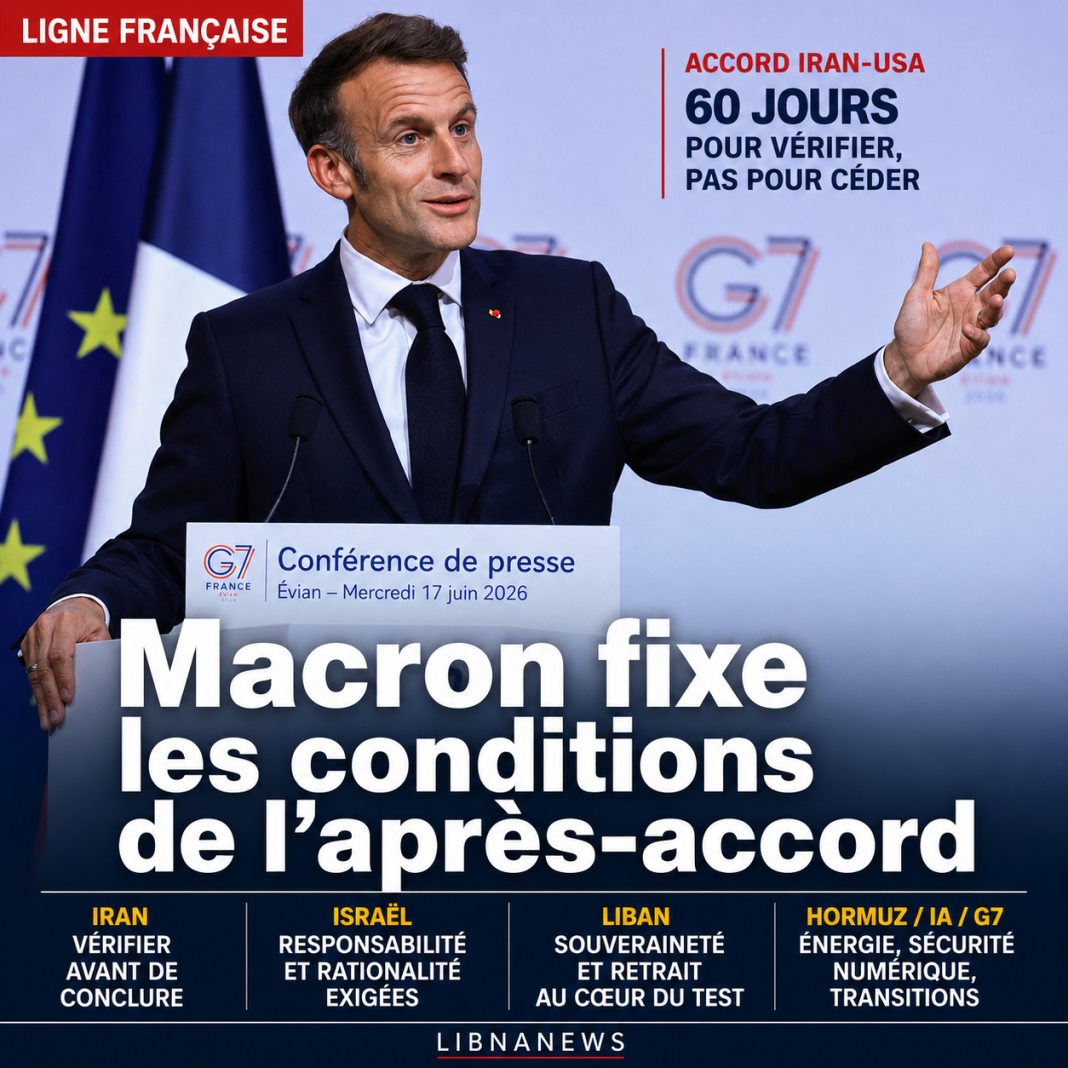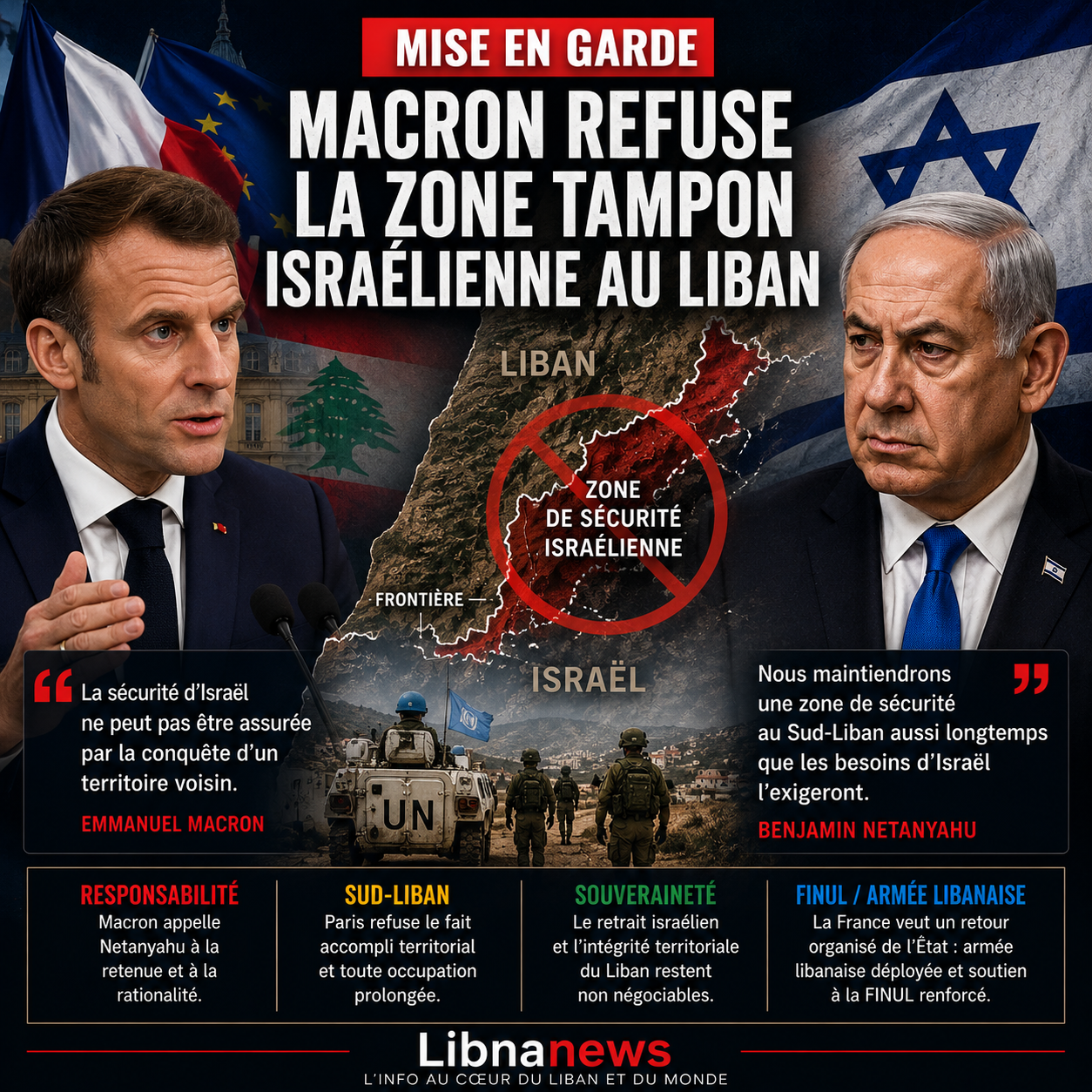
The passage most directly related to Lebanon concerns Benjamin Netanyahu. When asked about the situation in the Middle East, Emmanuel Macron called on the Israeli Prime Minister to show « responsibility » and « rationality ». He added that Israel’s security cannot be ensured by the conquest of a neighbouring territory. This sentence directly refers to the Israeli position on southern Lebanon and the maintenance of a safe area.
The wording is strong. Macron recognizes the issue of Israel’s security, but he rejects the idea that it can be guaranteed by the occupation or long-term control of Lebanese territory. It is the heart of the French line: Israel’s security, yes; territorial achievements in Lebanon, no.
This position comes at a time when Israeli strikes left southern Lebanon dead again on 18 June, despite the regional agreement. The Parisien recalls that three people were killed in Israeli strikes on southern Lebanon while the Memorandum of Understanding provides for the end of the war on several fronts. This persistence of strikes reinforces the difficulty of the sequence: the agreement exists, but its application in Lebanon remains contested by Israel.
France therefore wants the Lebanese front to be treated as a test of the agreement. The G7 supported a robust ceasefire in Lebanon, the efforts of the Lebanese authorities to achieve the disarmament of Hezbollah and the State monopoly of arms, as well as the protection of the territorial integrity and sovereignty of Lebanon. This formulation is important because it does not reduce the Lebanese file to Hezbollah’s weapons; it also includes Israeli withdrawal and respect for Lebanese territory.
What France wants to do for Lebanon
The French line on Lebanon has several concrete elements. First, Paris supports a robust and lasting ceasefire. Secondly, France calls for respect for Lebanese territorial integrity. It also wants the Lebanese State to gradually regain the arms monopoly, with a central role for the Lebanese army. Finally, it intends to maintain an international role in the South, including through UNIFIL and monitoring mechanisms.
These elements are not new, but they gain additional weight after the Washington-Tehran agreement. The Lebanese front is now included in regional de-escalation. If Israel maintains a security zone in the South, the agreement will be weakened. If Hezbollah refuses to discuss its weapons after an Israeli withdrawal, Lebanese sovereignty will remain incomplete. Paris therefore wants to support an orderly sequence: ceasefire, Israeli withdrawal, Lebanese army deployment, return of displaced persons, reconstruction and national dialogue.
Jean-Yves Le Drian, the personal representative of the French President for Lebanon, summarized the difficulty of the moment by explaining that the integrity and sovereignty of Lebanon are recognized by the protocol, but that the Israeli authorities do not feel connected to this agreement. He added that the negotiations would open on that basis and that Hezbollah said that it could not accept a ceasefire while Lebanese territory was occupied. This remark describes exactly the node of the sequence.
France can therefore act on three levers. The first is diplomatic: to weigh with the United States, Israel, the G7 and the Security Council for the Lebanese sovereignty clause to be applied. The second is military: to support the Lebanese army, which must become the central actor in the return of the State to the South. The third is civilian: contributing to the reconstruction of destroyed villages, the return of displaced persons and the restoration of essential services.
Macron has already repeated in several sequences that France is at its disposal to contribute to the stabilization between Lebanon and Israel. The novelty is that the Washington-Téhéran agreement can give this availability a more concrete framework. Paris will seek to integrate into the implementation phase, in particular around the Lebanese army, UNIFIL and the monitoring of violations.
Israel: France supports security, not buffer zone
Macron’s position towards Israel is therefore on two levels. It recognizes Israel’s right to security. It does not deny the threat of Hezbollah or Iran’s place in the regional equation. But it refuses to ensure this security by occupation or by an extended security zone in southern Lebanon.
This nuance is essential. She explains why Macron calls Netanyahu to responsibility and rationality rather than a breakup. The French President is trying to convince Israel that its long-term security cannot be built on a military presence without a horizon. Such a presence feeds the story of Hezbollah, makes it more difficult for the Lebanese displaced to return, weakens the Lebanese state and complicates the implementation of the regional agreement.