





On the occasion of Army Day, the Commander-in-Chief, General Rodolphe Haykal, delivered a message that goes far beyond the traditional tribute to the military. He assured that the institution would continue all its missions despite the lack of resources, the scale of the tasks and the fragility of the national context. Most of all, it accused Israel of obstructing the deployment to the South by continuing its attacks and violations. This declaration places the Lebanese army at the centre of a file where sovereignty, ceasefire, return of the inhabitants, disarmament and international support intersect.
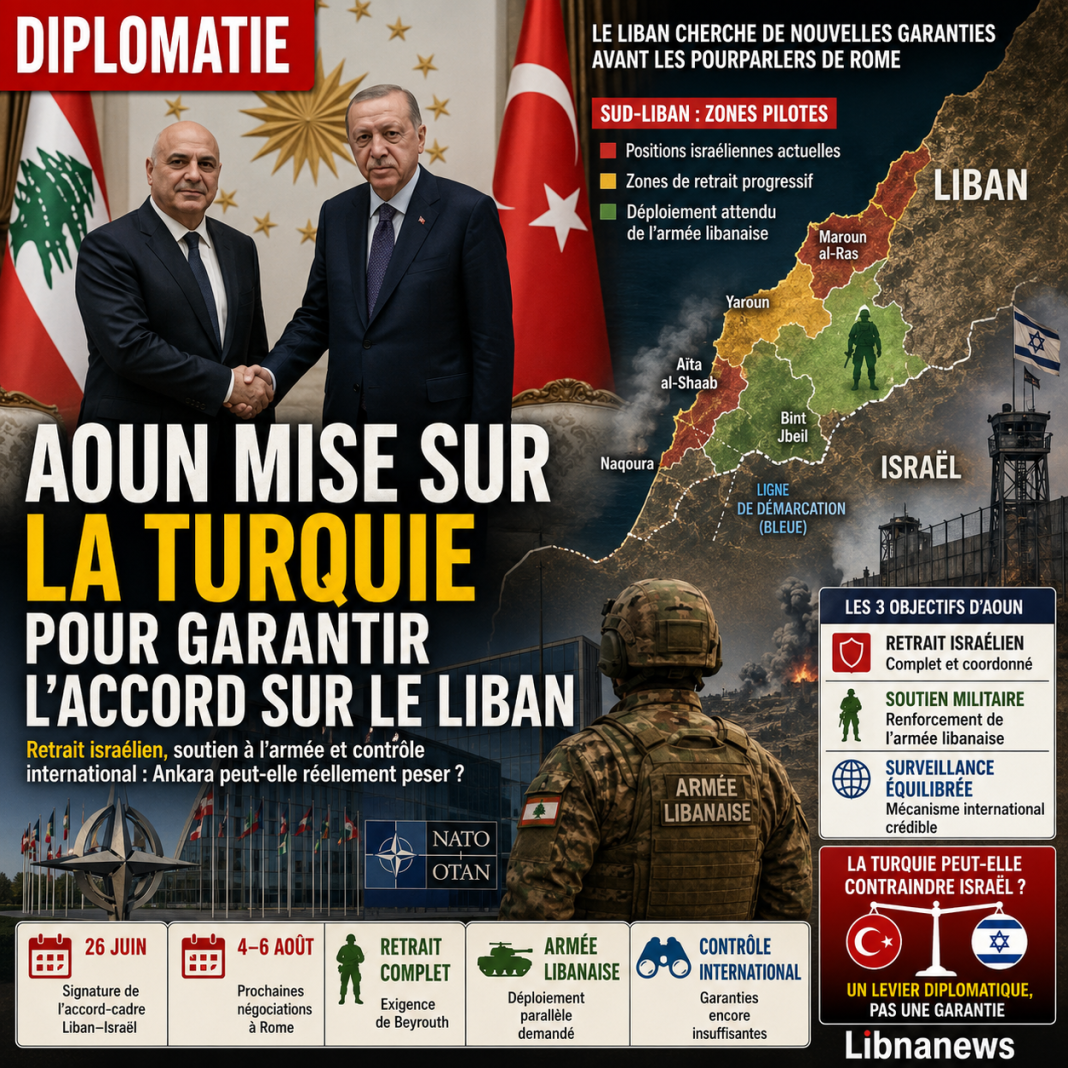
General Haykal confirmed that the army continued to deploy in southern Lebanon in accordance with existing agreements and national principles. He also stressed the desire to secure the return of the inhabitants to their villages. The institution expresses its readiness to enter any area evacuated by Israeli forces. This availability is one of the pillars of the mechanism negotiated to stabilize the border, but it faces a changing reality: partial withdrawals, destruction, firing, mined areas and disagreements over the pace of operations.
Rodolphe Haykal sets Lebanese Army priorities
The Chief Commander’s message is based on three priorities. The first concerns the maintenance of the national mission despite the constraints. The second concerns the South, where the army must extend its control as Israeli forces withdraw. The third concerns internal stability. Haykal claims that the institution will remain the guarantor of security and civil peace, without allowing the country to be dragged into discord.
These three dimensions are linked. A military deployment in the South cannot succeed if the army lacks fuel, equipment, demining capabilities or manpower. Nor can it last if political tensions transform soldiers into arbitrators of an internal conflict. The command therefore seeks to present a clear line: the army will carry out its national responsibilities, but it must receive the necessary resources and benefit from a political framework that protects its unity.
The choice of Army Day gives this speech a special meaning. August 1st celebrates an institution often presented as one of the last common symbols in a country divided by denominational affiliations and partisan rivalries. The Commander-in-Chief uses this opportunity to recall that military support cannot be limited to ceremonies. It must be translated into resources, equipment and sustainable cooperation with partner countries.
South Lebanon becomes the main operational test
Since the last ceasefire agreements and the arrangements negotiated under international mediation, the South has been the main test of state authority. The theoretical scenario foresees a gradual Israeli withdrawal of occupied areas, followed by the deployment of the Lebanese army. It must secure communities, inspect the ground, neutralize unexploded ordnance and allow the return of the inhabitants.
In fact, every step remains difficult. Several villages have suffered massive destruction. Roads, water systems, homes and public buildings are sometimes unusable. Soldiers cannot simply enter a locality and declare the mission accomplished. They must map risks, search for explosives, control access and coordinate with municipalities and relief services.
The deployment to Zawtar al-Gharbiyé illustrated these difficulties. After the Israeli withdrawal, the army began inspecting the area and preparing for the return of the inhabitants. But the magnitude of the damage quickly imposed restrictions. A large part of the village remained uninhabitable, while neighbouring areas remained under tension. This experience has shown that military withdrawal is not enough to immediately restore normal life.
Command wants to avoid these obstacles being interpreted as a lack of will. By accusing Israel of obstructing operations, Haykal points out that the army’s progress also depends on the behaviour of the other party. Fires, demolitions and military movements near Lebanese positions can slow down inspections, endanger soldiers and delay civilian access.
Why the army accuses Israel of obstructing its mission
The accusation made by Rodolphe Haykal echoes a position recently expressed by the military command. The army reported shooting, destruction and violations in areas where its units were to deploy. It believes that these actions undermine the implementation of the arrangements and prevent the safe return of the inhabitants.
This reading is based on a simple principle. The Lebanese Armed Forces cannot exercise full authority in an area if a foreign force maintains positions, conducts operations or restricts movement. Even when Lebanese soldiers are present, their margin of action remains reduced by the risk of an incident. Any miscoordination can cause direct confrontation.
The Israeli authorities also maintain that their operations are aimed at preventing Hezbollah from rebuilding its military capabilities near the border. They condition withdrawals with safeguards on arms control and the absence of threats. This divergence places the Lebanese army in a delicate position. It must reassure international partners of its ability to control the ground, while refusing Israel to decide alone on the timing and extent of its deployment.
Haykal’s speech therefore seeks to defend the credibility of the institution. He claims that the army is advancing in accordance with the agreements and remains ready to deploy wherever Israeli forces leave. It thus refers to the responsibility for delays in the persistence of occupation and violations, without abandoning the State’s commitment to strengthen its authority in the South.
The return of the inhabitants depends not only on withdrawals
The Commander-in-Chief places the return of the inhabitants among the priority objectives. This issue has a human, political and security dimension. Tens of thousands of people have been displaced during the clashes. Their return represents a concrete indicator of stabilization, but also a sovereign issue.
An empty village remains vulnerable, even when the army deploys a unit. The return of families will restore municipalities, shops, schools and services. It also gives civilian content to the presence of the State. However, this step requires more than military withdrawal. It is necessary to demine, rebuild roads, restore water and electricity, check the solidity of buildings and offer guarantees against further strikes.
The army plays a leading role here, but it cannot take on everything. It secures access and inspects hazardous areas. The government must then mobilize the administrations and finance reconstruction. Foreign donors may contribute, provided they have a transparent framework and a sufficiently stable situation.
The inhabitants, on the other hand, still face a dilemma. Many want to return quickly, even to damaged homes. Members must sometimes ask them to wait to avoid accidents. This tension can create incomprehension, especially when families perceive the maintenance of restrictions as an indirect extension of their displacement.
The challenge of arms monopoly
The strengthening of the army in the South is also part of the debate on the state monopoly on arms. Recent agreements and international resolutions provide that regular forces alone exercise military authority in the sectors concerned. This requirement directly targets Hezbollah’s infrastructure and weapons.
The institution announced that it had extended its operational control to a large part of the South, outside the areas still occupied. It conducted inspections, seized equipment and dismantled certain facilities. The command, however, avoids formulations that may lead to political or community confrontation.
Haykal therefore insists on civil peace. This reference is not secondary. It means that the army refuses to be drawn into an internal confrontation that threatens its cohesion. Disarmament cannot be treated as a mere police operation. It affects the political balance of the country, the role of Hezbollah and relations between communities.
The army must move between two pressures. The United States, Israel and several partners are calling for quick and verifiable results. Part of the Lebanese political forces also require an end to non-State weapons. Hezbollah claims that the issue cannot be separated from the occupation, Israeli threats and a national defence strategy.
This tension explains the measured tone of the Commander-in-Chief. It confirms the army’s mission, but recalls the obstacles. It defends the strengthening of the institution, without promising a brutal operation that could divide the country.
An army facing ever-wider missions
The South represents only part of the responsibilities entrusted to the Lebanese Armed Forces. The institution also monitors eastern and northern borders, combats trafficking, intervenes against armed groups, protects infrastructure and supports internal security forces. It must also respond to local crises, social tensions and the risks of political violence.
This accumulation weighs on staff and budgets. Units deployed in the South require protected vehicles, communications systems, surveillance drones, engineering and demining equipment. Soldiers must be raised, trained and supported logistically. A permanent presence in destroyed villages requires secure bases, electricity, water and connections.
The economic crisis has weakened the capacity of the State to finance these needs. The depreciation of the currency has reduced the real value of wages. Maintenance and purchase costs remain broadly denominated in foreign currency. Foreign aid has preserved some of the operational capacity, but it does not replace a stable national budget.
The military command has been seeking for several years to avoid a deterioration of morale and a massive departure of qualified personnel. Food, medical or salary aids have sometimes been used to respond to emergencies. But the necessary modernization in the South now requires more structured programmes.
International support as an investment
Rodolphe Haykal calls on brother and friend countries to strengthen their cooperation with the army. It presents this aid as an investment in Lebanon’s stability and regional security. This formulation aims to convince the partners that the financing of the institution does not only meet a Lebanese need.
A stronger army can limit the risk of border escalation, combat trafficking, prevent the establishment of armed groups and secure the territory. It can also provide a single interlocutor in ceasefire monitoring mechanisms. For Western and Arab partners, these functions justify lasting assistance.
The United States remains one of the main supporters of the Lebanese army. Other countries provide training, equipment, vehicles, medical equipment or logistical assistance. France, Italy, Qatar and several European and Arab States are participating in various programmes.
However, this cooperation remains sensitive. Each donor has its own priorities. Some insist on border control. Others want to accelerate deployment to the South or prepare for the post-FINUL. Command must preserve the army’s decision-making autonomy while meeting the transparency and efficiency requirements associated with these aids.
Post-FINUL increases emergency
The prospect of a reduction or transformation of the international presence in the South further reinforces the responsibilities of the army. For several decades, UNIFIL has been patrolling, observing the cessation of hostilities and serving as a liaison channel. It also helps document incidents and support local populations.
If this presence decreases, the army will have to resume part of these functions. It will need more monitoring, communication and mobility capabilities. It should also strengthen its links with municipalities and maintain mechanisms to prevent incidents with Israel.
The transition cannot be limited to a symbolic transfer. Lebanese soldiers will need the technical means that the international mission is providing today. The partners are already discussing new forms of assistance, including counselling, training and supervision.
Haykal’s message is therefore also preparing this deadline. When he claims that support for the army protects the region, he recalls that the weakening of the institution would create a vacuum. This vacuum could encourage armed groups, trafficking or further confrontation.
Civil peace, the red line of command
The last part of the message stresses the role of guaranteeing security and civil peace. In the current context, this promise targets several audiences. It reassures the Lebanese who fear an extension of the tensions from the South towards the interior. It also warns parties that the army will not accept armed mobilizations or clashes that could destabilize the country.
The formula is of particular importance in the debate on weapons. The command wants to avoid a national mission being presented as an attack on a community. The army rests on a fragile internal balance. Its units bring together soldiers from all regions and confessions. Excessive polarization could affect this cohesion.
Haykal therefore seeks to maintain a doctrine based on the national interest. The army deploys to the south because this mission is a matter of sovereignty. It protects the inhabitants because they are Lebanese citizens. It refuses internal unrest because stability remains a condition for any reconstruction.
This position does not resolve political contradictions. However, it sets a limit. The institution wants to carry out the tasks decided by the State, but it does not want to become the instrument of an internal war.
A message to the government as well as abroad
The call for support is not limited to international partners. It also targets the Lebanese authorities. The army needs regular credits, adequate legislation, a defence policy and a consensus on its priorities. Without these elements, external aid risks producing ad hoc improvements without solving structural weaknesses.
In particular, the government must determine how to finance the increase in deployment in the South. It must include balances, fuel, maintenance, infrastructure and demining operations. It must also coordinate military action with the reconstruction and return of public services.
Parliament plays a role in the adoption of budgets and the control of expenditure. Political forces must avoid imposing conflicting missions on the army. They cannot demand immediate restoration of the arms monopoly without defining a national strategy and managing the political consequences.
Haykal’s speech thus sends every actor back to his responsibilities. The army says it’s ready. But its success depends on the government’s decisions, Israel’s behaviour, international support and the ability of the Lebanese parties to maintain consensus around the institution.
The deployment to the South will remain the decisive test
Rodolphe Haykal’s statement comes at a time when the army must prove that it can transform agreements into reality on the ground. Every Israeli withdrawal opens a new mission. Each village requires inspection, clearance and security. Every return requires coordination with the civilian authorities.
Progress will necessarily be gradual. They may be challenged by an incident, strike or disagreement on disarmament. The command therefore seeks to protect the institution from unrealistic expectations. It does not deny the responsibilities of the army, but recalls that their execution depends on concrete conditions.
The Army Day message does not promise an immediate solution. He asserts continuity. The soldiers will remain engaged in the South, ready to enter the liberated areas and secure the return of the inhabitants. They will also seek to prevent external tensions from turning into internal discord.
The next steps will depend on the pace of Israeli withdrawals and the expansion of areas under Lebanese control. They will also depend on the means actually granted to the institution. The next village returned to the army will show whether diplomatic commitments can finally produce lasting sovereignty, beyond declarations and ceremonies.