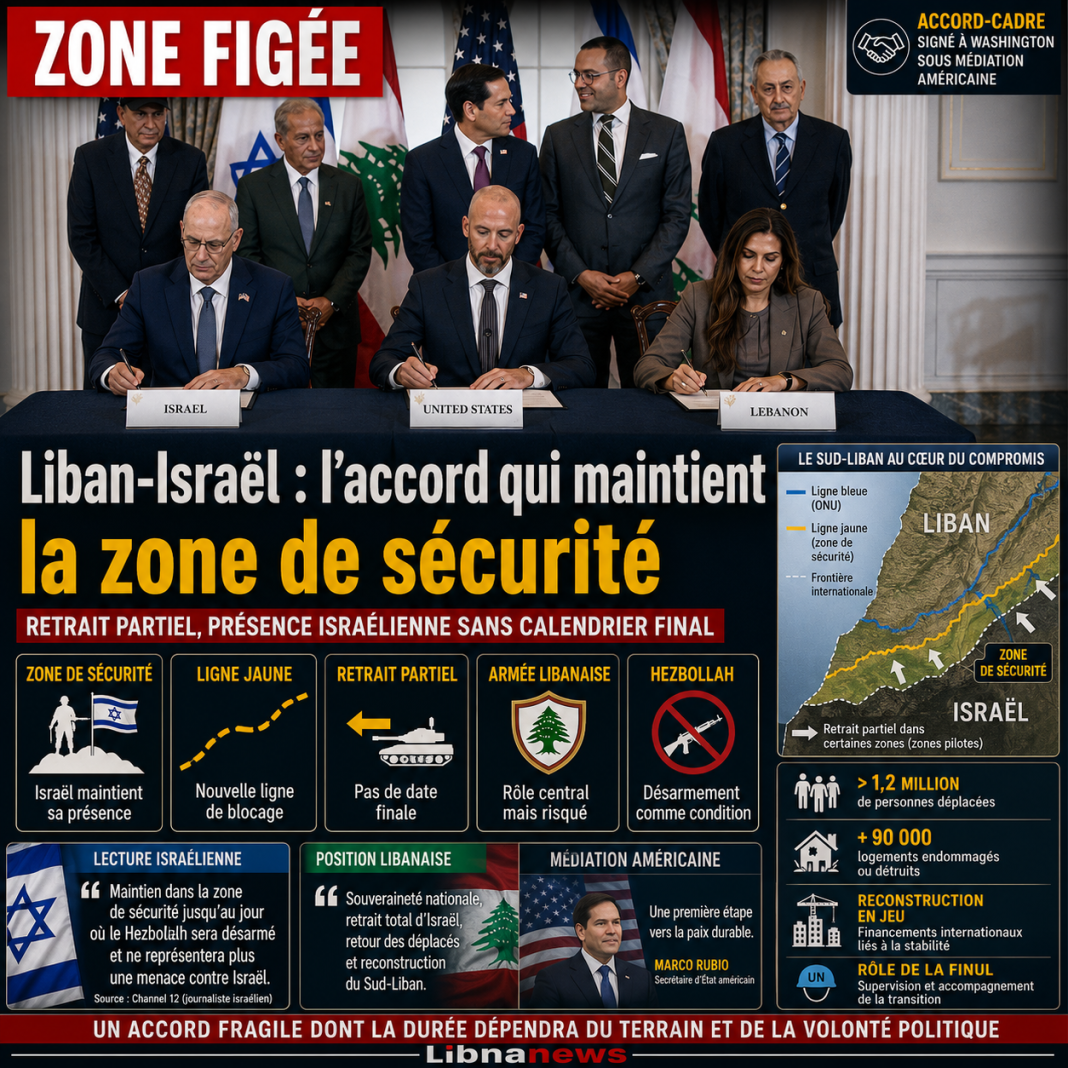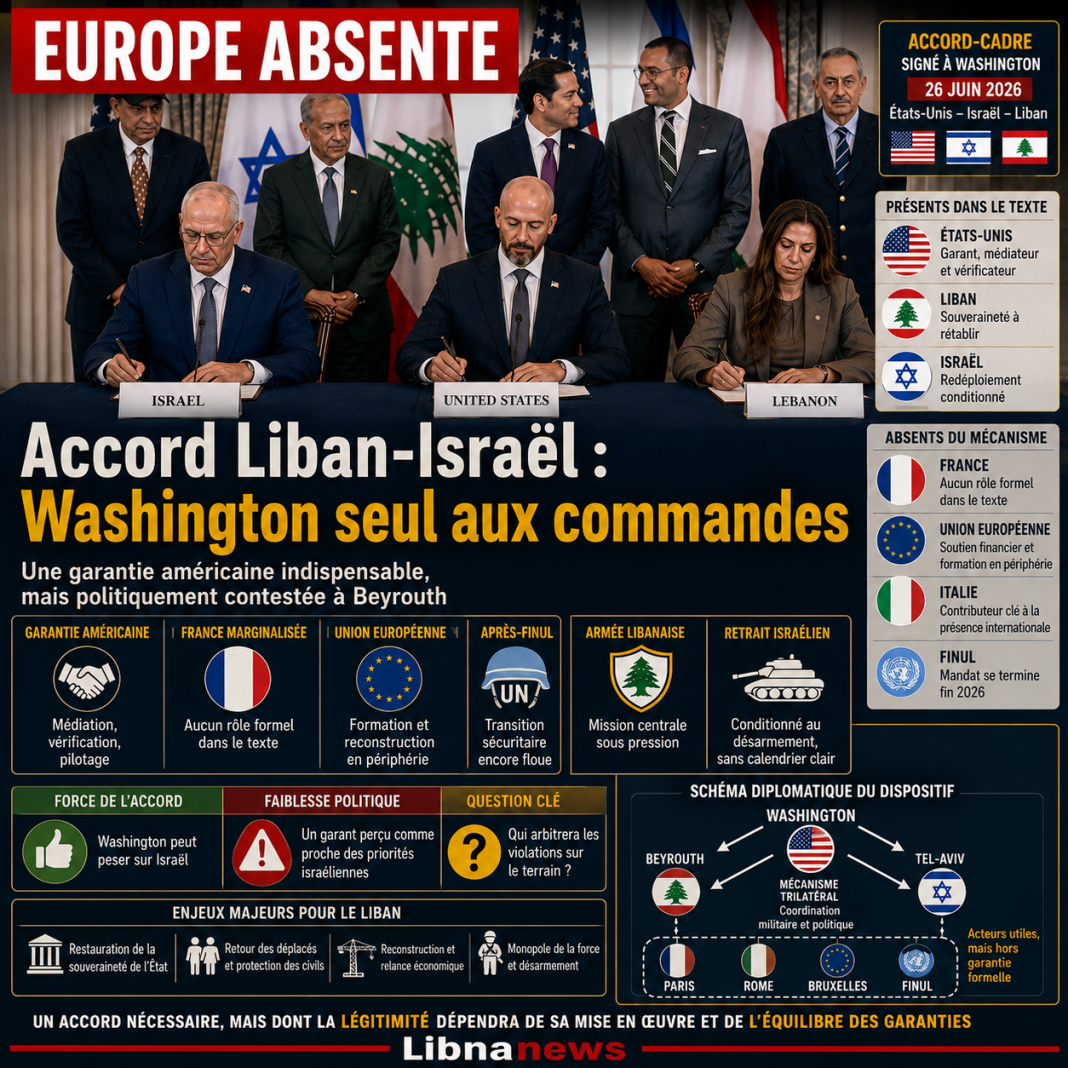






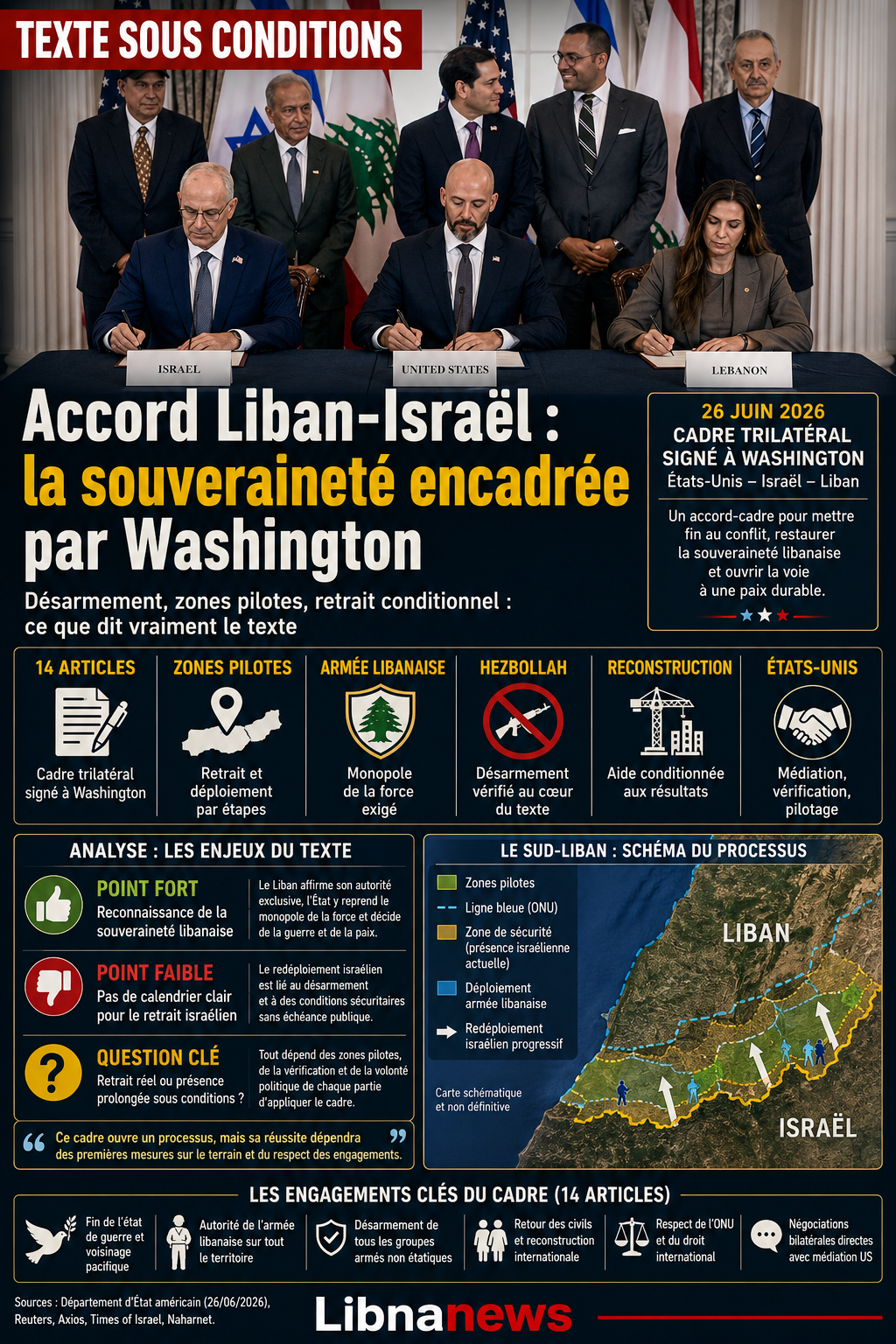
The text presented as a trilateral framework agreement between the United States, Israel and Lebanon marks a major diplomatic step. He does not settle the conflict alone. Nor does it set a clear timetable for full Israeli withdrawal. On the other hand, it establishes a political and security architecture that places the Lebanese army at the centre of the arrangement, makes reconstruction conditional on the disarmament of non-State armed groups and gives the United States a role of mediation, verification and leadership. The US State Department confirmed the signing of the trilateral framework on 26 June 2026, while Reuters reported that the agreement provides for a process to restore Lebanese sovereignty and disarm Hezbollah.
Full translation of text provided
Trilateral framework between the United States of America, the State of Israel and the Lebanese Republic
The Government of Israel and the Government of Lebanon, with the full support of the United States under the presidency of Donald J. Trump, affirm their common goal of achieving lasting peace and security. As reflected in the Trilateral Framework, hereinafter referred to as the « Framework », and through future agreements, both countries declare their ambition to end the conflict between them, to guarantee the sovereignty and security of both countries, and to establish peaceful neighbourhood relations between the two countries.
1.Israel and Lebanon affirm the right of each State to exist in peace, as well as their mutual will to live in security as neighbouring sovereign States. Israel and Lebanon hereby declare their intention to put an end to the conflict definitively, to address its root causes and, in so doing, to formally conclude any state of war between them. This Framework, obtained after several rounds of direct negotiations between the parties, builds on previous successful agreements and arrangements and expresses a determination to make irreversible progress towards the comprehensive settlement of all issues between the two countries. Both countries affirm their intention to resolve these issues as sovereign States through direct bilateral negotiations, with mediation and support from the United States.
2.The Government of Israel and the Government of Lebanon are engaged in a reciprocal and sequenced process, with clear conditions, whereby the Lebanese Armed Forces will restore effective sovereign authority throughout Lebanese territory, pending the verified disarmament of non-State armed groups and the dismantling of associated infrastructure, allowing the Israel Defense Forces to gradually redeploy from Lebanese territory. The components of this process will be detailed in a security annex, developed with the full support of the United States, which will complement this Framework. The Framework will set out the required measures, security arrangements and verification mechanisms to advance this process. The successful implementation of the Framework will pave the way for a stable and peaceful relationship between the two countries and enable the Israel Defense Forces to redeploy from Lebanese territory.
3.In accordance with the Security Annex, and as part of the broader effort to monopolize arms by the Lebanese State and sovereign control of its territory, the Lebanese Armed Forces will gradually assume full and effective security responsibility in pilot areas. These will serve as a mechanism for the phased and verified redeployment of the Israel Defense Forces and the deployment of the Lebanese Armed Forces. Two initial areas have been agreed by the Israel Defense Forces and the Lebanese Armed Forces, and future pilot areas will also be agreed upon. Following confirmation of the successful disarmament of non-State armed groups and the dismantling of their infrastructure in those areas, the Lebanese Armed Forces will assume full and effective security responsibility in those areas, reconstruction efforts supported by the international community will begin, and Lebanese civilians will be able to return safely to those areas under the exclusive control of the Lebanese State authorities. The United States intends to work closely with both countries to verify and support this process.
4.The Government of Lebanon reaffirms its firm and irreversible commitment to restore and exercise full sovereignty over its entire territory. The Government of Lebanon will rebuild the State monopoly on the use of force, achieve complete and verified disarmament of all non-State armed groups and ensure that these groups do not have any military or security role or armed capacity anywhere in Lebanon. The Government of Lebanon hereby requests the support of international partners, and in particular Arabs, under the leadership of the United States, in order to achieve this result.
5.The Government of Israel stresses that its military actions in Lebanon are solely the result of attacks, threats and hostile intent by non-State armed groups, particularly Hezbollah. The Israeli Government stresses that the end of this threat, through the disarmament and dismantling of these groups throughout Lebanon, as well as through additional security arrangements to be agreed between the two countries, will eliminate any future need for action or military presence of the Israel Defense Forces in Lebanon. In accordance with the above, the Government of Israel declares that it has no territorial ambition in Lebanon.
6.The Government of Lebanon, in accordance with the Charter of the United Nations and in the exercise of its sovereign authority, reaffirms that its security forces have exclusive responsibility for the security and defence of Lebanon, and that the Government of Lebanon has exclusive sovereign authority to decide war and peace. The Government of Lebanon rejects the claims of any State or non-State actor to use force on its behalf without its explicit authorization, and reaffirms that any claim by any State or non-State actor to exercise a military or security role is illegal in the light of the Lebanese Government ‘ s decisions and contrary to Lebanese national interests.
7.The Government of Lebanon and the Government of Israel affirm that nothing in this Framework prevents them from exercising their inherent right to defend themselves, as recognized by the Charter of the United Nations and in accordance with applicable international law, while reaffirming that no third party may exercise this right on their behalf. Both governments undertake to establish a military coordination group, with the support and participation of the United States, to ensure the overall implementation of this Framework.
8.Both countries claim to share the objective of a safe, rebuilt Lebanon under the full sovereignty of the Lebanese State, in which no non-State armed group poses a threat to Israel, Lebanon or the citizens of either country. In addition, both countries recognize that the restoration of security in southern Lebanon through the deployment of the Lebanese Armed Forces, the safe return of its civilian population and the security of northern Israeli communities are essential to long-term stability and peace.
9.The Government of Lebanon is committed to a rigorous, performance-based programme to enable the Lebanese Armed Forces to exercise complete military and security control in Lebanon, in accordance with the security arrangements agreed in the negotiations, and to implement the disarmament of all non-State armed groups and the exercise of effective authority throughout Lebanon. The Government of Lebanon welcomes the readiness of the United States to support these efforts, recognizing that any new US assistance will be strictly conditional on verifiable steps, full transparency, demonstrated results and ongoing supervision. This effort will enable the safe and orderly restoration of Lebanese sovereignty, also contributing to the wider stability and security of the entire Middle East.
10.Separately and simultaneously, the United States will mobilize international partners to actively support the Government of Lebanon in rebuilding the country, repairing infrastructure, rebuilding the economy and creating prospects for prosperity. This should include the mobilization of substantial reconstruction assistance and humanitarian aid for Lebanon, economic recovery programmes and investment initiatives, so that Lebanon can recover from years of conflict and provide a better future for all its citizens.
11.Lebanon and the United States undertake to prevent the movement of funds to any entity, organization or person affiliated with non-State armed groups and to take available legal measures to prohibit the activity of any such entity, organization or person. The Government of Lebanon explicitly commits itself to preventing the transfer of reconstruction funds to non-State armed groups and related entities.
12.At the signing of this Framework, the two countries will work towards establishing working groups to draft the Comprehensive Comprehensive Peace and Security Agreement. In addition, in order to achieve the objectives of the Framework, both governments will immediately establish complementary channels for direct and ongoing engagement, facilitated by the United States. Both governments commit themselves to acting in good faith until a complete and lasting peace is reached, bringing security, stability and prosperity to the peoples of Israel and Lebanon.
13.In accordance with their common objectives of establishing stable and peaceful relations, Israel and Lebanon undertake to take measures in good faith demonstrating a positive intention, including the cessation of any hostile or adverse actions in international political or legal forums, and undertake to work for the search and return of remains and the release of detainees.
14.Both governments recognize the role of the United States in supporting their efforts to end decades of conflict and establish lasting stability and comprehensive peace between the two countries, and express their deep gratitude for President Donald J. Trump’s vision and leadership.
Signed at Washington, D.C., on 26 June 2026, in three originals, in the English language.
Analysis: a frame that moves the centre of gravity
The text creates a new hierarchy of priorities. Israeli withdrawal is not presented as an immediate and autonomous obligation. It is linked to the verified disarmament of non-State armed groups, the dismantling of their infrastructure and the rise of the Lebanese army. This construction is in favour of Israel, as it turns withdrawal into a conditional result. It is more delicate for Lebanon, which accepts a framework without a public timetable for final settlement of the Israeli presence.
The decisive point is found in Articles 2, 3 and 5. Article 2 provides that the Israel Defense Forces may gradually redeploy from Lebanese territory when the Lebanese army restores its authority and when the disarmament of armed groups is verified. Article 3 introduces pilot zones. Article 5 links the end of Israeli military action or presence to the disappearance of the threat, particularly that of Hezbollah. These three provisions form the structure of the text.
For Lebanon, the agreement offers a clear recognition of state sovereignty. He claims that the Lebanese government alone has the authority to decide war and peace. It explicitly rejects any use of force by a non-State actor on its behalf. It promises international assistance to rebuild the country. He placed the Lebanese army as the central interlocutor. These are important institutional gains for a state weakened by years of crisis.
But the political cost is high. The text imposes a general obligation on Lebanon to disarm all non-State armed groups throughout the country. It is not limited to southern Lebanon. It directly targets Hezbollah, without naming it in all terms. It makes the Lebanese army the instrument of this change. This can mislead the military institution. It will have to restore state authority, but it may be accused by some domestic actors of applying Israeli-American requirements.
The risk is even greater in pilot areas. The Lebanese Armed Forces will take control of the area after confirmation of the disarmament and dismantling of the infrastructure of non-State armed groups. In practice, it must prevent Hezbollah or other actors from returning. It must also maintain calm during Israeli redeployments. If Israeli soldiers remain near or in a safe area, the Lebanese army can be seen as indirectly guaranteeing their security. This is one of the major political weaknesses of the scheme.
The text also creates a strong dependency on the United States. Washington supports, checks, participates in a military coordination group, conditions assistance, mobilizes partners and facilitates discussion channels. The United States is becoming the main guarantor of the process. For Beirut, this can be useful, because the Lebanese State lacks the means and the capacity to exert pressure on Israel. But this also increases the risk of framed sovereignty, where financing, security and reconstruction depend on steps validated by Washington.
Highlights of the Framework Agreement
The first strong point is the opening of a direct channel between Lebanon and Israel. The text affirms that disputes must be settled between sovereign States through direct bilateral negotiations with American mediation. This is a major break with the years when the Lebanese issue was often absorbed by regional balances, including the relationship between Israel, Iran and Hezbollah.
The second strong point is the reaffirmation of Lebanese sovereignty. The text states that the Lebanese Government must exercise its authority throughout the territory. It recalls that only the State decides on war and peace. He rejects the claim of any non-State actor to act militarily on behalf of Lebanon. This formulation legally strengthens the position of the Lebanese State, at least on paper.
The third strong point is the link between security and reconstruction. Pilot zones are not only areas of military redeployment. They must enable the return of civilians and the launching of internationally sustained reconstruction efforts. This link responds to a concrete emergency in South Lebanon, where residents expect open roads, repaired housing and restored services.
The fourth highlight is the introduction of a gradual logic. An immediate comprehensive agreement would probably have been impossible. Pilot zones allow testing a limited mechanism before extending. This method can reduce the risk of total failure. It also allows the parties to measure the ability of the Lebanese army to hold the ground and Israel to reduce its presence.
The fifth highlight is the US commitment to mobilize international aid. The text promises an effort for reconstruction, infrastructure, economy and investment. If this commitment translates into real funding, it can give the Lebanese government a concrete argument to the affected populations.
Weaknesses and risk areas
The first weak point is the lack of a clear timetable for full Israeli withdrawal. The text speaks of progressive redeployment, but does not set a final deadline. It links the Israeli exit to security conditions. This can create a long or indefinite transition if Israel believes that the threat has not disappeared.
The second weak point is the very broad nature of the disarmament objective. Lebanon undertakes to disarm all non-State armed groups throughout the country. This objective far exceeds the pilot areas. It touches at the heart of the internal political balance. Without Lebanese national agreement, its implementation can lead to a major crisis.
The third weak point concerns the Lebanese army. The text entrusts him with a central but politically risky mission. It should prevent armed groups from returning to certain areas, ensure local security and accompany Israeli redeployments. If perceived as indirectly securing the Israeli presence, it may lose some of its legitimacy with a part of the population.
The fourth weak point is dependence on the United States. Washington becomes referee, support, auditor and conditioner of aid. This centrality can make the process more efficient. It can also make it vulnerable to US political change and Washington’s strategic priorities.
The fifth weak point concerns reconstruction funds. The ban on funding related to non-State armed groups meets the requirements of donors. But it will be difficult to implement in a country where social, municipal, political and community networks are intertwined. Poorly applied, it can slow down aid. Applyed selectively, it can fuel accusations of political marginalization.
A strategic advantage for Israel
The agreement offers Israel an important strategic advantage. It tends to separate the Lebanese issue from the negotiations with Iran. By dealing directly with Beirut, Israel seeks to make Hezbollah a problem of Lebanese sovereignty, not a regional map negotiated with Tehran. This logic serves the Israeli objective of removing Iran and its relays from the framework of the regulation.
Israel also obtains that the end of its military presence is linked to the disappearance of the threat. This wording gives him a margin of appreciation. If Hezbollah retains armed capabilities, Israel can argue that the conditions for a complete withdrawal are not met. The agreement therefore transforms the Israeli withdrawal into a conditional process, not into a dated obligation.
The text also allows Israel to present its military presence as a defensive. Article 5 states that its actions in Lebanon are linked to attacks and threats by non-State armed groups. This formulation will not be accepted by all Lebanese actors, but it gives Israel a legal and political argument within the framework of the agreement.
A risky bet for Lebanon
For Lebanon, the agreement can be defended as an attempt to restore sovereignty in stages. It gives the Lebanese army a recognized role. It paves the way for international reconstruction. It places the return of civilians at the heart of the mechanism. He claims that the country must be controlled by its institutions, not by parallel forces.
But this bet is risky. Lebanon accepts a framework that does not immediately guarantee Israel’s complete withdrawal. It also accepts a logic in which its army must demonstrate its ability to neutralize non-State armed groups. If this mission fails, Israel will be able to slow down its withdrawal. If it succeeds too visibly against Hezbollah, it can cause an internal crisis. Beirut therefore lies between external pressure and internal fragility.
Public perception will be decisive. If the pilot areas allow the return of the inhabitants, the reduction of the strikes and the beginning of the reconstruction, the agreement can be defended. If they become extended surveillance zones, without a withdrawal schedule, the text will be denounced as a temporary legalization of the Israeli presence.
A decisive security annex
The decisive element may not be in the main text, but in the announced security annex. It will have to set maps, deadlines, verification criteria, the exact role of the Lebanese army, the place of the United States and the conditions for Israeli redeployment. Without this annex, the Framework remains a general political document.
Key questions are simple. Where are the first two pilot zones? Who confirms disarmament? Who checks the dismantling of infrastructure? What happens if Israel strikes in an area already transferred to the Lebanese army? What happens if an armed group returns? Who arbitrates disagreements? The main text does not give all the answers.
This annex will tell whether the agreement actually organizes the Israeli withdrawal or whether it organizes above all the conditions under which Israel can remain as long as the threat is deemed present. She would also say whether the Lebanese army was placed in a sovereign position or in a security mission under American supervision.
A possible peace, but not yet achieved
The text uses the vocabulary of peace, but it describes above all a transition. It sets ambitious goals: ending the state of war, peaceful neighbourhood relations, disarmament of armed groups, return of civilians, reconstruction and Lebanese sovereignty. But it leaves the practical conditions for these objectives open.
The agreement can become a useful step if the first measures are visible. A real Israeli withdrawal from a pilot zone, credible deployment of the Lebanese army, halting strikes, returning civilians and launching reconstruction would give weight to the text. Conversely, a prolonged Israeli presence, repeated bombings, a refusal by Hezbollah and the lack of a timetable would quickly weaken the scope of the signature.
The central question therefore remains this: does the Framework organize Israeli withdrawal, or does it organize the conditions under which Israel can remain until its security requirements are met? The response will depend less on diplomatic formulas than on the first steps on the ground: effective withdrawal of a pilot zone, visible deployment of the Lebanese army, return of civilians, cessation of strikes, independent monitoring of violations and publication of a credible timetable.