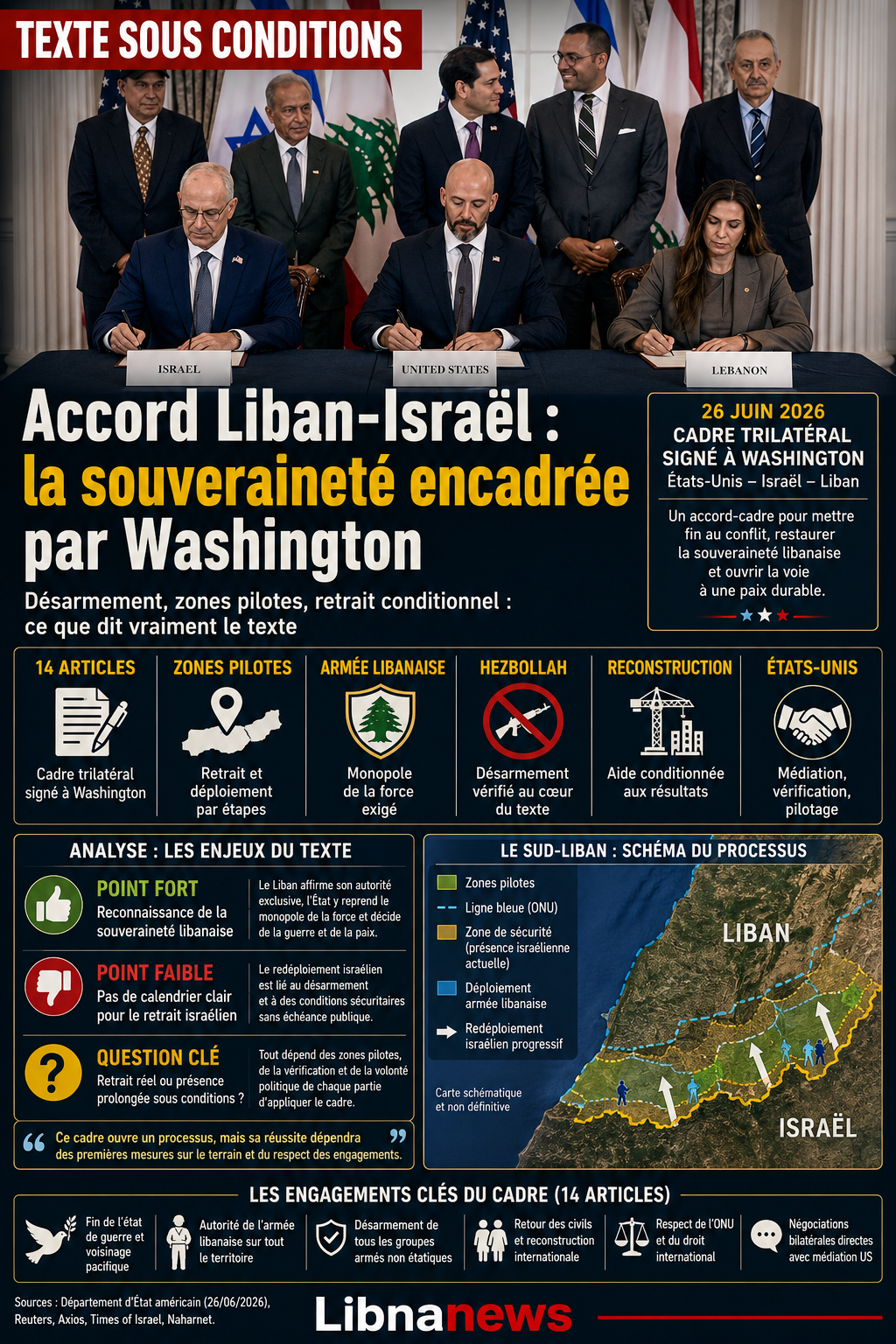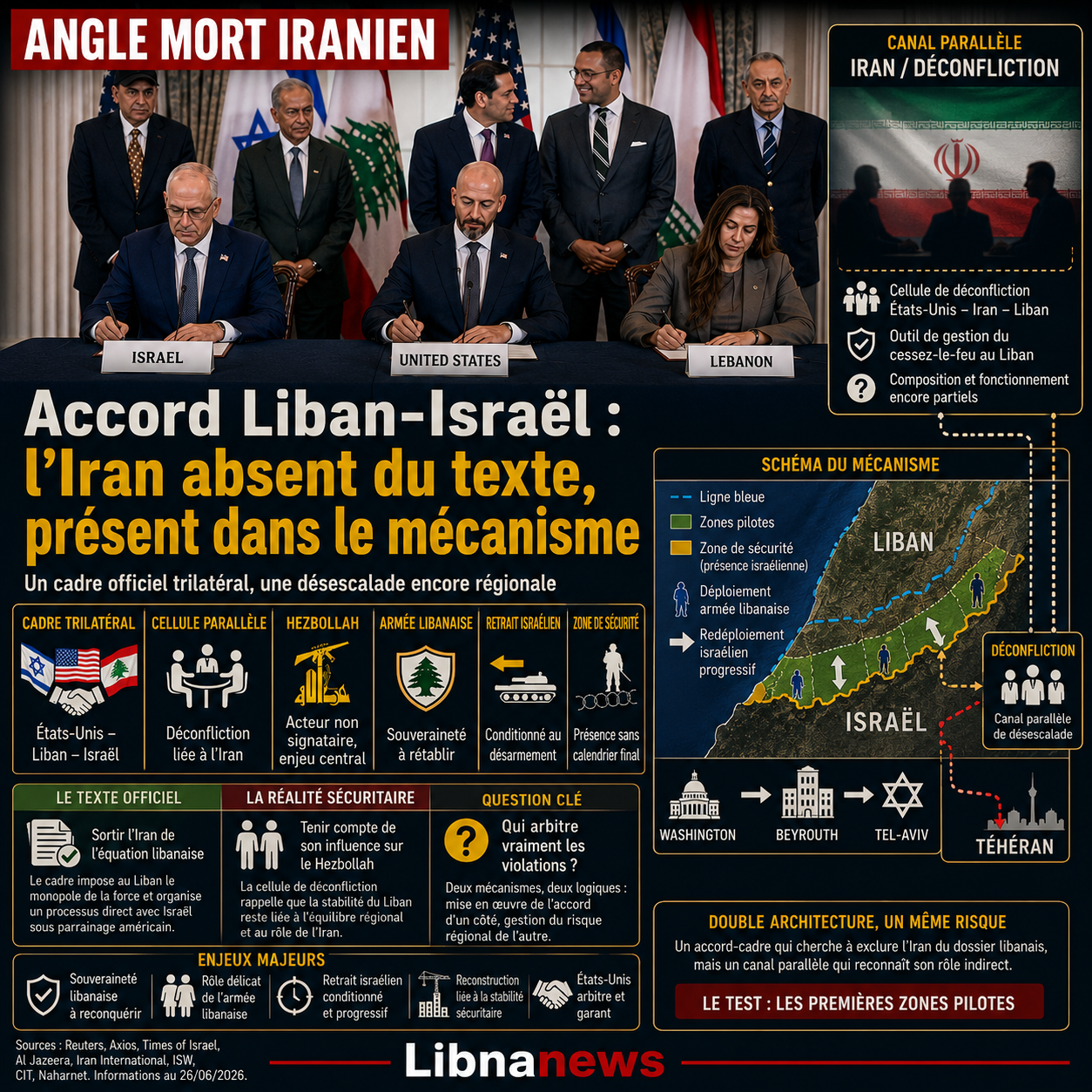






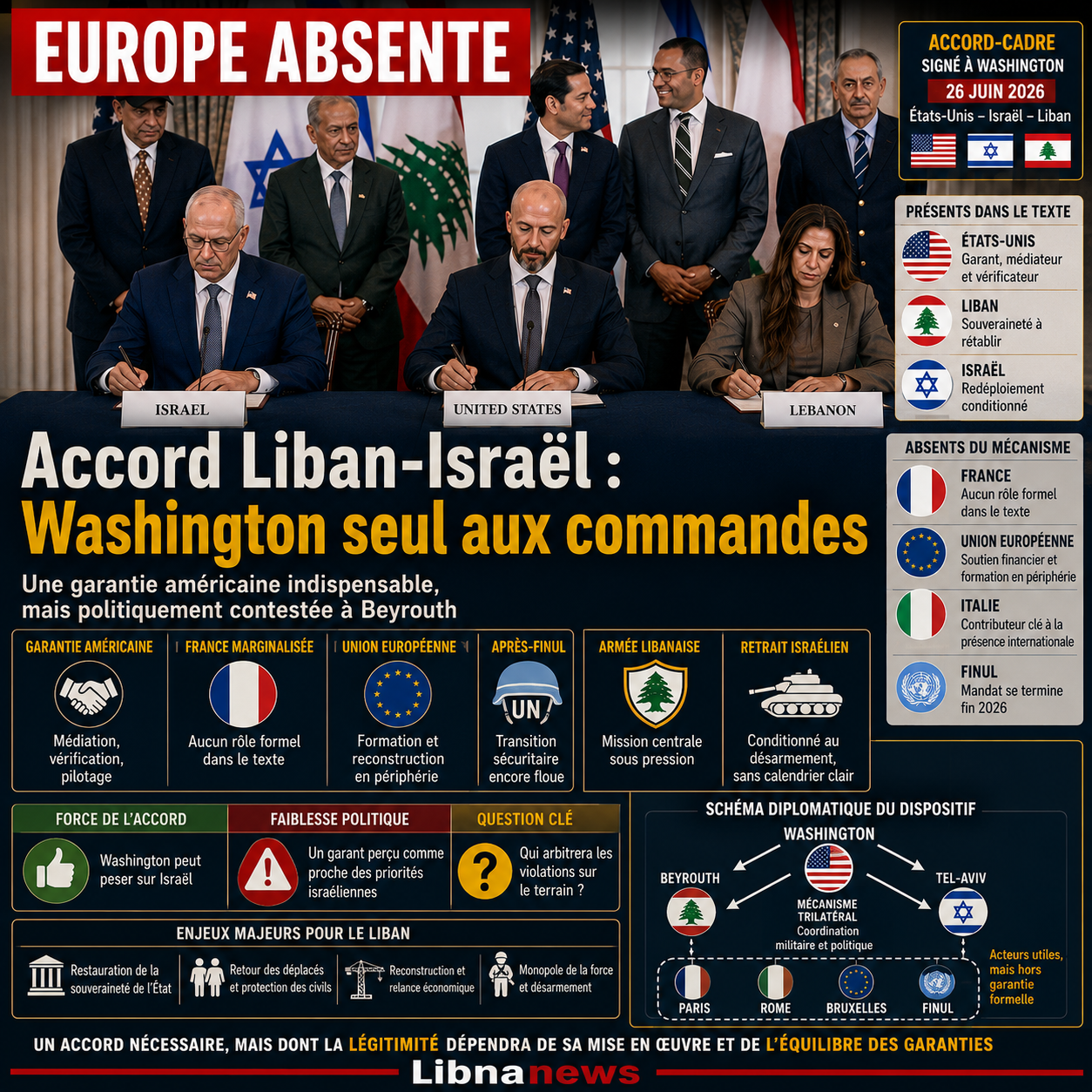
The framework agreement signed in Washington between Lebanon, Israel and the United States is seen as a diplomatic breakthrough. It opens a direct negotiation between two officially enemy countries. It promises a stabilization of southern Lebanon, an increased role for the Lebanese army, an international reconstruction and, ultimately, a complete peace. But its architecture also reveals a major absence: Europeans, and in particular France, do not occupy any formal place in the guarantee scheme.
This absence changes the political scope of the text. For decades, Paris, Rome and several European capitals have played a diplomatic, military and humanitarian role in Lebanon. France remains a historical player on the Lebanese file. Italy is one of the main contributors to the international presence in southern Lebanon. The European Union is preparing a mission to support Lebanese forces. Yet, in the Washington agreement, the central role is almost exclusively in the United States.
This choice is not neutral. The United States has a unique lever on Israel. No agreement involving even partial withdrawal of Israeli soldiers can be reached without American pressure. But this diplomatic efficiency has a price. In Beirut, Washington remains generally seen as a guarantor close to Israeli security priorities. This perception may weaken the Lebanese acceptability of the text, especially if the implementation gives Israel considerable scope for interpretation.
The text puts the United States at the centre of everything. They facilitate negotiations, support the security annex, participate in the military coordination group, verify the steps and mobilize international partners. Europeans appear mainly as potential donors or peripheral actors. They could finance reconstruction and train Lebanese forces, without really weighing on the political arbitration of violations or the Israeli withdrawal schedule.
An agreement dominated by the US guarantee
Washington’s signature illustrates a classic American method: to concentrate mediation in the hands of an actor who can speak directly to Israel and influence the Lebanese authorities. Marco Rubio presented the agreement as a step towards lasting peace. The United States wants to transform a fragile truce into a framed process, based on pilot zones, the disarmament of non-State armed groups and the gradual deployment of the Lebanese army.
This method offers an immediate advantage. It avoids channel dispersion. It gives the process a clear political authority. It allows Washington to impose deadlines, condition aid and manage disagreements between the parties. In such a sensitive case, this concentration can speed up decisions. Israel responds more to American guarantees than to European or United Nations mechanisms.
But the same choice creates an imbalance. The United States is not perceived as a neutral arbitrator by a large part of Lebanese opinion. Their strategic relationship with Israel, their military support for the Hebrew state and their security reading of Hezbollah influence their position. When Washington guarantees a withdrawal mechanism, many Lebanese question whether this guarantee will also protect Lebanese sovereignty requirements, or whether it will first serve Israeli security conditions.
The text itself reinforces this question. Israeli withdrawal is not presented as an immediate and dated obligation. It is linked to the verified disarmament of non-State armed groups, the dismantling of their infrastructure and additional security arrangements. This formulation largely reflects Israeli demands. It allows Israel to maintain a presence as long as it believes that the threat of Hezbollah has not disappeared.
France, a historical actor but absent from the mechanism
The French absence is one of the most remarkable elements of the framework signed in Washington. France has long defended a line of support for Lebanese institutions, UNIFIL and the Lebanese army. It also took part in the discussions on the post-FINUL, while the mandate of the United Nations force was to end at the end of 2026. Paris considers Lebanon to be a priority diplomatic issue in the Middle East, although its real influence has fluctuated over crises.
France has several assets. She knows the Lebanese actors. It is a member of the Security Council. It maintains a regular dialogue with the Beirut authorities. It has a military presence in UNIFIL. She can speak with Italy, Spain, Germany and other European contributors. It can also advocate a more focused approach to Lebanese sovereignty, the protection of civilians and reconstruction.
The Washington text does not give him any formal role. No Franco-American guarantee mechanism is foreseen. No place is explicitly given to the European Union. No precise articulation is established between the Washington-supported military coordination group and the envisaged European arrangements to strengthen Lebanese forces. This amounts to marginalizing an actor who could have served as a diplomatic counterweight.
Such marginalization can be voluntary. Israel often prefers American safeguards, which are considered more reliable and aligned with its security priorities. The United States may also want to retain control of a major diplomatic success. Lebanon, for its part, can accept this architecture for lack of alternative. But the French absence might weigh in the future. If the agreement became contested in Beirut, Paris could have played a more acceptable mediation role for some of the Lebanese actors.
European Union asked, but little associated
The European Union is not absent from the Lebanese file. His diplomatic service proposed a three-year mission to advise and train Lebanese forces. This mission would include territorial control, intelligence, border security, maritime security and port governance. It concerns the Lebanese Armed Forces and the Internal Security Forces.
This initiative corresponds to the needs identified by the Washington Agreement. The text calls on the Lebanese army to regain control of the territory, to secure the pilot areas and to participate in the disarmament of non-State armed groups. These objectives require resources, training, communications, equipment, vehicles, intelligence and a sustainable presence capacity. The European Union can provide some of this support.
The problem is institutional. The agreement gives the United States the role of political pilot. Europe could find itself in an executing position: training, financing, equipping, reconstructing, but without having a real right in the definition of rules. This situation is common in regional crises. Europeans pay part of the stabilization, but Washington keeps strategic arbitration.
For Lebanon, this configuration is not ideal. Formal European involvement could have diversified the guarantees. It would have allowed the agreement to be placed in a more multilateral framework. It also reportedly provided the Lebanese authorities with partners capable of defending certain civilian aspects: return of displaced persons, infrastructure, schools, health, municipalities and protection of the population. Without this institutional presence, security logic may dominate.
After FINUL makes the European absence more sensitive
European marginalization is all the more paradoxical as the post-FINUL approach approaches. The United Nations Interim Force in Lebanon has long been the main international presence in the South. Its scheduled withdrawal opens a period of uncertainty. Several European countries, including France and Italy, are already seeking to reflect on a substitute or support mechanism for Lebanese forces.
Paris and Rome referred to the possibility of supporting a multinational coalition or mechanism after UNIFIL. This approach responds to a clear fear: to avoid a security vacuum in southern Lebanon. If UNIFIL withdraws and the Lebanese army lacks resources, the area could become even more unstable. Israel could then justify maintaining its security zone. Hezbollah could retain a military argument. Civilians would remain exposed.
The Washington Agreement does not regulate this transition. He mentioned a military coordination group with the United States, but did not define the future role of Europeans in monitoring, training or accompanying redeployment. It also does not specify how post-FINUL devices will relate to pilot areas. This silence can create overlaps and rivalries.
France and Italy can therefore face a difficult choice. They can support the American process to avoid its failure. They may require a more structured place in implementation. They may also favour a support role for the Lebanese Armed Forces outside the main political framework. In all three cases, their influence will depend on the American willingness to share the guarantee.
Useful but disputed American guarantees
Lebanon needs an American guarantee to get something from Israel. It’s a diplomatic reality. Washington is the only actor able to exert decisive pressure on the Israeli government, especially when matters affect the security of northern Israel, Hezbollah and the military presence in southern Lebanon. Without the United States, Israel is unlikely to accept even partial withdrawal.
But this guarantee is also politically costly. The text gives the United States a role as judge of Lebanese performance. US aid will be conditional on verifiable steps, transparency, demonstrated results and ongoing supervision. This logic can improve efficiency. It can also be seen as a security guard. It requires Lebanon to prove its compliance with an agenda broadly defined by Washington.
The imbalance becomes more visible when the bonds are compared. Lebanon is committed to rebuilding the State monopoly on the use of force, disarming all non-State armed groups and preventing reconstruction funds from reaching entities linked to those groups. Israel claims not to have territorial ambitions, but its withdrawal remains conditional upon the end of the threat. The Lebanese calendar is therefore more binding than the Israeli calendar.
In this configuration, the American warranty can function as an asymmetric lever. Washington can ask Lebanon for precise results on Hezbollah. But will he be able to impose a complete withdrawal on Israel if the Israeli government considers the threat to be persistent? For Beirut, this is the decisive question. A guarantor close to Israel can obtain an agreement. It can also allow Israel’s most favourable clauses to continue in time.
The risk of Lebanese sovereignty under supervision
The agreement affirms its desire to restore Lebanese sovereignty. It is one of its pillars. But the planned arrangements create a very regulated sovereignty. The Lebanese army will have to assume responsibilities in pilot areas according to verified criteria. American aid will be conditioned. Reconstruction will be monitored to avoid any funding linked to armed groups. The United States will participate in the military coordination group. International partners will be mobilized under American leadership.
This framework can strengthen the Lebanese State if institutions manage to use it. It can give the army the means to regain control of the South. It can prevent embezzlement. It can reassure donors and reduce the risk of renewed fighting. But it can also give the image of a State under external surveillance, called upon to implement a safe road map designed first to address Israeli concerns.
The Israeli presence in a safe area makes this risk more acute. If the Lebanese army is to secure areas close to Israeli positions, it may be accused of indirectly protecting the remaining Israeli troops. If it does not do so, Israel may accuse it of failing to fulfil its commitments. This tension directly affects the legitimacy of the military institution, which must remain national, unaligned and accepted by the various components of the country.
A more visible European guarantee could have mitigated this risk. France, Italy or the European Union could have served as more acceptable civilian and military partners in certain segments of Lebanese opinion. Their presence could have shown that the agreement is not only an American-Israeli arrangement imposed on Beirut. Their absence leaves the field open for this criticism.
The problem of arbitration of violations
The issue of violations will be decisive. What if Israel strikes a pilot zone? What happens if Hezbollah tries to return? Who will verify the facts? Who will distinguish an immediate threat from preventive action? Who will tell if Lebanon has fulfilled its obligations? Who will say if Israel should withdraw from the next zone? The agreement refers part of these responses to a safe annex.
If arbitration remains essentially American, Lebanese will fear bias. The United States may consider an Israeli strike to be self-defence. Lebanon can see this as a violation of its sovereignty. Hezbollah can use it to justify a response. Europeans, if integrated into the mechanism, could offer a more multilateral reading of incidents, or at least a less dependent verification presence from Washington.
The United Nations could also have played a more assertive role. UNIFIL, despite its limitations, has a field experience and international legitimacy. It knows the locations, roads, incidents and liaison mechanisms. His mandate was ending, but his capacity could have been integrated into the transitional phase. The agreement, as presented, does not place the United Nations at the centre of the guarantee mechanism.
This absence of pluralist arbitrators can become a problem from the first incident. If a party disputes the American version, the mechanism may lose credibility. In such a polarised environment, the perception of impartiality counts almost as much as impartiality itself. An agreement guaranteed by a single actor very close to Israel will be more difficult to defend in Beirut.
France between frustration and need to follow
France is in an uncomfortable position. It cannot sabotage an agreement that could reduce violence in southern Lebanon. Nor can it ignore that it is largely absent. Paris will therefore probably have to support the process while seeking to insert it through secondary channels: support for the Lebanese army, reconstruction, European coordination, preparation for the post-FINUL and discussions in the Security Council.
This position can create diplomatic frustration. France has invested politically in Lebanon, but Washington is capturing the decisive moment. Paris can showcase its experience, network and military contribution. But he lacks the main lever over Israel. The United States can decide the diplomatic pace, the level of pressure and the translation of commitments into action. France will have to deal with this balance of power.
For Beirut, the interest would be to reintroduce France and Europeans into implementation. Not to replace Washington, but to balance the mechanism. A European presence in reconstruction, training, civilian surveillance and return monitoring could help the Lebanese government defend the agreement. It would also reduce the perception of an unequal face-to-face between a pro-Israeli American guarantor and a Lebanese state under pressure.
This reintroduction will depend on the security annex and the working groups. If these documents remain exclusively structured around the United States, Europeans will remain peripheral. If they provide for complementary mechanisms, Paris and Brussels will be able to recover part of the file. The diplomatic battle therefore concerns not only the signed text, but the annexes and modalities of implementation.
A reconstruction financed by several, controlled by one?
The agreement promises an international mobilization to rebuild Lebanon, repair infrastructure, revive the economy and create prospects for prosperity. This promise cannot be fulfilled by the United States alone. Europeans, Arab countries, international financial institutions and specialized agencies are likely to be solicited. Yet the text gives Washington the role of mobilising and coordinating lead.
This scheme asks a simple question: who will pay, and who will decide? If Europeans contribute massively to reconstruction without participating in political arbitration, they will finance a process defined elsewhere. This may lead to reservations in Brussels, Paris or Rome. European public opinion could hardly understand why their states would fund a mechanism where they only have a secondary role.
For Lebanon, the issue is equally important. Reconstruction funds will be subject to strict restrictions. They should not benefit entities linked to non-State armed groups. This condition applies to Hezbollah and its networks. It can reassure donors, but it can also complicate work in areas where municipal, social and political realities are intertwined.
A European approach could provide more civil flexibility, without necessarily contradicting transparency requirements. Europeans have experience in municipal programmes, infrastructure, humanitarian aid, local governance and institutional support. Their absence from the formal framework therefore risks reducing the social dimension of reconstruction to the point of security.
An opportunity for Israel
The European absence also serves Israeli interests. Israel prefers a mechanism where the United States is the central interlocutor. Washington better understands its security concerns and broadly shares the priority given to the disarmament of Hezbollah. A European guarantee would probably have placed more emphasis on Lebanese sovereignty, international law, the protection of civilians, air violations or the risk of prolonged occupation.
In the agreement, Israel obtains that its withdrawal is conditioned by the disappearance of the threat. He also obtained a commitment from the Lebanese State to disarm all non-State armed groups. He retains his right to self-defence. If the safeguards were American, Israel could hope for a more favourable interpretation of those clauses. That doesn’t mean Washington will accept everything. But the strategic relationship between the two countries reduces the risk for Israel of truly binding arbitration.
This explains why France and Europe could have been useful in Lebanon. They would not necessarily have imposed an immediate Israeli withdrawal. But they could have called for a clearer timetable, better definition of areas, a more important role for the United Nations and enhanced protection of civilians. Their absence leaves the text more secure and closer to the Israeli-American language.
The Israeli government can therefore present the agreement as a success. He accepts a process, but keeps the safe area until Hezbollah is disarmed. It urges Lebanon to regain control of its territory. He’s getting American supervision. It limits European and UN influence on operational decisions. It’s a real diplomatic advantage.
The Lebanese dilemma
Lebanon could not easily refuse the agreement. He needs a framework to get an Israeli withdrawal, even partial. He needs help rebuilding. He needs to strengthen his army. He needs American support to influence Israel. But accepting a Washington-dominated framework exposes the government to strong internal criticism.
The first criticism will be the lack of a full withdrawal schedule. The second will focus on the role of the Lebanese army, placed at the centre of a security mission that can be interpreted as supporting Israel. The third concerns the absence of strong European or United Nations guarantors. The fourth will deal with the conditionality of aid. The fifth will focus on the marginalization of France, perceived by some Lebanese actors as a more balanced partner than Washington.
The government will have to answer with facts. A truly restored first pilot zone, returning civilians, reopened roads, suspended strikes, unblocked aid and a visible Lebanese army can enhance the credibility of the text. Without these results, criticism of the agreement as a US supervisory mechanism will increase.
The role of Europeans could therefore become a subject of diplomatic catch-up. Beirut may request their inclusion in reconstruction and training programmes. It may request France to the Security Council. It may request a European presence in certain civilian monitoring mechanisms. It can also seek to involve Arab countries in reducing dependency on Washington. These adjustments will not change the signed text, but they may change the balance.
A fragile deal because too American
The framework agreement is fragile not only because it affects Hezbollah, Israeli withdrawal and Lebanese sovereignty. It is also fragile because it relies almost entirely on an American guarantee. This guarantee is essential to advance Israel. But it is not enough to reassure Lebanon. A process perceived as too American may be read as too Israeli.
Europeans, particularly France, are not only diplomatic absentees. They represent another view of the Lebanese issue: more multilateral, more institutional, more attentive to civil reconstruction and internal political balance. Their marginalization reduces Lebanon’s ability to present the agreement as a shared international framework.
The follow-up will therefore depend on Washington’s ability to open the mechanism without losing political control of the process. If the United States agrees to involve France, the European Union and the UN in implementation, the agreement will gain legitimacy. If they retain arbitration alone, Beirut will have to defend a text whose guarantees will be contested from the first incident.
The problem is this: the agreement wants to restore Lebanese sovereignty, but it does so under a guarantee perceived as aligned with Israel. He wants to prepare for reconstruction, but he marginalizes several of the actors who could finance and supervise it. It wants to replace the post-FINUL vacuum, but it does not give Europeans, the historical pillars of this presence, a clear role. The next annexes will say whether this absence remains a structural weakness, or whether Paris, Rome and Brussels manage to return to the game through the door of implementation.