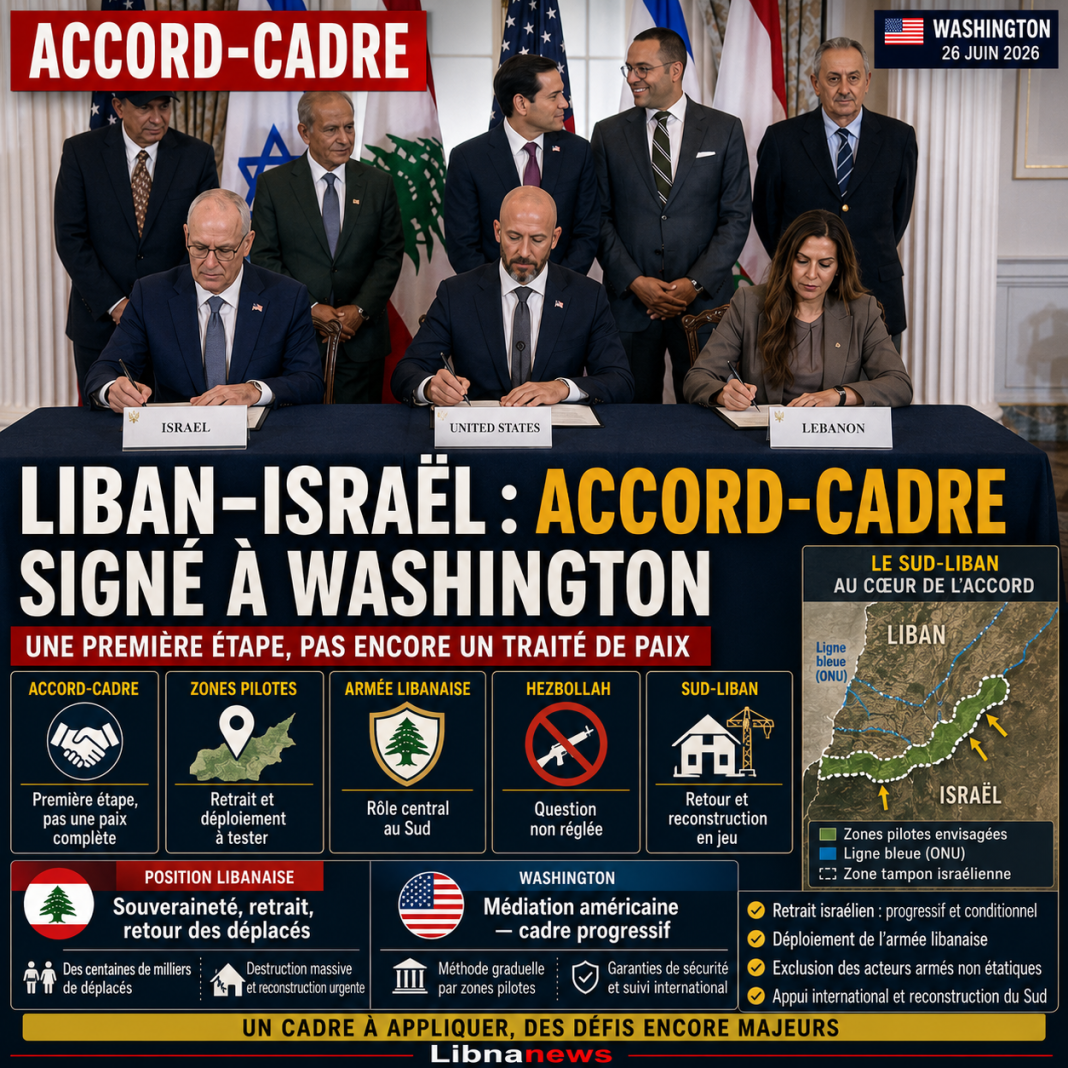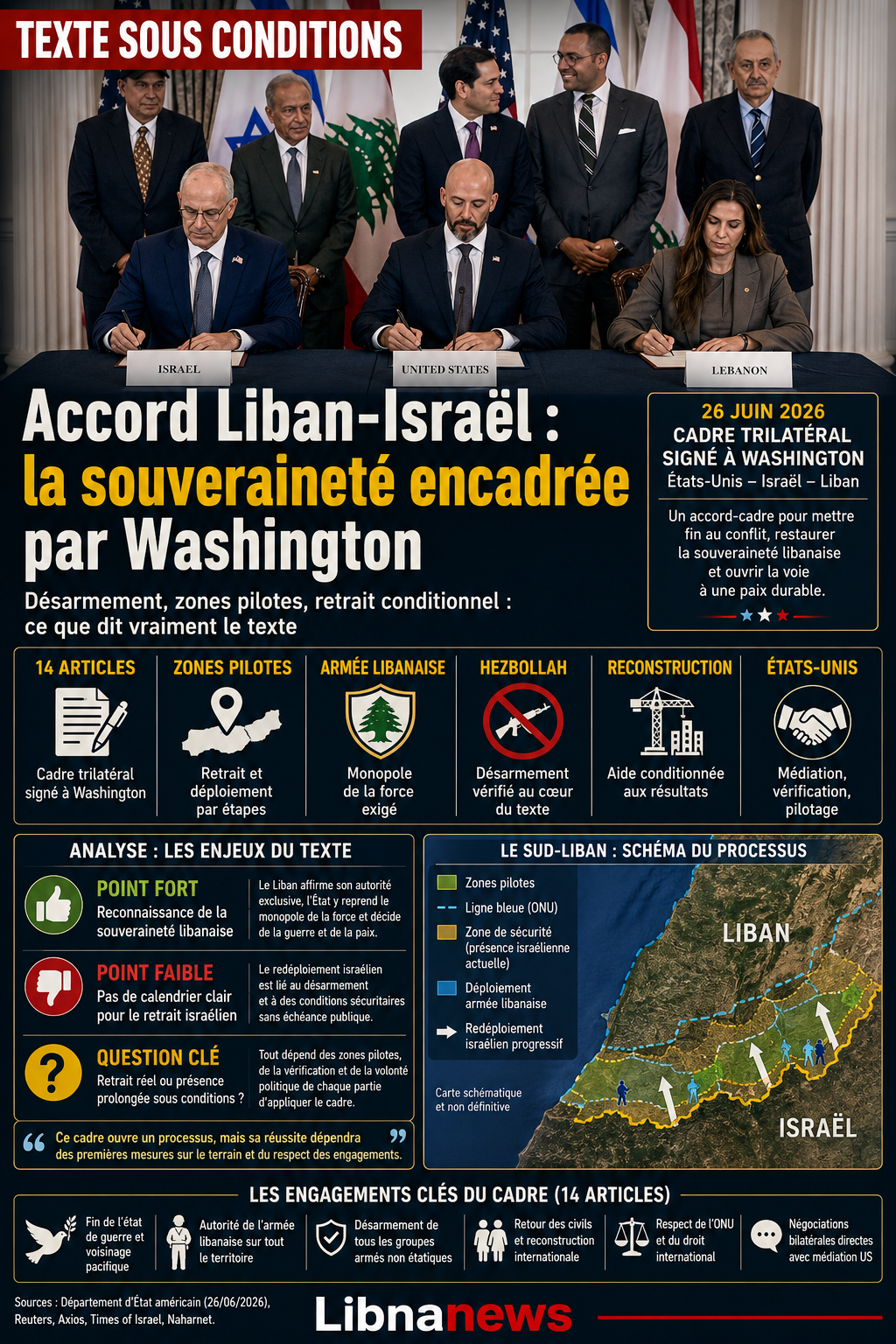






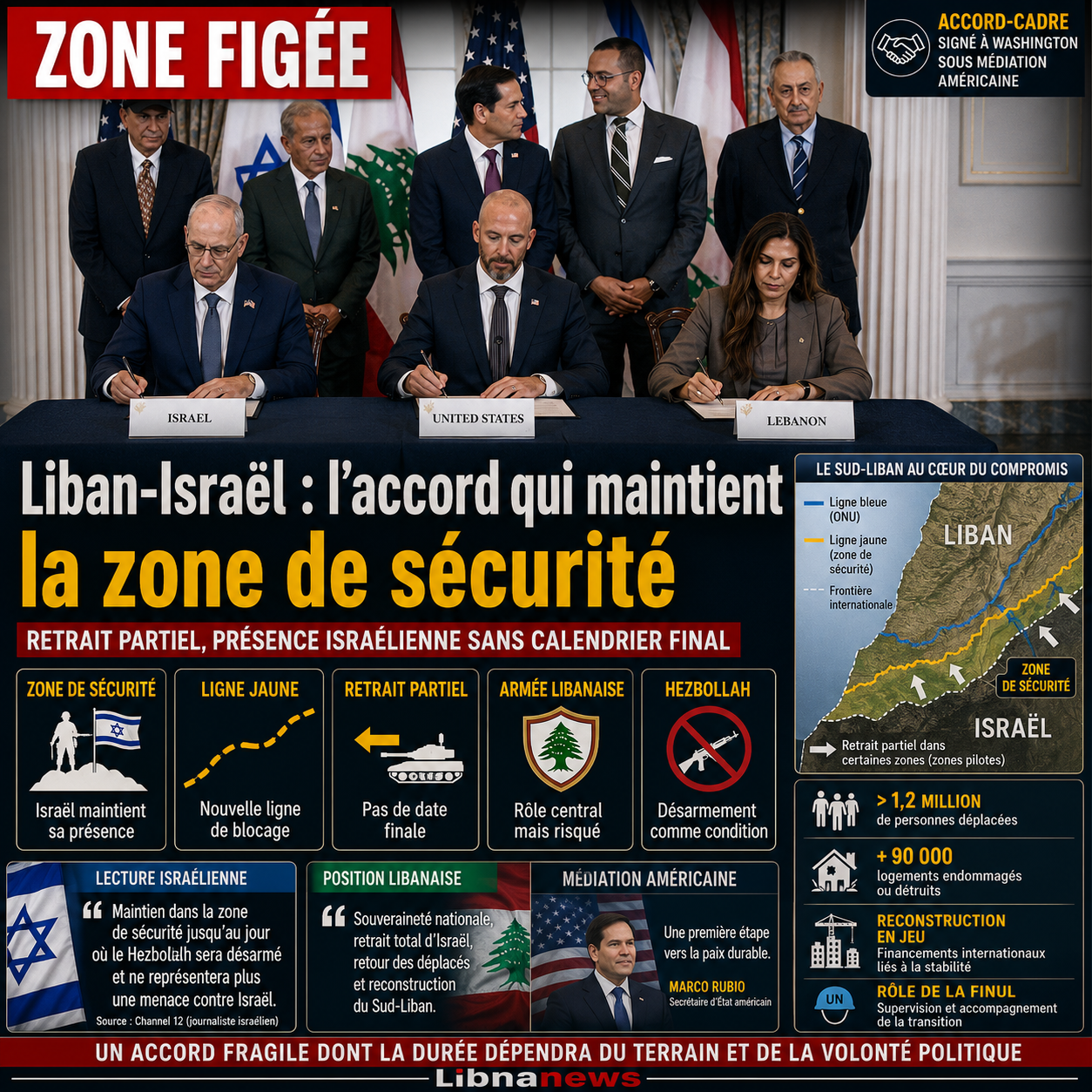
The statement attributed to Benjamin Netanyahu changes the reading of the framework agreement signed in Washington between Lebanon and Israel. By claiming that the most important point in the text is the continued existence of Israel in the security zone in southern Lebanon, the Israeli Prime Minister gives a very different interpretation from that defended by Beirut. For Lebanon, the agreement was to be presented as a first step towards the restoration of Israeli sovereignty and withdrawal. For Israel, it first becomes an instrument of military consolidation in a controlled band along the border.
The divergence is not just rhetoric. It touches the heart of compromise. Israel accepts the principle of partial withdrawal from certain sectors under US pressure, but maintains its presence in the safe area. Lebanon, for its part, accepts an agreement that does not set a clear timetable for the final settlement of this Israeli presence on its soil. This lack of a date transforms the framework agreement into an open transitional mechanism, the duration of which will depend on security criteria largely defined by Israel.
Israel will keep this area along the « yellow line » until the day that Hezbollah is disarmed and no longer poses a threat to Israeli territory from Lebanon. The same political leader quoted by the chain adds that the Israeli army’s freedom of military action will be maintained throughout the security zone in order to eliminate any threat. This formulation places the agreement in an extended control logic, not in a simple phase of technical withdrawal.
The issue therefore goes beyond the question of cards. The text creates a situation in which the Lebanese army could be called upon to stabilize the areas under its control, while avoiding attacks on Israeli forces still present in the safe area. This responsibility places Beirut in a delicate position. The Lebanese army must embody national sovereignty. However, it may be accused, by some opinion, of indirectly securing the presence of the Israeli army on Lebanese territory.
An American diplomatic victory, a Lebanese ambiguity
Washington presents the agreement as a first step towards lasting peace. Secretary of State Marco Rubio welcomed an important step forward, while acknowledging that work remained long. The United States is seeking to transform a fragile truce into a more stable security mechanism. They also want to bring the Lebanese case back into a state framework, giving the Lebanese army a central role in addressing Hezbollah.
For the Lebanese government, the signature can be defended as an attempt to obtain through negotiation what the war did not immediately remove: a progressive Israeli withdrawal, the return of the displaced, the reconstruction of the South and the restoration of state authority. But the Israeli reading of the text complicates this defence. If Israel announces that it will remain in the safe area until Hezbollah is disarmed, the agreement can be seen in Lebanon as a temporary acceptance of an occupation without a deadline.
This ambiguity is politically heavy. Beirut called for a total withdrawal. The signed text does not appear to guarantee this result within a specified period. It opens a process, but leaves the final decision suspended under very broad security conditions. The disarmament of Hezbollah, the disappearance of any threat and Israeli freedom of action are concepts that can be interpreted extensively. They may extend the transition indefinitely if no independent mechanism resolves disputes.
The Lebanese government must therefore explain that the agreement is not a recognition of the safe area, but a way to reduce it. This distinction will be difficult to defend if Israeli forces remain present, if the strikes continue and if the inhabitants of the South cannot return. Lebanese diplomacy must obtain written guarantees, maps, deadlines and international supervision. Otherwise, the agreement may be seen as a text that frames the Israeli presence instead of ending it.
Israeli bet: Dissociating Lebanon from Iran
For Israel, the main strategic interest of the agreement is to separate the Lebanese issue from the Iranian negotiations. Since the beginning of the crisis, the Lebanese front has been linked to the regional confrontation between Israel, Iran and their allies. Hezbollah remains the main military relay from Tehran to the Levant. Any discussion about South Lebanon therefore refers to the question of Iranian influence, missiles, drones and the deterrent capabilities of the Shiite movement.
Israel is seeking to move the centre of gravity. By signing a framework agreement directly with Lebanon, under American mediation, it tries to treat Hezbollah as a Lebanese internal problem and not as a part of a regional negotiation with Iran. This method serves several purposes. It reinforces the idea that the Lebanese State should assume sole responsibility for the territory. It puts the Lebanese army in front of the obligation to control the South. It reduces Tehran’s ability to present the Lebanese front as a negotiable regional map.
The statement attributed to the Israeli Ambassador in Washington goes in this direction. He claims that the agreement should allow Iran and Hezbollah to emerge from the equation. This formula reflects the Israeli reading of the compromise. Israel is not only seeking border calm. He wants to change the political and military structure of South Lebanon. He wants the security of his northern border to depend on the Lebanese army and American safeguards, not a balance with Hezbollah.
This dissociation also serves Netanyahu’s interests. The Israeli Prime Minister can say to his opinion that he does not surrender to Hezbollah. It can describe retention in the safe area as risk insurance. It can also accept partial withdrawals without appearing to be backwards, since the presence in the main band remains asserted. The agreement then became a tool for managing US pressure, more than an abandonment of Israel’s military strategy.
The « yellow line », the new centre of the conflict
The « yellow line » refers to the military area Israel says it wants to maintain in southern Lebanon. It does not correspond to an internationally recognized border. It is presented by Israel as an operational boundary to protect its northern localities. For Lebanon, it constitutes an infringement of national sovereignty if it results in lasting Israeli military control north of the border.
The difficulty comes from vocabulary. Israel is talking about a safe area. Lebanon can see it as an occupied area. The United States can treat it as a transitional zone. Hezbollah presents it as evidence that confrontation remains open. Each actor therefore uses a different definition to describe the same terrain. This divergence may prevent the implementation of the agreement if it is not clarified by precise maps and withdrawal rules.
The freedom of military action claimed by Israel is another explosive point. If the Israeli army retains the right to strike throughout the security zone, the truce will remain partial. The inhabitants will not be able to regard the region as stabilized. The Lebanese army will not be able to exercise full and visible authority. The charges of violation will multiply. Hezbollah will retain an argument to justify its presence or ability to react.
The situation can therefore create a paradox. The agreement aims to remove Hezbollah from the border. But if Israel maintains a safe area and freedom of military action, Hezbollah will be able to say that its local disarmament has no justification as long as the territory remains occupied. The mechanism that is supposed to reduce Hezbollah’s legitimacy can then provide a new political argument, especially to the populations living with the strikes and restrictions of access.
The Lebanese Army in a high-risk position
The role assigned to the Lebanese army is central, but dangerous. It must be the pillar of the return of the state to the South. Pilot zones must be under its exclusive control. No non-state actor should maintain weapons or positions. This architecture meets American and Israeli requirements. It also corresponds to the official objective of the Lebanese government, which wants to restore sovereignty.
But the mission can quickly become untenable. If the Lebanese army prevents attacks on Israeli soldiers remaining in the security zone, it may be accused of protecting the enemy. If it does not act, Israel will accuse it of failing to fulfil its commitments. If she confronts Hezbollah, she opens an internal crisis. If it avoids confrontation, Washington will judge that the mechanism does not work. The army is therefore at the centre of a mechanism whose political costs may exceed its institutional capacity.
This tension is all the greater because the Lebanese army lacks resources. It needs vehicles, communications, surveillance, fuel and funding. It must also preserve its national cohesion. An army perceived as neutral and sovereign can play a stabilizing role. An army perceived as executing Israeli-American conditions may lose some of its legitimacy in the areas concerned.
The government will therefore have to publicly define mission rules. The Lebanese army cannot appear as a guard of Israeli security. It must be presented as a guarantor of Lebanese security, the return of civilians and the gradual withdrawal. This nuance must be translated into reality. Lebanese soldiers will have to control the territory, but also protect the inhabitants. They will have to prevent illegal weapons, but also demand the cessation of Israeli strikes. Without this balance, the mission can become politically explosive.
Lack of a timetable that weakens the text
The lack of a definitive timetable is the major weakness of the agreement. A partial withdrawal can be a step towards a solution. It can also become a durable gel. It depends on time, conditions and arbitration mechanisms. If Israel can stay until it deems Hezbollah neutralized, the exit from the security zone will depend on a unilateral criterion. However, no Israeli actor will want to take the political risk of declaring that the threat has disappeared.
The disarmament of Hezbollah is not just a local measure. The movement has a military, political, social and regional dimension. Its arsenal is linked to Iran, the Lebanese internal scene, the relationship with Israel and the memory of previous wars. Fixing the Israeli withdrawal to the complete disappearance of the threat amounts to putting the end of the Israeli presence on a very uncertain horizon.
Lebanon would therefore benefit from a distinction between several levels of engagement. The first level concerns pilot areas. The second concerns the reduction of the security zone. The third concerns the final regulation. The fourth concerns the general issue of Hezbollah weapons. If these levels remain confused, each block on Hezbollah can be used to postpone the Israeli withdrawal.
The issue of timing is also essential for internally displaced persons. Families cannot organise their return around an endless transition. Municipalities cannot rebuild without knowing which areas will be accessible. International donors cannot finance infrastructure exposed to permanent military operations. The lack of concrete dates therefore makes the agreement difficult to transform into a real recovery.
Israeli tactical gains and strategic limitations
Israel achieved several tactical gains in this sequence. It maintains a presence in the security zone. He retains freedom of military action. He imposed the Hezbollah issue on the centre of the agreement. He obtained that the Lebanese army was called upon to control areas from which Hezbollah must be excluded. He also managed to secure acceptance, at least temporarily, of a partial rather than total withdrawal.
These gains do not guarantee a strategic victory. A prolonged presence in southern Lebanon exposes the Israeli army to continued wear and tear. Fighting, ambush, targeted fire and proximity attacks can turn the safe area into expensive space. Hezbollah does not need to win back the ground to challenge the Israeli presence. It is enough to make this presence unstable, politically costly and militarily vulnerable.
The risk for Israel is to win the card and lose the duration. The security zone can reassure some of Israel’s opinion in the short term. But if it produces regular losses, prevents the sustainable return of the people of northern Israel or maintains an open front with Hezbollah, it will become a burden. The historical experience of southern Lebanon weighs in Israeli memories. A security band can protect temporarily. It can also lock the army in a war of wear and tear.
Hezbollah, for its part, can exploit this contradiction. He suffered significant losses and destruction. But he can describe any Israeli maintenance as an occupation. He can wait for political pressure to rise in Israel. He can also use Israeli strikes to reinforce his resistance speech. That is why Israeli military gains do not automatically translate into a sustainable strategic advantage.
An Israeli debate under electoral pressure
Netanyahu’s statement also responds to an internal constraint. The Prime Minister must reassure an Israeli opinion marked by the Hezbollah attacks and the evacuation of northern localities. It must show that the Washington agreement does not mean a withdrawal under US pressure. By claiming that Israel will remain in the safe area, he guarantees his political camp and ministers opposed to any concession.
The toughest ministers of the coalition, including Bezall Smotrich and Itamar Ben Gvir, refuse the idea of a withdrawal perceived as a Hezbollah victory. Their pressure reduces Netanyahu’s margin of manoeuvre. Even partial withdrawal can lead to an internal crisis if guarantees are not considered sufficient. The Prime Minister must therefore reconcile three conflicting demands: to satisfy Washington, to avoid a break with his right and to maintain a firm stance against Hezbollah.
This constraint explains the importance of the sentence on the safe area. It transforms the framework agreement into a text compatible with the Israeli hardline. Netanyahu can say that Israel accepts a process, but does not give up its freedom of action. It can accept pilot areas without accepting a final withdrawal dated. It can sell the deal as a method to disarm Hezbollah, not as a territorial compromise.
For Washington, this posture is useful and problematic at the same time. It allows Netanyahu to sign. But it limits the scope of what it signs. If Israel remains free to act militarily and does not commit itself to a deadline, Lebanon will find it difficult to defend the agreement. American mediation will therefore have to convert political formulation into a binding mechanism. This is the most difficult point of the next phase.
Lebanon facing the political cost of transition
Beirut gained recognition for its state role in the South. The Lebanese army becomes the central actor of the arrangement. The pilot areas must be under Lebanese control. The principle of partial Israeli withdrawal is acquired. These elements give the government arguments to defend the agreement. But the political cost remains high.
Lebanon accepts an Israeli presence without a definitive timetable. It also accepts a security logic in which the Lebanese army must prove that it can prevent Hezbollah from acting in certain areas. This configuration can create a conflict between the sovereignty displayed and the sovereignty lived. If Israel continues to strike, if its soldiers remain in the safe area and if the Lebanese army must avoid incidents against them, the people may perceive the agreement as unbalanced.
The government will therefore need to achieve visible results quickly. A first real withdrawal, an area returned to the Lebanese army, reopened roads, returning residents, suspended strikes. Without these signs, the agreement will be attacked as a concession without consideration. With these signs, it can be presented as an imperfect but useful process.
The role of communication will be decisive. The Lebanese authorities must avoid excessive promises. They will have to explain that the agreement is not a complete peace, but a framework for de-escalation. They will also have to recognise the difficulties, in particular the lack of a final timetable. Too triumphal a speech would easily be denied by the field.
An agreement that can stabilize or freeze occupation
The framework agreement signed in Washington can pave the way for de-escalation. It can allow partial withdrawals, strengthen the Lebanese army and create areas without Hizbullah presence. It can also facilitate the return of internally displaced persons and reconstruction, if violence decreases. This is the reading defended by Washington and the supporters of the compromise in Beirut.
But the same agreement can also freeze an unfavourable reality in Lebanon. If the security zone remains under Israeli control for an indefinite period, if the Israeli military freedom of action continues and if the final withdrawal depends on the complete disarmament of Hezbollah, the text may frame a prolonged presence rather than put an end to it. It is the critical reading that will impose itself in part of the Lebanese debate.
It will depend on the annexes, maps, timelines and verification mechanism. A framework agreement can be useful if it sets a clear direction. It becomes dangerous if it leaves too much ambiguity in favour of the balance of power. Netanyahu’s statement shows that the balance of power remains central. Israel wants to keep the area safe. Lebanon wants to restore its sovereignty. The United States wants to separate the Lebanese file from the Iranian file. Hezbollah wants to prevent the text from turning its exclusion into an international obligation.
The sequel will not only be played in Washington. It will be played in the first pilot zone, in Hezbollah’s reaction, in the discipline of the Israeli army, in the ability of the Lebanese army to hold the ground and in American pressure on Netanyahu. The text was signed. Its true scope will depend on the first sector where Israel will agree to retreat, and the first moment when Lebanon will have to prove that it can regain control without appearing as the guardian of a prolonged Israeli presence.