

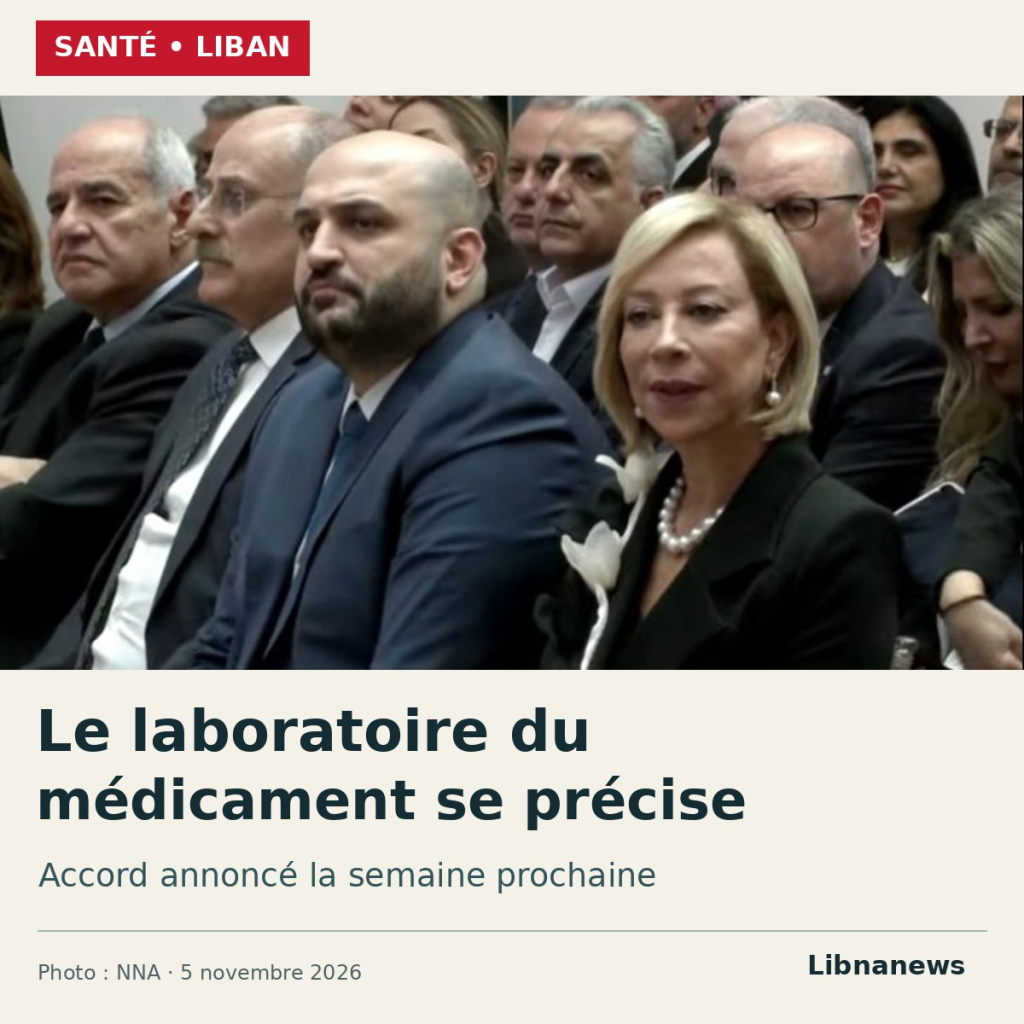
Lebanon is expected to sign next week the agreement to set up its pharmaceutical reference laboratory, with an announced start in the coming months. Minister of Health Rakan Nassereddine gave this calendar on Thursday, 5 November, when a campaign to support the Lebanese medicine was launched. For patients and manufacturers alike, the scope of the project will now depend on very concrete means: reliable analyses, trained teams and an authority able to follow up on the results.
At the Beirut National Museum, the ceremony included First Lady Nehmat Aoun, Minister of Industry Joe Issa El Khoury and representatives of the pharmaceutical sector. Behind the calls to buy Lebanese, the most tangible announcement concerned a long-awaited control tool. According toreport of the National Information AgencyThe Ministry started equipping the Central Laboratory with the agreement of the President of the Republic and the Prime Minister.
An agreement expected, then several months of preparation
The scheme must be developed in partnership with the Lebanese University. The Minister announced the signing of the agreement « Next week », and a start in the coming months. It did not give an opening day or present, in this report, the budget, the list of equipment, the number of personnel or the number of samples that the laboratory could process.
This announcement extends a working meeting held on 2 November between Rakan Nassereddine and the President of the Lebanese University, Bassam Badran. Theministry of Health then indicatedadministrative and technical preparations were discussed to assess the quality of pharmaceutical products according to international scientific criteria. The timetable announced on Thursday is therefore an additional step, still to be translated into a signed agreement and into effective operation.
The Minister recalled that, according to him, the country had failed to establish this reference laboratory in 35 years, despite the requirements for registration of drugs. This applies to the public structure announced. It does not mean that Lebanon would have no university, hospital or private laboratories.
What the analyses should bring
A testing laboratory may verify the conformity of samples to the applicable specifications and examine products suspected of being defective or falsified. Its usefulness lies in the reliability of the result, but also in what happens next: transmission to the competent authority, investigation and, where justified, measures on the products concerned.
Thegood practices published by the World Health Organization in 2024describe the necessary conditions: qualified personnel, equipment followed, appropriate methods, traceability of samples and data. They include market control as a whole, which also includes the inspection and monitoring of drug safety. The purchase of machinery is therefore not sufficient to make the service operational.
The recognized competence of the laboratory should also be specified. The press release does not state which product families will be covered initially, with which tests or according to which accreditation schedule. These distinctions count: a quality analysis on a batch does not alone demonstrate the clinical efficacy of a treatment. Organic products, in particular, require appropriate approaches.
The drug agency remains to be established
The laboratory is presented as an essential tool of the future National Drug Agency. According to the Minister, this agency is still not constituted, despite the adoption of its implementing decree. He said that he had seized the relevant administrations and called on the three Presidencies to advance the appointments.
Rakan Nassereddine attributed the main block to the « muhassassa », the division of positions according to political and denominational balances. This charge is that of the minister. However, it highlights the immediate difficulty of the project: the laboratory could advance technically while the organisation responsible for supervising the sector remains incomplete.
The government will need to clarify the responsibilities during this transition. Who will set the sampling priorities? Who will receive a non-compliant result? What procedure will make it possible to act quickly and safeguard the rights of the undertakings concerned? The convention with the Lebanese University should specify the chain of decision as well as the material means. Otherwise, an analysis may remain an additional administrative document.
Support production without weakening control
The announcement was made within an industrial promotion framework. The president of the manufacturers’ union, Carole Abi Karam, said that the share of Lebanese medicines had risen from 7% before 2019 to about 30% today. The report does not specify whether this comparison relates to volumes, sales value or any other indicator. It must be read as an estimate presented by the profession, without giving it a precision that it does not have.
The development of local manufacturing can reduce certain dependencies and support employment. It also reinforces the need for credible control, applicable to both Lebanese and imported medicines. Manufacturers should be able to present recognised results; patients must be able to rely on the same requirements regardless of the origin of the box.
This point deserves special vigilance when public authorities simultaneously encourage production and organise its supervision. The criteria for analysis, procedures for non-compliance, and conflict of interest prevention rules should be explicit. The scientific independence of the laboratory will also protect companies that meet the standards against less scrupulous competition.
The first deadline is now close: the promised signature for next week. The publication of the agreement, of the resources committed and of a timetable for the increase in expenditure would help to measure progress. After repeated announcements on drug reform, it is on these verifiable commitments that the project will be judged.





Comments