

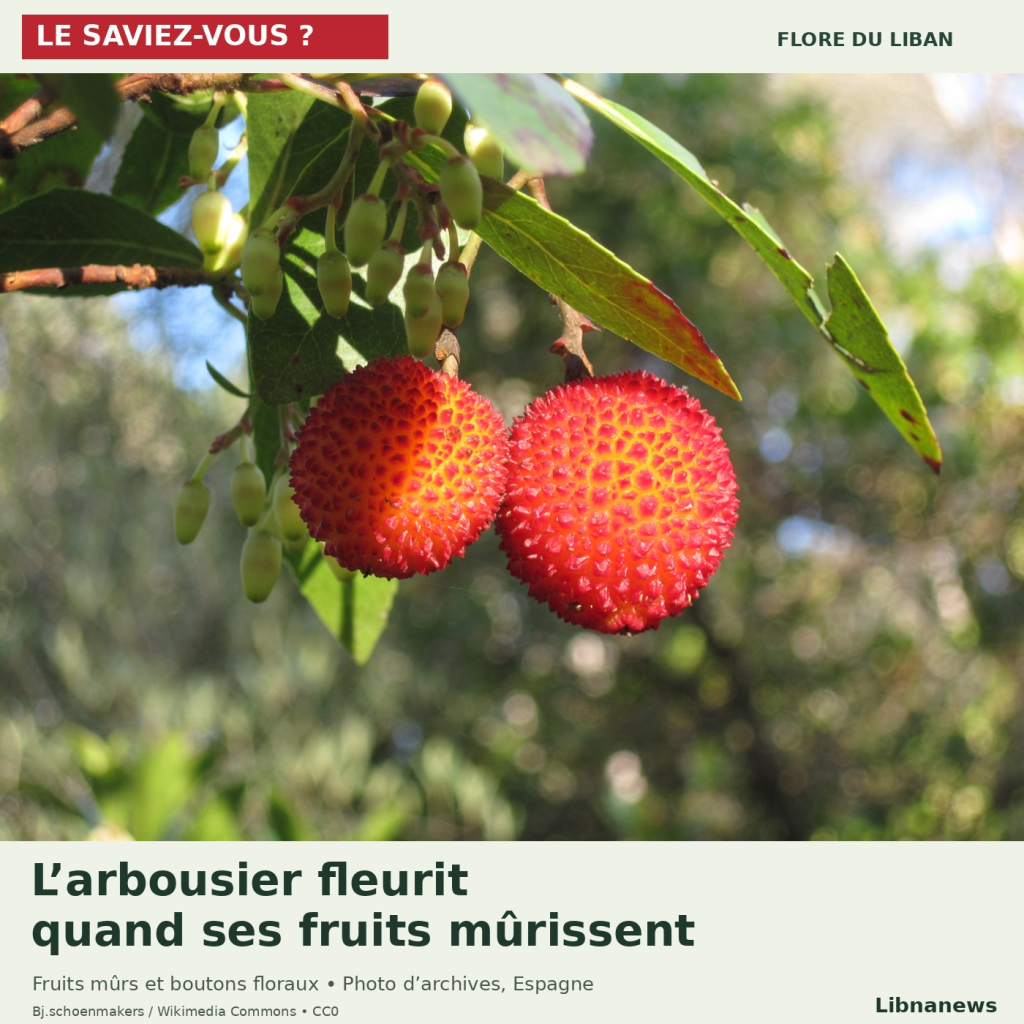
Did you know that? The tree can bear ripe flowers and fruit at the same time. In the fall, its small, light bells sometimes come alongside red arbouses. The fruits come from the previous flowering: they spent almost a year on the tree before reaching maturity.
This particularity belongs toArbutus undo, a Mediterranean species that the American University of Beirut ranks among the native plants of Lebanon. A tree of Lebanese natural heritage, therefore, whose calendar reads in the branches.
Almost a year to mature
In this shrub, flowering begins in autumn. The fruits which then form take their time: they mature in the following autumn, while a new flowering may already begin. The Botanical Garden of Cambridge University describes this overlap between the two generations on the same subject.
To understand what is seen, it is necessary to go back from one flowering season to another. The flowers of the moment prepare future fruits. Red arbouses, on the other hand, complete a development initiated much earlier. Their presence side by side does not mean that the flower has become fruit in a few days.
This rhythm is long even before opening flowers. A study published in November 2025Frontiers in Plant Science, carried out on three trees of the botanical garden of Rome Tor Vergata, followed their development between June 2023 and January 2024. The researchers distinguish seven stages, from the young button to the open flower. These observations were made in Rome and do not describe the precise timetable of Lebanese populations.
Green foliage, bells and red fruits
The tree keeps its leaves all year round. They are tough, shiny and lined with small teeth. The flowers, grouped in hanging clusters, take the form of small white bells with cream, sometimes pink. The fruits are rounded, with a well-recognized granular surface, and turn to orange and then to red while ripening.
It is this look that gives him the nickname of « tree with strawberries ». It belongs to the Ericaceae, the heather family. The National Museum of Natural History describes a sweet and acidic flesh, but rather floury. Arbouses are edible and are used to make jams. However, a photograph is not enough to identify a wild fruit before consuming it.
In Lebanon, distinguish between the two shrubs
The common name may be confusing. Lebanon also hostsArbutus andrachne, often called arbousier of Greece or eastern arbousier. He also keeps his foliage and bears orange red fruits. Its smooth bark stands out in thin plates, revealing changing hues.
Its timing differs: its flowering is usually spring, while its fruit matures in autumn. It is therefore not possible to attribute to all the shrubs the autumnal encounter of flowers and fruit characteristic ofArbutus undo. The name of the species counts as much as the colour of the berries.
To observe this detail, it is best to look at the whole branch: leaves, clusters of buds or flowers and fruits present. Depending on the place and conditions of the year, they are not all at the same stage. The photo accompanying this article, taken in Spain in December 2011, shows two ripe shrubs next to flower buds still closed.
Photograph:Bj.schoenmakers / Wikimedia CommonsMontes de Málaga, Spain, 25 December 2011,CC0. Original photo preserved, resized and accompanied by a typographical dressing.






Comments