

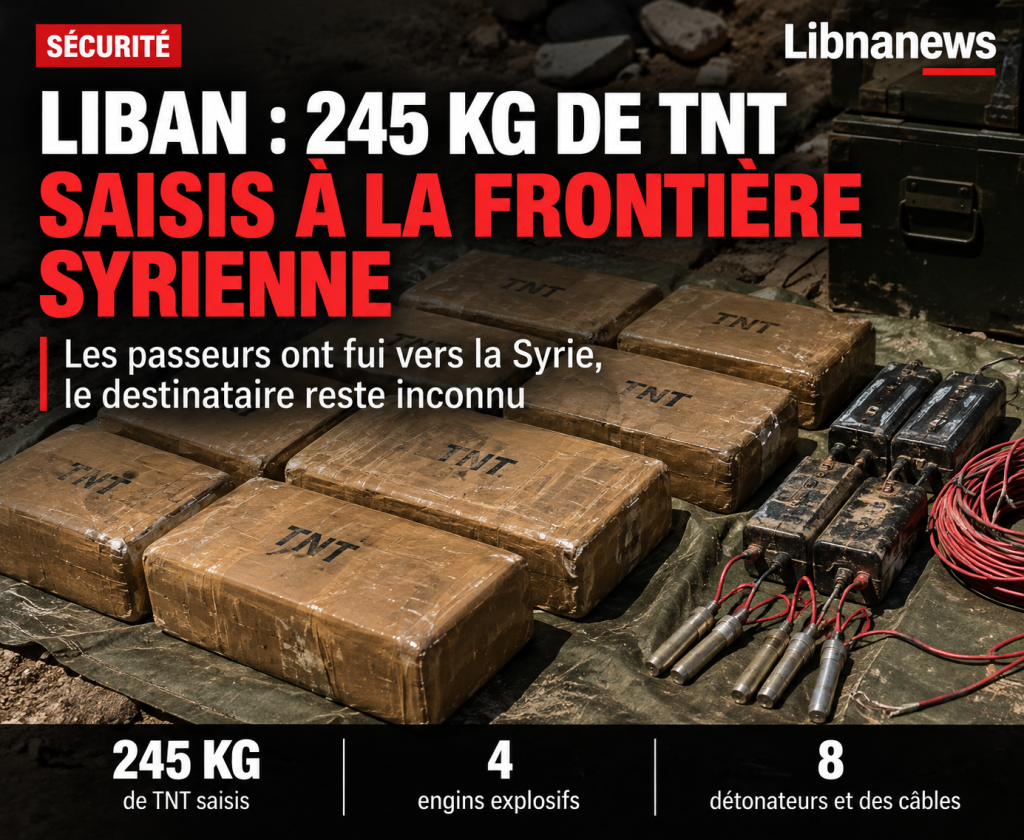
The Lebanese Armed Forces announced the seizure of245 kilograms of TNTfour explosive devices and eight detonators during an operation against trafficking from Syria to Lebanon. The smugglers managed to escape to Syrian territory upon the arrival of a patrol. The quantity and nature of the material seized now raises a central question: to whom was this cargo destined?
245 kg of TNT intercepted from Syria
The seizure was carried out on Thursday, 1 October, following military surveillance operations on the northern and eastern borders of Lebanon.
A military unit discovered a cargo of approximately 245 kilograms of highly explosive TNT.
The military also recovered four explosive devices, eight detonators and electrical cables for firing.
According to the army’s statement, all of them were being smuggled from Syrian territory to Lebanese territory.
However, smugglers were not arrested. They fled to Syria as soon as the Lebanese patrol arrived.
The material seized was handed over to the competent authorities. The army continues its investigations and coordination to identify and arrest those involved in the operation.
The amount seized distinguishes this case from a simple interception of individual weapons. TNT is a military explosive that can be used in different types of devices. The simultaneous presence of explosive devices, detonators and cables reinforces the safe importance of discovery.
However, the army did not communicate the exact location of the seizure or the route followed by the smugglers.
The destination of explosives remains unknown
The main element still missing from the file concerns the consignee of the cargo.
The military communiqué does not designate any organization and does not specify whether the intelligence services already have information on the network to receive the explosives in Lebanon.
It would therefore be premature to assign the cargo to a particular actor.
Several hypotheses can theoretically be considered in a secure environment where different networks have historically used clandestine passages between Lebanon and Syria.
A destination to Hezbollah cannot be claimed solely on the basis of the direction of traffic. The Syrian authorities have repeatedly announced interceptions of arms shipments that they presented as intended for the Lebanese Shia movement. Hezbollah denied any presence or activity on Syrian territory.
But the hypothesis of a destination to a jihadist cell or network linked to an organisation likeDaeshnor can they be excluded in theory until the sponsors have been identified.
Above all, it cannot be presented as established.
Lebanon and Syria have experienced the activity of jihadist groups in certain border areas over the past decade. The Islamic State organizations and the Nusra Front had, inter alia, occupied mountainous areas close to the Lebanese-Syrian border before the military operations that had driven them out.
This safe history makes it necessary to examine several leads when discovering a large amount of explosives. However, it does not constitute evidence of the cargo seized this week.
Other scenarios remain possible, such as a criminal network selling explosives to different clients without a particular political or jihadist affiliation.
The identification of the couriers and the network responsible for receiving the equipment will therefore be essential for establishing its actual destination.
The meaning of traffic is not enough to identify its beneficiary
The case has one particular feature: explosives were circulatingfrom Syria to Lebanonprotection caps (if present).
This detail may provide different interpretations in the current political context, but it is not possible to determine the identity of the recipient alone.
Since the fall of Bashar al-Assad in late 2024, the new Syrian authorities have announced several interceptions of arms shipments to Lebanon.
Some of these files were publicly linked by Damascus to networks accused of working for Hezbollah.
This situation explains why this trail can be immediately raised after a new seizure on the border. But the communiqué issued by the Lebanese Army on 1 October makes no such rapprochement.
The very nature of the cargo also requires that investigations should not be limited to a single hypothesis.
The four explosive devices already present with the 245 kilograms of TNT could, among other things, provide technical information to investigators. Their manufacture, components and assembly may help to determine their origin or to establish reconciliations with previous seizures.
No results of such expertise have been made public at the moment.
A border of 330 kilometres difficult to control
Lebanon and Syria share about330 kilometres of borderprotection caps (if present).
Part of this line crosses mountainous and rural areas where informal routes have long existed. Smuggling is a recurring problem for both States.
These networks not only carry weapons.
Fuels, goods, people and narcotics have travelled in both directions throughout economic, political and security crises.
In particular, Captagon has occupied an important place in regional traffic. Since the change of power in Damascus, the Lebanese and Syrian authorities have shown their willingness to strengthen the fight against these networks.
However, the problem remains complex because of the length of the border and the geography of certain areas.
The Lebanese Army has strengthened its surveillance operations and measures against clandestine infiltration. At the beginning of September, it announced the arrest of 108 Syrian nationals illegally entering Lebanon during a series of operations in different regions.
On 1 October, in conjunction with the seizure of explosives, another operation in Boudai, in the Baalbeck area, discovered equipment and raw materials for the manufacture of narcotic drugs, weapons and ammunition.
These operations demonstrate the diversity of trafficking faced by security forces.
Border control becomes a bilateral issue
The political change in Syria has altered security relations between Beirut and Damascus.
Both countries now have an interest in limiting the activity of illegal networks using the border. For the Lebanese authorities, the issue concerns both arms trafficking, narcotics, illegal passages and the risks associated with armed groups.
For Damascus, the control of passages to Lebanon is also part of the consolidation of its authority over Syrian territory after years of war.
However, the escape of smugglers during the operation on 1 October shows the practical limitations of the device.
According to the Lebanese army, the suspects were able to return to Syria before their arrest. The further investigation therefore requires cross-border coordination if their identity or route can be established.
The army states precisely that monitoring and coordination are continuing to arrest the people involved.
This step will be decisive in understanding whether the interception is an isolated operation or whether it can be traced back to a structured network.
A seizure in a sensitive security environment
The case occurs when the Lebanese armed forces are mobilized on several fronts.
The army must strengthen its control of the eastern and northern borders while assuming increasing responsibilities in the south of the country.
Tensions with Israel and deployment in the southern border areas require a significant part of its resources.
At the same time, arms control is a major domestic political issue. The government defends the principle of a state monopoly on arms and on the decision on war and peace.
In this context, a cargo of nearly a quarter of a tonne of TNT entering Lebanon illegally represents a particularly sensitive case, regardless of the identity of its consignee.
The discovery also raises a question about the possible existence of other cargoes on the same route.
In order to respond, the investigators will need to identify the smugglers, determine the starting point of the equipment in Syria and find the people who had to pick it up in Lebanon.
It is these elements that will eventually make it possible to establish a connection with a particular organization.





Comments