

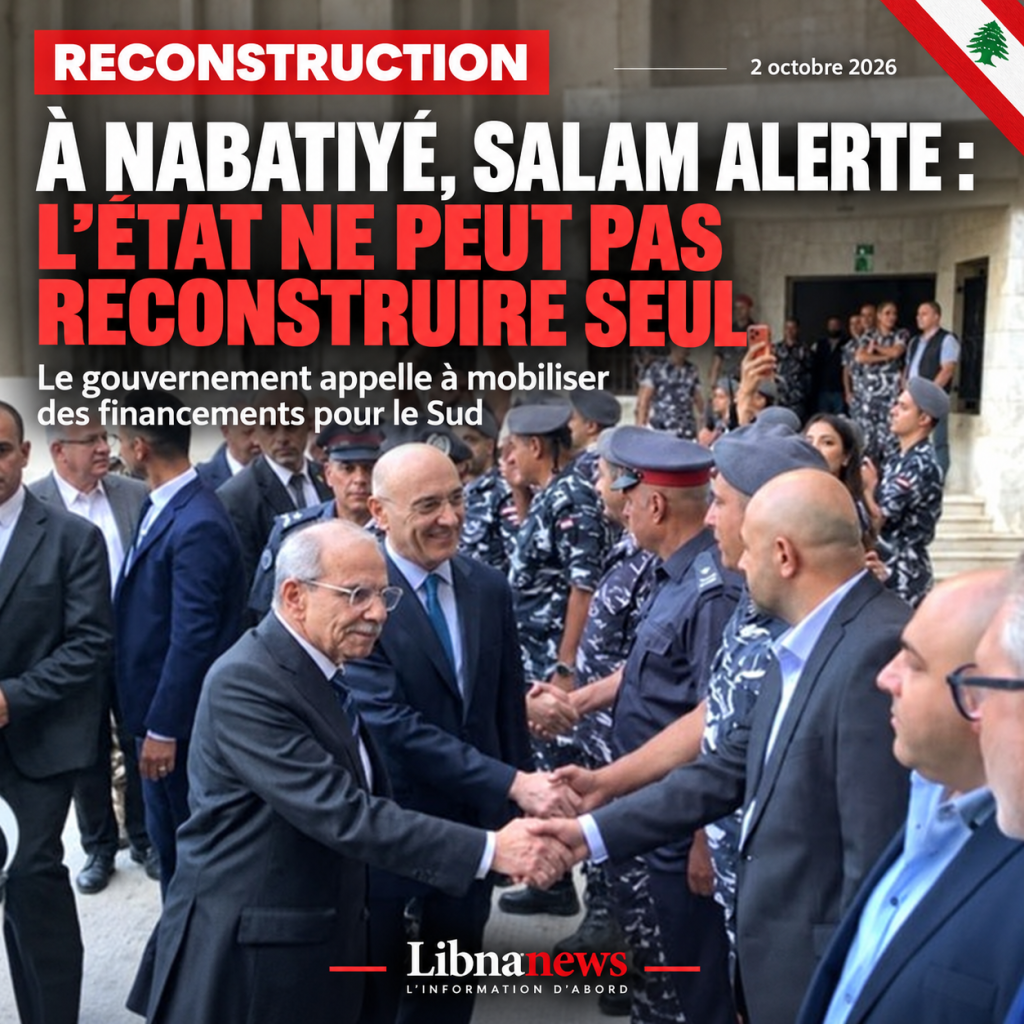
Prime Minister of LebanonAmbassador Nawaf Salamannounced Friday, 2 October in Nabatiyah, the launch or preparation of several dozens of contracts to restore public services and support the reconstruction of the South Lebanon. The Council for Development and Reconstruction has issued 23 calls for tenders and is expected to open another 12 during the month, including five hospitals. On a visit to a region heavily affected by the war, however, the Head of Government acknowledged that the needs exceeded the financial capacity of the State. It set three priorities: stopping Israeli attacks, fully withdrawing Israel from Lebanese territory and ensuring the safe return of its inhabitants.
Salam announces 23 tenders in Nabatiyah
For his third visit to Nabatiyah since the formation of his government, Nawaf Salam wanted to present concrete achievements rather than a new schedule of promises.
The Prime Minister visited the Nabatiyah Internal Security Forces Company in Kfarjouz on Friday. He was accompanied by Minister of Finance Yassine Jaber, Minister of Labour Mohammad Haidar, Minister of Interior and Municipalities Ahmad Hajjar, as well as security officials and public bodies.
Salam announced that the Council for Development and Reconstruction had launched23 calls for tendersincluding several projects in Nabatiyah District.
These include the clearance of obstacles, the rehabilitation of roads and the rehabilitation of accommodation centres. The programme also provides for the acquisition of ambulances, medical equipment and radio and satellite communications equipment.
Twelve additional calls for tenders are due in October.
They will include the rehabilitation of five hospitals, including the government hospital in Nabatiyah, as well as the provision of vehicles and equipment for emergency and firefighting operations.
Markets for the rehabilitation of power plants and water systems are also under preparation.
For the government, these projects must mark the transition from a phase devoted to the evaluation of destruction to that of public procurement and the execution of works.
Public services reopen in the city
The visit was also devoted to the return of public administrations to Nabatiyah.
Salam announced the completion of the restoration of the city’s government seral, carried out through an initiative of the Husseini Club. At the same time, several services must resume their activities.
The State Security Centre and the Civil Registry Service are reopening, as is the General Security Centre. The Courthouse is also expected to resume its activities in the near future.
The Head of Government presented these reopenings as a component of the return of the State to a region deeply disturbed by the war.
The Southern Council intervenes after assessing the damage and removing rubble. It must begin the construction of a new Civil Defence headquarters, whose first stone is laid on the occasion of the government visit.
The security dimension was also present. Starting with the ISP company in Kfarjouz, Salam wanted to focus on the role of the security forces and on strengthening their capabilities.
His message to the police focused on their proximity to the population. The government wants to combine material reconstruction, the return of administrations and the restoration of security institutions.
The reconstruction of the South exceeds the capacity of the State
Despite these announcements, Nawaf Salam acknowledged that the projects undertaken remain limited in terms of the extent of the destruction.
The Prime Minister referred to destroyed housing, displacement and the loss of jobs or sources of income. Most importantly, it acknowledged that the available funding did not allow the State to meet all needs on its own.
» The volume of needs exceeds the capacity of the Lebanese State », he said in substance to the officials and inhabitants of Nabatiyah.
The government is still looking for significant external funding.
Salam recalled having carried the needs of the South during his recent trips to New York and Washington. His discussions with international officials included the resources needed to finance recovery and reconstruction.
Last week, he had participated in several meetings in New York to mobilize Arab and international support for Lebanon.
The question of financing became central as the scale of destruction increased. The Prime Minister had recently estimated that the cumulative cost of wars could exceed $27 billion.
The projects announced on Friday therefore cover only part of the needs. Above all, they must enable the restoration of essential infrastructure and services in areas where intervention can begin immediately.
Reconstruction delayed by the new war
Salam also put the October 2 announcements back in the timeline of the last few months.
During his first visit to Nabatiyah after his government had obtained parliamentary confidence, he had met with local residents and officials to identify their needs.
A few months later, a second visit was devoted to launching the reconstruction process, after obtaining a first funding envelope.
The new war interrupted this dynamic.
Additional destruction increased needs, resulted in further loss of life and created emergencies that did not exist in the early stages of the programme.
The Government must now take over previous projects while integrating the consequences of this new phase of the conflict.
In this context, on Friday Salam insisted on the concrete nature of the tenders announced. However, he refused to present the works as a sufficient response to the damage suffered by Nabatiyah and the whole South.
The available funding will determine the speed and extent of reconstruction.
Salam sets three priorities for the South
Beyond infrastructure projects, the Prime Minister defined his government’s political priorities for South Lebanon.
The first concernsstop israeli attacksprotection caps (if present).
The second concerns thefull withdrawal of israeli forces from lebanese territoryprotection caps (if present).
The third concerns thesafe and dignified return to their homeswith the restoration of their livelihoods.
These objectives remain closely linked to reconstruction. The rehabilitation of a road, hospital or water system is not sufficient to allow the sustainable return of a population if safety conditions are not met.
Israeli attacks continued in several areas of the South despite the decrease in the intensity of violence observed since June. In particular, the Nabatiyah region and its surroundings continued to be affected.
On 25 September, several areas around Nabatiyé were again hit, including Bani Hayyan, Kfartebnit and Zawtar al-Sharkiyé. Artillery fire had also been reported in several localities.
The security situation therefore remains one of the main obstacles to sustainable reconstruction and the return of displaced persons.
» An army, a decision » : Salam reaffirms its line
Nabatiyah’s visit also gave rise to a political stance on the conditions, according to Nawaf Salam, necessary to prevent a new war.
When asked about guarantees to avoid a resumption of hostilities, the Prime Minister defended the strengthening of the State and its institutions.
He pleaded for « a single State for all its citizens », with a single army and decision-making authority, including on war and peace.
This position prolongs Salam’s position in recent weeks.
During his meetings in New York and then in Washington, he had already stated that the decision to wage war and peace should be made exclusively by the Lebanese State. At the same time, it called for Israeli withdrawal and the restoration of Lebanese sovereignty over the entire territory.
This line faces Hizbullah’s refusal to disarm as long as Lebanese territories remain under Israeli occupation. The subject remains one of the main points of political tension in the country.
Salam acknowledged to Nabatiyah the existence of differences on this issue. He maintained, however, that the reconstruction of a State capable of exercising its authority was, according to his Government, the guarantee to reduce the risk of a new war.
Government refuses to wait for great regional agreement
The Prime Minister also rejected the idea of suspending Lebanese decisions to a future regional agreement.
In his view, such a solution could take several years, never materialize or intervene in conditions unfavourable to Lebanon.
In particular, Salam raised the question of the cost to the people of the South of a new regional war.
His argument relates to urgency: displaced persons cannot remain indefinitely in wait, while the reconstruction of houses, public services and economic activities remains suspended.
This position is in line with the Government’s approach to the United States and its international partners.
On 29 September in Washington, during a meeting with US Secretary of State Marco Rubio, Salam called for concrete steps to be taken in the Lebanon-Israel arrangements. In particular, it had called for a complete Israeli withdrawal and the restoration of State sovereignty.
In Nabatiyé on Friday, this diplomatic speech was translated into a series of local announcements: reopening of administrations, rehabilitation of infrastructure, emergency equipment and new calls for tenders.
The timing of this work will now depend on the allocation procedures and especially the funding available. After the 23 tenders already launched,12 others are due in octoberincluding the rehabilitation of five hospitals, including Nabatiyah.





Comments