

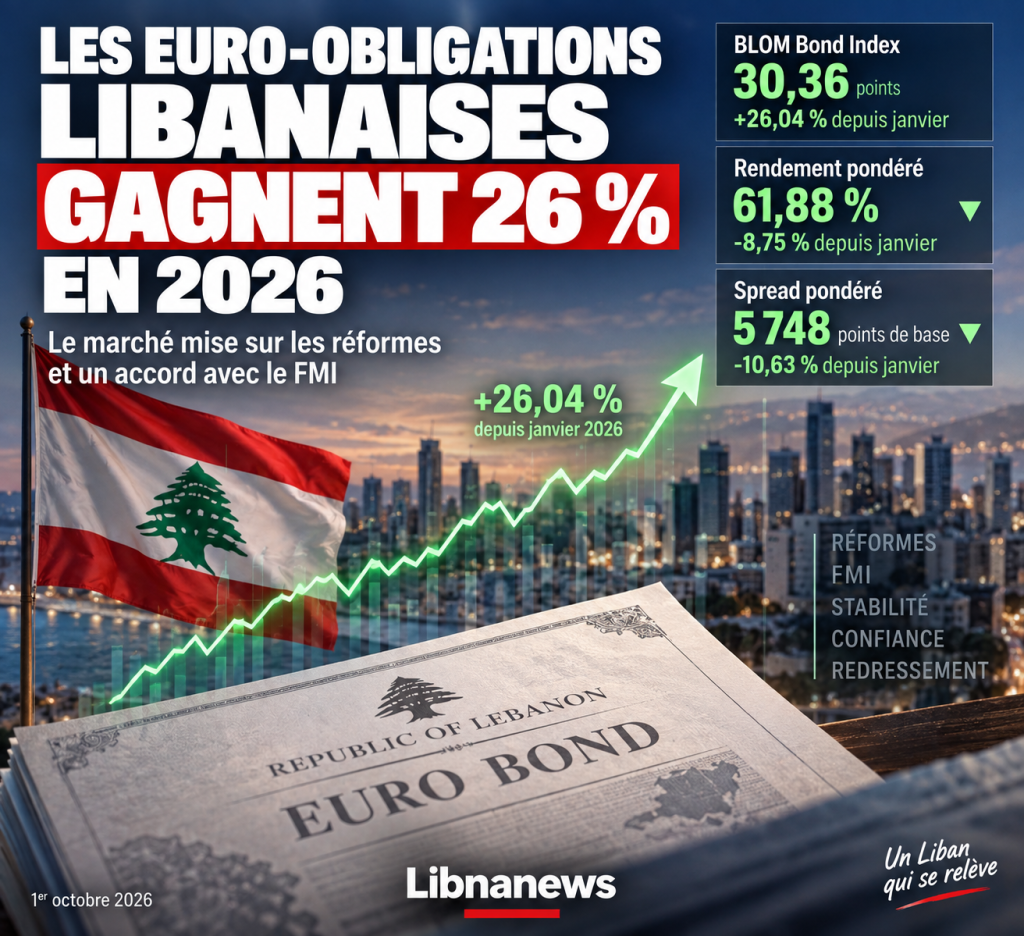
Thelebanese eurobondscontinued their progress during the week ended 1 October 2026. The BLOM Bond Index (BBI), which measures their performance without coupon payments, earned 1.88% in one week to reach 30.36 points. The increase has now reached 26.04 % since the beginning of the year. This progress is taking place against the background of economic and security developments in Lebanon, while prospects for an agreement with the International Monetary Fund and progress on several reform issues continue to fuel market expectations.
BLOM Bond Index reaches 30.36 points
The trend remains positive in the Lebanese sovereign foreign currency debt market.
As of 1 October, the BLOM Bond Index was30.36 pointsagainst 29.80 on 24 September. It thus shows a weekly increase of 1.88%.
The movement has been even more marked since the beginning of the year. The BBI has won 26.04 per cent since January 2026, confirming the recovery in Lebanese sovereign securities prices.
This rise in prices mechanically leads to lower yields. The weighted average return on euro bonds thus increased from 62.42% on 24 September to61.88 % on 1 october.
The decline reached 54 basis points in a week. Since the beginning of the year, the weighted return has decreased by 8.75 %.
The weighted spread follows the same direction. It has gone from 5,794 to5,748 basis points, a weekly decrease of 0.81%. Since January, it has fallen to 10.63 per cent.
| Indicator | 24 september 2026 | 1 october 2026 | Weekly change | Since January |
|---|---|---|---|---|
| BLOM Bond Index | 29.80 | 30.36 | +1.88% | +26,04 % |
| Weighted yield | 62,42 % | 61.88 % | -0.86% | -8.75% |
| Weighted spread | 5 794 pb | 5 748 pb | -0.81 % | -10,63 % |
The three indicators thus describe the same evolution. Prices are rising, while yields and spreads are declining.
However, absolute levels remain far removed from a standard financial situation. A weighted return of more than 60% and a spread of several thousand basis points continue to reflect exceptionally high sovereign risk.
Lebanese Eurobonds: the market for reforms
Thelebanese eurobondsas several economic and financial issues evolve simultaneously.
In particular, the market is monitoring the prospects for an agreement between Lebanon and the International Monetary Fund. Resuming dialogue with the IMF is a key element, as an international financial programme would require concrete progress in bank restructuring, the treatment of financial losses and the consolidation of public finances.
IMF Executive Director Kristalina Georgieva met with Prime Minister Nawaf Salam. The Fund reaffirmed its commitment to assist Lebanon in designing and implementing a comprehensive reform agenda.
The IMF acknowledges some progress made by the Lebanese authorities. He also stressed the macroeconomic stability maintained in a difficult environment.
However, this progress does not mean that a financial agreement is imminent or acquired.
Several conditions remain to be met. These include banking resolution, treatment of the accumulated financial deficit, fiscal policy and structural reforms.
For investors on Lebanese debt, these issues are of particular importance. Their outcome could determine the conditions for future restructuring of sovereign debt and hence the value ultimately recovered from the euro bonds currently in default.
IMF still waiting for several Beirut measures
Discussions with the Fund remain conditional on specific legislative and economic decisions.
In particular, the IMF awaits the entry into force of a satisfactory framework for bank resolution. He also called for legislation to deal with the financial deficit accumulated in the system.
A third component is the 2027 budget and the fiscal trajectory.
The Fund calls on Lebanon to put in place a medium-term budgetary framework compatible with the sustainability of public debt. The objective is to prevent any restructuring from being followed by a new accumulation of unsustainable deficits and debt.
These requirements explain why institutional progress is closely monitored in the bond market.
Lebanon had already concluded a preliminary agreement with the IMF in April 2022. However, it had never led to a comprehensive financial programme, due to the lack of several prior reforms.
The current situation places the authorities at a well-known challenge: turning political and legislative commitments into effective measures.
Banking restructuring remains central
One of the most sensitive issues is the reorganization of the banking sector.
The Lebanese Parliament adopted amendments to the legislation on the banking resolution in August. The IMF had seen this as an important step towards establishing a framework for restructuring institutions in difficulty.
The issue goes far beyond the internal functioning of banks.
Since the outbreak of the financial crisis in 2019, Lebanon has had to determine how to allocate the accumulated losses between the State, the Bank of Lebanon, banks, their shareholders and other relevant actors.
This distribution is directly related to the issue of bank deposits.
The treatment of losses must also remain compatible with the restructuring of the public debt. A solution that would transfer an excessive financial burden to the State could compromise its ability to recover a sustainable debt.
For eurobond holders, the issue is therefore essential. The future financial capacity of the State will depend in part on how all these commitments will be addressed.
The « financial gap » still to be settled
The other major project concerns the law to deal with the accumulated financial deficit.
This case, generally referred to in Lebanon as the « financial gap », must establish mechanisms for allocating losses and determining how deposits are recovered.
In particular, IMF insists on respect for the debt hierarchy.
Under this principle, shareholders and lower-ranking creditors must absorb losses before they are imposed on depositors. The treatment chosen must also preserve the viability of banks that can continue to operate after restructuring.
The challenge is to find a balance between several objectives that are difficult to reconcile: to protect depositors as much as possible, to clean up banks, to preserve public finances and to make government debt sustainable.
This financial architecture will necessarily have consequences for the future restructuring of euro bonds.
For this reason, any progress in discussions with the IMF can influence investors’ expectations even before a final agreement is reached.
A significant increase, but still a massive discount
The 26.04 per cent increase in the BLOM Bond Index since January must be seen in the context of the Lebanese sovereign default.
Lebanon ceased to repay its Eurobonds in March 2020, opening an extended default period on its external debt. Since then, securities have been traded with a considerable discount relative to their nominal value.
The rise of the BBI to 30.36 points thus reflects an improvement in expectations rather than a return to a normal situation.
Investors continue to integrate debt restructuring and significant uncertainty about its modalities.
The level of weighted yield clearly illustrates. Despite its decline to 61.88 per cent, it remains extremely high.
The same applies to the 5,748 basis point spread. Such a gap always reflects a very high perception of the risk associated with Lebanese sovereign debt.
However, the increase observed since January shows that the market now values bonds more than at the beginning of the year. The continuation of this movement will largely depend on the economic and political decisions that still need to be taken.
Budget 2027 also under surveillance
Investors are also following the preparation of the 2027 budget.
For the IMF, a return to a credible fiscal trajectory is an essential condition for sustainable debt restructuring.
The Fund calls for a medium-term budgetary framework capable of ensuring the sustainability of public finances. He also stressed the need to improve the management of State finances and governance.
This dimension is particularly important after several years in which the financial crisis, the contraction of the economy and the collapse of the pound have profoundly changed the structure of public revenue and expenditure.
The restoration of a predictable fiscal policy is therefore one of the elements needed to rebuild the state’s financial credibility.
For the bond market, the question is simple: restructuring can only improve the situation sustainably if the resulting debt can then be honoured.
Investors will thus seek to measure not only the progress of the reform texts, but also their application and impact on public accounts.
Security remains a volatility factor
Economic factors are not the only factors influencing the market.
BLOMINvest stresses that the development of Eurobonds during the week is also in the context of security developments in Lebanon.
The persistence of tensions poses a risk to economic activity, public finances and prospects for recovery. A significant deterioration in the situation could therefore affect the expectations that supported the increase in bonds.
Conversely, a security stabilization combined with concrete progress in reforms could reinforce the perception of a more predictable financial path.
The 1.88% increase recorded in the last week of September shows, for the time being, that favourable factors continued to support prices despite these risks.
The next test will be the ability of the authorities to transform legislative advances and discussions with the IMF into operational measures. On October 1st, the market has already integrated some of these expectations: the BLOM Bond Index stands at 30.36 points, up more than a quarter since the beginning of 2026.





Comments