

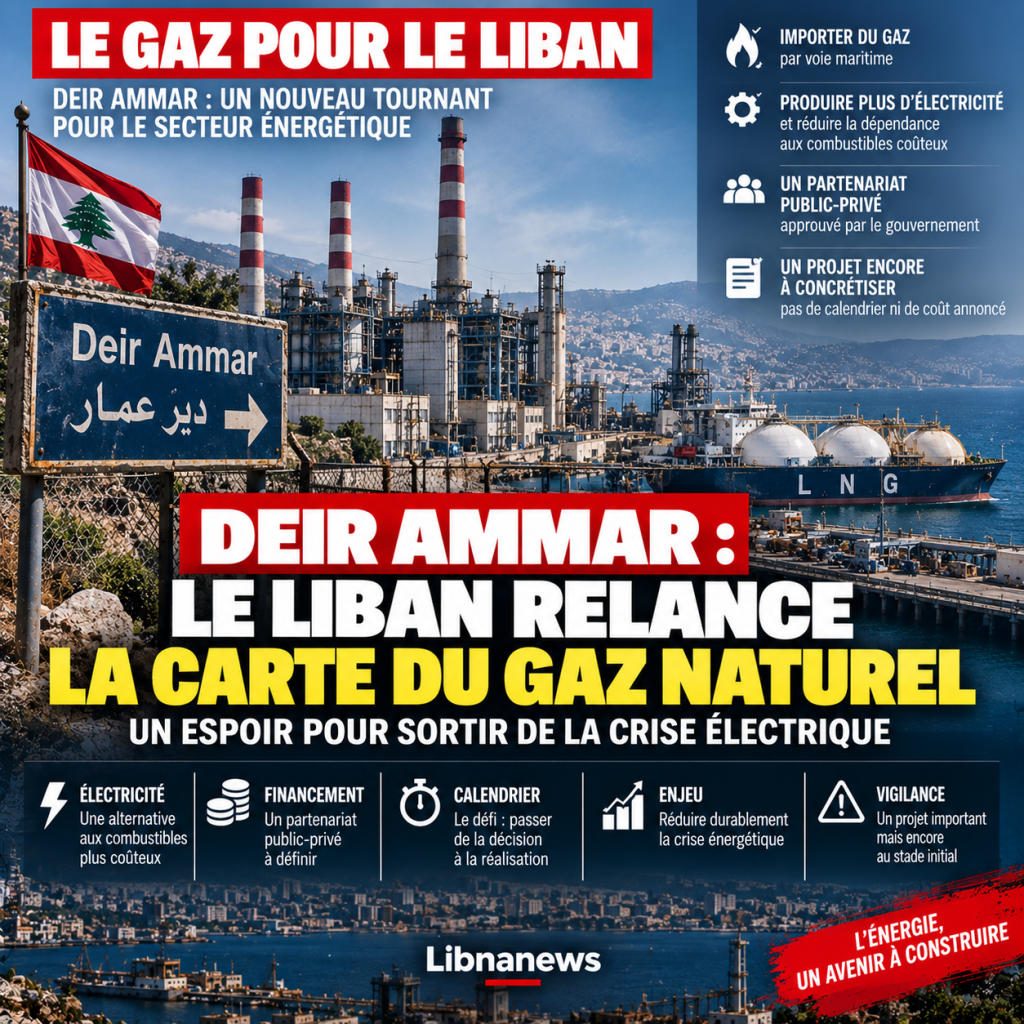
The government of Nawaf Salam has reached a new stage in its search for a solution to the Lebanese energy deficit. At its meeting on 1 October 2026, the Council of Ministers approved a project to convert liquefied natural gas into natural gas in the Deir Ammar region in the north of the country. The scheme must be developed on the basis of a partnership between the public and private sectors. Behind this relatively discreet decision is a strategic choice: to create an infrastructure to import gas by sea to supply the Lebanese energy system.
However, the government decision does not mean that a terminal is already funded, built or about to enter service. The corpus documents indicate the approval of the project, but do not provide a detailed construction schedule, final cost, identity of a selected private operator, or date of commencement. This difference is fundamental. Lebanon has a long history of energy projects announced and subsequently delayed. The challenge therefore begins after the decision of the Council of Ministers: to transform a political orientation into a truly funded and exploitable infrastructure.
A regasification project rather than a new production source
The approved device is based on a floating storage and regasification unit. Its principle is to receive liquefied natural gas transported by ship. The gas is kept in liquid form during transport in order to significantly reduce its volume. Upon arrival at the terminal, it must be returned to the gaseous state before being injected into the energy installations.
The project therefore does not create a new Lebanese gas resource. It offers an additional way to import fuel. This is important in a country where gas discussions are often associated with offshore resources and prospects for exploitation in the Mediterranean. Deir Ammar responds to a different logic. The aim is to be able to buy gas from outside markets and to have the infrastructure to receive it.
The interest of a floating unit lies in its flexibility in relation to the construction of a large land terminal. But this flexibility does not remove infrastructure needs. Regasified gas must be transported to the plants that consume it. Connection, security, port equipment and operating conditions must therefore be integrated into the project.
The October 2 sources do not provide the technical characteristics chosen by the government. Nor can they determine the intended capacity of the installation. It would therefore be premature to estimate precisely the amount of electricity that could be generated by the device.
Why Deir Ammar occupies a strategic position
The choice of Deir Ammar is not trivial. Northern Lebanon concentrates several energy infrastructures and is at the heart of various regional connection projects. The Government is now seeking to add an import capacity of liquefied natural gas to this package.
This location can also be reconciled with the ongoing reflections on the economic role of Tripoli and the north. Railway projects are being considered towards the Syrian border. Energy talks exist with Turkey and Syria. The possibility of electrical interconnections is investigated. The former Tripoli oil infrastructure is also returning to the regional debates.
Deir Ammar could thus become a piece of a larger ensemble. However, it would be premature to present all these projects as the components already decided upon in a single plan. Sources show separate discussions and initiatives, some of which are much more advanced than others.
The decision on liquefied natural gas, however, has an important difference: it has been formally approved by the Council of Ministers. The file thus leaves the simple stage of diplomatic ideas or discussions.
Gas could reduce fuel dependency more expensive
The economic interest of gas lies largely in its use as a fuel for electricity production. The Lebanese system has long suffered from a costly energy supply and dependence on oil products whose prices weigh heavily on the sector’s finances.
Powering certain installations with gas can offer an alternative. But the ultimate benefit will depend on the price at which Lebanon will buy liquefied natural gas, the cost of its transport, the cost of regasification and the efficiency of the plants that will use it. The existence of a terminal does not automatically guarantee cheap electricity.
The international price of gas can vary greatly. An importing country must also secure its contracts and organize its supply. It can choose long-term contracts or be more exposed to spot markets. These choices partly determine the stability of costs.
The corpus does not provide any indication of the commercial strategy Lebanon would adopt. No supplier is identified in the available items. It is therefore not possible to say where gas would come from or at what price it would be purchased.
The government’s decision begins with the infrastructure needed to receive this fuel.
A public-private partnership to avoid a burden entirely borne by the State
The Council of Ministers has chosen the principle of a partnership between the public and private sectors. This approach responds to an obvious constraint: Lebanese public finances have limited margins to finance only a major new energy infrastructure.
The partnership can mobilize private capital, technical skills and operating capacity that the State does not necessarily want to assume directly. But this formula does not make the project free for public finances. It all depends on the contract chosen, the remuneration of the operator, possible guarantees and risk sharing.
Poor partnership can transfer losses to the public sector while leaving the private sector with guaranteed remuneration. On the contrary, a well-built system can spread responsibilities and reduce the need for immediate public investment.
The content of the future contract will therefore be decisive. It will be necessary to know the duration of the concession or partnership, the tariff mechanisms, the performance obligations and the conditions under which the State will purchase or use the installation services.
None of these parameters are yet detailed in available sources. Government approval must therefore be understood as launching a direction, not as completing the financial package.
Lebanese electricity will not be saved by a different fuel
The main risk would be to present Deir Ammar as a global solution to the electrical crisis. The problem of the sector is not only the fuel used. It also covers production, transport, distribution, losses, collection of invoices and the financial situation of electricity in Lebanon.
Changing fuel can improve part of the equation. It does not automatically repair the network. It does not reduce technical losses alone. It does not guarantee payment of invoices. Nor does it regulate the governance of the sector.
The distinction is essential because Lebanon has often treated the electrical crisis as a problem of production capacity. But producing more in a system that continues to accumulate losses can simply increase the financial cost of malfunction.
The Deir Ammar project must therefore be linked with a broader reform. Its success cannot be assessed solely on the basis of the arrival of the first gas vessel. Its effect will have to be determined on the actual cost of the kilowatt hour, the availability of electricity and public finances.
A decision taken while energy costs weigh on households
The timing of project approval is significant. The government is facing high fuel cost pressures. The increase in prices forced the Council of Ministers to amend the transport allowances and to provide additional resources to support public transport drivers.
The same Council of Ministers has recalculated the daily employee travel allowance for five litres of petrol, with a floor of 500,000 pounds and a ceiling of 800,000 pounds. It also approved an additional appropriation of over £1,450 billion to support public drivers affected by the increase in fuel for three months.
These decisions show how much energy exceeds the electricity sector alone. Its cost is passed on to transport, businesses and prices paid by households.
An energy policy capable of reducing certain costs in a sustainable manner would therefore have a much wider effect. But the Deir Ammar terminal will not directly meet the price of gasoline or diesel used in transportation. Its main potential impact concerns electricity production.
The various components of the national energy bill should therefore not be confused.
Competition from other regional solutions
Lebanon is not just working on liquefied natural gas. Several regional avenues are also being explored. Discussions with Turkey include electricity and energy infrastructure. A solution could be through exchanges using the Syrian network. Another is considering a more ambitious connection to northern Lebanon.
These options are not necessarily competing. An electrical interconnection allows for the direct import of electricity. A gas terminal can import a fuel and then generate electricity in Lebanon. The two mechanisms therefore offer different forms of energy security.
Diversification can be an advantage. Depending on a single supply route makes a country vulnerable to political or technical crises. Having several possibilities can improve resilience.
But there is also a risk of multiplying projects: dispersing investments. Lebanon will need to determine which infrastructure is truly relevant to its needs and which are financially viable. A country with limited resources cannot simultaneously engage all possible projects without hierarchy.
Deir Ammar will therefore have to be compared with other options on specific criteria: cost, delay, security of supply, infrastructure needs and impact on public finances.
The supplier’s question will remain politically sensitive
The origin of the gas will be another important step. A terminal capable of receiving liquefied natural gas theoretically opens access to several suppliers. This diversity can reduce dependency on a single country. Lebanon also faces the realities of the global market and geopolitical choices that often accompany energy contracts.
The sources of the corpus do not mention any supply contracts already concluded. Any attribution of the future gas to a specific country would therefore be speculative.
The government will have to choose between different business options. Long contracts can offer greater visibility but lock the country in sustainable commitments. More flexible purchases make it possible to take advantage of certain price reductions, but expose them more to periods of international tension.
The choice will also depend on the volume required. An oversized facility could impose high fixed costs. Too small a facility would not achieve the desired savings.
The technical and commercial study must therefore precede any significant financial commitment.
The credibility of the project will depend on the transparency of the call to the private
The use of public-private partnership makes transparency particularly important. Lebanon seeks to restore the confidence of investors and international financial institutions. A major energy project is therefore also a governance test.
The selection procedures must allow for genuine competition. The technical and financial criteria must be public. The contract must avoid excessive guarantees which would transfer most of the risk to the State.
This issue is particularly sensitive in the energy sector, which for years has been a major burden on public finances. A new project cannot be presented as a reform if it reproduces the mechanisms that contributed to past deficits.
The partnership will also have to specify who assumes the risk associated with changes in gas demand and price. If the State guarantees a level of revenue regardless of the actual use of the terminal, it could end up with new heavy financial obligations.
The quality of the contract will therefore be as important as the technical quality of the installation.
Deir Ammar can become a test of the new government method
The government of Nawaf Salam seeks to present its economic action as a transition from immediate crisis management to structural reform. The decision on Deir Ammar follows this logic. It took place at the same meeting which saw the adoption of the draft budget for 2027, social measures and a project on special economic zones and technology industries.
The challenge now is to demonstrate that decisions can be implemented. In the Lebanese energy sector, the gap between announcement and implementation has often been considerable. A project may remain blocked for years by funding, tendering, political disagreements or administrative constraints.
Deir Ammar can therefore only be assessed through several concrete steps: definition of the technical model, selection of the partner, financing, contracting, construction of connections and operation.
The Council of Ministers has just opened this sequence.
An energy opportunity whose real cost is still unknown
The main interest of the project is clear. Lebanon wants to give itself the opportunity to import liquefied natural gas and diversify the fuels available for its energy system. Deir Ammar offers a strategic location in the north and can fit into an environment where several regional transport and energy projects are also discussed.
But the unknowns remain numerous. The sources of 2 October 2026 do not give the amount of investment, the capacity of the unit, the timetable, the gas supplier, the expected price of the fuel or the identity of the private partner. It is therefore not yet possible to state that the project will effectively reduce the cost of electricity.
The decision of 1 October is important precisely because it turns an energy option into a government approved project. It is not yet the solution to the electrical crisis. This will depend on the price of gas, the quality of the partnership, the operation of power plants and, above all, the reform of the electricity system as a whole.
Deir Ammar can become an important part of this energy reconstruction. It can also join the long list of announced projects without achieving lasting transformation of the sector. The difference will now be played in execution.





Comments