

Access to the Egyptian market for Lebanese medicines requires more than a commercial rapprochement. The meeting between Joe Issa el-Khoury and Ambassador Tamim Khallaf, reported by Al Sharq on 11 November, puts this perspective on the agenda. For the manufacturers, however, the decisive step remains the review of each product by the Egyptian Drug Authority, according to the corresponding procedure.
The pharmaceutical angle therefore differs from a general export balance. An outlet can be attractive and diplomatically supported while regulatory files remain to be prepared. The official Egyptian documents consulted identify the main levels of examination. They do not permit the establishment of a list of Lebanese medicines authorized as a result of this meeting, nor do they permit a further bilateral derogation.
The product must be properly processed
The Egyptian Drug Authority Guide on Decision 450 of 2023 organizes several registration routes. Its version 5, dated 30 October 2025, includes imported finished human drugs and bulk imported products. The rules distinguish situations according to the nature of the product and its previous authorizations.
The same text excludes from this framework certain sets, including biological products, herbal medicines and veterinary products. It would therefore be misleading to present a single procedure as valid for all the Lebanese pharmaceutical industry. The first task is to establish the exact classification of the specialty and the applicable route.Source: Egyptian regulatory guide, version 5, scope.
A technical file, beyond Lebanese origin
The record record must document the product. The requirements published by the authority shall include, according to the headings concerned, good manufacturing practices, identification of manufacturers and elements for assessing stability. In particular, the guide requires test results and information on batches and storage conditions.Source: Guide to File Requirements, Version 4.
These elements answer different questions. The conformity of a manufacturing site concerns the conditions of production. Stability data are used to assess the maintenance of the drug’s characteristics during storage. None of these checks can be replaced by the reputation of an undertaking alone or by the nationality of the manufacturer.
For an exporting company, this preparation requires that the documents already available be reconciled with the requirements of the relevant market. The cost will depend on what is really missing on the file, the specialty and the work required. The sources examined do not allow an average cost to be deducted for Lebanese laboratories.
Foreign authorization can help, without deciding instead of Egypt
The Egyptian Authority also provides for mechanisms to build on the assessments of other authorities. Its guide on this practice, called « reliance », explicitly states that it retains the responsibility and independence of its decision. The existence of an evaluation recognised elsewhere can therefore facilitate certain steps under the conditions foreseen, without automatically opening the Egyptian market.Source: Egyptian guide on binding practices.
This is essential when a manufacturer highlights international partnerships. A trade or industrial agreement with a foreign company alone does not demonstrate that a particular product has the required regulatory authorizations. The relevant evidence must relate to the specialty, site and file concerned.
Registration does not measure sales
After the regulatory stages, the business challenge remains: identifying buyers, organizing distribution, preserving transport conditions and securing settlement. An authorisation allows for progress in market access. It does not guarantee any order or export volume.
A useful balance sheet of the reconciliation should therefore publish separately the files filed, the decisions obtained, the commercial contracts and the shipments carried out. At this stage, the reported exchanges open a diplomatic yard. The documentary work to be done is produced by product, before being able to measure a result for factories and employment in Lebanon.
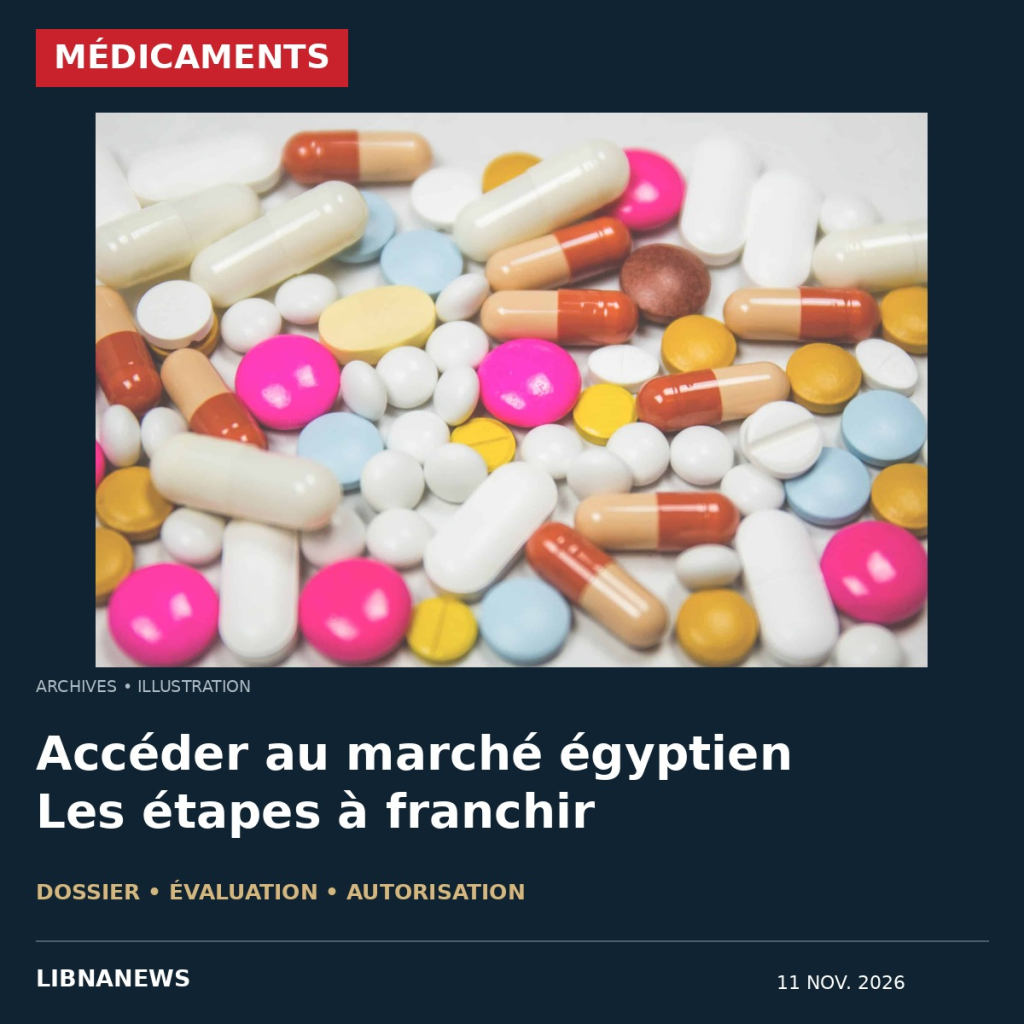
Unidentified tablets and capsules, photo archive Libnanews published in September 2020. Photographer, exact location and date not provided. Generic illustration, without established Lebanese origin. Integer photograph preserved, deterministic editorial editing without retouching the scene.





Comments