

Funding of $200 million for social safety nets is on the agenda of the November 12 parliamentary session. For the Aman programme, the issue goes beyond the continuation of cash transfers: the project involves helping households, accessing social services and improving management tools. Its approval by the World Bank in January and its review in Lebanon are, however, two distinct steps.
The third point of the official parliamentary document is the draft transmitted by Decree 3228 on the loan agreement with the International Bank for Reconstruction and Development. It identifies the Social Safety Net Enhancement and System Building Project. This entry confirms the subject matter submitted to Members, without prejudice to their vote or the date on which the funds would become available.Source: Parliamentary agenda of 12 November.
A separate social envelope of the digital project
The World Bank announced on 27 January the approval of two projects totalling $350 million. The first, dedicated to social protection, represents 200 million. The second, with a budget of 150 million, concerns the digital acceleration of public services. This separation must be maintained: the 350 million does not constitute an envelope of transfers to families.
The social project must complement public resources allocated to benefits, while supporting access to economic opportunities and services. The World Bank places particular emphasis on women, youth and vulnerable populations. It also plans to develop Daem, the platform used for Aman, so that it can serve as a broader social registry.Source: World Bank communiqué of 27 January 2026.
Transfers represent the main planned expenditure
The project evaluation document reserves $160 million for monetary assistance. This amount is part of a 185 million component combining financial support, economic inclusion and social services. An additional 10 million are foreseen for management systems and institutional strengthening. These allocations describe the design of the funding, not the payments already received by families.
The same document provides for the targeting and updating of the poorest households. Its initial schedule and payment assumptions should not be transformed into an individual promise for November: an assessment document prepared before approval does not confirm the actual implementation several months later.Source: Project evaluation document P512384, components and aid mechanism.
European support comes from another funding
A second commitment must be distinguished from the loan. On 29 April, the European Union announced a €45 million grant directly to the Ministry of Social Affairs. Forty million are to finance five months of benefits per 90,000 families, in a total of 150,000 families then eligible. The remaining five million relate to the Ministry’s reforms and updating of data.
Hanine Sayed then presented this support as an investment in the quality of protection systems and transparency of distribution beyond monetary aid. This statement is contained in the communiqué of the European delegation. It clarifies the institutional function of financing without establishing that all announced disbursements have already taken place.Source: European Union delegation to Lebanon, 29 April 2026.
What needs to be checked after the meeting
For one family, three informations will count more than the overall amount of the loan: confirmation of eligibility, the amount actually allocated and the timing of payment. An entry in a register facilitates the instruction of an application. It alone is not sufficient to prove that a benefit is open or that a payment is available.
Monitoring of funding will also have to distinguish between administrative expenditure and transferred amounts and then reconcile commitments to payments. The number of registered persons, the number of households retained and the number of households actually paid answer different questions. Presenting them separately will measure the continuity of the programme and its possible extension.
The next verifiable step will therefore be the parliamentary decision on the agreement. Information on its entry into force and implementation will then be provided. At this stage, the loan offers an identified financing framework; it does not allow to announce a new payment date or guarantee the immediate opening of a right to each applicant.
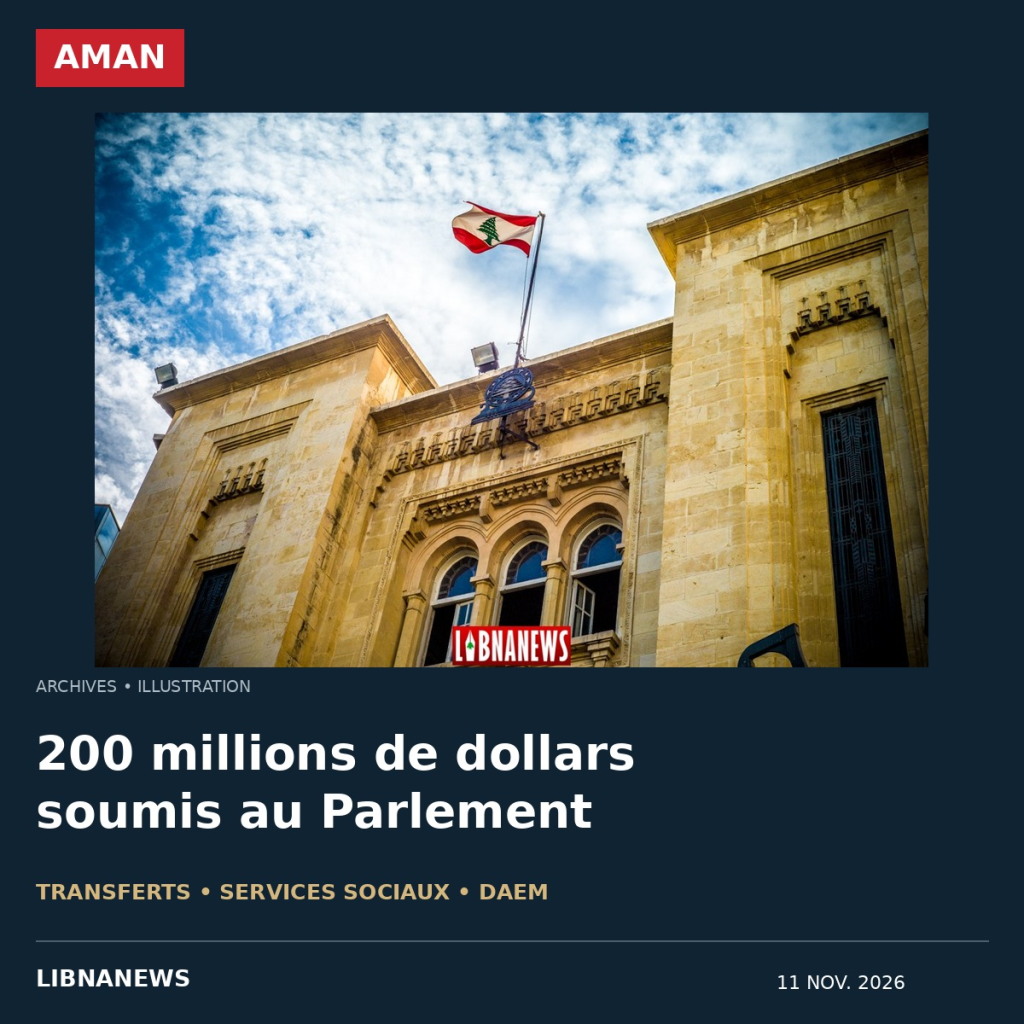
Lebanese Parliament in Beirut, photo archive. Exact date not established. © François el Bacha for Libnanews.com. Institutional illustration, not photograph of the November 12 session. Integer photograph preserved, deterministic editorial editing without retouching the scene.





Comments