

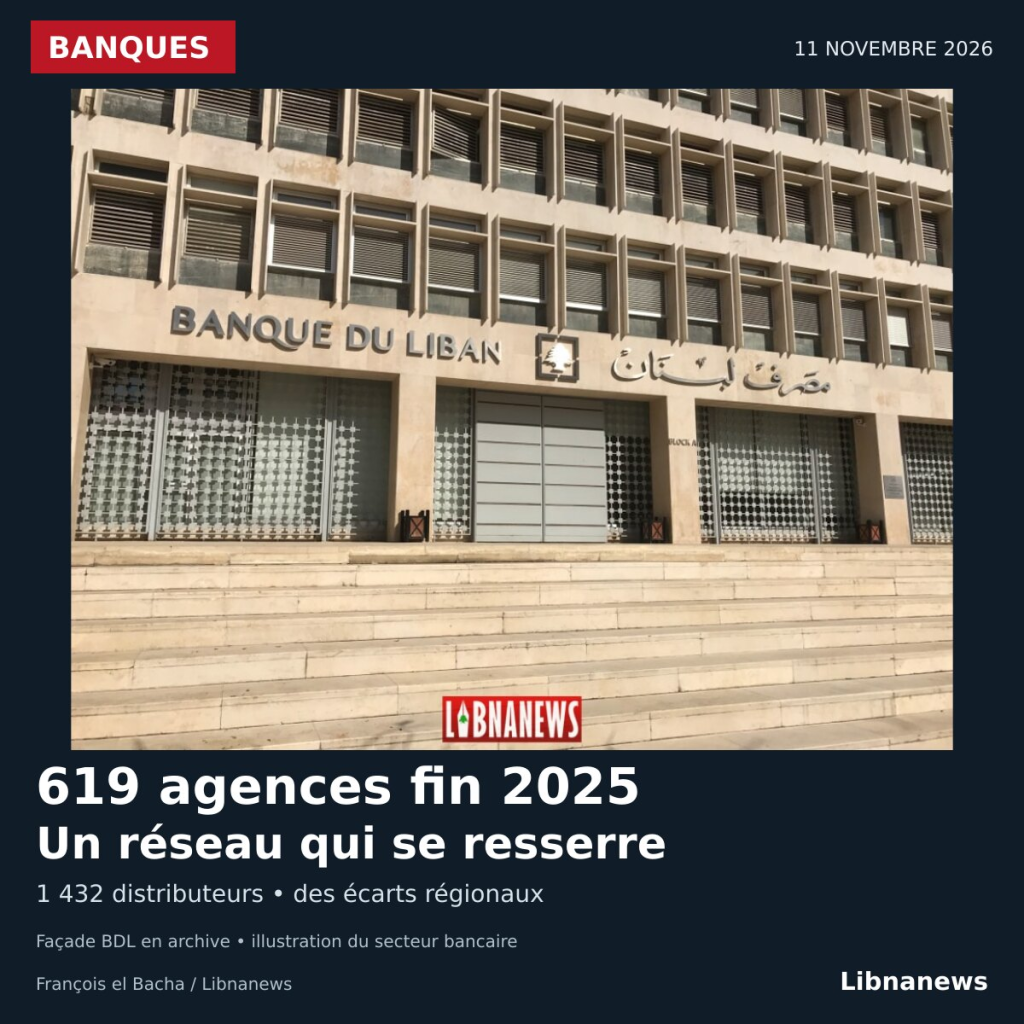
Lebanon had 619 commercial banking agencies at the end of 2025, compared with 633 one year earlier. The network continues to contract. ATMs follow another path: their number increases from 1,412 to 1,432. These data from the Bank of Lebanon provide more concentrated banking access, without allowing the quality of service to be measured by themselves.
The bank card in Lebanon is no longer a uniform closure of the contact points. The BDL macroeconomic review, which was published in December 2025 and published in April 2026, distinguishes three movements. Agencies are decreasing, staff are shrinking and the stock of distributors is increasing slightly. However, the periods of comparison must remain separate: the changes in establishments are year-on-year, the changes in employees in the second half of the year.
This is a state of the network at the end of 2025, not an inventory of the windows opened today. This precision counts in a country where the conditions of movement and operation can change rapidly. A device listed in a statistic does not provide information on its schedules, ticketing or actual transactions.
Banking agencies in Lebanon close less quickly
The increase from 633 to 619 agencies represents a net decrease of 14 establishments, or about 2.2%. The BDL compares this movement with 59 closures in 2024 and 111 in 2023. The reduction of the network is slowing down considerably. She’s not the other way around.
The number of registered banks remains at 57 in December 2025. This total includes 45 commercial banks and 12 investment banks. It is therefore not necessary to confuse a bank, a registered legal person, with its agencies. An establishment may reduce its geographical location while maintaining its approval. The stability of the number of banks does not show that customers have the same number of reception points.
| Indicator | Starting point | Arrival point | Change |
|---|---|---|---|
| Commercial agencies in Lebanon | 633, december 2024 | 619, december 2025 | -14 -2.2 per cent |
| ATMs | 1 412, december 2024 | 1 432, december 2025 | +20, or +1.4 per cent |
| Banking employees | 12 972, june 2025 | 12 684, december 2025 | -288, or -2.2 per cent |
The first two lines cover 12 months; the third, six months. This difference prohibits presenting the three rates as a homogeneous annual balance sheet. It also avoids mechanically assigning employee departures to the fourteen agencies less. The aggregated data do not describe the positions concerned or the decisions of each institution.
Distributors are increasing mainly in the major centres
The national increase in distributors remains modest: 20 additional devices in one year. Geographical distribution shows contrasting trends. Mount Lebanon increased from 553 to 564 machines, Beirut and its suburbs from 439 to 444, the North from 153 to 159. Conversely, the South fell from 120 to 119 and the Bekaa from 119 to 116.
| Area cited in the report | December 2024 | December 2025 | Difference |
|---|---|---|---|
| Mount Lebanon | 553 | 564 | +11 |
| Beirut and the suburbs | 439 | 444 | +5 |
| Northern Lebanon | 153 | 159 | +6 |
| South Lebanon | 120 | 119 | -1 |
| Bekaa | 119 | 116 | -3 |
These five lines reproduce the numbers explicitly commented on by the BDL. They do not constitute the entire country: Nabatiyah appears separately in the regional graph of the report. It would therefore be wrong to add up this partial table and then present its sum as the national total.
Mount Lebanon, as well as Beirut and its suburbs, have 1,008 distributors, or about 70.4 per cent of the 1,432 devices listed. This calculation measures a concentration of the fleet. It is not enough to establish per capita inequality. This would require comparable resident populations corresponding to the same statistical boundaries and period.
The BDL refers to security and operational constraints to explain some of the regional differences. This interpretation remains that of the institution. The table does not distinguish the effect of each bank’s security, demand, costs or choices. A closure in a given area cannot therefore be linked to a single cause from these figures alone.
An agency and a automata do not do the same service
The slight increase in the number of distributors does not necessarily compensate for the reduction of agencies. The two equipments serve different purposes. An automaton can facilitate certain routine operations. It does not replace all the procedures requiring a particular contact, file or examination by the bank.
The number of machines does not tell which customers can use them, at what cost and for what amounts. These conditions depend on the services offered and the rules applicable to the accounts. Infrastructure statistics therefore do not measure the full availability of deposits or the overall lending capacity of institutions.
For a user, effective access has several dimensions: distance, mobility, availability of service and authorized operations. The published data mainly shed light on the first dimension, at a still wide regional scale. They do not provide a communal map of travel times or facilities accessible to disabled people.
The downsizing requires a separate reading
The number of employees increased from 12,972 in June 2025 to 12,684 in December. The decrease of 288 posts takes place over six months. It accompanies the reduction in bank establishment, but the report does not provide a breakdown to link each job movement to a precise closure.
The fall in employees alone does not provide information on queues or processing times. These effects also depend on attendance, tasks transferred to other channels and work organisation. Measuring them would require service data, missing from this network record.
The 2025 balance sheet thus shows a slower contraction of agencies and a limited increase of distributors. In order to follow up, future surveys will need to specify where the contact points are maintained, moving or disappearing. Their alignment with schedules, available operations and attendance would allow for a shift from the number of equipments to the extent of the service actually accessible.





Comments