

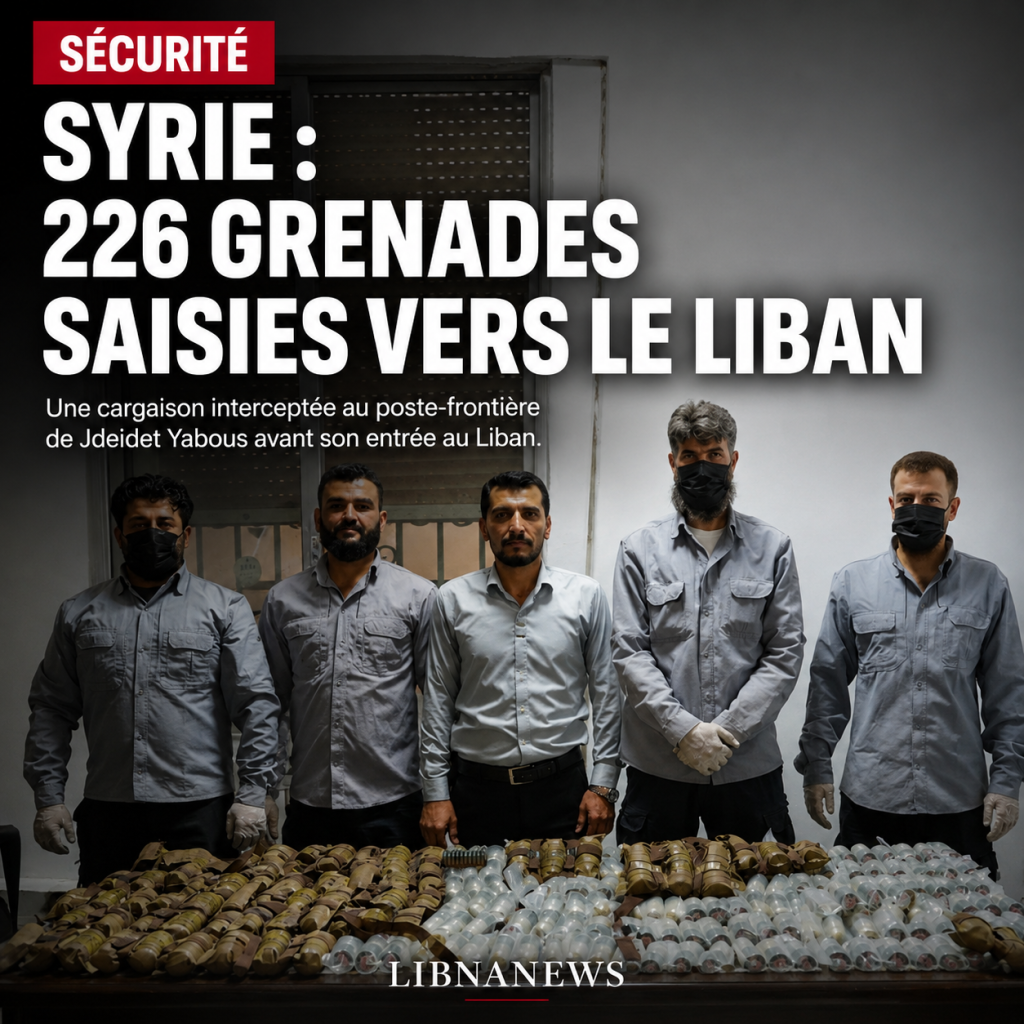
The Syrian authorities announced the interception of 226 grenades hidden in a car heading towards Lebanon. The discovery took place at the Jdeidet Yabous border crossing on the road from Damascus to the Lebanese Masnaa crossing. According to the Syrian General Authority of Land and Maritime Crossing Points, customs, security and safety officers have located the equipment after a thorough inspection of the vehicle. The grenades, presented as RGC type, had been placed in secret compartments. The statement does not specify the identity of the driver, the origin of the weapons or their final destination. This seizure puts at the forefront the issue of arms trafficking between Syria and Lebanon, as well as the ability of the two States to control a border marked by official passages, secondary roads and clandestine channels.
What the Syrian authorities confirmed
The main fact lies in a few elements. A car arrived at the post of Jdeidet Yabous in order to continue its journey towards Lebanese territory. Syrian agents conducted a search that was described as accurate. They discovered about 226 grenades hidden in spaces inside the vehicle.
The announcement comes from the authority responsible for managing Syrian land and sea crossings. It was published on Telegram and then taken over by a Lebanese news agency. The authorities also reported that several services had participated in the operation, including customs and post security units.
However, the press release does not detail how the vehicle was selected. The agents were able to act on the basis of intelligence, suspicious behaviour, technical anomaly or random control. None of these scenarios is confirmed.
The announcement also does not specify whether the car had already completed the Syrian formalities. She did not say whether she was still in the departure area, in the inspection area or near the line between the two posts.
These details may seem secondary. However, they are essential for understanding the functioning of the network. An intelligence response would reveal pre-monitoring. An accidental discovery would rather show that the control devices detected a cargo despite the absence of an alert.
226 grenades hidden in a vehicle
The number announced gives the case an important dimension. Two hundred and twenty-six grenades represent a cargo that far exceeds individual possession or improvised transport of a few weapons.
Such a quantity implies first a source of supply. The equipment had to be assembled, stored and transferred to the vehicle. Their loading probably required several operations and a secure space.
The vehicle was also reportedly modified. The Syrian authorities refer to secret caches, indicating that the weapons were not simply placed in the trunk. Compartments could be arranged in the floor, doors, seats, walls or other areas of the bodywork.
This type of transformation requires time and expertise. The cargo must be hidden while maintaining a vehicle capable of running normally. The weight must be distributed. The openings must remain invisible during a quick inspection.
The transport of grenades also poses an immediate risk. Their danger depends on their condition, the firing system and storage conditions. The release does not state whether the detonators were installed, separated or absent.
The term « GCR » itself remains to be specified. The authorities have not published any data sheets, lot numbers and manufacturer information. It is therefore impossible, on the basis of the communication alone, to determine with certainty the characteristics of the equipment.
A Lebanese destination, but no recipient named
The vehicle was heading towards Lebanon. This is confirmed by the Syrian authorities. It alone does not identify the person or organization who was to receive the grenades.
The press release does not mention any Lebanese city. He does not mention the Bekaa, Beirut, South Lebanon or a Palestinian camp. It does not further specify whether the cargo should remain in Lebanon or transit to another destination.
No armed groups are appointed. It would therefore be imprudent to assign weapons to Hezbollah, a Palestinian organization, a criminal network or an extremist cell.
Lebanon has a number of categories of actors that can search for weapons. Structured organizations have their own circuits. Criminal groups also use weapons of war to protect their activities, intimidate their rivals or conduct settlements.
Intermediaries can finally buy a cargo before dividing it into smaller lots. Two hundred and twenty-six grenades can be distributed among several buyers. This method then complicates their traceability.
The identity of the addressee is therefore the main question of the investigation. It can only be established on the basis of material elements: driver’s phone, messages, itinerary, financing, contacts in Lebanon and possible accompanying vehicles.
Jdeidet Yabous, a strategic passage
The post of Jdeidet Yabous is located on the international road between Damascus and Beirut. He faces the Lebanese passage of Masnaa. This axis is the most direct terrestrial link between the two capitals.
Passenger cars, taxis, buses and trucks are used daily. It is used for trade, family travel and passenger transit.
This density creates a permanent difficulty for control services. A full search of each vehicle would significantly slow traffic. Officers must therefore combine visual inspection, document analysis, vehicle selection and available information.
Traffickers can try to exploit this constraint. An ordinary car, driven by a person without visible nervousness, can blend into traffic.
The choice of an official passage is therefore not necessarily inconsistent. Illegal roads expose smugglers to patrols, terrain and local groups that control certain areas. The official post offers a quick route, provided that it passes the controls.
The discovery thus shows that the routes are not based solely on mountain paths. They can also test state procedures and use fitted vehicles.
The Syrian-Lebanese border, a difficult line to control
The border between Syria and Lebanon crosses mountainous and rural areas. Several sectors remain difficult to monitor continuously. Roads connect villages, agricultural lands and areas far from official posts.
This geography has long favoured smuggling. Products transported vary according to periods, prices and crises. Networks can carry fuel, cigarettes, medicines, food, narcotics, people or weapons.
Family ties between the two sides sometimes facilitate travel. Some communities have long-standing economic relationships. Traffickers can rely on these networks to obtain housing, vehicles and information.
Control is not limited to the number of soldiers. It requires accurate mapping, surveillance, mobile units and rapid exchange of information.
It also implies cooperation between Beirut and Damascus. A cargo intercepted in Syria may have been financed or organized from Lebanon. Conversely, weapons in Lebanon can be directed to Syrian actors.
The seizure of Jdeidet Yabous thus reminds us that the security of the two countries remains linked. Effective control on one side is not enough if the network retains its managers, funding and reception points on the other side.
A border transformed by regional crises
The Syrian war has profoundly altered border balances. From 2011, weapons, combatants and contraband products moved in both directions.
Several groups used border areas according to the different phases of the conflict. The fighting in Qalamoun and around Qousseir gave particular military importance to certain axes.
In Lebanon, the Bekaa and Hermel also suffered the consequences of this instability. Conflicts, abductions, trafficking and security operations have affected several sectors.
The Syrian political developments then led to a recomposition of the networks. When an authority changes, local protections, routes and alliances also change.
Some traffickers lose their relays. Others are seeking new partners. Channels can move from an underground track to an official post or use previously unknown intermediaries.
The seizure of 226 grenades can be included in this reorganization phase. It may also reflect a strengthening of Syrian inspections. The press release does not allow a decision to be made between an increase in traffic and an improvement in controls.
A stake for the arms monopoly in Lebanon
The clandestine entry of grenades directly affects the issue of the Lebanese state monopoly on weapons. Any undeclared cargo strengthens actors who escape institutional control.
The danger does not depend solely on the recipient. Weapons intended for a structured group, a criminal network or an intermediary in any case feed an underground market.
The grenades are easy to hide after delivery. They can be stored in houses, warehouses or vehicles. Once separated into small lots, they become difficult to find.
Their presence increases the risks during local clashes. She can turn an armed dispute into a murderous incident. It can also be used in attacks on buildings, patrols or shops.
Storage is another danger. Fire or improper handling can cause an explosion in a inhabited area.
The case therefore goes beyond the question of border crossing. It concerns Lebanese internal security, the traceability of weapons and the ability of the State to prosecute those who organize their entry.
Questions to guide the investigation
The first question concerns the driver. The authorities must establish whether he knew the nature of the cargo or whether he acted as a mere carrier.
Its phone may contain messages, contact information or indications about the place of delivery. His recent travels may also reveal meetings with organizers.
The second question concerns the vehicle. Investigators must identify its owner, the workshop which changed it and the persons who paid for the work.
The third one concerns grenades. Markings, batch numbers and components may indicate their origin. They can also allow comparison with other seizures.
The fourth question concerns funding. A cargo of this size has a value. Payments may have passed through cash, intermediaries or informal networks.
The fifth concerns the Lebanese consignee. Syrian investigators will have to transmit contacts and contact information to the Beirut authorities. A surveillance operation could then identify the persons awaiting delivery.
A driver-limited investigation could leave the main structure intact. Networks often use replaceable carriers. Dismantling them requires going back to suppliers and buyers.
Official communication to be completed
The Syrian announcement highlights the effectiveness of Jdeidet Yabous agents. However, it is too short to measure the actual scope of the operation.
No arrest is explicitly detailed. No suspects are brought to justice in the press release. No cooperation with Lebanon is mentioned.
This caution may protect an ongoing investigation. Authorities may choose not to disclose information that may alert accomplices.
It can also respond to a communication logic. An institution announces a seizure to show its vigilance, but retains the sensitive elements.
Future statements will determine the strength of the file. Judicial communication should specify the charges, suspects and initial technical conclusions.
The prolonged silence would instead create a space for rumours. In Lebanon, every seizure of weapons can quickly be integrated into the political debate and attributed without evidence to a camp.
Transparency must therefore progress without compromising the investigation. The authorities can confirm the existence of arrests, referrals to the courts and bilateral cooperation without revealing the ongoing operations.
The expected role of the Lebanese authorities
Lebanese services must determine whether people were waiting for the vehicle in Masnaa or on another point of the route.
They can examine cameras, communications and vehicle movements around the post. They can also look for links between the driver and individuals already known for arms trafficking.
The authorities must verify whether similar grenades have been seized in Lebanon. Technical correspondence could reveal a regular stream.
Cooperation with Damascus must go through official channels. The information provided must be able to be used by the courts and verified.
Beirut must also avoid premature accusations. Identifying a group without evidence could politicize the case and complicate the investigation.
The priority remains network identification. The driver, if detained, is probably just one link. Procurement and reception officials are the main targets.
Strengthening controls without paralyzing trade
Seizure can lead to a hardening of inspections in Jdeidet Yabous and Masnaa. This response must remain focused.
Excessively slow control would penalise travellers and businesses. It could also push more people to clandestine roads.
The authorities must therefore improve the selection of vehicles. Scanners, specialized dogs and mechanical anomalies analysis can enhance detection.
The training of officers remains crucial. Secret compartments are constantly evolving. The services must know the new methods of concealment.
Another aspect is the fight against corruption. A network may seek to purchase protection, obtain information on schedules or avoid certain inspection queues.
Team rotation, video surveillance and traceability of searches can reduce these risks. They must be accompanied by internal investigations when suspicions arise.
Lastly, technical cooperation between the two posts would allow for the comparison of vehicle lists and the detection of inconsistencies. A car considered suspicious on the Syrian side must be immediately reported to the Lebanese side.
An important seizure, but a network still invisible
Interception of 226 grenades prevents dangerous cargo from entering Lebanon. It represents a concrete result for Syrian services.
It does not yet mean that the network has been dismantled. Other vehicles, stocks and routes are available to the organisers.
The investigation will have to determine whether the delivery was exceptional or regular. It will also have to check whether similar shipments have already crossed the border.
The number of grenades suggests an organized demand. It does not reveal the buyer’s identity. Any attribution therefore remains speculative at this stage.
The follow-up will depend on information extracted from the vehicle, weapons and aircraft seized. It will also depend on the speed with which Syria will pass on useful elements to Lebanon.
The publication of the names of the suspects, the origin of the grenades and the intended place of delivery will help to measure the actual scope of the case. In the meantime, one point remains: a car loaded with 226 grenades attempted to borrow the main official passage between Damascus and Beirut, while the Lebanese consignee remains unknown.




