

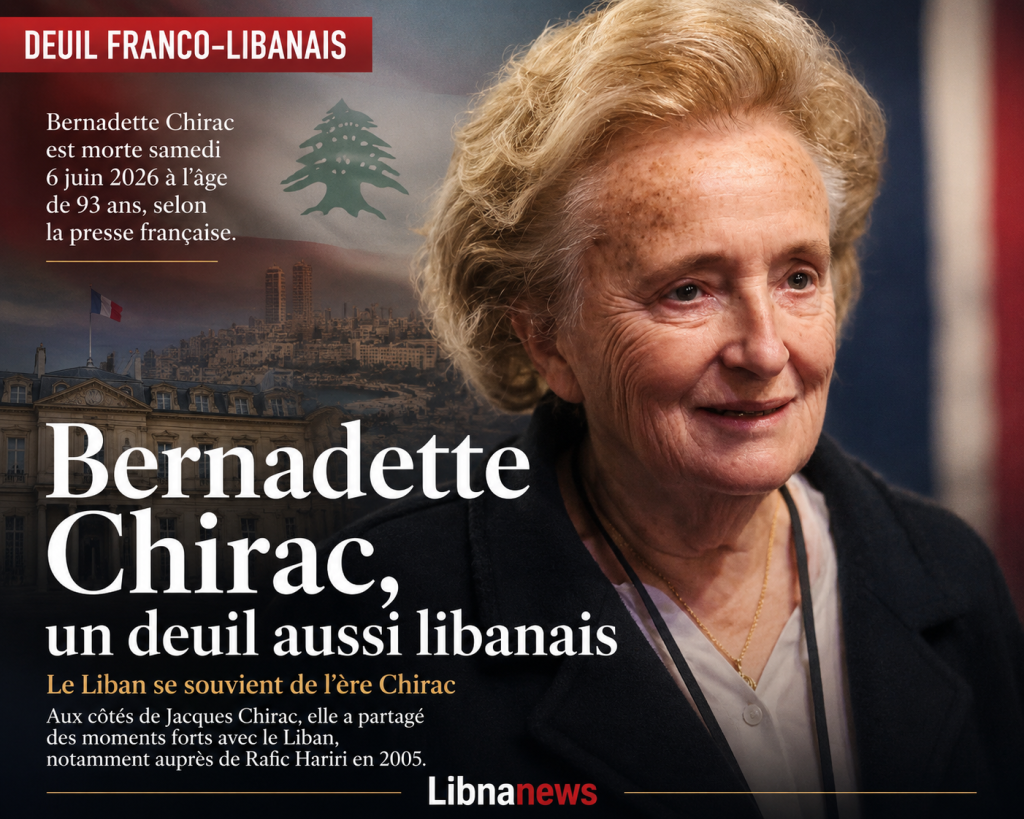
Bernadette Chirac died on Saturday 6 June 2026 at the age of 93, according to the French press. With it disappears one of the last figures of a political cycle opened under the Fifth Gaullist Republic and closed after the death of Jacques Chirac in 2019. Former First Lady, elected local of Corrèze and face of the Yellow Coins, she leaves a more complex image than that long held by the cartoons. In Lebanon, her disappearance resonates mainly through the memory of her husband, regarded by a large part of the political class and opinion as one of the closest French presidents to the land of the Cedar.
A Lebanese tribute to Bernadette Chirac would therefore have a special significance. It would not only be diplomatic courtesy. It would recall a personal, political and emotional relationship between Lebanon and the Chirac couple. Jacques Chirac had made Lebanese sovereignty a marker of his near-eastern policy. He also maintained a public friendship with Rafic Hariri, until he went to Beirut after the assassination of the former Prime Minister in February 2005. Bernadette Chirac then accompanied him on this emotional journey. This memory remains associated with a period when France still seemed able to speak in Lebanon with a singular voice.
Bernadette Chirac, a familiar French presence in Lebanon
Bernadette Chirac never held a diplomatic office in the strict sense. She was not a minister, ambassador or negotiator. However, his place at the Élysée between 1995 and 2007 was at the heart of a sequence in which Franco-Lebanon relations took on a rare intensity. Along with Jacques Chirac, she accompanied the presidency’s rituals, official visits and moments of mourning. For the Lebanese who followed this period, his name remains attached to that of a French president who spoke of Lebanon with warmth, supported his independence and defended his place in the French-speaking space.
This association must not hide its own path. Born Bernadette Chodron de Courcel on 18 May 1933 in Paris, she belonged to a family of the French Catholic bourgeoisie. She married Jacques Chirac in 1956. For years, she appears as the discreet wife of a man launched into a rapid ascent. But it also creates a personal political base in Corrèze. Elected municipal in Sarran in 1971, she became a general councillor in 1979, becoming one of the few wives of president who had long-term elected office. This local establishment gives him a legitimacy that the only elysean life would not have brought him.
At Elysée, his image slowly changes. Long perceived as stiff, distant or severe, she managed to impose herself in public space by constancy. The Yellow Coins play a decisive role. From 1994, she chaired the Fondation Hospitalaux de Paris-Hopitaux de France and gave the collection for hospitalized children a national reputation. Small cardboard piggy bankers, promotional trains, hospital visits and popular sponsors bring his action into the daily life of the French. This campaign makes it more accessible and corrects an image previously dominated by protocol.
The Lebanese link goes through Jacques Chirac
In Lebanon, it is first the memory of Jacques Chirac who gives Bernadette Chirac’s death a special dimension. The former French President occupied a singular place in the Lebanese political imagination. He was not only seen as a foreign head of state. He was seen as an attentive interlocutor, sometimes as a protector, often as a friend of Lebanon. This perception was built by concrete gestures, speeches, international conferences and a very strong relationship with Rafic Hariri.
Jacques Chirac supported Lebanon during the post-war reconstruction. It hosted meetings in Paris to mobilize financial and political assistance. He defended the territorial integrity of the country after the Israeli withdrawal from southern Lebanon in 2000. In his speeches he used a language of fraternity that the Lebanese readily held. He spoke of the Lebanese people as a friendly, inventive, wounded but standing people. These formulas may seem expected in diplomatic language. However, they weighed in a country that sought to rebuild its state and regain international visibility.
Friendship with Rafic Hariri strengthened this proximity. The two men shared a vision of the reconstruction of Beirut and the role of France in the Middle East. This relationship has sometimes generated debate, including on Lebanon’s economic choices, public debt and the limitations of the reconstruction model. But, in Lebanese political memory, it remains associated with a time when Paris was heavily involved in Lebanese issues. The presence of Jacques Chirac in Beirut after the assassination of Rafic Hariri was a significant factor. Bernadette Chirac was at her side during this trip.
The Remembrance of February 2005
On 16 February 2005, two days after the attack that killed Rafic Hariri, Jacques Chirac arrived in Beirut to express his condolences to his family. This trip is not an ordinary protocol trip. He’s short, serious, almost family. The French president addresses the press at the airport and then goes to the relatives of the deceased. He describes the murder as an abominable crime and asks for all the light to be shed. This gesture reinforces the image of a French Head of State personally affected by the Lebanese tragedy.
Bernadette Chirac accompanies him in this moment. Its presence gives the scene a marital and family dimension. She doesn’t take the lead. It is not intended to do so. But she stands in this grieving delegation to a president who comes to greet a murdered friend. For many Lebanese, this image records Bernadette Chirac in the indirect memory of the relationship between France and Lebanon. It belongs to this political and emotional setting where families, states and national wounds intersect.
That memory explains why a Lebanese tribute would not be inappropriate. He would recall that the Chirac couple participated in a pivotal moment in the country’s recent history. In 2005, the assassination of Rafic Hariri opened a major sequence: popular mobilization, Syrian withdrawal, political recomposition and internationalization of the Lebanese file. Jacques Chirac then supported Lebanon’s demand for truth and sovereignty. Bernadette Chirac remains more in retreat, but she is present in one of the moments when this French solidarity becomes visible.
A former first lady became popular figure
In France, Bernadette Chirac had to fight an unfavourable image for a long time. Political circles considered it austere. The media focused on its maintenance, its social accent, its apparent hardness or its relations with the Chiracian clan. Yet it gained late popularity. This reversal is due to his tenacity, his sense of the ground and his hospitable commitment. The French eventually saw in her something other than a presidential wife: a local politician, an associative activist and a guardian of family memory.
The Yellow Coins played a central role in this development. The operation financed projects to improve the lives of children, adolescents and families in hospital. Bernadette Chirac made it a very visible campaign. She knew how to mobilize popular personalities, talk to caregivers, visit paediatric services and give continuity to a simple cause. This action has affected several generations of French. It has also shown a more concrete facet of its character: organization, discipline, obstinacy and fidelity to a long-term commitment.
This personality can affect the Lebanese public, even if its hospital action was first deployed in France. Lebanon knows the value of initiatives to support hospitals, children and fragile families. In a country where successive crises have exhausted public structures, the figure of a former first lady associated with care and childhood can be echoed. The Lebanese tribute may therefore not be limited to the memory of Jacques Chirac. He could also greet a woman who used her position to support an identified social cause.
Why Lebanon keeps Jacques Chirac in memory
The popularity of Jacques Chirac in Lebanon lies in several layers of history. First, there is the old link between France and Lebanon, marked by the Francophonie, schools, universities, cultural networks and family solidarity. Then there is the post-war period, during which Paris accompanies the reconstruction and supports Lebanon’s inclusion in international frameworks. Finally, there are political and regional crises, where Jacques Chirac often adopts a line seen in Beirut as favourable to Lebanese sovereignty.
His opposition to the Iraq war in 2003 also reinforced his image in a part of the Arab world. In Lebanon, this position was read as proof of a France capable of not automatically following Washington. It has consolidated a reputation for independence. For many Lebanese, Chirac represented a classic, Gaully France, attentive to regional balance and anxious to speak to the Arab States without abandoning its own alliances. This image resisted the debates on its French internal balance sheet.
When Jacques Chirac died in September 2019, Lebanon decreed a day of national mourning. Flags are put in half-mast. Saad Hariri, then Prime Minister, greets one of the great men of France and evokes the pain felt by the Lebanese and Arabs. This precedent gives a clear indication. The Chirac family occupies a special place in Lebanese official memory. The disappearance of Bernadette Chirac, seven years later, will probably not lead to the same level of protocol. However, it may call for a message of condolences from the presidency, the government or officials attached to Franco-Lebanese history.
An expected but not yet set tribute
In the immediate future, no official Lebanese tribute had been identified after Bernadette Chirac’s death. This immediate absence does not prejudge a reaction within the following hours. Lebanon is going through a period of war, institutional crisis and security tensions that often reduces the focus on international messages. But the previous Jacques Chirac makes plausible a gesture of Beirut, even sober. It could take the form of a communiqué of condolences addressed to Claude Chirac, the family of the former First Lady or the French authorities.
Such a message would have several levels of reading. He would first honour Bernadette Chirac as former French first lady. He would then recall the friendship between Jacques Chirac and Lebanon. Finally, he would stress the continuity of a Franco-Lebanese relationship that recent crises have sometimes made more difficult to read. France remains present in the Lebanese dossiers, but its influence was no longer as sharp as in the Chirac years. An official tribute could therefore also serve to recall a time when this relationship seemed more direct, personal and readable.
President Joseph Aoun and Prime Minister Nawaf Salam, if they choose to react, will have to find the right tone. It will not be a matter of turning Bernadette Chirac into a central actor of Lebanese politics. She wasn’t. But it would be fair to recognize the place she occupied with a French president who was deeply linked to Lebanon. The message could evoke his humanitarian commitment, his role as former first lady and the memory of Jacques Chirac, whose friendship for Lebanon remains alive in a part of society.
A French page, a Lebanese resonance
The death of Bernadette Chirac also closes a French page observed carefully from Lebanon. The Chirac generation belonged to a time when the bilateral relationship relied heavily on people. Affinities, fidelities, symbolic gestures and political networks weighed heavily. This diplomacy had its limits. It depended on men and women, on circumstances and friendships sometimes contested. But it also produced legible signs. The Lebanese knew who to call in Paris. They knew which French president had an emotional relationship with their country.
Today, this clarity has weakened. France remains an important diplomatic actor in Lebanon. It intervenes in aid conferences, political discussions, military issues and humanitarian initiatives. But the era of great personal figures seems far away. The disappearance of Bernadette Chirac revives this comparison. It recalls a time when a French presidential couple alone could symbolize a lasting proximity to Beirut, Sarran, the Corrèze and the palace of the Elysée, which, through a strange detour of history, was linked to Lebanese wounds.
This memory must not prevent a lucid look. The Chirac years did not resolve the deep fragility of Lebanon. International conferences have not prevented debt, institutional blockages or the subsequent collapse of the financial system. Franco-Lebanese friendship did not protect the country from all interference. But it has offered moments of real political support, including on sovereignty and international recognition of Lebanese crises. It is this part of memory that Bernadette Chirac’s death reacts today.
For Beirut, a tribute to Bernadette Chirac would be less a tribute to a leader than a greeting to a shared memory. He would say gratitude to a French political family whose name remains linked to Lebanon. He would recall Bernadette’s presence alongside Jacques Chirac in moments of mourning and fidelity. It would also make it possible to reaffirm, in a context of war and uncertainty, that the links between Lebanon and France are not confined to the diplomatic emergencies of the moment. In Paris and Beirut, the wait is now about official messages, gestures of condolences and words that will say what the name Chirac continues to represent for the country of the Cedar.




