

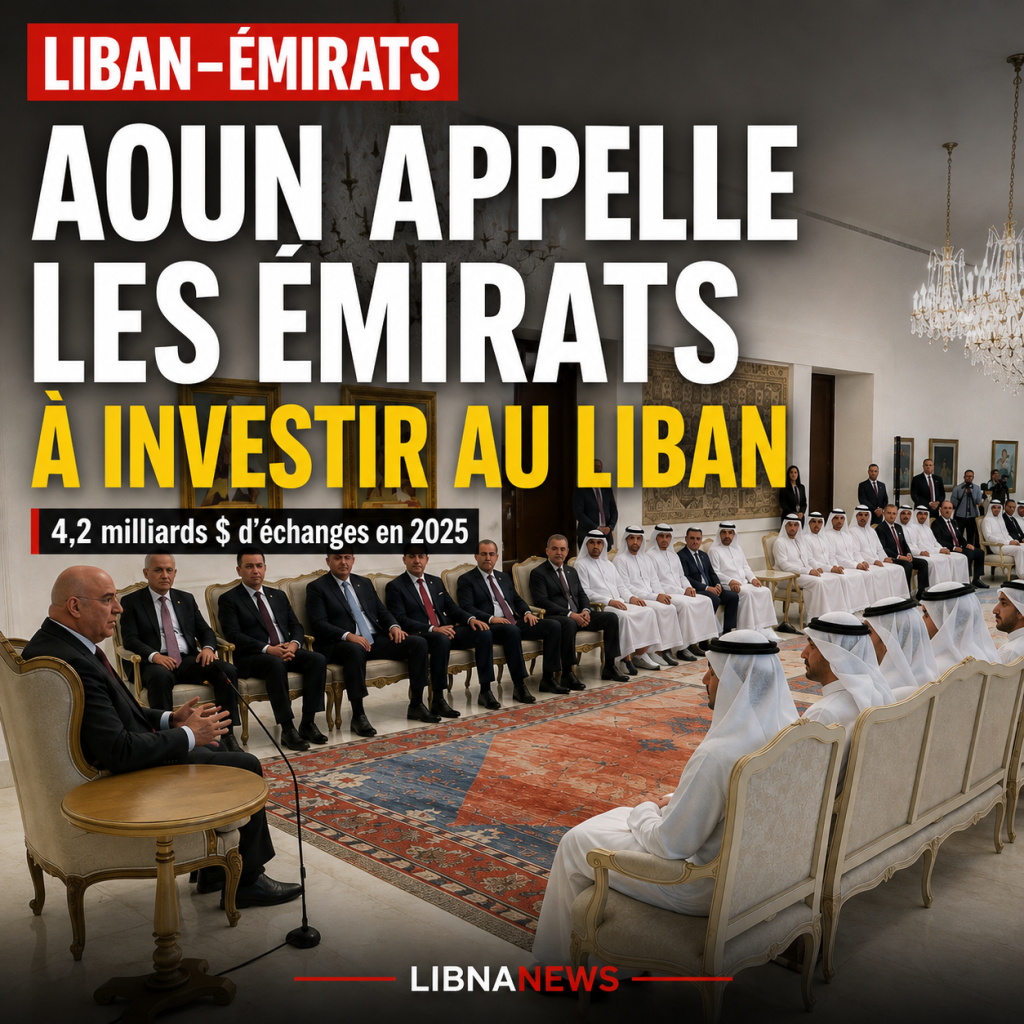
President Joseph Aoun called on the companies of the United Arab Emirates to invest in Lebanon on Thursday, 27 August, by receiving a large delegation from the Baabda Palace led by the Emirati Minister of Foreign Trade, Thani bin Ahmed Al Zeyoudi. The Head of State presented the visit as a « message of hope » and confidence in the stability of the country. Al Zeyoudi also announced that non-oil trade between the two countries had reached$4.2 billion in 2025, one of the highest levels in the last 15 years. This two-day visit is already accompanied by several memorandums of understanding and discussions on a broader economic framework between Beirut and Abu Dhabi.
Joseph Aoun: « Lebanon is your second country »
On Thursday, the second day of the Emirate economic visit to Lebanon took on a political dimension with the reception of the delegation by Joseph Aoun at the Baabda Presidential Palace. The President welcomed Thani bin Ahmed Al Zeyoudi and the accompanying businessmen and investors, in the presence of several Lebanese and Emirati economic leaders.
Joseph Aoun stressed the depth of relations between the two countries and thanked the Emirates for their support for Lebanon. He presented the presence of an economic delegation of this importance as a sign exceeding the mere holding of trade meetings. According to him, it reflects confidence in « the stability of Lebanon and its future » and can open up new opportunities for cooperation and investment.
The President directly invited Emirati entrepreneurs to undertake projects in the country. « Lebanon is your second country, we invite you to invest in it, » he said. He highlighted Lebanese human capital, the dynamism of the private sector, the country’s geographical position and the importance of the diaspora as the main benefits that could attract investors.
Aoun also thanked President Emirati, Mohammed bin Zayed Al Nahyane, for his support. He claimed that the Emirati leader had responded favourably to Lebanese demands, seeing it as a manifestation of the links between the two countries and their populations.
« Security and investment are linked »
However, the Head of State did not avoid one of the main obstacles to the return of foreign capital. « There is no doubt that security and investment are linked, » he acknowledged to the delegation.
This statement takes place in a particularly sensitive context. Israeli military operations continue in southern Lebanon, where strikes, artillery fire and blasting were reported again this week. The security situation is therefore an immediate consideration for investors considering long-term commitments.
Joseph Aoun, however, wanted to dissociate the existence of these difficulties from an impossibility of investing. He felt that sufficient political and economic will could overcome them. « As long as there is sincere will and intent, challenges will not be an obstacle, » he said.
His message aims to convince Emirati companies that Lebanon can present opportunities even before its recovery is complete. This approach is consistent with that advocated by several members of the government, who seek to bring Arab investors back while pursuing institutional and economic reforms.
$4.2 billion in non-oil trade
Thani ben Ahmed Al Zeyoudi brought an important figure to this sequence: the non-oil trade between the United Arab Emirates and Lebanon reached$4.2 billion in 2025. The Minister presented this result as one of the highest levels in the last fifteen years.
The data provided at the Lebanese-Emirati Economic Forum also indicate an annual increase in the number of women in employment35.6%in 2025. This increase shows that trade relations continued to develop despite the Lebanese economic crisis and the tensions that had characterized relations between Beirut and several Gulf States in previous years.
| Indicator | Data |
|---|---|
| Non-oil trade Lebanon-Emirates in 2025 | $4.2 billion |
| Annual growth in 2025 | 35.6% |
| Initial announced size of delegation | 67 economic leaders |
| Participants mentioned at the forum | more than 70, up to about 90 according to the records |
| Memorandums of understanding signed on 26 August | 5 |
| Economic partnership agreements concluded by the Emirates worldwide | 38 |
Changes in the number of members of the delegation are explained by the different scopes used in the announcements. Formal preparations initially referred to67 emirati leaders and economic leaders. The proceedings of the forum held on Wednesday then reported more than 70 Emirati participants, some of which evoked about 90 personalities including all investors, managers and members associated with the mission.
The economic importance of the visit is therefore not only measured by its size. It is mainly due to the profile of the participants and the sectors represented, as well as to the agreements already reached during the Beirut meetings.
Five Memoranda of Understanding signed in Beirut
The delegation did not come only for a series of political meetings. The first day of the visit, Wednesday 26 August, culminated in the signing offive memoranda of understandingwithin the framework of the Lebanese-Emirati Economic Forum in Beirut.
One concerns the establishment of the Lebanese-Emirati Joint Business Council to provide a permanent framework for relations between the private sectors of the two countries. Two other agreements were concluded between the Beirut and Mount Lebanon Chamber of Commerce, Industry and Agriculture and its Abu Dhabi and Ras al-Khaimah counterparts.
Two additional protocols concern the Emirati group Elite Agro Holding. One is cooperation with the American University of Beirut in the fields of food security and arid agriculture. The other associates the group with Jarjoura Dakkache & Sons around greenhouse crops.
These agreements remain memoranda of understanding and should not be treated as five major investments already funded and committed. However, they are instruments enabling the companies and institutions concerned to transform the discussions into specific projects.
Infrastructure and digitisation were also among the sectors discussed. However, no specific agreement had been announced on these two areas after the first day.
Al Zeyoudi wants to strengthen the logistical and technological link
In front of Joseph Aoun, Thani Al Zeyoudi described meetings with Lebanese companies and investors as « excellent ». According to him, they enabled the delegation to identify more precisely the opportunities available in different sectors of the Lebanese economy.
The minister particularly stressed the logistical potential. He believes that the Emirati companies present in Beirut can help strengthen connections between Lebanon, the Emirates and companies active in other international markets. The technology sector is one of the areas it considers promising.
This is in line with Abu Dhabi’s international trade strategy. The Emirates has developed its network of economic partnership agreements in recent years. Their programme now counts38 comprehensive economic partnership agreementsto facilitate market access and reduce trade barriers.
Al Zeyoudi presented the Emirates not only as a potential source of capital, but also as a platform for Lebanese companies to access a much larger commercial network.
The Lebanese skills highlighted
The Minister Emirati also stressed the role played by Lebanese in the economy of the Emirates. He praised their expertise and contribution to the development of Emirati enterprises and institutions, including in the design of strategies and project management.
This presence of the diaspora is one of the main economic ties between the two countries. The Lebanese authorities are now seeking to use this human capital as a bridge to facilitate the return of investment to Lebanon.
Al Zeyoudi presented his delegation’s visit as a form of recognition of this contribution. « Our presence is proof of the Emirates’ love for Lebanon, » he said, also referring to a willingness to return part of what the Lebanese have brought to the development of his country.
The Minister conveyed to Joseph Aoun the greetings of President Mohammed bin Zayed Al Nahyane, Vice-President and Prime Minister Mohammed bin Rachid Al Maktoum and Mansour bin Zayed Al Nahyane, Vice-President and Deputy Prime Minister.
The lifting of the travel ban as the first signal
The current economic rapprochement was preceded by an important political decision: the lifting of the ban that prevented Emirati citizens from visiting Lebanon. Al Zeyoudi stressed on Thursday the positive effect of this measure on bilateral relations.
This decision directly facilitates tourism, business travel and investor contacts. It also has a symbolic significance, as it reflects an improvement in the emirate assessment of the Lebanese situation after several years of prudence.
In July, the Emirati Ambassador to Lebanon, Fahad Salem Saeed Al Kaabi, had already mentioned with Joseph Aoun the strengthening of bilateral relations. The Lebanese President thanked Abu Dhabi for allowing his nationals to return to Lebanon.
The current movement does not therefore begin with the delegation of 26 and 27 August alone. Rather, this represents an acceleration and economic achievement of a rapprochement gradually initiated in the previous months.
Towards a wider economic agreement
One of the most important developments is the willingness to go beyond sectoral protocols. Thani Al Zeyoudi mentioned the need to start working on acomprehensive economic agreementto serve as a framework for bilateral relations.
The Lebanese Minister of Economy and Trade, Amer Bisat, also highlighted this perspective. Present at the meeting in Baabda, he explained that discussions had focused on creating a broader investment framework and indicated that work would continue after the visit.
At this stage, therefore, this is not an agreement already concluded. Both sides explore the possible form of a strengthened economic framework. The next steps will have to specify its scope, the sectors concerned and any trade or regulatory measures that would accompany it.
For Lebanon, such a mechanism could provide more visibility for Emirati investors. For Abu Dhabi, it would enable the Lebanese market to be more closely integrated into its regional and international network of partnerships.
Private sector at centre of rapprochement
Both Governments give a central role to the private sector. Al Zeyoudi considered that it should be the main driving force behind the implementation of the projects and the « general coverage » of the economic relations with the various Lebanese parties.
This approach makes it possible to distinguish the current visit from the direct financial assistance that the Gulf countries have been able to provide to Lebanon in previous periods. This time the speech focuses more on investment, partnerships, businesses and the creation of economically viable projects.
For Beirut, this is both an opportunity and a demand. Attracting private capital means proposing profitable projects, but also a sufficiently predictable regulatory, banking, judicial and security environment.
The presence in Baabda of the Minister for Technology and Artificial Intelligence, Kamal Shehadi, alongside Amer Bisat, also illustrates the Lebanese desire to broaden discussions beyond traditional economic sectors.
A political signal, but investments still to be realized
The visit is undoubtedly a signal of rapprochement between Beirut and Abu Dhabi. It brings together an important economic delegation, intervenes after the removal of travel restrictions and has already produced five memorandums of understanding. The level of trade also provides a real basis for this relationship, with$4.2 billion in non-oil trade in 2025.
However, it would be premature to present this sequence as a massive and already acquired return of Emirati investments. The protocols still need to be translated into achievements and the project for a comprehensive economic framework remains to be developed. The security situation, which Joseph Aoun himself had linked to investment, also remained a determining factor.
It is precisely on this point that the presidential speech makes sense. Aoun does not deny the risks to Lebanon, but seeks to convince investors that they do not make any initiative impossible. His appeal to Emirati businesses is based on the idea that economic recovery can begin before all political and security problems are resolved.
The delegation must complete its two-day visit to Beirut on Thursday. The next indicator will now be less the number of officials present than the transformation of the five signed protocols, sectoral discussions and the economic partnership project into investments actually undertaken in Lebanon.




