

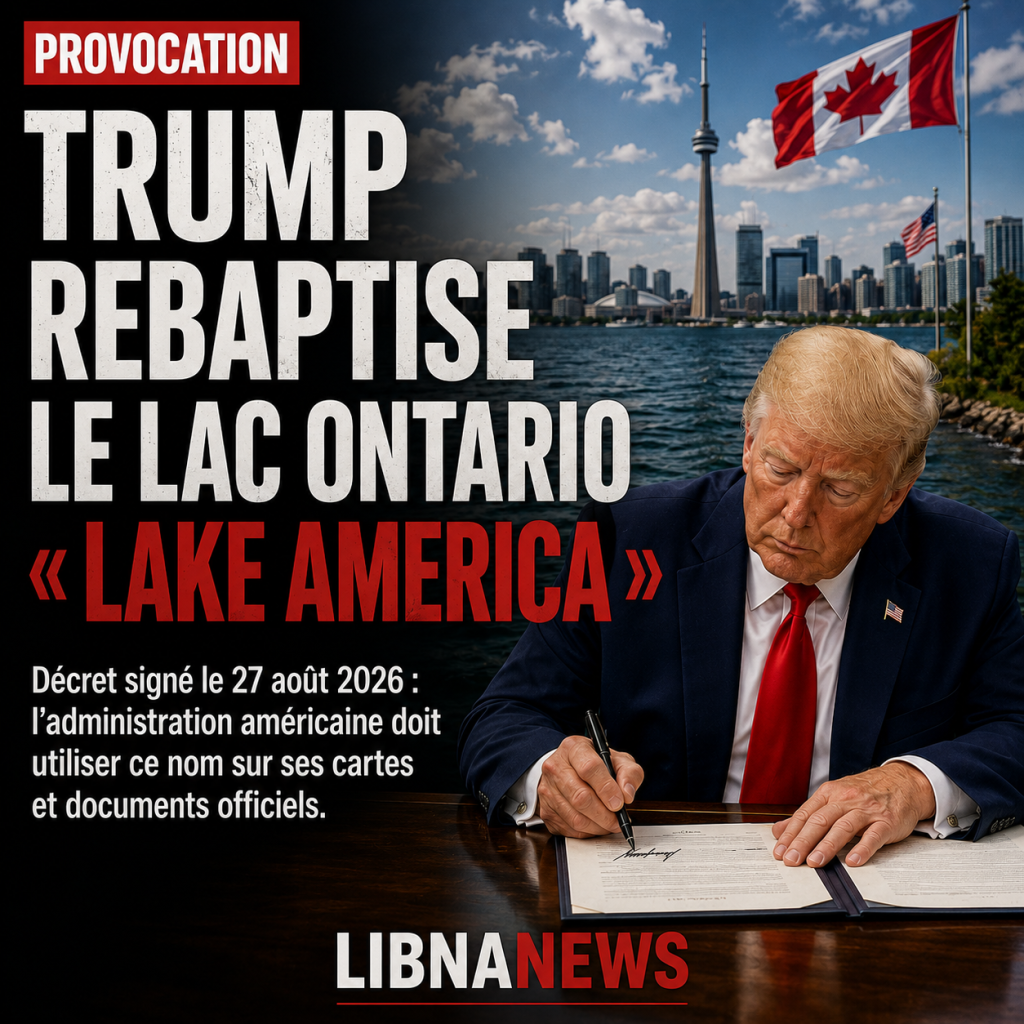
Donald Trump signed an order on Thursday, August 27, ordering the U.S. federal government to rename Lake Ontario « Lake America », just two days after launching this idea publicly in the midst of a trade war with Canada. The decision, essentially symbolic since Washington cannot impose this designation on Canada, concerns one of the five Great Lakes and an international water area shared between the State of New York and the Canadian province of Ontario. Behind an initiative that may seem derisory in terms of economic issues between the two countries, the gesture constitutes a new political provocation to Ottawa after the failure of trade negotiations and the introduction of US tariffs of 50% on a portion of Canadian products.
Trump transforms Lake Ontario into Lake America
The threat took only two days to become a presidential decision. On Tuesday, August 25, Donald Trump announced on his social network that the United States was « seriously » considering changing the name of Lake Ontario. On Thursday, the US President signed the decree in the Oval Bureau.
» We will change the name of Lake Ontario, with immediate effect, in Lake America, » Donald Trump said before signing the document.
The decree asks the Secretary of the Interior, Doug Burgum, to make the necessary changes in the US federal system of geographical names. The Geographic Names Information System will now have to register the lake under its new name for federal official use.
The U.S. authorities will be required to adopt « Lake America » in their official documents and references in accordance with the terms and conditions of the Order. Maps produced by federal agencies are also affected.
However, the decision does not remove Lake Ontario from Canadian maps. The US President’s power stops the US administration.
Trump can’t impose that name on Canada
This is the main limit of the decision. Lake Ontario is not an exclusively American stretch of water. The U.S.-Canada border crosses the lake, which separates New York State from Ontario.
Washington may decide on the name used by its own administrations, but has no authority to require Ottawa to adopt Lake America. The Canadian government can continue to employ « Lake Ontario, » as can the authorities in the province of Ontario.
Nor are international bodies required to follow the American decision. The same applies to private companies, card publishers or individuals.
This limit gives the decree a political and symbolic scope. The geography of the lake obviously does not change, nor does it change the international boundary that crosses it or the rights exercised by each of the two countries over their waters.
The United States and Canada continue to jointly manage several issues related to the Great Lakes. In particular, the International Joint Commission is involved in transboundary waters, while the Great Lakes Water Quality Agreement organizes part of bilateral environmental cooperation.
A decision openly linked to the commercial war
The choice of Lake Ontario is not accidental. Donald Trump himself linked his name change project to the current trade dispute between Washington and Ottawa.
When he announced his intention on Tuesday, the president explained that the United States was considering this change because they no longer planned to « do a lot of business with Ontario. ».
The province, however, is Canada’s industrial heart and has extremely close economic relations with the United States. It includes a significant portion of the Canadian automotive industry, whose production lines are deeply integrated with those of Michigan and other U.S. states.
The name change therefore appears to be a symbolic attack directly targeting the most populous province in Canada.
Questioned Thursday about the message he wanted to send to the Canadian government, Donald Trump assured us that there was « none ». He immediately added that Canada had long been « conquering » the United States in trade and Washington was providing its defence free of charge.
The link with the bilateral conflict remains explicit, despite the presidential denial of the existence of a particular message.
50% customs duties at the heart of the crisis
The dispute over the name of the lake comes into a more serious economic conflict. After the failure of the last negotiations, the Trump administration imposed customs duties of50% of approximately $20 billion in canadian products.
American and Canadian negotiators had been trying for several days to find a compromise. The discussions eventually failed, each of the two governments rejecting responsibility for the breakup on the other.
Ottawa decided to retaliate. Canada is preparing equivalent tariffs for several hundred U.S. products, with an expected entry into force on September 8. The sectors concerned include steel, agricultural products and various consumer goods.
The conflict threatens production chains built for decades around the border. The U.S. and Canadian economies are among the most integrated in the world, particularly in automotive, energy and agri-food.
In this context, the semantic battle around Lake Ontario appears economically secondary. Nevertheless, it contributes to further deterioration of an already strongly degraded political relationship.
Canadians welcome the threat with sarcasm
Even before the Order was signed, Canadian reactions had largely related the scope of the American threat. Several officials recalled that Donald Trump could ask his administration to use the name of his choice without being able to decide the vocabulary used in Canada.
Ontario Premier Doug Ford responded ironically. According to him, Donald Trump might even decide to call the water « Lake Trump » if he wished: on the Canadian side, she would remain Lake Ontario.
Other federal officials have adopted a similar attitude, seeking to avoid turning the US proposal into an additional political crisis. They stressed the need to focus Canadian efforts on the economic consequences of trade war.
This strategy contrasts with the much more offensive rhetoric used by Donald Trump. For several days, the U.S. President has been multiplying statements about Canada and its leaders in parallel with tariff decisions.
The new name thus appears as an additional tool in a confrontation that is taking place both in the field of political communication and in the field of trade.
« Ontario », a name long before the United States
The choice to delete the word « Ontario » also has a particular historical dimension. The name was not invented by the modern Canadian province and is not linked to a government hostile to the United States.
It is of indigenous origin and was used long before the birth of the United States. His etymology is generally related to Iroquoian languages and expressions of a large or beautiful stretch of water.
The name of the lake therefore preceded by more than a century the creation of the United States in 1776. The Canadian province of Ontario, formed much later, takes its own name from the lake, not the other way around.
This chronology gives an additional dimension to the presidential gesture. Donald Trump presents the change as a response to his current conflict with Ontario and Canada, when the name is part of a much older history than contemporary political boundaries.
The lake is also the easternmost of the five Great Lakes. It communicates with Lake Erie through the Niagara River and with the St. Lawrence River toward the Atlantic.
After the Gulf of America, Lake America
The decision is not unprecedented in Trump’s second presidency. On his return to the White House, Donald Trump had ordered the US federal administration to replace « Gulf of America » with « Gulf of America ».
The mechanism used for Lake Ontario is directly inspired. In both cases, the President uses his authority over federal geographical names to impose new terminology on U.S. organizations.
The precedent in the Gulf of Mexico also showed the limitations and indirect effects of such a measure. Of course, Mexico did not abandon the historic name and the United States could not compel it. However, some U.S. private companies have adopted or partially incorporated the new name into their services.
The same situation could now occur for Lake Ontario. Cartographic platforms or U.S. companies may decide to adopt « Lake America » for their users in the U.S., even if they are not necessarily constrained by the Order.
The result could be the coexistence of several names across countries, administrations and digital services used.
A spectacular gesture for a limited legal scope
The contrast between the solemnity of a presidential decree and its real international effect explains the unusual nature of the episode. Donald Trump is mobilizing an instrument of the executive power to change the terminology used by his own government about an area of water, much of which is under the control of another sovereign state.
The decree does not alter any border treaty. It does not transfer any portion of the lake to the United States and does not change Canadian rights. Nor does it compel the Toronto or Ottawa authorities to abandon the historic name.
Its function is therefore essentially symbolic. In the current context, however, the symbol is difficult to separate from Washington’s relationship of power with its neighbour.
The decision is part of a series of Donald Trump’s statements questioning the relationship with Canada. The President has repeatedly used rhetoric that challenges or minimizes Canadian political sovereignty, particularly when he referred to the country as an American « 51st state » potential.
A change in the name of a shared water body necessarily takes on a particular meaning in this context, even if its legal effects remain limited.
A symbolic diversion in the midst of a very concrete conflict
The sequence can be grinned by its spectacular character: in the space of 48 hours, a provocation published on a social network became a presidential decree concerning the official name of one of the Great Lakes. But the conflict in which it takes place has far less anecdotal consequences.
The 50 per cent customs duty imposed by Washington covers approximately $20 billion in Canadian goods. The reprisals announced by Ottawa will in turn affect U.S. exporters. Companies on both sides of the border must now integrate these new barriers into their prices, supplies and investments.
The automotive and industrial sectors are particularly exposed due to supply chains that cross the border several times before the assembly of a final product. A prolonged tariff war can therefore simultaneously affect companies and workers in both countries.
It is this shift that gives the « Lake America » Order its singular character. At a time when Washington and Ottawa face tens of billions of dollars, the name of a lake shared for centuries also becomes an instrument of confrontation.
For U.S. federal governments, the change must now come into effect. For Canadians, there is no obligation to follow. On the north shore of the lake, Toronto will continue to look at Lake Ontario; on the official maps of the US federal government, across the border, the same stretch of water will now have to be called Lake America.




