

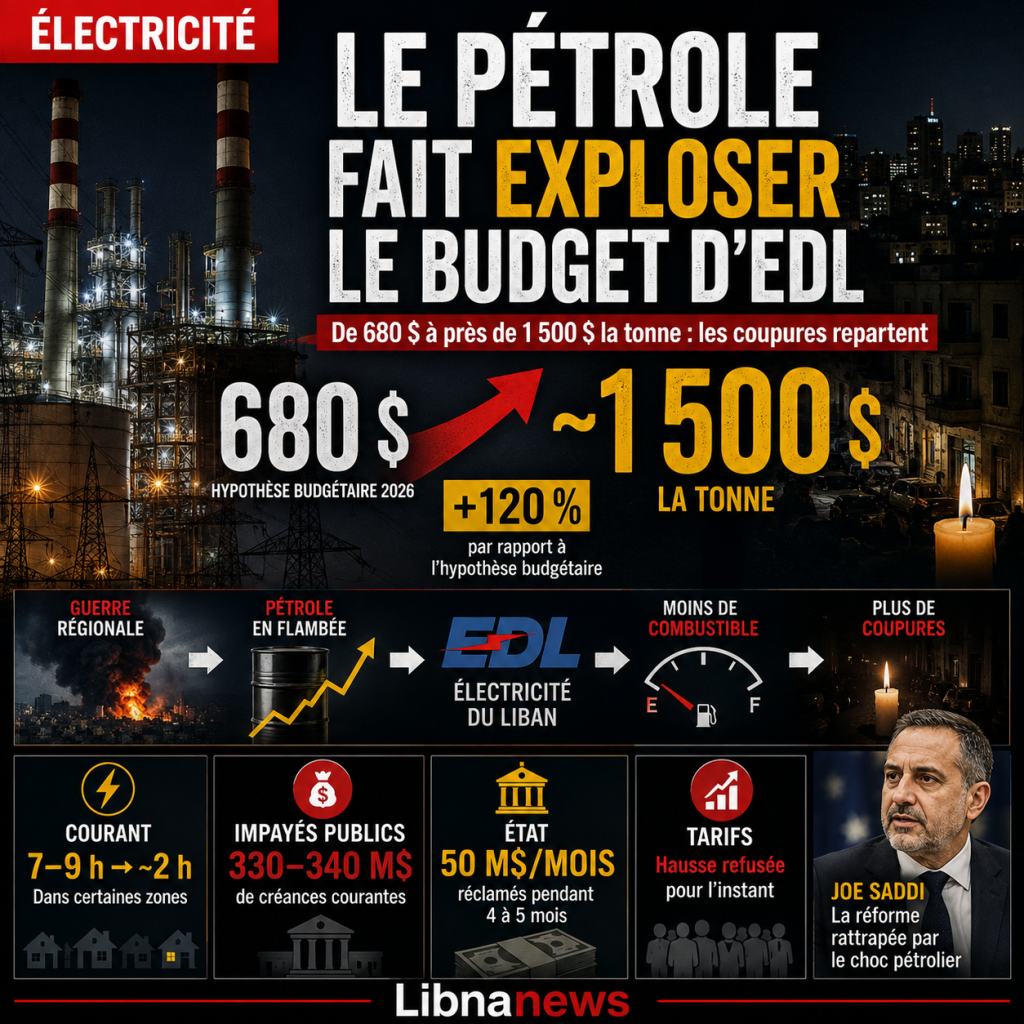
A few months have been enough to make one of the main assumptions of the Lebanese electricity budget obsolete. Electricity from Lebanon (EDL) built its 2026 budget on a diesel oil around $680 per tonne. The international price approached $1,500 in the context of regional war. As a result, fuel costs more than twice as much as the level in the calculations of the public establishment. This shock comes when public production has already contracted strongly and some areas, including Tripoli, are receiving only about two hours of electricity per day. It also weakens the policy of energy minister Joe Saddi, who had obtained seven to nine hours of daily power in February before the war and the oil surge reversed this improvement.
The problem now exceeds the management of EDL alone. The establishment must buy a much more expensive fuel with revenues already weakened by public unpaid payments, non-technical losses, illegal connections and insufficient collection in several regions. The government is currently refusing a tariff increase because of the social situation. The result is a difficult equation: without additional money, EDL has to buy less fuel, reduce other spending or find new resources. In all three cases, the risk of further cuts remains directly related to the institution’s financial capacity.
From 680 to nearly $1,500: Equation of EDL explodes
Data published by the Arab press on 25 August are used to measure the extent of the shock. EDL had withheld approximately $680 per metric tonne of diesel fuel for its 2026 budget. The market then approached $1,500. The absolute difference thus reaches about $820 per tonne.
At first glance, the calculation suggests an increase of 120.6% between the budget assumption of $680 and a price of $1,500. EDL referred to a global increase between 88 % and 91 %, corresponding to the evolution of market references followed by the institution over the period considered. The two figures therefore do not describe exactly the same comparison. However, for the EDL finances, the essential fact remains the same: the price at which the institution must obtain its energy has much more to do with the price used to build its budget.
Technically, the consequence is immediate. With a constant financial envelope, one ton purchased $1,500 mobilizes 2.21 times the amount budgeted for one ton at $680. At $68 million, for example, a theoretical assumption of $680 would buy 100,000 tons. At $1,500, the same amount would cover only about 45,300. This illustrative calculation is not a forecast of actual purchases of EDL, but it shows why the fuel price directly determines the number of hours that the facility can produce.
Joe Saddi had publicly summarized as early as 23 July: when the price of double fuel oil, EDL can only buy, with constant resources, about half the previous quantity. The minister explained that the establishment had managed to temporarily maintain its production thanks to its availability, before the persistence of the war made this strategy difficult to sustain.
Seven to nine hours in February, then the return of the cuts
The violence of the reversal appears when the current situation is compared at the beginning of the year. According to Joe Saddi, EDL had reached the end of February 2026 to provide between seven and nine hours of power per day on average, without any additional transfer from the Treasury to finance this power supply.
This improvement did not resist the regional energy shock. The war in March caused a surge in the cost of oil products. The establishment continued for two or three months to maintain its level of production, in the hope of a relaxing course. When this relaxation did not become sustainable, the financial constraint turned into physical stress: less fuel available means less kilowatt hours produced.
The contrast is particularly visible in Tripoli. On 14 August, MP Ashraf Rifi denounced a diet of about two hours daily in the city and implicitly accused the distribution system of disadvantageing the North. The Ministry of Energy has challenged any geographical discrimination. He confirmed, however, that the electricity situation had become « very difficult » throughout Lebanon.
The department also explained that the distribution depended on the level of production available and that electricity flights and defaults weighed on the capacity of LEDL to power the network. In other words, the decline in supply is no longer merely a perception of users. The department itself acknowledges that the improvement observed in February was interrupted.
Losses and unpaid payments aggravate oil shock
The price of fuel would be less dangerous for EDL if the establishment had a sound financial system. That’s not the case. The oil shock overtakes several old frailties that the war has aggravated.
EDL cites non-technical losses in particular. These are mainly electricity injected into the grid but not billed or unpaid due to illegal connections, meter manipulation or other forms of fraud. For a producer already suffering from a fuel shortage, every kilowatt hour consumed without revenue further deteriorates the financial balance.
Collection is a second problem. In several war-affected areas, the collection of invoices has deteriorated. Exemptions have also been granted to certain areas, particularly in the South. Joe Saddi does not dispute the principle of these destruction and displacement measures. However, the Panel finds that their cost should be offset by the Consolidated Revenue Fund and not borne by EDL.
To this are added the debts of administrations, public institutions, water authorities and municipalities. In July, the Minister estimated the accumulated debts to the end of December 2025 at approximately $250 million. According to his figures, these amounts continued to increase by approximately $12 million per month, bringing the current total from 330 to 340 million dollars.
This mass is of new importance when the fuel reaches exceptional levels. Invoices that could previously be seen as a cash flow problem are now becoming an indispensable financial reserve for maintaining the plants.
EDL starts cutting off bad public payers
The institution therefore chose to act on the collection. After an ultimatum of five working days, EDL began on 24 August to cut electricity to governments, public institutions and municipalities that had not regularized their bills. Public hospitals have been exempted from this measure.
This decision shows that the crisis has entered a more difficult phase. EDL is no longer simply claiming payment of arrears. It uses the interruption of supply as a collection instrument, including to public sector bodies.
The institution justifies this policy by a situation which it describes as force majeure. At the same time, it invokes the increase in oil products, the consequences of war, non-technical losses, weak recovery and accumulation of public debt. The stake displayed is the continuity of the service itself.
In areas where losses are particularly high, a reduction in food supply can also be used to limit energy supplied without financial compensation. However, this logic is socially delicate: a cut applied to a network with a lot of fraud also affects subscribers who normally pay their bills.
Tariff, economic solution but social problem
In the face of a much more expensive fuel, one of the theoretical answers is to raise the price of electricity. Joe Saddi indicated that he had proposed to the Council of Ministers a mobile tariff mechanism linked to international oil prices.
Economically, the principle is simple. If the variable cost of production increases, the tariff paid by the user changes in the same direction. A subsequent decline in oil could produce the opposite movement. This type of mechanism reduces the risk that a lasting gap between costs and revenues will clear the producer’s cash flow.
However, the government did not select this option at this stage. It considered that a tariff increase would be difficult to bear in the current economic and social situation. The choice temporarily protects EDL subscribers, but it does not eliminate the cost of oil. It simply shifts the question of its financing.
The Minister then proposed a second solution: that the State reimburse EDL $50 million per month for four or five months for its own debts and those of its institutions. This sum would therefore not, according to its presentation, constitute a new subsidy comparable to the old massive transfers to the electricity sector, but the payment of invoices and compensations already due.
The problem is that Joe Saddi stated on July 23 that this proposal, formulated about a month earlier, had still not been implemented. He then asked that she start the next week. The current crisis shows how much this delay has become sensitive.
Joe Saddi’s promises face the reality of the network
The current situation also requires a distinction between the structural reforms undertaken by Joe Saddi and their translation into household electrical outlets. Since joining the ministry in 2025, he has emphasized the institutional reorganization of the sector, the fight against theft, the reform of governance and the end of temporary solutions.
An important step has indeed been taken with the appointment of the Electricity Regulatory Authority, which has been expected for more than 20 years. The Council of Ministers also approved on 23 July 2026 a new sectoral policy defining a transition period and a longer-term model. The Ministry is working in parallel on the board of directors of EDL, the production, the gas infrastructure and the opening of the sector under the law.
However, these institutional advances have not yet produced the sustainable improvement of the diet expected by the population. The shift from seven to nine hours in February to a situation where some areas receive only about two hours illustrates this difference between the reform of the framework and the actual availability of energy.
We also need to be specific about political « promises ». The high-profile promise of 24-hour electricity after a year of Lebanese Forces management of the ministry was made in January 2025 by Charles Jabbour, then responsible for party communication, before the appointment of Joe Saddi. It would therefore be incorrect to attribute it personally to the minister. His political opponents, however, oppose him today because he was chosen by the Lebanese Forces to lead the ministry.
Joe Saddi promised to put the sector back on a viable path, to form the regulatory authority, to combat illegal connections and to break the logic of « refistolage solutions ». An institutional part of this programme has advanced. On the other hand, the promise of tangible and sustainable improvement in supply remains in the face of fuel shortages and the financing of EDL.
Four options, none without cost
In the short term, choices are relatively easy to identify, but none is painless. EDL can absorb part of the incremental cost by using its cash flow, reducing its security margin. It can reduce its purchases or certain expenses, with a direct risk to production. The State may provide additional resources or settle its debts. Finally, some of the shock can be passed on to consumers through tariffs.
There is no documented decision today to say that only one of these solutions will be implemented. The government has so far ruled out the immediate tariff increase. EDL accelerates collection and write-offs against debtors. At the same time, the Ministry is demanding payment of public debts.
For households, the question is not limited to the amount of the EDL invoice. When the public current decreases, consumption does not disappear. It moves to private generators, batteries, solar installations or other booster systems. Consumers can therefore pay an unchanged public tariff while seeing their total energy expenditure increase.
Companies are subject to the same mechanism. A factory, business, restaurant or hotel must ensure an electrical continuity that the public network does not guarantee. The more the cuts increase, the more the cost of self-production enters the cost. The oil shock ended up being passed on to goods and services, even if the government temporarily maintained the official tariff.
Technically coherent reform remains exposed to oil
This is precisely what the current crisis reveals. Lebanon can improve the governance of EDL, install a regulator, strengthen collection, combat illegal connections and design a more coherent model. These reforms address the internal causes of the electricity deficit. However, they do not automatically protect the country from external fuel shock.
As long as most of the available production depends on imported fuels and the EDL finances have little margin, a sharp increase in oil can cancel in a few weeks an improvement achieved for several months. The gap between 680 and nearly $1,500 now provides the most direct demonstration.
The emergency is now on two levels. The government must decide who will absorb the immediate additional cost of fuel, while the reform must ultimately reduce this vulnerability. Between the two, EDL continues to operate with a very concrete variable: every additional dollar spent on one tonne of fuel reduces the resources available elsewhere, and every cargo that has become too expensive can result in more hours without current.




