

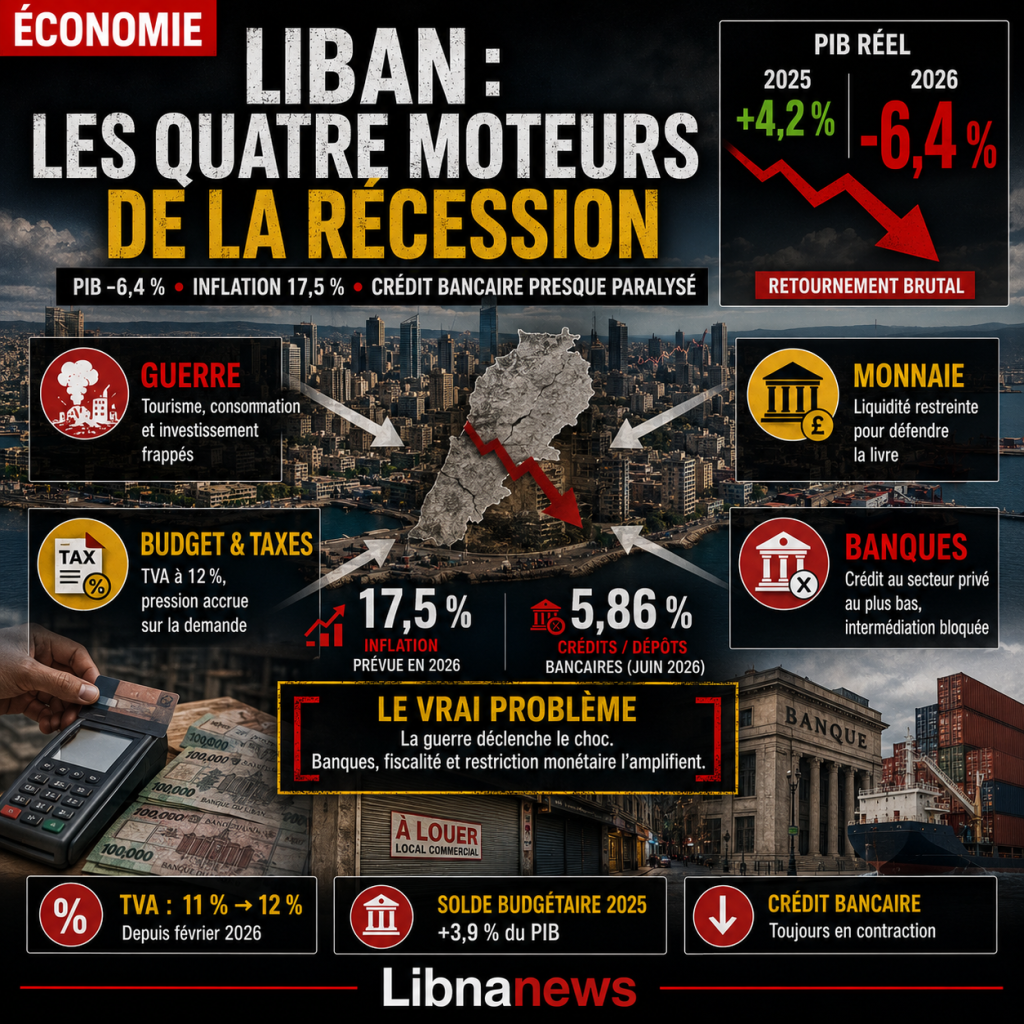
The Lebanese economy is expected to contract by 6.4 per cent in 2026. The figure marks a sharp reversal after an estimated 4.2% real growth in 2025. The resumption of the war in March explains a decisive part of this deterioration, but it is not enough to understand the depth of the recession. The military shock is affecting an economy already subject to restrictive monetary policy, prudent fiscal policy, higher levies and, above all, a banking system that is still almost no longer financing the real economy.
This combination turns an external shock into a much wider economic crisis. Households lose purchasing power, businesses reduce their investments and importers have to finance a large part of their goods with their own liquidity. At the same time, the State seeks to maintain fiscal balance and the Bank of Lebanon defends the stability of the pound by closely monitoring liquidity. Lebanon thus finds itself with several comprehensible policies taken separately, but whose cumulative effects become highly restrictive when activity collapses.
A 6.4% recession after the 2025 rebound
The change of course is considerable. Real GDP had increased by 4.2 per cent in 2025, the best performance since the financial crisis began in 2019. Consumption, tourism and some investments had started to grow again. This recovery remained fragile, but it gave hope for progressive normalization.
In 2026, GDP is expected to fall by 6.4 per cent. One international institution estimates that growth is about 10.4 points below what it could have achieved in a scenario without a new war. This calculation confirms that the conflict is the major immediate shock. It also shows what the country is losing in potential growth, beyond mere accounting contraction.
The situation is aggravated by expected inflation of around 17.5 per cent. Lebanon is therefore not only experiencing a decrease in the quantity of goods and services produced. At the same time it is experiencing a significant increase in their price. For households, this combination is much more difficult than a recession with lower prices.
| Indicator | Level or evolution | Economic reading |
|---|---|---|
| Real growth in 2025 | +4.2 % | Resumed after several years of crisis |
| Forecast growth 2026 | -6.4 % | Back to a strong recession |
| Difference with a conflict-free scenario | -10.4 points | Measuring the impact of war |
| Inflation planned for 2026 | 17.5% | Further decrease in purchasing power |
| Budget balance 2025 | +3.9% of GDP | Very prudent budgetary policy |
| VAT | 12% compared to 11% | Additional pressure on consumption |
| Bank loans/deposits | 5.86 % in june | Extremely weak banking intermediation |
War is the trigger, not the only cause
The first engine of the recession is obviously safe. The war disrupted tourism, caused population displacement, damaged housing and infrastructure and made businesses much more cautious. It has also affected domestic consumption, as households facing uncertainty carry forward expenditure that is not essential.
Tourism is particularly sensitive to this type of shock. When airlines reduce their turnover, insurance increases their premiums or visitors fear an escalation, reservations can disappear within a few days. At the same time, hotels, restaurants, travel agencies, transport and shops lose part of their revenues.
The war also brought oil, freight and some imports. For an economy extremely dependent on the outside world, this increase is rapidly passed on to all prices. The cost of an imported product depends not only on its original price, but also on the transport, fuel, insurance, financing and taxes levied before its arrival at the consumer.
The Lebanese peculiarity is that these shocks encounter an economy without several traditional depreciation mechanisms. Bank credit remains very low, the state cannot borrow normally on the markets and the central bank cannot inject massive liquidity without risking further destabilization of the currency.
Monetary policy stabilizes the pound but slows activity
The Bank of Lebanon’s policy has been based for several years on restrictive liquidity management in books. This strategy helped to stabilize the exchange rate after the monetary collapse in the early years of the crisis. It also reduced the risk of a new spiral between monetary creation, depreciation and inflation.
This stability is an important achievement. A resumption of the fall in the pound would immediately lead to a further increase in import prices and could lead to a further loss of confidence. In an economy where many essential products are purchased in foreign currency, preserving the exchange rate remains a central objective.
But this policy has an economic cost. Closely controlled book liquidity limits the ability of the financial system to create credit. It also prevents the State from financing a major stimulus through monetary creation. In times of growth, this discipline can help stabilize the economy. In times of recession, however, it reinforces weak demand.
Lebanon therefore faces a real monetary dilemma. Strong easing of monetary policy could temporarily support activity, but could put the pound and prices back under pressure. Maintaining the current policy further protects the currency, but leaves households and businesses with much of the contraction.
Lack of credit has become a factor of recession
The weakness of the banking system probably represents the main structural handicap of the Lebanese economy. Six years after the outbreak of the financial crisis, banks continue to lend very little to the private sector. At the end of June 2026, credit to the private sector accounted for only 5.86 per cent of bank deposits.
The figure is exceptionally low for an economy historically based on banks. Private sector funding reached around £453 billion in June. They had decreased further by 2.66 per cent since the beginning of the year and by 7.4 per cent over 12 months. Deposits remain massively dollarized at almost 98.7%.
This means that there is a large amount of saving in the system, but it does not normally flow to investment. Banks remain extremely cautious because of their historical losses, liquidity constraints and uncertainty surrounding the restructuring of the sector.
In a functional economy, a company can borrow to buy a machine, finance a stock or absorb a temporary decrease in sales. In Lebanon, it often has to raise its own funds or seek external financing. This slows growth even when the company has a potential market.
Banks indirectly increase import costs
The banking problem is particularly visible in external trade. Importing requires financing several weeks or even months between ordering a product and payment by the final customer. In a normal banking system, this period may be covered by a letter of credit, a cash facility or short-term financing.
Where these instruments are rare, the importer must immobilize his own dollars. He may have to pay his supplier before shipping, finance the transport, pay the duties on arrival and then keep the goods in stock until it is sold. Each step consumes cash.
The economic cost of this asset is then reflected in the price. The importer must pay his capital, cover the risk and maintain a greater margin of security. Two products purchased at the same price abroad can therefore be sold at different prices depending on the quality of the financial system that finances their delivery.
| Step | With normal bank credit | In the Lebanese situation | Effect on cost |
|---|---|---|---|
| Command | Letter of credit | Advance or cash | Fixed cash |
| Transport | Short-term credit | Own funds | Cost of capital |
| Customs clearance | Banking line | Immediate payment | Liquidity requirement |
| Storage | Stock financing | Self-financing | Prolonged capitalization |
| Sale | Commercial credit | Payment sought quickly | Pressure on customers |
| Risk | Shared with the bank | Supported by the company | Safety margin |
This mechanics affects almost all sectors. An importer of food, medicine, automotive parts or machinery must pass on part of the financial cost to its customers. The banking crisis thus maintains a form of structural inflation while simultaneously limiting investment.
A vicious circle between banks and businesses
Banks’ prudence can be understood from a microeconomic point of view. Lending during a recession increases the risk of default. A bank still weakened by losses accumulated since 2019 logically hesitates to take new significant risks.
The problem arises when all banks simultaneously adopt this attitude. Credit contracts, firms invest less and their activity slows down. This economic weakness then increases the risk that banks had specifically sought to avoid.
The relationship becomes circular. Banks do not lend because the economy is fragile, and the economy remains fragile because banks do not lend. This is why bank restructuring is not just a question of returning deposits. It is one of the main conditions for a sustainable return to growth.
The legislative changes adopted in 2026 are a step in this direction. However, they are not sufficient to restore immediate confidence, recapitalize viable institutions and re-circulate large amounts of credit.
Tax policy becomes heavier in full economic weakness
At the same time, the government sought to maintain the balance of public finances. This strategy responds to a real constraint: the Lebanese state can no longer finance large deficits through traditional debt and cannot safely return to the monetary financing that had accompanied the collapse of the pound.
However, this discipline has a restrictive effect when applied in a shrinking economy. The public budget does not fully play its countercyclical role. When private consumption and investment fall, the state does not increase its own investments sufficiently to compensate for this decline.
By 2025, public accounts had recorded an overall surplus of about 3.9% of GDP. This performance reflected an improvement in tax collection, customs revenue and VAT. It demonstrated a new capacity to better control public finances.
But a surplus also has macroeconomic significance. It states that the State is taking more resources from the economy than it does from it in the form of a deficit. In a phase of reconstruction and growth, this discipline can build confidence. In a severe recession, demand may increase if it is not accompanied by significant productive investment.
12% VAT: more revenue, less disposable income
In February 2026, the government decided to increase the VAT rate from 11% to 12%. The measure was part of the funding of an increase in public and military compensation and allowances. The budgetary objective was to avoid this additional expenditure creating an unfunded deficit.
This decision is consistent from an accounting point of view. A new permanent expenditure must normally be accompanied by a permanent revenue. However, it becomes more difficult to absorb when it occurs a few weeks before a major deterioration in activity.
VAT is paid on consumption. By increasing its rate, the State takes a slightly higher share of household expenditure. The consumer pays more if the company fully transfers the tax. If it absorbs part of the increase, its margin decreases.
In both cases, the private economy bears the cost. The consumer loses purchasing power or the company loses profitability. The individual effect seems limited for a single transaction, but becomes significant when it concerns millions of purchases for a whole year.
Fuel adds second tax burden
The government has also decided to increase the price of a 20-litre can of gasoline by some £300,000, while removing a previously envisaged increase on fuel oil. This decision was also intended to contribute to the financing of new public expenditure.
A gas tax, however, far exceeds the motorist. Transport takes place in all production and distribution chains. An increase in fuel affects taxis, deliveries, transport companies, sales representatives and employee travel.
Companies are gradually passing some of these costs on their tariffs. When the tax is followed, as in 2026, by a sharp international increase in oil, the two effects cumulate. A relatively limited budgetary measure at the time of adoption becomes an additional element of the energy shock.
Import taxes and cash requirements
Other import levies also play a role. In particular, the tax system maintains a 3% contribution on certain imported goods subject to VAT. For certain categories of importers not complying with their tax obligations, an advance of 1.5% may also be deducted at entry.
Not all these levies should be treated as a definitive tax increase. A tax advance can be recovered or deducted from the tax finally due. However, it creates a need for immediate cash at the time of clearance.
This is precisely where tax policy is facing the banking crisis. A prepaid levy would be relatively easy to support by a company with a bank credit line. In an economy where credit is scarce, the same advance obliges the importer to raise even more cash.
A border tax can thus have a higher effect than its facial amount when applied in an underfunded economy.
The cumulative cost to an enterprise
The difficulties of Lebanese companies are therefore not due to a single variable. They simultaneously support several cost increases while their sales may decrease.
| Factor | Effect on enterprise |
|---|---|
| War | Lower demand and increased risk |
| Oil | More expensive transport and production |
| VAT | Pressure on final price or margin |
| Import tax | Additional cost and cash flow |
| Rare bank credit | Self-financing of stocks |
| High rates or difficult access to the loan | Delayed investment |
| Unstable electricity | Use of private solutions |
| Inflation | More expensive wages and inputs |
A healthy business can absorb one or two of these shocks for a limited period of time. Their accumulation for several months, however, changes their behaviour. It postpones recruitment, reduces its orders and avoids investments that are uncertain in return.
This behaviour is rational for each manager. At the national level, it becomes recessive. Less investment means fewer orders for suppliers, fewer jobs and less income distributed.
The paradox of public wage increases
However, new taxes do not disappear entirely from the economy. Part of their revenue finances the remuneration of civil servants, military and retired public sector employees. These households then use part of this additional income to consume.
There is therefore a compensation effect. Taxes reduce consumption on one side, while improving public incomes can increase on the other. The net balance sheet depends on the behaviour of households and how income is used.
The issue of distribution remains important. VAT affects a very broad consumer base. The wage increase benefits a specific category of the population. Smaller households generally spend a higher share of their income on current expenditure, making indirect taxes proportionately heavier for them.
The problem, therefore, is not only the total amount of revenue raised, but also the way in which their costs are distributed.
A difficult countercyclical fiscal policy
In a classic recession, the state can temporarily accept a deficit in order to finance infrastructure, support income and prevent a sharp fall in demand. Lebanon has limited capacity to implement this strategy.
The public debt remains unsustainable and its restructuring is not completed. The country therefore cannot borrow freely at acceptable rates. A recovery financed by monetary creation could threaten the stability of the pound.
The government is thus forced to seek revenue when it wants to increase spending. This discipline reduces monetary risk but severely limits the fiscal multiplier that could support activity.
Low public investment exacerbates this problem. When a state increases a tax to finance a road, power grid or port that improves future productivity, part of the tax cost can be offset by the growth generated. When investment remains insufficient, this effect is much weaker.
The combination of the four shocks
The Lebanese recession can thus be understood as the result of an accumulation of constraints rather than as the effect of a single cause.
| Engine | Objective or origin | Recessive consequence |
|---|---|---|
| War | External shock | Less tourism, consumption and investment |
| Monetary policy | Stabilize the book | Limited liquidity and recovery capacity |
| Budgetary policy | Avoid deficit | Low public support for demand |
| Taxation | Financing expenditure | Purchasing power and pressure margins |
| Banking system | Maintaining fragile balance sheets | Extremely low credit |
| Imported inflation | Oil and logistics | Real income down |
However, it would be incorrect to arbitrarily distribute the 6.4 points of contraction between these factors. The available data do not suggest that taxes explain one point of GDP or that the monetary restriction explains two. This would require a detailed macroeconomic model to isolate each shock.
The economic conclusion is more cautious. The war explains a major part of the reversal observed in 2026, but it acts on an economy whose demand, financing and investment were already severely constrained. Monetary and fiscal choices reduce certain risks, particularly that of a further monetary collapse, while limiting the country’s ability to absorb a new recession.
Households suffer a real stagflation
For households, the most important consequence is not GDP itself. It lies in the combination of income, employment and price.
With an expected average inflation of 17.5%, an employee whose income remains unchanged loses a significant share of his real purchasing power. Even a nominal increase of 10% is not enough to compensate fully for price increases of this magnitude.
Families then reduce expenses considered carryable. Restaurants, leisure, equipment, clothing, repairs and some care can be postponed. Households favour food, housing, electricity and transport.
However, every household saving becomes a lost revenue for a business. This is the mechanism of the recessive multiplier. An initial decline in consumption gradually spreads across the whole economic fabric.
Employment can deteriorate without a statistical explosion of unemployment
The Lebanese labour market has a strong informal component. Economic deterioration does not necessarily immediately produce a dramatic rise in official unemployment.
An employee can keep his or her job but work less days. A company can reduce commissions, remove overtime or freeze recruitment. Seasonal employment may not be renewed.
The main risk is the increase in the number of poor workers. These people remain economically active but their real income decreases faster than their essential expenses.
Tourism, catering, trade, agriculture and construction are among the most vulnerable sectors. Their activity depends directly on the level of confidence, travel, investment and disposable income.
Poverty risks rising
The recession of 2026 came as several social indicators began to stabilize. The new combination of inflation, population displacement and decline in activity may interrupt this improvement.
The smallest households are particularly vulnerable to indirect taxes and food or energy inflation. They have little savings and devote much of their resources to basic needs.
When a household loses a few hundred dollars of annual income, the consequences are not limited to a drop in comfort. It can reduce medical expenses, protein consumption, travel or some educational expenses.
The recession then becomes a human capital problem. A prolonged crisis affects not only the current standard of living, but also the health, education and future productivity of the population.
2027: the rebound will depend more on reform than on a ceasefire
A safe improvement could cause a statistical rebound in 2027. Tourism could return, the diaspora could return more during the summer and some suspended investments could be reactivated.
But this rebound will only be sustainable if the other brakes also begin to disappear. The economic priority would be to restore a banking system capable of financing businesses without recreating the imbalances that preceded 2019.
The second condition concerns budgetary policy. Lebanon must preserve the discipline of accounts, but it will gradually have to shift more spending towards productive investment, infrastructure and targeted social protection.
The third concerns monetary policy. As long as confidence in the currency remains fragile, the Bank of Lebanon will not be able to pursue a highly expansionist policy. The best way to gradually expand its policy space would therefore be to restore banking and budgetary credibility rather than returning to monetary creation.
In a favourable scenario, lasting cessation of hostilities, externally financed reconstruction, bank recapitalisation and the gradual return of credit would allow a relatively rapid recovery. In an intermediate scenario, tourism would leave, but investment would remain low, which would produce growth mainly based on consumption.
The worst case scenario would be a prolonged war with a still paralysed banking system and an increasing tax burden to finance the immediate needs of the state. Lebanon would then risk entering a new phase of stagnation, where the economy would continue to function mainly in cash and through external transfers, without any real reconstruction of its productive capacity.
The central question after the expected decline of 6.4% is therefore not just when the war will stop. It is a question of determining whether, at a time when the security shock will diminish, Lebanon will have a bank system capable of lending, a budget capable of investing and a fiscal policy sufficiently balanced to avoid stifling the recovery it will seek precisely to bring about.




