

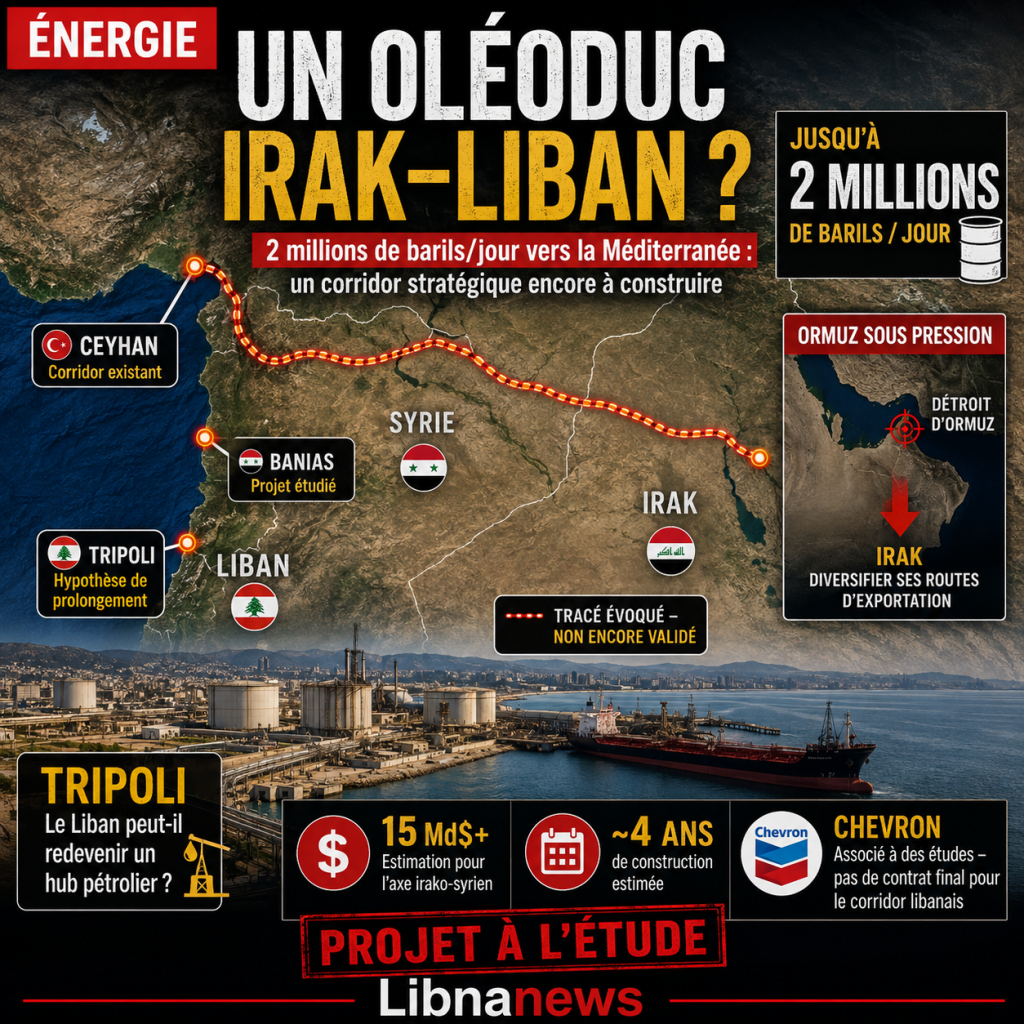
The idea is spectacular: bring up to two million barrels of Iraqi oil a day to the Mediterranean using a new land corridor through Turkey, Syria and Lebanon. It comes especially at a time when the crisis in the Strait of Ormuz has shown Iraq’s strategic vulnerability, most of which is historically dependent on the Gulf. At this stage, however, the projects formally studied by Baghdad must be distinguished from the prospect of an extension to Lebanese territory. On August 25,Al Akhbarreports that General Security Director Hassan Choucair spoke to Lebanese officials about a new pipeline project involving the American company Chevron. Several elements of this energy architecture are well documented. The full corridor to Lebanon still has no published inter-State agreement, no announced funding, no timetable for implementation.
A project evoked by Hassan Choucair after his visit to Iraq
According toAl AkhbarHassan Choucair informed Lebanese political, official and media figures about the discussions he was reportedly aware of during a recent visit to Iraq. The Director General of General Security met with Iraqi Prime Minister Ali Faleh al-Zaidi and several officials.
The daily describes an Iraqi project to establish a new oil axis to transport crude oil to the Mediterranean coast. The reported route would pass through Iraq, Turkey, Syria and Lebanon before reaching marine loading facilities. The reported capacity would reach about two million barrels per day.
By comparison, such a volume would represent a major infrastructure in the Middle East. Two million barrels per day correspond to a very large share of Iraq’s current exports. The pipeline would therefore not be a mere technical extension to the Lebanese market. Its main function would be the international export of Iraqi crude by the Mediterranean.
Al Akhbaralso associates Chevron with the project. However, this participation must be precisely formulated. The involvement of the American group in several Iraqi oil pipeline studies and projects is confirmed by the Baghdad authorities. On the other hand, the public documents available do not yet establish that a final contract would have been awarded to Chevron to build an integrated corridor passing successively through Turkey, Syria and Lebanon.
This nuance is essential. The project builds on real energy discussions, but several different projects still seem to coexist.
What Iraq has actually committed
Baghdad has been working for several months on an accelerated diversification of its export routes. The closure or disruption of the Strait of Ormuz during the regional war turned an old strategic concern into an economic emergency.
The Iraqi Oil Ministry confirmed in July that it was studying a new pipeline architecture. One of the axes is to link Bassora, in the southern petroleum of the country, to Fishkhabur, in the north. It could then join the network leading to the Turkish port of Ceyhan. Another axis would link Haditha, in western Iraq, to the Syrian port of Banias on the Mediterranean.
A consortium comprising Chevron, the American company TI Capital and the Qatari group UCC is involved in the technical and financial studies of some of these projects. The Iraqi authorities also announced discussions with Chevron on the increase in production and the development of new logistics capabilities.
However, the distinction between study and construction remains crucial. Iraq’s oil ministry has itself specified that certain agreements signed in July focused on technical studies, initial design and feasibility. These documents do not necessarily create, at this stage, a definitive financial obligation for the Iraqi State.
The project is therefore more advanced than a simple political idea, but less advanced than a fully funded project.
Two million barrels: a credible figure, but not yet Lebanese
The volume of two million barrels a day is not just from the story published on August 25. It already appears in the projects officially discussed between Iraq and its partners.
Iraqi officials mentioned a new capacity of this kind for the system linking the southern fields to the Mediterranean exits. Projects on the Haditha-Banias axis were also presented with a potential capacity of 2 million barrels per day.
This concordance reinforces the credibility of the figure. It does not automatically confirm the complete route to Lebanon.
Iraqi public announcements today identify two major Mediterranean markets: Ceyhan in Turkey and Banias in Syria. Lebanon appears in another series of discussions with Baghdad, including around Tripoli and the possibility of resuming a transit and storage function.
In other words, there are several rooms. It remains to be demonstrated that they are already part of a single industrial project.
Why Ormuz completely changes Iraqi calculation
The Ormuz Strait crisis provides the main economic justification for this acceleration. Before the regional war, Iraq exported the vast majority of its crude oil through its Gulf terminals. This geography offers considerable capacity, but it also focuses risk on a single marine passage.
When traffic in the Strait was severely disrupted, Iraqi exports fell sharply. Baghdad has found itself confronted with a structural problem: having large reserves and productive capacity is only partially used when oil can no longer reach international markets.
Dependence is all the more significant as oil revenues provide the bulk of Iraq’s budgetary resources. A prolonged interruption in exports therefore does not only affect oil companies. It directly threatens public finances, state spending and economic stability.
A land network to the Mediterranean would offer strategic assurance. It would probably not replace the Gulf, but would allow Iraq to have several independent exits. The crude oil could reach Ceyhan, Banias or, in the Lebanese case, facilities on the Lebanese coast.
The Iraqi strategy has thus moved from commercial optimization to resilience.
Ceyhan already exists, Banias has to be largely rebuilt
The corridor to Turkey has a clear advantage: some infrastructure already exists. The Iraq-Turkey pipeline links northern Iraq to the Mediterranean port of Ceyhan. Baghdad and Ankara signed a one-year agreement in early August, now in operation, pending a broader arrangement.
The agreement covers a transport capacity of up to 750,000 barrels per day in its current phase. The historical system theoretically has superior capabilities, but its real flows remain affected by technical problems, conflicts over Kurdish exports and the consequences of war.
The Syrian way poses a different problem. The former Kirkuk-Banias pipeline has long been a western outlet for Iraqi oil. But the infrastructure is old, damaged and largely inadequate for the volumes currently envisaged.
Estimates reported in August estimate the cost of a new Iraq-Syria system at at least $15 billion and the necessary construction time at about four years. These figures give an idea of the financial scope of the project.
That’s why talking about « reopening » an old pipe would be misleading. To transport up to two million barrels a day, much of the system would have to be rebuilt or new pipes, pumping stations, storage capacities and terminals installed.
In Lebanon, a new conduit rather than a restoration
The same logic appears in the information attributed to Hassan Choucair. According toAl AkhbarThe Lebanese official would have understood from his Iraqi interlocutors that the Lebanese project would require a new pipeline.
The old network would have neither the technical characteristics nor the capacity to transport the volumes mentioned. A corridor of two million barrels a day would require a very different infrastructure from the historic facilities that once connected Syrian networks to Tripoli.
This clarification significantly alters the scope of the project. Restoring an old pipeline can be an important but relatively limited project. Building a new cross-border pipeline requires mapping studies, expropriations, pumping stations, security devices, storage capacities and port facilities sized for international flows.
Lebanon should also decide where the oil would be directed. Tripoli has an oil legacy and storage facilities, but they would also require major investments to become the terminal for a corridor carrying volumes of this size.
Lebanon had already proposed a road to Tripoli
The hypothesis does not arise entirely on August 25. At the end of July, Prime Minister Nawaf Salam visited Baghdad with a delegation including energy minister Joe Saddi. The discussions had focused on energy and opportunities to strengthen trade between the two countries.
Lebanon then proposed to re-establish a role in the transit of Iraqi oil to the Mediterranean. The scenarios mentioned included the transport of crude oil by land, the use of facilities in Tripoli and, in the longer term, the rehabilitation or construction of fixed infrastructure.
A joint technical team was to examine the options available. This is an important step, as it confirms the existence of a bilateral political interest. However, it is not a decision to build an oil pipeline.
Lebanon’s first discussions even focused on more immediate solutions, including tanker transport across Syria. Such a formula would already require the rehabilitation of roads, border crossings, storage capacity and reception facilities in Tripoli.
The pipeline would therefore correspond to a much more ambitious stage of cooperation.
A geography that still requires explanations
The route reported byAl Akhbarit also deserves a careful technical reading. A corridor passing successively through Iraq, Turkey, Syria and Lebanon would be particularly complex. It would involve four jurisdictions, several existing networks and connections that are not yet publicly detailed.
The plans officially described by Baghdad are now more legible: one axis towards Turkey and Ceyhan, and another towards Syria and Banias. The extension to Lebanon could theoretically become part of a Syrian network or form an independent branch. The available information does not yet make it possible to determine the chosen architecture.
This lack of detail does not make the project impossible. It only means that the political concept still precedes definitive engineering.
A real pipeline project must specify its origin, diameter, flow rate, pumping stations, exact route, terminals served and commercial conditions of access to the network. No complete set of such data has yet been made public for an Iraq-Lebanon corridor.
Four States should guarantee the same pipe
The most obvious obstacle would be diplomatic. A cross-border pipeline is viable only if all the States crossed accept transit conditions for several decades.
Iraq would supply oil. Turkey, Syria and Lebanon should guarantee the passage of the network according to the route finally chosen. Everyone would like to negotiate their transit rights, technical responsibilities, possible taxes and dispute settlement mechanisms.
Security would be just as important. A pipeline of this dimension constitutes a strategic infrastructure exposed to sabotage, military strikes, armed groups and political tensions. A break over a few kilometres could immobilize the entire chain.
Syria is a central challenge in this regard. Despite the new political configuration, some regions remain fragile and Syrian energy infrastructure has suffered years of war and underinvestment.
Funding would be huge
The second obstacle concerns money. The only estimates for the Irak-Syrian axis already evoke at least $15 billion. Adding a Lebanese branch, modernizing terminals and building storage capacity would necessarily increase investment.
A company like Chevron can bring its technical expertise and facilitate the mobilization of capital, but its participation does not remove the need for a clear economic model.
Investors would like to know the guaranteed volumes, duration of transit contracts, tariffs, sovereign risks and mechanisms of protection in the event of war or political change.
In order to transport two million barrels daily, there would also need to be strong enough commercial commitments to ensure pipeline use over a long period of time.
What Lebanon could gain
For Lebanon, the interest would not lie primarily in access to crude oil itself. It would be in the country’s return on the regional energy infrastructure map.
A Mediterranean terminal could generate transit rights, storage revenues, port investments and a new logistics activity. Tripoli could regain an energy function that it lost with the shutdown of the old installations.
The project could also justify the modernization of oil equipment, roads and port facilities. In a country seeking productive investment and foreign exchange earnings, this perspective has an obvious economic dimension.
But these benefits remain hypothetical for the moment. No transit tariff has been fixed. No volume reserved for Lebanon was announced. No port investment directly related to this pipeline is confirmed.
A credible project by its components, uncertain as a whole
It is ultimately this distinction that makes it possible to assess the information of 25 August correctly. Iraq is trying to reduce its dependence on the Strait of Ormuz. It invests in several land corridors. He negotiates with Turkey, studies a new link with Syria and works with a consortium including Chevron. The figure of 2 million barrels per day appears well in the projects currently under study.
Lebanon, for its part, is seeking to find a place in the transport of Iraqi oil to the Mediterranean. Discussions between Beirut and Baghdad are also established.
What is not yet established, however, is the existence of a final decision transforming these elements into a single Iraq-Turkey-Syria-Lebanon pipeline. Detailed studies, transit agreements, financing, final route and timetable are still missing.
The Ormuz crisis has made the idea much more relevant than it would have been a few years earlier. It did not remove obstacles. For Lebanon, the return to a regional energy transit function therefore becomes a credible prospect to be examined, but not yet an infrastructure that can be considered as acquired.




