

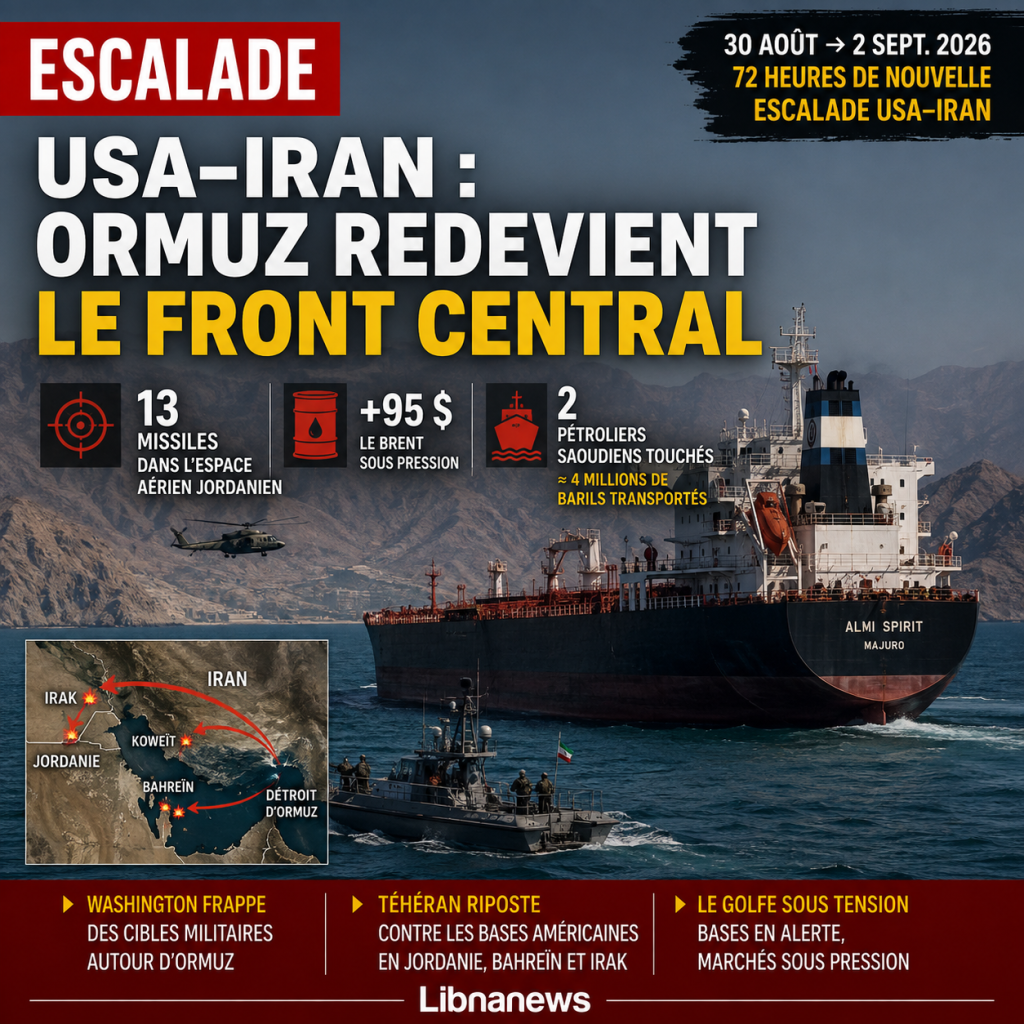
The US-Iran confrontation entered a new phase between 30 August and 2 September 2026. After several weeks of relative military crisis, Washington resumed its bombings against Iranian targets around the Strait of Ormuz. Tehran has responded by ballistic missiles and drones against facilities hosting US forces in Jordan, Bahrain and Iraq, while Kuwait has also activated its defences. Civilians were killed in Iran and two oil tankers carrying Saudi crude oil were attacked in the Strait. This series of strikes put an end to the hope of rapid de-escalation and put direct military conflict between Washington and Tehran at the centre of the regional crisis.
The US-Iran escalation resumes after a month of decline
The new gear starts on August 30 with an American strike against two Iranian launchers on the island of Larak, located in the Strait of Ormuz. Washington states that the equipment was linked to Iranian attempts to disrupt navigation, including the use of mines. This operation is the first known American attack on Iranian territory in about a month. It comes after a period during which the confrontation took the form of an economic and maritime arm.
The Iranian response is quick. The Revolutionary Guards are announcing ballistic missile fire at two bases used by US forces in Jordan, King Hussein and Al-Azraq. Initial US reports do not indicate any significant loss during this attack. Donald Trump nevertheless threatens Tehran with a much stronger response if Iran continues its operations. This threat is followed on 1 September by a new US bombing campaign on Iranian territory.
The United States Central Command then announced that it had targeted facilities for the Revolutionary Guards. Objectives include air defence systems, radars, communications infrastructure, marine assets and mine anchorage capabilities. The choice of targets shows that Washington is primarily seeking to weaken the mechanism for Iran to monitor and threaten the Strait of Ormuz. The conflict thus returns, in less than 72 hours, from an economic confrontation to a direct exchange of strikes between the two countries.
Washington hits Iranian military capabilities around Ormuz
The geography of the American bombings is decisive. The reported explosions and attacks are concentrated especially in southern Iran, around Hormozgan, Bandar Abbas, Qeshm and facilities that control Iranian access to the Strait. Washington claims to be acting after attempts to attack commercial shipping and US troops in the area.
Air radars and defences enable Iran to monitor its coastline and protect its facilities. Naval assets and mine anchorage systems pose a direct threat to ships crossing Ormuz. By simultaneously targeting these capabilities, the United States seeks less to conquer territory than to reduce Iran’s ability to turn the Strait into an economic and military weapon.
This strategy marks an important development after six months of war. Nuclear facilities and ballistic capabilities remain major challenges, but Ormuz has become one of the main centres of gravity of the conflict. Iran has a geographical advantage that Washington cannot suppress by its only aerial superiority: its immediate proximity to a maritime route on which a vital part of Gulf energy exports depends.
Donald Trump presented the new strikes as justified and threatened Iran with even greater operations in case of a response. The problem for Washington is that this response has already begun. The immediate question therefore becomes that of a new American response and the risk of a cycle where each operation serves as a justification for the next.
Iran responds against US military network
Tehran does not seek to respond to the United States through a comparable air campaign. Its strategy is based on ballistic missiles, drones and the geographical dispersion of American facilities in the Middle East. This asymmetry allows Iran to extend the cost of conflict far beyond its own territory.
During the night of 1 to 2 September, Iranian attacks concerned several countries hosting American forces. Missiles are launched towards Jordan. Drones and warnings are reported in Bahrain and Kuwait. Iran also claims strikes against American installations in Iraq, especially around Erbil. Tehran claims to have inflicted losses on US forces, but these claims were not confirmed by Washington at the time of the latest available information.
This distinction is essential. The existence of attacks and interceptions is established, but Iran’s claims cannot be regarded as confirmed when they are denied by the United States or have no independent verification. The communication war now accompanies every military exchange.
However, the Iranian strategy remains visible: to compel Washington to simultaneously defend installations scattered over several countries. The United States has more than 50,000 military personnel in the region according to American command. This presence guarantees an important offensive capability, but also multiplies potential targets for Iranian missiles and drones.
Jordan directly caught in confrontation
Jordan is one of the most sensitive theatres of this response. During the night of 1 to 2 September, thirteen Iranian ballistic missiles entered its airspace. According to the Jordanian authorities, ten were intercepted and three fell into remote areas. No death was reported.
The Al-Azraq and King Hussein bases had already been explicitly designated by the Revolutionary Guards during the 30 August response. Al-Azraq, also known as Muwaffaq Salti, hosts Jordanian and American means and plays a role in the Western military apparatus in the Levant. For Iran, these facilities therefore belong to the network allowing the United States to conduct its regional operations.
Jordan, however, seeks not to become a party to the conflict. Amman presents his interceptions as a defence of his sovereignty and population. This distinction becomes difficult to maintain when its territory hosts United States forces and Iranian missiles are directed directly to these facilities.
The threat is not theoretical. Previous attacks had already caused American casualties in Jordan. The precedent reinforces the political risk associated with the new waves: an attack causing several American deaths could provoke a much greater response against Iran.
Civilians killed in bombing in Iran
The resumption of the American strikes also resulted in civilian casualties. Near Sirik, in southern Iran, an attack hit a house where a marriage was taking place. Five people, including one child, were killed and several dozen injured according to available information.
Other victims were reported in Khouzestan. Iranian authorities reported seven deaths and eight injuries after several strikes. These figures come from Iranian officials and must be presented as such until they have complete independent verification.
Washington says the goals of his campaign are military. CENTCOM indicated that it was aware of information concerning civilian victims. The concentration of military, port and civilian facilities in some areas of southern Iran, however, increases the risk of non-combatant losses as bombardments increase.
For Tehran, these deaths also fuel the political justification for reprisals. Each civilian victim reinforces internal pressure for a response, even when Iran is also seeking to keep diplomatic channels open.
Bahrain, Kuwait and Iraq exposed to reprisals
The extension of the shots to several countries shows that the USA-Iran confrontation is no longer geographically limited to the territory of the two opponents. Bahrain hosts the headquarters of the Fifth American Fleet. Kuwait also hosts United States forces and is an important logistics point. Iraq maintains several facilities where US military personnel are present.
In Bahrain, defences were mobilized in the face of new Iranian attacks. In Kuwait, a drone caused a fire in a residential area without causing any casualties, according to initial reports. In Iraq, the Revolutionary Guards claimed attacks against American positions and claimed to have caused losses, which the United States has not confirmed.
Tehran is trying to distinguish the governments of these countries from the American forces they host. This line is becoming increasingly fragile. An intercepted missile can produce debris on a inhabited area and a drone targeting a military facility may miss its objective. The States concerned must therefore defend their own territory, even when they wish to remain outside confrontation.
This multiplication of theatres increases the risk of error. An Iranian strike causing civilian casualties in a Gulf State could lead to a response from that country. An attack causing heavy American losses could immediately alter the scale of Washington’s campaign.
Two Saudi tankers attacked in the Strait of Ormuz
The maritime front experienced a particularly worrying development on 1 September. Two oil tankers carrying Saudi crude were hit by projectiles a few minutes apart as they crossed the Strait of Ormuz near Khasab, Oman. The two ships each loaded about two million barrels of oil at the Saudi terminal in Juymah.
No deaths were reported. The origin of the projectiles was not established at the time of the latest available information. It would therefore be incorrect to attribute these attacks to Iran without further evidence. Their occurrence during the resumption of the clashes nevertheless shows how exposed commercial shipping is.
The incident occurred as Washington accused the Iranian forces of threatening the ships and preparing mine anchorage operations. Iran, for its part, claims that American strikes will lead to further restrictions in the Strait.
This confrontation around navigation is one of the main risks of economic internationalisation of the conflict. An attack on a base can remain a regional military event. A sustainable closure of Ormuz directly affects Asian, European and global economies.
Ormuz becomes Tehran’s economic weapon
Prior to the war, almost 20% of world oil flows passed through the Strait of Ormuz. Iran is now using its ability to control or disrupt this route as the main means of compensating for its weakness in the face of US air power.
Traffic remains severely reduced. On 1 September, only four vessels carrying raw materials crossed the Strait, compared to 10 the previous day and about 13 per day on average in the previous 10 days. These statistics do not necessarily account for vessels that disable their transponder, but they confirm the extent of the disturbance.
A few days earlier, Tehran announced that it had placed 45 oil tankers on a blacklist for violating its new navigation rules. The Iranian authorities threatened these buildings with sanctions, detention or confiscation of their cargoes. Several oil companies have begun to avoid the vessels concerned.
This policy shows that Iran is not only seeking to physically close the Strait. It is also trying to impose a maritime control regime which shipowners must take into account. The United States refused this claim and sought to maintain freedom of navigation, which placed the two powers directly in competition in the same waters.
The US embargo hits Iranian exports
Washington has its own maritime pressure instrument. Since mid-July, the US naval blockade has severely reduced Iran’s ability to export its oil through Ormuz. This policy is now achieving results that several years of financial sanctions had not been achieved.
Iran’s crude oil shipments reportedly fell between 220,000 and 255,000 barrels per day in August. They reached about two million barrels a day in March. China remains the main buyer, but Iran is increasingly dependent on floating stocks already positioned in Asia.
This situation directly threatens Tehran’s foreign currency revenues. It comes at a time when the Iranian economy is already experiencing very high inflation, the destruction of infrastructure and the cost of six months of war. The Iranian government itself has recognized a sharp contraction in its external trade.
The strategic paradox is now obvious. Iran needs Ormuz to export its oil, but Washington prevents it from doing so normally. Tehran then has an increasing incentive to make it more difficult to export oil from its neighbours. This logic transforms the strait into an instrument of economic retaliation.
Oil exceeds $95
Markets quickly integrated the return of military risk. The Brent earned more than four dollars on September 1 to finish at $94.65 a barrel. The US crude WTI closed at $90.22. On 2 September, the Brent exceeded $95 in the first exchanges.
This increase results from several simultaneous risks. The first concerns a further reduction in traffic in Ormuz. The second concerns attacks on oil tankers. The third concerns a possible extension of the strikes to the energy infrastructure of the Gulf producing countries.
The two oil tankers carrying Saudi crude directly illustrate the second danger. Even when a ship is not sunk, an attack increases insurance premiums and can lead shipowners to suspend certain crossings.
The conflict thus affects world prices without the need for massive destruction of oil facilities. The only possibility of a prolonged interruption is to introduce a large risk premium.
Six months of war without decisive victory
The new escalation occurred six months after the outbreak of the war on 28 February. What would initially be a limited campaign turned into a protracted confrontation between the United States, Israel and Iran, with consequences for the entire Middle East.
Iran has suffered considerable human and material losses. Several thousand people have been killed since February according to available records. Its air defences, naval assets, military installations and several elements of its nuclear programme were struck.
The United States also recorded deaths and injuries among its military personnel. Their military apparatus remains far superior to that of Iran, but a six-month war imposes different constraints on a few days’ campaign: ammunition consumption, mobilization of missile systems, rotation of units and protection of a vast network of bases.
Despite these losses, no camp achieved a decisive result. Washington did not force Iran to surrender and did not restore normal navigation in Ormuz. Tehran has not obtained the American withdrawal and is under increasing economic pressure. The situation therefore resembles a war of wear and tear more than a confrontation close to its end.
Iran remains able to launch regional battles
The American and Israeli bombings destroyed a significant part of Iran’s military capabilities. However, the events from 30 August to 2 September show that Tehran maintains an operational arsenal sufficient to threaten several countries simultaneously.
This residual capacity is one of the main strategic problems for Washington. Destroying radars, ships or communications centres does not mean eliminating all mobile launchers, drones and missile stocks throughout Iran.
Iran can thus accept a strong attrition while maintaining the ability to provoke ad hoc crises. A salve does not need to destroy an entire base to be effective. It obliges the United States and its allies to use interceptors, interrupt certain operations and keep tens of thousands of military personnel alert.
The United States strategy is to make every new attack more costly for Tehran by destroying the infrastructure to prepare and coordinate these operations. The strikes of 1 September correspond precisely to this logic.
Diplomacy surpassed by military rhythm
Resumption of the fighting occurred when a diplomatic channel had not completely disappeared. On 1 September, Iranian President Massoud Pezeshkian declared that Tehran was ready to honour the commitments of the interim agreement concluded in June if Washington did the same.
The agreement had allowed for a temporary reduction in military intensity. It then disaggregated as both sides accused themselves of failing to meet their commitments. Qatar and other mediators continued to seek a formula around navigation in Ormuz and a resumption of discussions.
The problem is now that of rhythm. Negotiations require consultation and guarantees. A strike can be decided within a few hours. Between 30 August and 2 September, military operations therefore exceeded diplomatic efforts.
Yes. Heredirect follow-up, without repeating the passages already displayed.
Ormuz, second front of the USA-Iran confrontation
The resumption of the bombing cannot be understood without the Strait of Ormuz. For several months, this passage has been Tehran’s main means of pressure against American military superiority. Prior to the war, a significant proportion of world oil exports passed daily between the Iranian and Omani coasts. The United States is therefore seeking to prevent Iran from imposing its conditions on it on a lasting basis. U.S. strikes against naval, radar, communications and mine anchoring capabilities directly meet this objective. Iran, on the other hand, warns that intensified bombardment will lead to further restrictions on navigation.
Maritime traffic remains much lower than its normal functioning. On 1 September, the preliminary monitoring data available recorded only four vessels carrying raw materials that had crossed the strait, compared with 10 the previous day and about 13 per day on average in the previous 10 days. These figures do not necessarily include all movements, especially when transponders are cut. However, they confirm a highly disturbed traffic pattern. This situation increases delays, insurance costs and risks incurred by shipowners.
Two Saudi tankers affected on 1 September
The threat to navigation took on an additional dimension on 1 September. Two oil tankers carrying Saudi oil were hit by projectiles a few minutes apart in the Strait of Ormuz. Each was carrying approximately two million barrels loaded at the Saudi terminal in Juymah. No deaths were reported. However, as at 2 September, the origin of the fire was not established with sufficient certainty to attribute these attacks to Iran.
This distinction is essential. The incident is confirmed, but its author is not. Its strategic importance remains considerable. Two ships carrying approximately four million barrels of oil together were struck in the main maritime confrontation zone between Washington and Tehran. Repeating such incidents could cause shipowners to suspend their crossings, even without official closure of the Strait. The economic impact of a maritime war can thus quickly exceed that of the destruction directly caused by the projectiles.
American blockade hits Tehran’s income
The United States is also using its naval superiority to reduce Iranian oil exports. Since the re-establishment of the blockade in mid-July, movements of crude oil from Iranian terminals have declined sharply. The available estimates place the August loadings around 220,000 to 255,000 barrels per day. They still reached about two million barrels daily in March, before war and maritime restrictions upset the flow.
This fall directly affects Iranian finances. China remains the main outlet for Tehran’s crude oil, but some of the current supplies come from stocks already on ships in Asia. The problem for Iran is now to renew these volumes. While oil tankers cannot normally rotate between Iranian terminals and their customers, floating stocks eventually decline. The blockade gradually transforms control of access to Ormuz into an instrument of economic pressure.
This strategy also explains part of Iran’s determination to maintain a threat to the Strait. If Tehran can no longer normally export its own oil, it can seek to increase the cost to other producers and the global economy. Washington is precisely trying to break this capacity by destroying the equipment that allows Revolutionary Guards to monitor, mine or disrupt the passage.
Oil goes up over $95
Markets quickly integrated the return of military risk. The Brent completed the September 1st session at $94.65 per barrel, up 4.6 per cent. The U.S. gross WTI earned 5.2 per cent at $90.22. On 2 September, the Brent exceeded $95 in trade. This increase mainly reflects the fear of further disruption of Gulf supplies.
Three threats are now superimposed. The first concerns a further reduction in traffic in Ormuz. The second comes from direct attacks on the tankers, illustrated by the two Saudi tankers affected. The third would be an extension of the bombings to the energy infrastructure of the producing countries. Such a development would affect not only Iran, but also the export capabilities of several Gulf monarchies.
Liquefied natural gas is also affected by the crisis. Qatari and Emirati cargoes had to resort to transfers between vessels outside the Strait. This unusual practice avoids some additional crossings of the hazardous area. Asian LNG prices have risen sharply since the beginning of the war. The USA-Iran confrontation thus weighs simultaneously on oil and gas markets.
Six months of war have profoundly weakened Iran
The new escalation occurred six months after the outbreak of the open war on 28 February 2026. United States and Israeli forces have since repeatedly struck Iranian air defences, military installations, naval infrastructure and command structures. Tehran has lost a significant part of its conventional capabilities and now needs to further disperse its launchers, drones and command centres to maintain its response capacity.
U.S. estimates of the exact level of destruction should be considered with caution, as they come from a belligerent. The events of the past few days nevertheless show that Iran maintains a significant operational capability. Despite six months of bombing, it can still launch several ballistic missiles simultaneously, send drones to different countries and threaten navigation around Ormuz. So Washington did not eliminate Iran’s ability to retaliate.
This resistance does not mean that Iranian capabilities are intact. Tehran must simultaneously manage military losses, the destruction of infrastructure, the reduction of oil revenues and an economy already hit by very high inflation. Iran’s strategy is increasingly based on asymmetric means: missiles, drones, launcher dispersion and maritime threat. The aim is no longer to achieve conventional superiority against the United States, but to make the continuation of the war sufficiently costly for Washington and its partners.
More than 3,500 deaths in Iran since February
The human balance is another measure of this prolonged war. Consolidated data available at the end of August reported at least 3,527 deaths in Iran since the outbreak of hostilities. This figure precedes the new victims announced after the bombings of 1 September. It includes losses recorded during several waves of strikes and does not always allow precise distinction between combatants and civilians.
Several bombings have resulted in significant civilian casualties in the past six months. The new strike that hit the wedding near Sirik adds to this list. Each episode feeds the Iranian discourse accusing Washington of waging a war against the population, while the United States claims to focus its operations on the military capabilities and facilities of the Revolutionary Guards.
A final assessment remains difficult in the midst of war. The Iranian authorities control some of the information from the affected areas, while the United States does not always immediately have an independent ground assessment. The figures should therefore be updated as new verifiable data become available.
The US also pays the price of a long war
American military superiority does not mean Washington is going through the conflict without loss. By the end of August, 18 United States military personnel had been killed and 757 wounded since the beginning of the war, according to available records. These figures should not be increased from the only Iranian claims of 1 and 2 September until they are confirmed by Washington or independent elements.
Material losses are also significant. A report by the Congressional Research Service published in the spring reported 42 U.S. military aircraft lost during the conflict due to enemy fire or accidents. The financial cost of the campaign is also fuelled by the intensive use of precision missiles, missile interceptors, drones and flight hours.
Duration thus becomes a strategic variable. The United States can continue to hit Iran, but each additional month increases the consumption of equipment that is difficult to replace quickly. Iran is suffering much heavier destruction, but it does not need to match American capabilities to prolong the conflict. It is enough to retain enough missiles, drones and maritime assets to force Washington to maintain an expensive regional arrangement.
US stocks become a strategic issue
U.S. ammunition consumption is one of the main lessons learned in the first six months. Several evaluations published during the summer reported a sharp decrease in the reserves of certain precision weapons. The exact figures remain partially classified and the Pentagon challenged the most alarmist presentations. However, the general trend is recognized: a prolonged war against an opponent with a large arsenal of missiles requires a considerable amount of offensive and defensive ammunition.
The problem concerns interceptors in particular. Each Iranian salve to an American base requires Washington and its allies to use expensive anti-missile missiles. The night of September 1 to 2 in Jordan is another example. Ten Iranian missiles were destroyed according to Amman. Effective defence avoids losses, but consumes equipment with limited annual production.
This issue goes beyond the Middle East. The United States must also retain stocks for its commitments in Europe and for its Indo-Pacific strategy. A long war against Iran therefore imposes industrial and military arbitrations that would not result in a few weeks’ campaign.
Nuclear energy remains a major dispute, but the more so
The Iranian nuclear programme remains one of the root causes of the confrontation. The American and Israeli strikes damaged several facilities and disrupted enrichment capabilities. Washington sees Iran’s inability to acquire a nuclear weapon as a strategic objective. Tehran continues to claim that its programme is not aimed at the manufacture of a bomb.
However, major uncertainty remains around highly enriched uranium stocks. The International Atomic Energy Agency no longer has the same access as before the bombing of all Iranian installations. The precise location of some of the approximately 440 kilograms of 60% enriched uranium known before the strikes remains a central question.
Six months of war at the same time displaced part of the conflict. The events from 30 August to 2 September do not relate directly to a nuclear facility. They concern navigation in Ormuz, Iranian military capabilities and American bases in the region. The war initially focused on the nuclear threat turned into a broader strategic confrontation between Washington and Tehran.
Israel remains present, but is not the subject of the new sequence
Israel remains a major player in the conflict that began in February. Its forces participated in campaigns that weakened Iranian air defences, military structures and strategic capabilities. Its role remains essential to understand the current state of Iranian forces.
However, this context must be distinguished from the main fact this week. The strikes of 30 August and 1 September described here were conducted by the United States. Iranian reprisals explicitly targeted American forces and settlements. The current sequence is therefore primarily a direct confrontation between Washington and Tehran.
A larger Israeli intervention in the coming days could change that pattern. It would add a new level of escalation to a conflict that already extends from Iran to Jordan, Iraq and the Gulf.
Diplomacy survives behind bombings
Diplomatic channels have not completely disappeared. On 1 September, a few hours before the new US bombings, Iranian President Massoud Pezeshkian declared that Tehran was ready to honour the commitments of the interim agreement concluded in June if the United States did the same. This proposal shows that part of Iran’s power is still looking for a way out to reduce fighting.
The June agreement was to establish a cessation of operations and open a trading period. It gradually disintegrated in July as a result of further attacks and mutual accusations of violation. Regional mediators continued to convey messages between the two sides, without achieving lasting stability.
The problem is now that of rhythm. A negotiation requires several days of contacts and guarantees. A strike can cause a response within a few hours. Between 30 August and 2 September, the military cycle therefore advanced much faster than diplomatic attempts.
The US-Iran escalation is entering a more dangerous phase
The current recovery is distinguished from previous surges by the simultaneousity of the fronts. The United States directly bombards Iranian territory. Tehran launches missiles to American settlements in Jordan and claims attacks elsewhere in the region. Bahrain’s and Kuwait’s defences are mobilized. Iraq remains exposed. Oil tankers are hit in Ormuz and energy markets are reacting.
None of these events alone constitute a new war. Their combination, however, changes the level of risk. The more numerous and dispersed the strikes, the greater the likelihood of an event leading to a disproportionate response. A missile that escapes Jordanian defences, a drone that reaches a inhabited Gulf area, a sank tanker or a bombardment causing many civilian casualties in Iran can alter the political calculation within hours.
Washington and Tehran also remain locked up with incompatible objectives. The United States wants to guarantee navigation in Ormuz, protect its forces and reduce Iranian military capacity. Iran wants to break the blockade, keep its lever on the strait and demonstrate that American bombings will have a regional cost.
As of 2 September 2026, no cease-fire has interrupted this mechanism. The last Iranian rounds were widely intercepted in Jordan, but Tehran showed that it could still launch ballistic missiles after six months of strikes. Washington, for its part, retains the capacity to hit Iranian infrastructure deeply and is already threatening to step up its operations.
The next US decision thus becomes the immediate development to be monitored. A new wave of bombardments could lead to a new Iranian response against bases or navigation. A suspension of the strikes would, on the contrary, give the mediators a few hours or days to try to restore a mechanism of de-escalation. In the immediate future, US and Iranian forces remain mobilized, the defences of neighbouring countries remain on alert and the Strait of Ormuz continues to operate under the threat of a further exchange of fire.




