

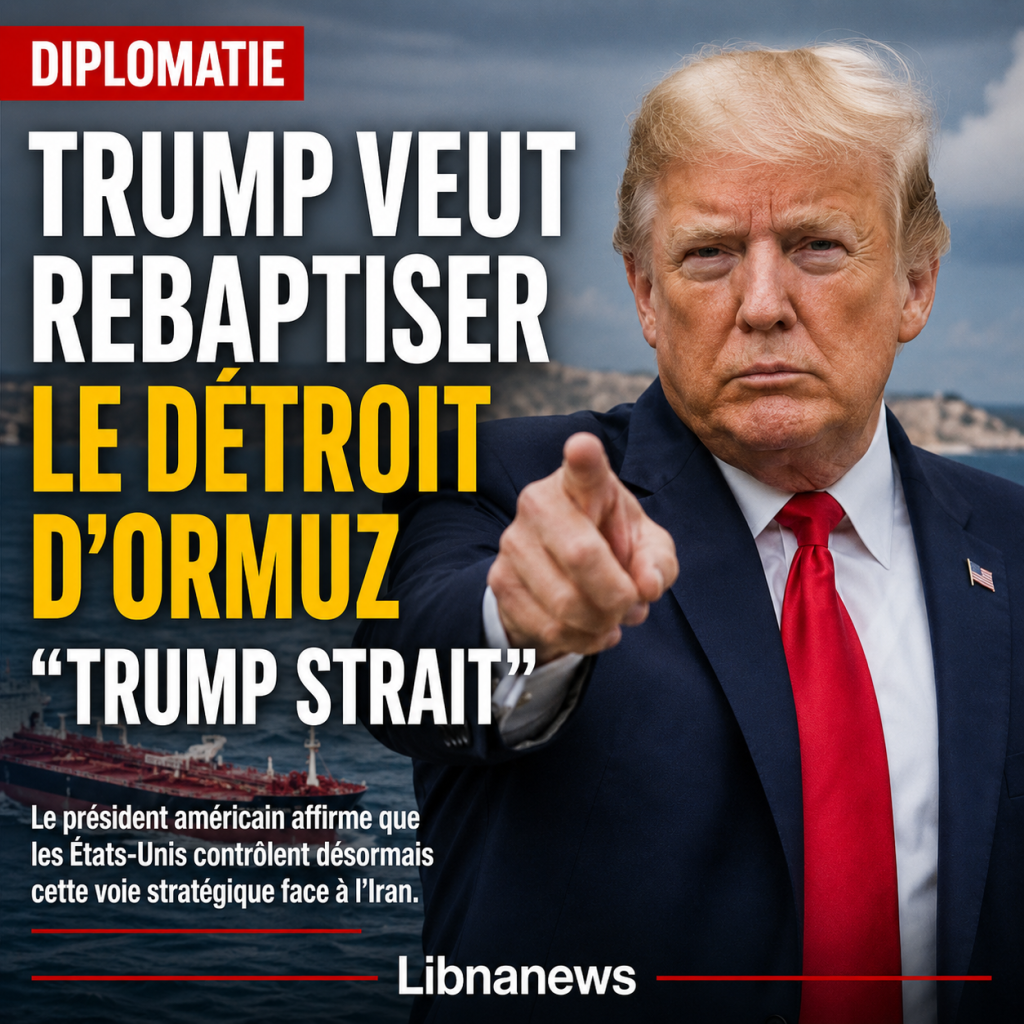
Donald Trump proposed Wednesday, September 2, to rename the Strait of Ormuz « Trump Strait », or « Trump Strait », saying that the United States now controlled this strategic maritime route at the heart of its confrontation with Iran. Behind the American President’s provocation is a much more serious military claim: Washington considers that it has weakened Iran’s capabilities sufficiently to take the ascendant in a passage borrowed, before the war, by about a fifth of the world’s oil flows. However, this proclamation comes at a time when the fighting has just resumed, when American forces again bomb Iranian installations around Ormuz and commercial shipping remains exposed to attacks.
« Should we change his name to Trump Strait? »
Donald Trump launched his proposal on Wednesday on Truth Social, his social network, by linking it directly to the military power relationship with Tehran. « Now that we are under American control, should we change the name of the Strait of Ormuz to TRUMP STRAIT? » asked the US President. He then presented the passage as, in his view, « hotter than ever. » The proposal is not accompanied by any legal or diplomatic procedure that would effectively change the international name of the Strait. It is, above all, a political declaration to present the American campaign against Iran as a victory.
However, this exit is not isolated. For several weeks, Donald Trump claims that the United States has gradually taken control of Ormuz. On Tuesday, September 1, a few hours before his proposal to change his name, he already assured that Washington had « almost complete » control of the passage. In his view, this situation would be one of the reasons why the United States would no longer be in urgent need of agreement with Tehran. The president thus transforms the strait into a measure of the success of his strategy: preventing Iran from controlling navigation would mean removing its main economic lever in the war.
A proclamation in the wake of new bombardments
The time chosen gives the declaration a particular scope. The US forces have just resumed their bombings against Iranian targets after several weeks of relative decline. On 30 August, they hit two launchers on the Iranian island of Larak, located in the Strait. Washington states that such equipment could be involved in mine anchorage operations that could threaten civilian and military buildings.
The campaign expanded on 1 September. The United States Central Command announced that it had struck air defence systems, radars, maritime capabilities, mine anchorage capabilities and communications facilities belonging to the Revolutionary Guards. These objectives have one thing in common: they directly contribute to Iran’s ability to monitor, defend or disrupt the Strait. When Donald Trump declared the next day that he had placed Ormuz under American control, he therefore politically claimed the result of these military operations.
However, Iran has not stopped responding. Missiles and drones have been launched into facilities hosting United States forces in several countries in the region, including Jordan. At the same time, Tehran continues to assert that it has the necessary means to restrict navigation in the Strait if United States operations continue. The « Strait of Trump » is therefore proclaimed as the battle for its control is far from over.
US control over Ormuz remains contested
The United States’ naval and air superiority in the region is considerable. It does not mean, however, that Washington exercises sovereignty over the Strait or can guarantee that no attack will occur there. Iran has a long coastline north of the crossing, coastal missiles, drones, small naval units and mine anchorage capabilities. Even severely weakened by the bombings, these forces can still disrupt traffic.
On August 25, Donald Trump claimed that all mines in international waters of the Strait had been destroyed or removed. He had also threatened to destroy any Iranian building caught in the process of laying new ones. Washington states that it has surveillance capabilities to monitor Iranian movements. The strike against Larak five days later, however, shows that US forces still consider the threat of new mines to be serious enough to justify an attack on Iranian territory.
Two oil tankers carrying Saudi crude oil were also hit by projectiles on 1 September as they crossed the Ormuz area. Each vessel carried approximately two million barrels. No deaths were reported and the origin of the projectiles was not formally established in the first available information. However, the incident is sufficient to show that a military control claimed by Washington does not yet correspond to a complete normalization of commercial navigation.
Ormuz, Iran’s main lever against the United States
The Strait of Ormuz is disproportionate to its size. Located between Iran in the north and Oman in the south, it is the sea exit from the Gulf to the Indian Ocean. Prior to the conflict, about one fifth of the world’s oil flows were transiting, with significant volumes of liquefied natural gas added. Saudi Arabia, the United Arab Emirates, Qatar, Kuwait and Iraq depend to different degrees on this path for their energy exports.
This geography gives Tehran a pressure capacity that the conventional military power ratio does not offer. Iran cannot compete with American air power, but it can significantly increase the global cost of the conflict by making navigation dangerous. A few mines, missiles, or drone attacks can lead to higher insurance premiums, slow down crossings and push some shipowners to avoid the area.
Washington is precisely trying to neutralize this lever. As a result, bombings against Iranian radars, communications and naval capabilities are not only aimed at protecting American military vessels. They must allow tankers and LNG operators to circulate independently of Tehran’s threats. In this perspective, the control of Ormuz has gradually become a full war objective.
Trump claims since July the role of « guard » of the Strait
The proposal to rename Ormuz in his name extends a series of statements by Donald Trump. As early as July, the President had stated that the United States should control the Strait and be paid for its safety. He had presented Washington as the future « guard » of this sea route, considering that the countries whose exports enjoy US protection should participate at its cost.
This design transforms the freedom of navigation into a security service provided by American power. It is challenged by Iran, which considers its presence in the Strait as a right deriving from its geography and rejects any attempt by Washington to become its dominant authority. Oman, which controls the other bank, traditionally plays a more discreet role and seeks to preserve international traffic.
Trump Strait’s proposal now pushes this logic to the symbol. The American president no longer merely asserts that his forces secure the passage: he suggests to give him his own name, as if the military superiority claimed created a new geopolitical reality.
Trump Strait would have no automatic legal value
Donald Trump, however, cannot unilaterally change the international name of the Strait. The United States may choose a particular name in its own documents or maps, but such a decision does not oblige other governments or international organizations to use it. Ormuz is not under American sovereignty and borders directly Iran and Oman.
The proposal is therefore essentially political in scope. It aims to personally associate Donald Trump with what he describes as an American military success. It is also a message addressed to Tehran: Washington claims to have removed Iran from control of the passage it used to threaten the global economy.
This approach recalls other geographic initiatives of the US President. After his return to the White House in January 2025, Donald Trump ordered the federal government to use the term « Gulf of America » to designate the Gulf of Mexico. The Ormuz proposal is part of this policy of name change, but in a much more sensitive context, as it concerns this time an area in the heart of a war.
Additional provocation to Tehran
For Iran, the formula can hardly be seen as a mere joke. The Strait is a central element of its national security and economy. Part of Iran’s exports must go this way, even though the US blockade has greatly reduced the volume of crude oil shipped from the country’s terminals.
The statement comes mainly after American bombings on Iranian territory. Civilian casualties were reported in the south of the country, including a strike on a house where a marriage was taking place near Sirik. Tehran responded by launching missiles and drones against American interests in several countries.
In this context, symbolically giving the name of the American president in the Strait amounts to proclaiming Iranian defeat while Tehran still claims to be able to continue the fight. The American communication can thus itself become a factor of escalation if the Iranian leaders seek to demonstrate that the control claimed by Donald Trump does not exist.
Oil reminds battle not over
Markets remain particularly sensitive to every development around Ormuz. After the resurgence of the strikes, the Brent exceeded $95 per barrel, while the US crude WTI settled above $90. Operators now integrate the risk of further traffic reduction, attacks on tankers or an extension of fighting to the Gulf energy infrastructure.
Maritime traffic also remains below its normal level. Available data show significant variations from day to day, indicating that companies continue to adapt their movements to the level of threat. Liquefied natural gas exports are also affected, with shipments being transferred outside the Strait to reduce some crossings.
These indicators are a more concrete measure of Ormuz control than political declarations. A truly secure passage should allow a sustainable return of traffic and a reduction in the energy risk premium. This standardisation is not yet achieved.
A victory proclaimed before the end of the battle
The proposal for « Trump Strait » finally summarizes two dimensions of the presidential strategy. The first relates to personal communication: Donald Trump once again seeks to associate his name with a major geographical area. The second is military: he wants to present the six-month campaign against Iran as having allowed the United States to neutralize Tehran’s main instrument of pressure.
The situation on the ground, however, remains more uncertain. American forces dominate the area militarily, but continue to strike Iranian capabilities precisely because they still consider them dangerous. Iran continues to launch missiles and drones, threatens navigation and claims to be able to impose further restrictions. Commercial vessels remain exposed to attacks.
The next step will therefore be less on the name of the strait than on the remaining oil tanker movements and Iranian capabilities. If traffic returns to normal on a sustainable basis, Washington will be able to present Ormuz security as a strategic achievement. If Tehran succeeds in further attacks against navigation, it will have shown, on the contrary, that the Trump Strait proclaimed by the US President remains a disputed strait.




