

Joseph Aoun estimates the losses suffered by Lebanese agriculture as a result of the war, particularly in border areas, at about $620 million. The President advanced this amount in Baabda on 19 November before the Ministers of Agriculture of Jordan, Iraq and Syria and representatives of FAO. This is an estimate, not a compensation fund.
The Presidency communiqué does not specify the period chosen, the combined positions or the share of losses in each region. It is not possible to determine what fraction of the amount corresponds to lost crops, land that has become inaccessible or equipment destroyed. However, these situations do not require the same expenditure. A missed campaign deprives revenue exploitation; A damaged irrigation system also prevents production in subsequent campaigns.
A more detailed landmark exists for June. In an assessment published on June 17, the Ministry of Agriculture estimated production losses separately at $530.5 million and direct damage at $41.2 million. These two posts shed light on the difference between a loss of profits and the value of the assets affected. In the absence of a comparable method published in November, the June balance sheet cannot be subtracted from the figure quoted in Baabda to calculate additional losses.
In the South, regain access to land before reviving crops
FAO described damage to land, irrigation facilities and other agricultural equipment in the fall following a mission to the Nabatiyah region. She also reported that about half of the agricultural land in the southern governorates and Nabatiyah was inaccessible. This figure describes a lack of access in two governorates, not the proportion of parcels destroyed throughout the country. It is not part of a verifiable calculation of the 620 million announced by the President.
Reinstatement of access does not alone address the issue of income. A parcel may be accessible again but its harvest already lost. Operators may also need to repair facilities, buy inputs or find an outlet. The President linked this reactivation to the maintenance of families on their lands. The joint assessment of the Ministry of Agriculture, FAO and the World Food Programme of 11 November shows why the issue goes beyond production: it notes that rural income losses and lack of access to land weaken the ability of these households to feed themselves.
An existing loan, distinct from war compensation
The Development and Reconstruction Council identifies several tools already in place. The food processing programme, financed by a $200 million loan approved by the World Bank in 2023, includes the rehabilitation of irrigation systems and agricultural roads. It also aims to improve services and market access for farms and small businesses in the sector. Its purpose is broader than compensation for the only losses mentioned in Baabda.
In October, the Ministry, the Development and Reconstruction Council and the United Nations Development Programme launched a $20 million cost-shared grant scheme under this programme. In particular, it supports investments in water and the rehabilitation of certain equipment. The 20 million are part of the programme, they do not add to it. These amounts describe financing instruments, not individual payments already made or the share of the 620 million actually covered.
Regional trade can help to sell production
The Baabda meeting also focused on the agricultural agreement signed in 2023 by Lebanon, Syria, Jordan and Iraq. Lebanese Minister Nizar Hani said that the four countries were seeking to put this agreement into practice. The topics cited range from border control to agricultural research and investment. In particular, Joseph Aoun asked FAO for technical support to test the electronic exchange of phytosanitary certificates. The press release neither announces that these certificates are already exchanged between the four countries nor a timetable for commissioning.
For a producer who has regained access to his land and can sell, more predictable formalities can make a regional outlet more reliable. For those whose irrigation is out of use, this simplification does not finance re-cultivation. The two dossiers progress according to different timetables: on the one hand, work and aid to farms, and on the other, the execution of a trade agreement. The national agricultural strategy from 2026 to 2035 provides for the rehabilitation of the means of production, but no new quantitative allocation in response to the estimate of 19 November was announced at this meeting.
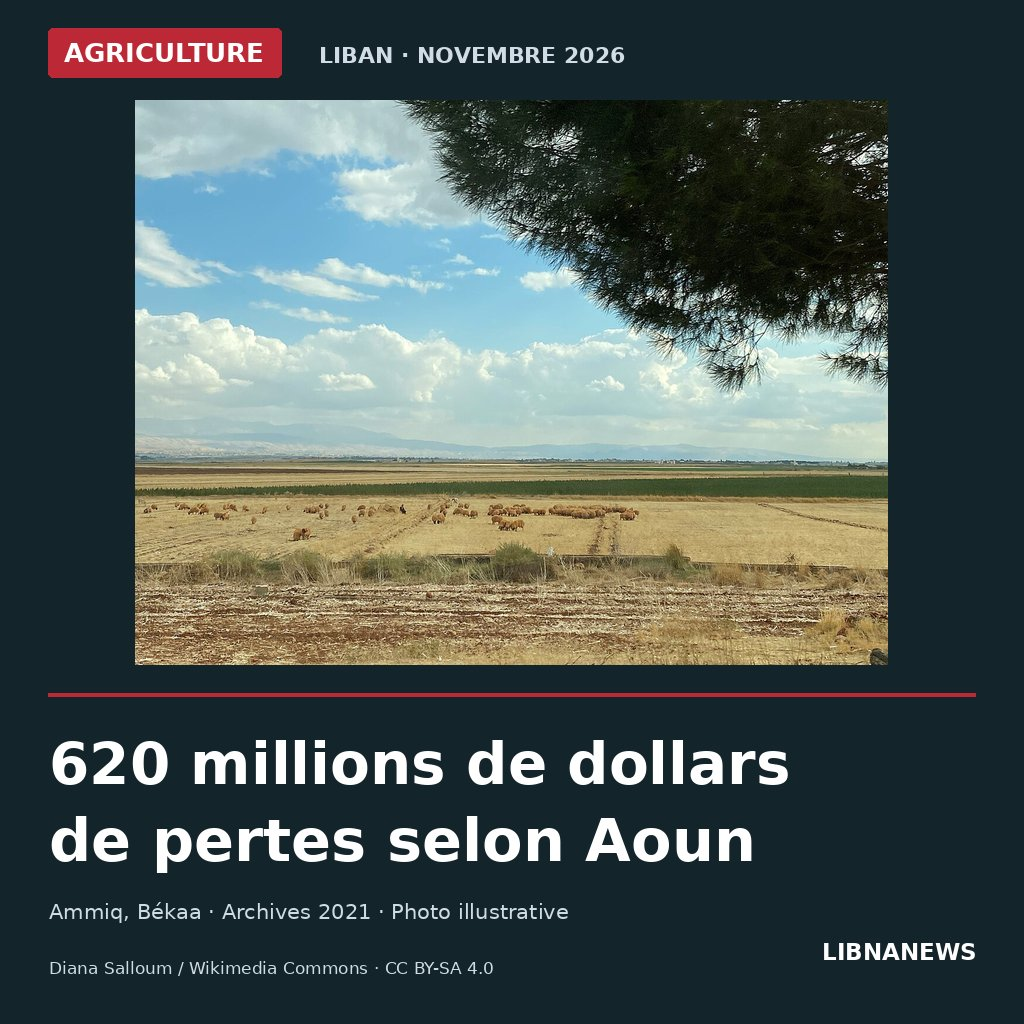
Archive photograph: farmland and herd near Ammiq, Bekaa, September 15, 2021. Illustration of the sector; shows neither the affected plots nor any war damage. Photo:Diana Salloum / Wikimedia Commons,CC BY-SA 4.0. Resized photo without cropping, Libnanews dressing; adaptation under CC BY-SA 4.0.






Comments