

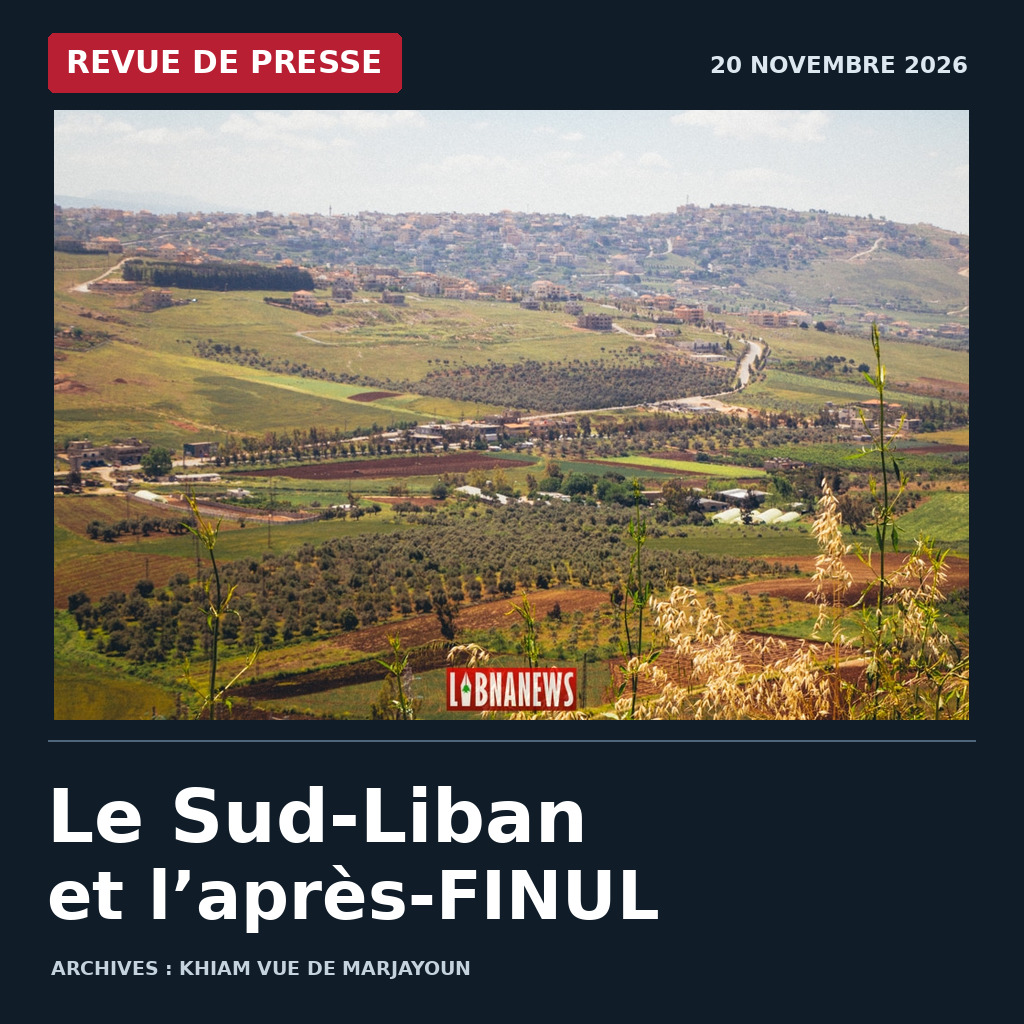
On the front page: the post-FINUL, Shenzhen’s disagreements and electricity bill
In the Security Council, the finding of an occupation does not resolve the dispute over withdrawal
The Security Council held closed consultations on 19 November on the implementation of resolution 1701. Al Akhbar, on 20 November 2026, reports that the members heard Jean-Pierre Lacroix, head of United Nations peace operations, and Jean Arnault, acting UN coordinator in Lebanon. According to the newspaper, the report by António Guterres covers the period from 21 June to 20 October 2026. It describes the continued occupation of Israeli forces in areas of Lebanese territory and describes the difficulties in implementing the framework agreement of 26 June.
The difference relates in particular to the order in which commitments are to be fulfilled. Al Akhbar, on 20 November 2026, presents the Israeli withdrawal and the cessation of hostilities as conditions imposed by Beirut to extend State authority. The newspaper states that Israel links its withdrawal to the effective control of Lebanese territory and the disarmament of non-State armed groups. The pilot areas provided for in the framework agreement therefore did not lead to the transfer of responsibility sought, according to the report. The newspaper distinguishes the army’s efforts, particularly in terms of mine clearance and aid facilitation, from the expected political result, which remains unattainable in its narrative.
Ad Diyar, November 20, 2026, insists on the absence of a decision at this meeting. The daily presents the consultations as a step in the discussions on the future of the international presence. The information he reports on French and American variants comes from unnamed diplomatic or political sources. They describe leads, not an agreed mandate. A UN multinational formula and a coordination mechanism between Lebanese and Israeli soldiers would not answer the same question: the first concerns the international presence, the second concerns the mode of contact between the parties.
Shenzhen: a joint statement, divergent readings
Al Akhbar, November 20, 2026, presents the meeting of Donald Trump, Xi Jinping and Vladimir Putin in Shenzhen as a meeting that confirmed the possibility of speaking without reducing disagreements over Iran and Ukraine. The daily reports that a joint statement followed about an hour and a half of interviews on the margins of the Asia-Pacific Economic Cooperation Forum. In reading the text, the commitments in principle are neither accompanied by a regulation on Iran’s nuclear programme nor by an agreement on the conditions for an exit from war in Ukraine. The newspaper also points out that the intention to stabilize energy flows does not translate into production targets or a specific agreement on Ormuz.
Al Bina, 20 November 2026, retains another significance of the meeting. One sees dialogue between the three capitals as the beginning of a dialogue that will last. His comment stressed the statement on the impossibility of winning a nuclear war, as well as the maintenance of a channel for consultation on crises. The expression of a common direction of the world nevertheless belongs to the analysis of the newspaper. It does not correspond in its narrative to the creation of an institution with a mandate or the allocation of decision-making power over specific conflicts.
Ad Diyar, November 20, 2026, recalls in his analysis that the Middle East is an issue of these exchanges without being the sole object. The newspaper distinguishes the expectations placed at the top from the decisions that should have been taken to change the regional situation. Al Akhbar also examines Iranian positions and European discussions on Ukraine. These files do not become Shenzhen’s results simply because they appear in the pages dedicated to the meeting.
Electricity: the proposed increase is first targeted at the first tranche
Al Akhbar, November 20, 2026, publishes elements of a variable pricing project prepared by Electricity Lebanon at the request of Energy Minister Joe Saddi. In the daily assumptions, the increase would be 40% for the first instalment, up to 100 kilowatt hours, and 21.3% for consumption beyond. The percentages therefore do not describe a uniform increase in the invoice or a new scale that has been introduced. The newspaper announces a review in the Council of Ministers, without mentioning an adoption.
The formula presented by Al Akhbar on 20 November 2026 is intended to reflect changes in the cost of production. It would take into account different fuels, the efficiency of power plants and an expenditure cover model. The above-mentioned document also provides that the Board of Directors of Electricity of Lebanon may adjust or maintain the scale. The daily paper highlights one limitation: an accounting increase in expected revenues does not automatically provide the currencies needed to buy fuel.
Finally, the file distinguishes the electricity bill of Lebanon from the expenses incurred to compensate for an intermittent public service. Al Akhbar, 20 November 2026, describes the persistence of subscriptions to generators and devotes a separate report to the solar market. It reports a rise in demand, not least on the business side, but also difficulties in financing and quality of equipment. These observations do not make it possible to quantify the future bill of all households. They explain why the official tariff is only part of the cost paid to dispose of electricity.
Reconstruction: the amount of approved funding does not say what was spent
Ad Diyar, November 20, 2026, looks back at the disbursement gaps of the World Bank-funded emergency assistance project in Lebanon. According to figures cited following the visit of its Chief Operating Officer, Anna Bjerde, $4.2 million had been disbursed according to a follow-up report, for initial funding of $250 million. The daily reports that a volume of 100 million was expected at an intermediate date. This is the rate of execution of a project, not an estimate of the total cost of reconstruction.
Prime Minister Nawaf Salam’s office, quoted by Ad Diyar on November 20, 2026, attributes this pace to two factors: the late approval of the funding agreement in Parliament and the difficulty of access by teams in the affected areas in the South. The daily mentions planned works on roads in Nabatiyah district and calls for tenders in Marjayoun. He also reports that Finance Minister Yassine Jaber is seeking to expand the envelope and is calling for donations for solar installations. The work announced, funding requests and payments performed are at different stages.
Local politics: preparing parties, the role of the army and disagreement over institutions
Baabda asks for a holiday scheme, without yet announcing its timetables
Joseph Aoun chaired a meeting in Baabda on the interior situation and holiday preparation. Ad Diyar and Al Bina, on 20 November 2026, reported the presence of Defence Minister Michel Menassa, Interior Minister Ahmad Hajjar, Army Commander Rodolphe Haykal and senior security officials. According to both newspapers, the president insisted on the application of the law without preferential treatment. He also presented the protection of civil peace as a national responsibility, regardless of the citizenship or place of residence.
The meeting was not limited to the situation in the South. Al Bina, on 20 November 2026, reported that the President had requested a specific preparation for the end-of-year trips, in particular for heavy goods vehicles, periods of heavy traffic and the airport road. This is a request for services, not a calendar that can be applied to users. Schedules, dates and practical arrangements are not included in the minutes. Ad Diyar also noted that the President welcomed the simplification of certain procedures and the use of digital tools for the issuance of passports, including in certain diplomatic representations.
The presidential day included further discussions, separate from the security meeting. Ad Diyar, November 20, 2026, reports that Joseph Aoun met with the Minister of Agriculture Nizar Hani and his counterparts from Syria, Jordan and Iraq. The journal describes an exchange on the agricultural strategy and the operation of a joint technical committee, not the announcement of new trade rules. He also reported an interview with the head of the Alawite Islamic Council and an update on oil facilities with the relevant administration.
As independence approaches, Berri and Haykal set different priorities
On the occasion of the 83rd anniversary of independence, Nabih Berri defended the role of the army and requested that it receive the means to carry out its missions. Ad Diyar and Al Bina, on 20 November 2026, reproduce the substance of the President’s message. It links the exercise of sovereignty at the end of the occupation, the return of the inhabitants and the reconstruction of the affected localities. He also rejected the public questioning of the sacrifices of the military institution. This message initiates its political reading of the situation; It does not announce any parliamentary decisions or new operations.
Rodolphe Haykal focuses on the army’s own responsibilities. Its agenda, published by Ad Diyar and Al Bina on 20 November 2026, evokes both the liberation of the territory and the principle that weapons must be the responsibility of the State. The Commander calls on the military to maintain internal cohesion and not to be led by incentives for division. It warns that the UNIFIL transition increases the responsibilities of the institution. Ad Diyar also reports a visit by the commander to the South and his meeting with military personnel; These approaches alone are not a change of mandate.
Ad Diyar, November 20, 2026, reports that Nabih Berri’s entourage perceives attacks against the army commander as an additional threat in the transition debate. This reading comes from sources close to Ain al-Tinah. It is to be distinguished from the public message of the Speaker of the House, who defends the army without establishing the existence of a coordinated campaign. On another page, Ad Diyar quotes the general order of Edgar Lawandos, Director of State Security, reminding its agents of the obligation to enforce the law and to respect the decisions of the political power.
Political dialogue and independence of the five youth dossier
Al Akhbar, on 20 November 2026, reports that five young people arrested in the mountainous region of Bcharre and Batrun were prosecuted. The newspaper also publishes an account of anonymous sources about the political and judicial contacts that would have preceded this stage. According to them, assurances of release had circulated before the case was dealt with otherwise. The daily lives associate this change with alleged external pressures. He does not provide any independent evidence in the narrative: attribution belongs to his sources, and prosecution is not a finding of guilt.
Ad Diyar, November 20, 2026, presents the same period from the angle of the dialogue between Baabda and Hezbollah. According to its sources, the presidency defends a unconditional resumption while the party calls for a change of direction of the government on previous decisions. The newspaper refers to an attempt to compromise without result. Such information shall not replace a judicial decision or a joint statement by the parties. They point to disagreements on how to deal separately with a judicial case and political negotiation.
Al Bina, on 20 November 2026, published the criticisms of the parliamentary bloc Faithful to resistance. The bloc denounces interference that it attributes to foreign actors and accuses the power not to respond sufficiently to attacks against the South. These are the public accusations of a political group. Al Akhbar, on the same day, presented a press conference of MP Hussein Hajj Hassan as an eventuality. The publication does not establish that it has taken place.
The partisan proposals do not form a common Lebanese position
In an interview with Ad Diyar on 20 November 2026, MP Melhem Riachi, a member of the Strong Republic bloc, said he was considering a different international presence after UNIFIL’s departure. He referred to a possible recourse to Chapter VII of the UN Charter and linked that reflection to the question of Israeli withdrawal and the role of the army. The journalist also collects his forecasts on the schedule of negotiations and on an American initiative. These forecasts do not involve the Lebanese Presidency or Washington. On the same page, Ad Diyar reports exchanges between a delegation of the Free Patriotic Current and the Saudi ambassador in another context.
In a separate contribution published by Al Akhbar on 20 November 2026, Khaldoun Sharif referred to the proposals of Melhem Riahi, Ibrahim Al Amine and Fares Suhaid concerning the institutional framework. It contrasts the search for specific guarantees for communities with a programme to implement existing institutions. The Taif agreement, the debate on neutrality and the definition of State prerogatives are treated as long-term political choices. The text is a matter of discussion and not of the presentation of a draft which is put to the vote.
Quotes and speeches: Aoun, Haykal and Berri outline their priorities before independence
Joseph Aoun calls for prevention security, without protection for offenders
Al Jumhouriya and Al Sharq of 20 November 2026 report that Joseph Aoun brought together military and security officials in Baabda. The Head of State asked them for special preparation for the holidays. He refuses any pass-right and any selective application of the measures, reports both newspapers. It calls on the services to act more firmly against theft, shooting in the air and possession of illegal weapons. The Ministry of Defence and the Ministry of Interior were represented by Michel Menassa and Ahmad al-Hajjar.
The operational component reported by Al Sharq of 20 November 2026 is not limited to an increase in patrols. More demand for prevention and exchange of information between services. It cites places of worship, commercial areas, tourist sites and public facilities. The newspaper also mentions the management of congestion and traffic near the airport. These are requests made at a meeting. The report does not give a complete timetable or order defining the restrictions. The Minister of the Interior must convene the Central Security Council to translate these guidelines into measures.
The President also stressed the presence of the State throughout the country, with a special mention of the South. Al Sharq of 20 November 2026 reports another interview, this time with a delegation of business councils. Aoun presents internal security as stable and invites the officials met to continue their projects. This judgment is that of the Head of State. It is not an independent criminal record and should not be extended to border localities exposed to strikes. The two interventions have different recipients: one gives instructions to the services, the other seeks to reassure economic actors.
Rodolphe Haykal talks about withdrawal, deployment and civilian command
Al Sharq of 20 November 2026 reproduces Rodolphe Haykal’s agenda for the 83rd anniversary of Independence. The army commander recalls that Israel still occupies part of Lebanese territory. It links repeated attacks, destruction and obstruction to the return of the inhabitants. It presents the restoration of sovereignty over the entire territory as a priority. The formula does not give a date for an Israeli withdrawal, nor does it give an assessment of returns to villages.
Haykal recalls that the institution implements the decisions of the political power and the commitments in force. It combines continued deployment in the South with the state monopoly on arms. As UNIFIL operations were approaching their deadline, it called for continued preparation of troops. It also refers to border surveillance in the north and east. He cited the control of territorial waters and the fight against trafficking. He thanked friendly States for their support, without announcing new delivery or financing. Al Jumhouriya of 20 November 2026 restores the same axes. The newspaper also reports its visit to the command of the fifth intervention regiment in Kfar Dounine, Bint Jbeil area.
Al Sharq and Al Jumhouriya of 20 November 2026 thus distinguish two statements: the agenda addressed to the military and the statements made during the trip to the South. In the first, the general calls on the troops to preserve their discipline and to remain at equal distance from the parties. In the second, it links the exercise of their mission to the presence of the State in all regions. The General plans to continue the deployment. Nothing in his remarks means that the army has finished or that the state already has a monopoly on arms.
Nabih Berri links independence to the return of the inhabitants and refuses a buffer zone
Al Sharq and Al Liwa of 20 November 2026 echo the message of Nabih Berri for Independence. The President of the Chamber refused to allow the South to become a buffer zone for the benefit of another State. He described the liberation of occupied lands as a duty, invoking the means permitted by international law. In the same passage, he cites the dignified return of the inhabitants, the reconstruction and the release of the prisoners. These objectives belong to his speech. The formula does not describe a announced operation or a draft buffer zone decided by an international institution.
Berri presents the army as a pillar of independence and asks that it have the necessary resources. In his tribute, he also cites the inhabitants of border villages, resistance fighters, security forces and UNIFIL soldiers. Al Jumhouriya of 20 November 2026 notes his call to place sovereignty and unity above denominational, partisan or regional affiliations. The link between army and sovereignty echoes Haykal’s words. The two men, however, do not address Hezbollah’s weapons in the same terms. Their speeches are not enough to reach agreement on this point.
The Hezbollah bloc is critical of American pressure; Aoun also focuses on agriculture
Al Sharq of 20 November 2026 reproduces the communiqué of the parliamentary bloc Faithful to resistance. The block accuses Washington of putting pressure on the Lebanese authorities. He fears that a new resolution will erase existing references. The bloc invokes resolution 1701, the cessation of hostilities arrangement of 27 November 2024 and the Armistice of 1949. He also denounced what he described as interference in judicial proceedings. The charges belong to the O.R. The journal does not produce adopted text that would delete these references. The warning does not demonstrate the intention given to Washington.
On another ground, Al Sharq and Al Liwa of 20 November 2026 reported Joseph Aoun’s words to a delegation of Arab Ministers of Agriculture. The President referred to agricultural losses of approximately $620 million attributed to the war, particularly in border areas. He presented the restoration of production as a condition for the inhabitants of the South to remain on their land. This amount is the estimate advanced by Aoun, not a statement of the editorial staff. Its call to facilitate trade between Arab countries is a political orientation. It does not describe an already operational common market or financing for operators.
Diplomacy: the post-FINUL remains formulaless, Beirut expands its exchanges
In New York, the end of operations does not say what will follow
Al Liwa of 20 November 2026 follows the exchanges between Beirut, Washington and New York on the post-FINUL. The daily quotes anonymous diplomatic sources. According to them, the format of a possible replacement presence, its powers and relations with the army remain open. The newspaper does not report any arrest warrant or Lebanese agreement on the powers that would be entrusted to such a structure. Al Joumhouriya of 20 November 2026 notes the same uncertainty about the proposals of Mike Waltz, US Ambassador to the UN. A reading of American and European preferences is not worth a formal draft.
These discussions must be distinguished from the timetable already set by the Security Council. Resolution 2790 provides for the termination of UNIFIL operations on 31 December 2026. The orderly withdrawal must then take place over a period of up to one year. A term of office does not therefore imply that all staff leave the territory on the evening of 31 December. Thursday’s consultations focused on the implementation of resolution 1701. They are not valid for decision on post-FINUL. No alternative text is included in the records reviewed. For the southern localities, three functions are involved: liaison, incident monitoring and support to the Lebanese authorities. The newspapers report discussions about these functions, not an agreement to distribute them.
Paris and Moscow: two approaches whose scope remains distinct
According to Al Sharq and Al Liwa of 20 November 2026, former President Michel Sleiman received French Ambassador Patrick Durel. The interview focused on the effects of regional tensions and the future of UNIFIL. Sleiman thanked France for its efforts to extend the mission or seek an alternative. He also commended French efforts to convene conferences in support of the army. He wished to revive the International Support Group for Lebanon, launched in 2013. The last proposal is that of a former president. The report does not give any French decision to relaunch, nor does it give a firm date of conference or payment.
Ambassador Alexander Rudakov gave Joseph Aoun a written message from Vladimir Putin. Al Jumhouriya, Al Liwa and Al Sharq are listed in their 20 November 2026 editions. According to the words reported, Moscow expresses its support for the sovereignty of the Lebanese State, its territorial integrity and its national unity. The letter expresses a diplomatic position. It does not establish military guarantees or Russian commitments to participate in a mission after UNIFIL. Al Joumhouriya distinguishes this bilateral approach from the meeting between the American, Chinese and Russian leaders in Shenzhen. The daily newspaper does not record in the announced results any agreement or mention concerning Lebanon. The indirect effects imagined in the chronicles are therefore not decisions applicable to Beirut.
Washington sanctions, other than UN discussions
Al Sharq of 20 November 2026 relays the US State Department’s position on the measures against Wa Tawanu. Washington is also targeting a network he says is linked to Hezbollah financing. The US Treasury announced its designations on November 18. The daily newspaper of 20 reproduces the political explanation of this measure. This is not a new set of sanctions. Washington states that the association, which claims to provide relief in the South, would serve as a cover for Hezbollah activities. Other targets include individuals and businesses that the Treasury relates to cash transfers for the benefit of the movement.
The designation is an act of the American administration. The facts presented to justify it remain charges attributed to the authorities who took the measure. They are not a Lebanese judicial decision. Diplomatic exchanges on a possible international presence in the South are also not confused with measures taken by the US administration. Al Sharq of 20 November 2026 publishes on the same page a reaction of the parliamentary bloc Faithful to the resistance. It more broadly denounces American pressure. This communiqué sheds light on the political disagreement in Lebanon; it does not reproduce a negotiating text submitted to the Security Council.
Four-party agricultural cooperation and social memorandum with Turkey
The Ministers of Agriculture of Lebanon, Syria, Jordan and Iraq met in Beirut. Al Sharq and Al Liwa of 20 November 2026 report the presence of representatives of the Food and Agriculture Organisation of the United Nations. Lebanese Minister Nizar Hani presents the meeting as a step towards the implementation of the framework signed in 2023. Work focuses on opportunities, applied research and health standards. They also concern the movement of products between the four countries. Al Sharq reported that Joseph Aoun wanted technical support. He cited a work programme and electronic exchange of phytosanitary certificates. These elements describe work to be carried out, not the immediate abolition of formalities or the establishment of a common market.
Al Liwa and Al Sharq of 20 November 2026 also report a memorandum of social cooperation. The signatories are the Lebanese Minister of Social Affairs, Haneen al-Sayed, and his Turkish counterpart, Mahinur Özdemir Göktaş. Al Sharq and the Turkish Ministry place the signature in Manila. It took place on the sidelines of the conference on ending violence against children. Areas covered include family and child protection, improved social services and exchange of experience. This signed document is a separate fact from the intentions expressed at the agricultural meeting. Al Sharq presented it as a continuation of a visit by the Lebanese Minister to Turkey in July. The newspaper mentions technical visits, working meetings and the appointment of focal points to monitor implementation. These arrangements make it possible to distinguish between services and a new aid scheme. The report does not give any payment, schedule of care, or immediate opening of a right for families.
International policy: Shenzhen’s commitments, the European response and regional negotiations
In Shenzhen, four commitments but no settlement of wars
Al Arabi Al Jadid of 20 November 2026 reports that Donald Trump, Xi Jinping and Vladimir Putin met Thursday in Shenzhen, on the margins of the Asia-Pacific Economic Cooperation Forum. The three leaders adopted a joint declaration in four parts. It covers the reform of the United Nations, the stability of energy supplies, the jurisdiction of international criminal courts and the reduction of nuclear risks. Neither the war in Ukraine nor the conflict with Iran is included in the document.
Al Sharq Al Awsat of 20 November 2026 notes that the declaration provides for a dialogue on nuclear risks, without a timetable or quantified target for the reduction of arsenals. On energy, the signatories say they want to increase production and deliveries of refined petroleum products. They do not detail volumes, deadlines or binding commitments. Lastly, the defence of governmental immunities and the criticism of the exercise of the jurisdiction of the International Criminal Court did not by themselves alter the applicable law. The declaration establishes common positions on these four issues, without resolving the disputes raised at bilateral meetings.
Al Arabi Al Jadid of 20 November 2026 distinguishes the opening of the summit from its final text. Trump and Putin talked about the war in Ukraine, while Xi insisted on continued dialogue. On Iran, the US President said he was not planning to seek help from Beijing or Moscow to end the conflict. The newspaper also reports a call from the United States, France, the United Kingdom and Germany for the return of inspectors from the International Atomic Energy Agency. The Agency’s approach is a different forum from the summit.
In Berlin, the talks announced, a representation still to be settled
Al Sharq Al Awsat of 20 November 2026 reports that Ukraine’s allies met in Berlin in the presence of Volodymyr Zelensky. US envoys Steve Witkoff and Jared Kushner participated in the exchanges. Chancellor Friedrich Merz announced possible talks between Russians, Ukrainians, Americans and Europeans. He did not communicate a place arrested. The United Arab Emirates was mentioned as a possibility, not as a confirmed host.
The same daily newspaper, dated 20 November 2026, points out that Europeans have not fixed their way of representation. The idea of appointing one person was discussed, without consensus on the mandate or the place of different governments. Emmanuel Macron challenged Shenzhen’s reading as a new sharing of the world. The meeting of the Heads of State in China and the consultations in Berlin were held in parallel. The statement of the former therefore does not give the conditions for the talks envisaged after the second.
In Iraq, Baghdad announces a command, the withdrawal of the armed group remains contested
Al Arabi Al Jadid of 20 November 2026 reports that the Iraqi government created a joint command in Jurf al-Sakhr, also known as Jurf al-Nasr. The announced arrangement brings together the army, the federal police and the popular mobilization forces. The spokesperson for the Commander-in-Chief indicated that this command should begin its work on Friday. A security source cited by the newspaper describes a progressive deployment. This does not mean that the entire system is installed or that the population has been able to return.
Al Sharq Al Awsat of 20 November 2026 reports contradictory information about the departure of the Kataëb Hezbollah, an Iraqi armed group based in the area. The daily reports on mediation exchanges and disagreements on the conditions for a possible withdrawal. Al Arabi Al Jadid of 20 November 2026 cites a source of the group claiming that he intends to remain, while an Iraqi official said his forces would be displaced. The formation of a common command is therefore distinct from the actual transfer of control of the area.
From Cairo to Ankara, cooperation does not solve disputes
Al Sharq Al Awsat of 20 November 2026 reports that Abdel Fattah al-Sissi received in Cairo Abdelhamid Dbeibah, head of the Libyan national unity government. Both officials attended the signing of agreements and protocols in several sectors. The newspaper cites infrastructure, gas, refining, research and vocational training. The exchanges also covered visas and the situation of students. The rapprochement with the authorities in the West Libyan did not, according to the published evidence, amount to a lifting of the Egyptian disagreement on the maritime agreement between Libya and Turkey.
Al Arabi Al Jadid of 20 November 2026 reports that Ankara detailed the defence agreement signed with Qatar the previous week. According to the Turkish Ministry of Defence, support in the event of an external armed attack requires an express request and a joint decision. The text therefore does not provide for the automatic dispatch of troops. The Ministry states that implementation decisions are the responsibility of the strategic council of both countries. No firm commitment of staff or financial resources was announced in this presentation.
Syria and Sudan, decisions and alerts of international bodies
Al Arabi Al Jadid of 20 November 2026 reports that the Third Committee of the UN General Assembly adopted by consensus on 18 November a draft resolution on human rights in Syria. The head of Syrian diplomacy, Assad al-Shaibani, welcomed a change of approach. It is a vote in committee, not a final vote of the General Assembly. The newspaper also recalls that Syrian organizations continue to document violations during the transition. Consensus on a draft text is not a certification of the situation on the ground.
In the Sudan, Al Sharq Al Awsat of 20 November 2026 relayed an Amnesty International investigation into attacks on neighbourhoods and civilian infrastructure in El-Obeid, Northern Kordofan. The organization assigns them to the Rapid Support Forces and believes that they could constitute war crimes. These are the findings of an inquiry, not a judgment. The daily also reports that the World Food Programme had to cut off some of its emergency food aid due to lack of funding. The organization warns about new hunger outbreaks in Darfur and Kordofan, without extending the famine diagnosis to the entire country.
Economy: the price of electricity, heating and rents in Lebanon
Electricity: the bill would follow fuel costs more closely
In its November 20, 2026 edition, Annahar details a proposed variable tariff for Electricity in Lebanon. It is not in force. Following comments from the Minister of Energy and Water, the Council of State issued an advisory opinion. According to the newspaper, the approval of the formula was considered by the Council of Ministers. The file returned to the department, which is preparing its transmission to the government. The notice therefore does not set a new price and does not authorize an increase to be announced at a given date.
The project would introduce a monthly review. The calculation would take into account the average price of Brent oil the previous month, the price of diesel oil and the various sources of production. Annahar explained that the ministry had asked to include hydropower plants, which were absent from an initial approach focusing mainly on thermal power plants. This change counts: the composition of production, and not just the price of oil, would influence the cost. The newspaper also reports that the Board of Directors would retain a margin of choice when revising the tariff. A reduction in the cost of production would therefore not automatically be passed on to the consumer.
Annahar notes that the project does not provide for a quantitative ceiling of increase by revision or a mandatory floor. The tables cite a base of 27 cents of dollars per kilowatt hour beyond the first 100 kilowatt hours. This figure describes a file parameter, not a new rate decided for all subscribers. An attached simulation tests a fuel shock. In this scenario, the cost of the first instalment increased from $10 to $18, a relative increase of 80 per cent. This is neither a forecast nor the total invoice: the year excludes fixed charges and taxes. It shows, however, why the treatment of the first kilowatt hours will be decisive for households that consume little.
The file also distinguishes the share paid to the network from any subscription to the private generator. One may increase without the other receding. The published simulation does not measure a decrease in the duration of the cuts and does not allow to deduct savings from private subscriptions. In the same edition of November 20, Annahar reports that a Lebanese Forces official defends the action of Minister Joe Saddi invoking the establishment of the regulator and the work with Qatar. This is the assessment of his political camp, not the expected decision on the formula.
Heating: Families split their purchases of fuel oil
In Nida al-Watan of 20 November 2026, the heating report describes the Bekaa and Chouf households that no longer buy their fuel for all winter. A resident of the Bekaa says he gets a few cans and heats only one room. In the Chouf, another explains that he starts the season with the dry branches from his trees, because he cannot buy his wood or oil from the start. These are two accounts of family cash flow, not a national consumer survey.
The newspaper also draws on the Ministry of Energy and Water’s price table. He quotes a price of approximately 2,524 million pounds for 20 litres of fuel oil at the time of his report. To show the difference between the unit purchase and the seasonal budget, he estimates that some $1,410 is the fuel needed for a home that would consume 1,000 litres. This calculation does not cover the delivery, repair or purchase of a stove. The price is not guaranteed for the following weeks. The changeover to wood also does not eliminate the expense: its cost and storage requirements vary according to fuel and housing.
Old rents: three more years for some tenants are under study
Nida al-Watan of 20 November 2026 reports on the work of the Parliamentary Committee on Administration and Justice on former residential leases governed by the 2017 Act. The debate does not cover all rents or all commercial premises. The parliamentary record of 10 November confirms that the committee examined a formula discussed at its meeting on 3 November. The newspaper reports a recommendation to adopt the amended proposals. A recommendation in committee is neither a vote nor an entry into force.
According to the formula described by Nida al-Watan, some tenants meeting the criteria of the support fund could remain until 28 February 2029. The proposal provides for a gradual increase in rent and would give the tenants concerned who have not already filed an application the possibility of submitting it to the court seised of expulsion. The owner would retain the right to challenge if the conditions were met. The processing of these appeals is as important as the proposed date: the Commission had already indicated that the fund and its bodies had not been set up as planned. The text discussed does not mean that funding is now open to stakeholders.
In the newspaper, the advisor of the owner federation Charbel Charfane opposes a further extension and highlights agreements that have already allowed for the signing of new leases. Maya Jaara, adviser to the Tenant Federation, points out that some of the remaining occupants are old and have no other housing. It defends a retention period with a gradual increase. Both interventions give the position of the organizations they represent. They do not establish an audited national count of the households concerned or the outcome of the disputes.
Agriculture: $620 million loss according to Joseph Aoun
Nida al-Watan of 20 November 2026 reports that Joseph Aoun estimated the previous day the war-related agricultural losses to be approximately $620 million, particularly in border areas. The Presidency confirms the amount quoted before a delegation of Arab Ministers of Agriculture and representatives of the Food and Agriculture Organization of the United Nations. It does not publish in this press release a breakdown of losses by crop, year or territory. The figure must therefore remain allocated to the President and does not correspond to a decided compensation envelope.
The meeting linked the reactivation of the southern farms to the possibility for their inhabitants to remain on their land. It also focused on exchanges: the Syrian minister highlighted coordination with his Lebanese counterpart, while the regional representative of the United Nations organization referred to the work needed to better link production seasons and outlets. Neither the Baabda report nor Nida al-Watan announce a signed trade agreement or aid. The prospects for cooperation and the resources allocated for rehabilitation remain two separate informations.
Food industry: production costs seen from the company
In an interview published on 20 November 2026 by Annahar, the Lebanese industrialist Edmond Gharios returns to the path of the family business. It tells of the closure of the factory during the war in 1976, and then the displacement of activity. For the current period, he cited the cost of capital, recruitment difficulties and the price of fresh milk. He hopes that the opening of trade with Syria will facilitate supply. This perspective is that of an entrepreneur: the newspaper does not present a new import contract or a price reduction already observed. The interview gives an example of a company behind the debate on agricultural markets and inputs.
Justice: five prisoners prosecuted in the North, an investigation to distinguish from political debate
Military justice case
Annahar of 20 November 2026 reports that the Commissioner of the Government to the Military Tribunal brought charges against five persons arrested in northern Lebanon. The newspaper presents them as members of Hezbollah and cites, among the alleged acts, the formation of an armed group, the recruitment and equipment of its members. The prosecution involves alleged breaches of the internal security of the State. They open a judicial stage; they do not establish the guilt of the five people. The pleadings and the details of the evidence are not included in the editions examined.
Nida al-Watan of 20 November 2026 covers the same file in its local pages. The newspaper reports a statement by Samir Geagea, who asks to expand the investigations to include those responsible for Hezbollah’s military and security structures. The leader of the Lebanese Forces assigns the party’s authorities responsibility for more than five detainees. That’s his interpretation of the file. It does not constitute a charge ordered by the court. The fact that two dailies repeat their position establishes the content of the statement, not the existence of evidence in support of this accusation.
On another page of its 20 November edition, Annahar also gives the floor to interlocutors close to Hezbollah. They contest the merits of the prosecution and claim that no weapon was found on the arrested persons. The newspaper attributes this to sources it does not name. This is neither a record of seizure nor the formal version of the detainees’ lawyers. The alleged absence of weapons at the time of the inquiry and the facts covered by the prosecution are also two separate issues. The information available does not allow the charges to be excluded or proved.
The daily newspapers also refer to possible hearings of party officials. They do not provide an order to verify the perimeter, nor do they establish that the persons referred to appeared. A summons to be heard would not prejudge the status of the person heard. Anonymous statements on the intentions given to the group and the names circulating in the recaptures are not necessary to account for the procedure. The solid fact at this stage is the number of persons already involved in the reported prosecutions, not the definitive scope of the investigation.
The separate dispute of the cargo of explosives
In Annahar of 20 November 2026, Minister Kamal Chehade recalls that the Lebanese Forces are asking to include on the agenda of the Council of Ministers the referral of the explosive cargo file to the Council of Justice. He explains that his colleagues do not wish to wait until the end of the investigation for the government to discuss it. This statement provides information on the dispute between ministers. It does not confirm that the Government has decided to return or that the court has been seized.
Annahar’s article on the Lebanese Forces’ participation in the government and his account of the prosecutions in the North deal with two cases. Putting them in the same debate on State authority is not enough to bring them together on a judicial level. On the one hand, according to the newspaper, a prosecutor prosecuted five detainees; on the other, ministers asked to examine a change of jurisdiction for an explosive case. No act published in the corpus establishes the identity of the persons concerned in both cases, a common procedure or a decision to refer them.
Baux: a summons to Jbeil is not worth expulsion
The legal advertisements page of Annahar of 20 November 2026 reproduces a notification from the civil court of Jbeil in a dispute over professional premises. Applicants request the revocation of the right to lease and the release of the premises. The notice invites certain defendants whose current domicile is unknown to appear at the Registry to receive the documents. It therefore indicates what the applicants are asking for and the stage of notification. It does not mean that the court granted the request or decided to enforce an expulsion.
The file makes it possible to distinguish non-residential premises from the debate in Nida al-Watan on 20 November. The newspaper describes a study modification for old residential leases. This proposal includes tenants eligible for a support fund. It does not provide the rule applicable to Jbeil’s commercial dispute. The publication of notices in both newspapers is used to follow the stages of a proceeding, whether it is a notice of notification, a debt dispute or a court sale. It does not allow us to know the position of the party which has not yet presented itself, nor to deduce a national trend from the volume of announcements of a single day.
The same page publishes a summons from a Kesrouan court for a credit claim. In particular, the court asks the parties to discuss the jurisdiction of the judge with respect to the value of the dispute. It is therefore not possible to read in the amount claimed a legally recognized debt. The interest of these opinions lies in the procedural document which they make public. The names, addresses and other personal information they contain are not necessary for this reading.
In The Hague, the responsibility of a State and not that of individuals
In its 20 November 2026 edition, Nida al-Watan reports that the International Court of Justice concluded the previous day that Myanmar had committed genocide against the Rohingya. The newspaper recalls that the qualification requires examining not only the acts committed, but also the intention to destroy, in whole or in part, a protected group. The case was brought by the Gambia under the 1948 Convention. This procedure undermines Myanmar’s obligations as a State. It does not impose punishment on individual perpetrators.
This distinction counts when articles on the Shenzhen summit are read in the same edition of Nida al-Watan and in Annahar on 20 November. The statement reported by these newspapers refers to the International Criminal Court and the immunities of State officials. This is the political position of the three governments, not a court decision. The International Criminal Court judges persons; The International Court of Justice shall, inter alia, settle disputes between States. Shenzhen’s political text does not change the Rohingya judgment. In the absence of the full mechanism in the documents consulted for this review, the details of the repairs and the vote count are not included.
Society: preparation of independence and access to services in conflict zones
Traffic and services at the heart of preparations
In the run-up to Independence Day, President Joseph Aoun brought security officials together and asked for a daytime arrangement, with particular attention to traffic and the airport road. The newspaper does not provide a detailed traffic plan: these preparations are not worth announcing closures or changing routes. Annahar reported on the meeting in its November 20, 2026 edition.
Keep the school open around Ramallah
In the occupied West Bank, student attendance is affected by the safety of school travel. In Al-Mughayyir, near Ramallah, the director of the secondary school for boys, which accommodates 452 students, reports that after the shooting of a student in April, families initially refused to send their children back to school. The institution has strengthened its protections and provided psychological support. In Umm Safa, schools, local councils and civil society actors cooperated on evacuation and first aid. These two cases show how schools try to maintain classes despite the risks: they do not constitute a balance sheet for the entire West Bank. Annahar’s report appeared on November 20, 2026.
Al Quds Al Arabi of 20 November 2026 expands this table to cover children in conflict. The newspaper reports that, in its annual review, Save the Children estimates that 589 million children lived in a conflict zone in 2025, about one in four worldwide. This estimate is not a count of child victims of an attack. The report distinguishes this area from that of serious violations recorded over a year. The daily reports that about one third of these violations worldwide concern the Palestinian territories. The figures do not make it possible to calculate a balance sheet specific to the two schools of Annahar’s report.
In Gaza and Yemen, accommodation needs separate from military balances
In central Gaza, Al Quds Al Arabi of 20 November 2026 reported further family displacements and damage following a land operation. The Gaza News Office is advancing a number of internally displaced persons; It is an assigned balance sheet, not a journal count. The reports also reveal a different question: being able to return to a dwelling after the announced end of an operation. An announcement to reopen an axis does not make it possible to conclude that families have already been able to return. The stories collected by the daily distinguish between the advertisement and the observed circulation.
The same newspaper reports an alert from the Al-Insan Centre for Democracy and Rights. It focuses on pre-winter installation difficulties: degraded shelters, inadequate reception centres, drainage equipment and inadequate insulation equipment. The centre attributed part of the problem to Israeli restrictions on the entry of supplies and explained its reading of humanitarian obligations. This position is that of the centre. However, the needs it describes are not limited to one figure: a tent, a damaged building and a collective centre do not present the same risks during heavy rains.
In Yemen, Al Quds Al Arabi of 20 November 2026 reports a total of 357,658 persons displaced since the June escalation, according to the International Organization for Migration monitoring mechanism, which he cites. The newspaper distinguishes this cumulative total of about 9,000 new trips reported over a 24-hour period. The two should not be mechanically added. In particular, the data identify Taëz as a province that receives a large number of displaced persons. They relate to the information recorded by the scheme, not to a general census of the inhabitants who have changed places of life.
Culture: As independence approaches, two ways to turn Lebanese cinema into circulation
« LAUBA », back on Lebanese screens
Al Quds Al Arabi of 20 November 2026 places on Thursday 19 November the return of « L-Aube » in Lebanese rooms. Tony Abu Elias’ film, written by Antoine Ghandour and produced in 2000, features the 1943 struggle for independence. Nida al-Watan of 20 November 2026 also devotes an interview to this new version, more than a quarter of a century after the first. The director and actress Mirna Khayyat presents a work of restoration and technical recovery that lasted more than five months, according to her account. She had announced the date of the recovery on November 8, at Sawt Loubnan’s microphone. It is a spring, not the discovery of a novel film.
The story follows two paths. The first follows Rami, whom the proxy authorities move away to a village where he teaches. He met Nadia there, who was prosecuted for his writings in favour of independence. The second puts these characters back in the political time of arrests and popular mobilization. The film includes the imprisonment of Becharah al-Khury, Riad al-Solh and members of the government at the Rashaya citadel. These are not documentary images of arrests: fiction combines historical episodes with characters that allow to tell the ordinary commitment.
The use of artificial intelligence in the new copy is part of the production narrative, but it is not enough to describe restoration. In Al Quds Al Arabi of 20 November 2026, Mirna Khayyat explains that the team sought to preserve the colours, places and strength of the scenes, even in some imperfections of the original material. The minutes do not list the operations carried out plan by plan. They also do not indicate which parts were automatically retouched or compared to a reference copy. The release should therefore not be presented as a recreation of the film by artificial intelligence.
The newspaper also pays tribute to the missing actors in the presentation of this version. Mirna Khayyat, Walid Alayli, Wajih Sakr, Tarek Tamim and Patrick Mubarak were among the performers cited. On 2 November, the Presidency recorded the visit of the filmmaker and actress, who had invited Joseph Aoun to the premiere. This meeting attests to the invitation, not the President’s presence at the screening. The programming of each room remains distinct from the announced national date.
The archives of Jocelyne Saab read by Mohanad Yaqubi
In Al Quds Al Arabi of 20 November 2026, the critic Salim al-Beik addresses another form of return to images. « Revolutionaries never die », by Mohanad Yaqubi, goes back to the films of Lebanese filmmaker Jocelyne Saab and addresses her with texts inserted in the narrative. The Locarno Festival confirmed the special prize of the jury received by the film in the section of filmmakers of the present. This is the course of the work in festival, not a screening announcement in Lebanon this week.
The material assembled, according to the report, comes from sixteen films of different lengths, shot between 1973 and 1983. The titles mentioned cover the beginnings of the civil war, children in Beirut at war, villages in the South and the Palestinian cause. Al-Beik describes eleven boxes kept at the Centre national du cinéma et de l’image animée in Paris containing reels and soundtracks. The assembly retains fragments. He adds them a contemporary address, instead of aligning sequences like the chapters of an inventory.
In his reading, the critic welcomes the place given to Saab and the way in which his images still illuminate Lebanon and Palestine. He also issued a building reserve: the passage of this ensemble to Egypt, Western Sahara and Iran slowed down, according to him, the thread of the film. However, these movements attest to the extent of Saab’s search. The critic thus distinguishes two decisions of the editor: to testify as widely as possible to a period of the filmmaker’s work, or to tighten the narrative on the Palestinian-Lebanese link. His appreciation of the rhythm does not dispute either the sources or the conservation work.
These two works return to the screen according to different principles. In « Lebe », the 2000 version remains the work to be transmitted; technical work is expected to extend its dissemination. At Yaqubi, Saab’s fragments become the material of a new film, the editing of which takes its own look. The first case raises the question of fidelity to a copy and its authors; the second, the source of the images and the meaning they take after leaving their original order.
Books, a scene and a local memory
Al Quds Al Arabi of 20 November 2026 reports that an association of arts and culture in Rachaya hosted the signature of « La Age marche pied nude », a collection of Khodr Haidar, native of Tyre Debba, in the Tyre Caza. The brief presents the book through personal memory, absence and age-related transformations. It reports a demonstration that took place. It does not give any other date of meeting or availability in bookstore.
In the same delivery, Bassem Khandaqji returns to « Ramallah », a novel by Abbad Yahya published in 2020. The critic explains how the author passes the history of the city through a family, its places and its daily accounts, rather than by the mere succession of public events. The publication of the critical series in November 2026 therefore does not give the novel the status of novelty. Its presence in the newspaper brings together two different objects: a collection presented in Rachaya and a reading text that questions how to write a Palestinian city.
The musical part of the same issue reports a new song by Fadel Chaker as part of the album « Un nouveau rêve ». The title, interpreted about the Gulf, is given as the second in this record within the album. The lyrics and music are attributed to Joumana Jamal; The video was shot in Qatar. The trend indications reported by the newspaper describe starting on a platform and do not constitute a general ranking of sales or listening.
Sport: Morocco ranks fifth in the world and FIFA prepares for election
A new edition of the men’s world ranking
FIFA released its men’s ranking on November 18. The tables consulted for Lebanon do not match; the rank announced in the edition of Al Quds Al Arabi of 20 November 2026 is therefore not retained here. The world ranking does not act as a qualification table. Nor does it measure the level difference between two selections during a given match.
The most visible change at the top of the table concerns Morocco. FIFA announced on 18 November that the Atlas Lions were back two places in this edition. They are fifth, their best since the introduction of the classification in 1993. Al Quds Al Arabi of 20 November 2026 places this progression after Morocco’s two victories against Niger in the playoffs of the African Cup of Nations. The setbacks of Portugal and Brazil have also changed the relative positions. Spain, Argentina, France and England have the top four places.
The rankings are more consistent than the meetings in this campaign alone. FIFA has 169 matches since its previous point of comparison, including African qualifications and friendly encounters. Canada ranks 25th, a top in its selection, while Colombia ranks 10th. The measure should not be confused with the result of a continental championship: teams involved in different competitions are ranked together based on their results, their opponents and the weight of the matches.
The Rabat election has not yet its final list
The FIFA General Secretariat announced on 19 November that it had received three nominations for the presidency. Al Quds Al Arabi of 20 November 2026 details them: Philippe Diallo, president of the French Federation, Gianni Infantino, outgoing president, and the Japanese Kohzo Tashima, former president of his national federation. The vote is scheduled for 18 March 2027 in Rabat. At this stage, receiving a file does not mean declaring its author definitively admissible. The electoral authority shall examine the candidatures and the list of persons admitted shall be announced to the federations by 18 February 2027.
The daily also distinguishes the support displayed from the result of the vote. He reported the support of the Union of European Football Associations to Philippe Diallo and that of the Asian Confederation to Gianni Infantino. The Japanese application adds to this configuration. Diallo reported being open to an exchange with Tashima; he said he would listen to a proposal for reconciliation, without announcing a withdrawal or a joint application. The vote belongs to the member associations, and a continental position does not necessarily read as a recorded count of votes.
The election has as its backdrop a disagreement over FIFA governance, including the abandoned plan to open the World Cup to private investors. The newspaper reports that Diallo defends more collective decisions. He also stressed that the outgoing President retained support. These positions do not constitute an irregularity or judgment on a procedure. They shed light on the terms of the campaign, now separate from the file audit.
In Asia, a first-time award-winning guardian
Al Quds Al Arabi of 20 November 2026 reports the election of Iranian Alireza Beiranvand as Asian player of the year. The Asian Football Confederation confirmed its sacre in Bangkok on 19 November: he was the first goalkeeper to receive this trophy. It is ahead of Saudis Salem al-Dawsari and Firas al-Burikan. The distinction is about a goalkeeper’s performance in a year when his performance with Iran and his club was assessed, not on a collective title won by his selection.
The newspaper picks up its match against Belgium at the 2026 World Cup and the fact that Iran did not pass the group phase. The Confederation also celebrates its season with Tractor, on the Iranian stage and in Asian competition. The award illustrates the distinction between individual performance and team journeys. Al-Dawsari had already been rewarded in 2022 and 2025. Beiranvand had been among the nominees in 2019.
Strasbourg change of technician
Al Quds Al Arabi of 20 November 2026 relays the announcement of the replacement of Hugo Oliveira by Vítor Matos at the Racing Club in Strasbourg. The club talks about a separation with Oliveira. The newspaper places the change after a series of five defeats in six championship matches and places Strasbourg 13th after ten matches, two points in the relegation zone. Matos arrived from Swansea, whose Strasburg club put forward the recovery after his arrival in November 2025. The first game announced is that against Brest on Saturday; No results are yet known.
Technology: financing artificial intelligence, banking risks and new dissemination channels
Anthropic, distinguishing the public offer from the funds paid to the company
Al Arabi Al Jadid of 20 November 2026 returns to Anthropic’s entrance to Nasdaq on Thursday 19 November. The developer of the assistant Claude set his introductory price at $83 per share. The initial range ranged from $70 to $78. The volume of the offer was increased to 980 million securities. The gross product of this supply, calculated at the fixed price, is approximately $81.3 billion.
This sum describes the size of the operation. It does not correspond to what Anthropic will cash net: the offer also includes securities transferred by shareholders and fees apply. Al Arabi Al Jadid of 20 November 2026 also distinguishes private placement from public offer. These amounts must also be separated from the company’s valuation. The latter depends on the number of securities used in the calculation, not just the securities offered on the stock exchange. Pre-quotation transactions, referred to by the daily, also do not give the closing price of the first day.
The journal places this introduction in a sector where infrastructure financing and the cost of computing power are among the main issues. The transaction provides information on investor demand for a particular company. It does not measure the profitability of artificial intelligence as a whole or the ability of each company in the sector to finance its equipment on the same terms.
Banks: technology providers enter the supervisor’s balance sheet
Al Sharq Al Awsat of 20 November 2026 notes that the European Central Bank considers the management of the operational and IT risks of many large banks in the euro area to be fragile. The newspaper cites old systems, insufficient internal controls and increasing reliance on external suppliers. This applies to the quality of prevention and continuity of service arrangements. It does not mean that all the banks concerned have suffered an intrusion or interruption.
The same daily newspaper, dated 20 November 2026, reports that 78 banks were subject to new qualitative measures during the year. Not all of them concern information technology: they also concern governance and credit risk. This includes correcting how risks are identified, monitored and passed on to the institution’s officials. Supervision priorities also include examining the ability of banks to deal with provider-related incidents and threats amplified by artificial intelligence.
The issue of computer systems is therefore not limited to an additional capital requirement. Supervision examines separately the losses that an institution can absorb and how it operates when a provider or computer service encounters a problem. Recommendations are prevention and control, not a count of successful attacks.
Al Sharq Al Awsat of 20 November 2026 notes that there is little progress in the overall balance sheet of core capital requirements and recommendations. This stability does not obviate requests to certain banks. It also does not exempt establishments from verifying the operation of their services in the event of disruption.
Free videos to paid catalogues
Al Arabi Al Jadid of 20 November 2026 describes how online video creators enter the catalogues of paid services and film production channels. The daily quotes the announced agreement between Netflix and the brothers Alan and Alex Stokes. A selection of their videos was offered to subscribers in July 2026, while a longer original program is planned for 2027. The provision of archives and the commissioning of a new programme are two distinct aspects of this agreement.
The daily explains what these circuits change for producers. A video already published lets you know where spectators stop watching or, on the contrary, stay in front of the screen. Creators can use these observations in their next montage. The producers have examples of completed works and their reception. However, this is not enough to predict the audience of a feature film or series from the same universe.
Al Arabi Al Jadid of 20 November 2026 quotes data from Parrot Analytics: adaptations of content from YouTube or social media represented less than 1% of all adaptations broadcast in 2025. Yet their number had more than quadrupled since 2017. Both observations are complementary. Growth is for a segment that remains small and does not show that this content has replaced books, series or other sources of adaptation.
Video game: GTA VI release does not validate projected sales figures
Al Arabi Al Jadid of 20 November 2026 looks back on the release, the day before, of the sixth episode of the GTA series, thirteen years after the previous one. The daily reports a market launch and the role of broadcasting platforms in the visibility of the game. It reports estimates of pre-orders, but does not present a consolidated balance sheet and audited sales. The estimated volume of orders and anticipated revenues are not post-output results.
The journal also devotes a box to age classifications. They are distinct according to the markets: the European system and the North American system do not belong to the same organization. The ranking does not summarize the game to a note. It is accompanied by information on the nature of the content. The possibilities of interaction and purchases are aspects to be examined separately depending on the game and the settings of the console.
An experimental route of administration tested in mice
Al Sharq Al Awsat of 20 November 2026 presents an Australian research on a nasal administration method to study cognitive functions. The experiments reported included elderly mice and an animal model of Alzheimer’s disease. Researchers observed results on some memory and learning tasks. In contrast, amyloid protein deposition did not decrease in the model studied.
The daily stated that the team still had to study the safety of the approach in animals before considering human testing. It also reports that differences between the nasal pathways of mice and humans remain to be assessed. The results therefore describe a research path and do not constitute evidence of safety or efficacy in a person with the disease.
Personalities: transmission of companies and circulation of texts
Edmond Gharios, from industry to hospital
Lebanese industry Edmond Gharios traced the transition from the family fruit juice business to other agri-food activities and then to health. In this interview, he says he resumed family activity while still a student. He goes back to the closure of the factory during the war in 1976, the displacement of part of the activity to Syria and diversification to dairy products and ice cream. A co-founder of the Mount Lebanon Hospital, in 1996 he established the establishment of the first radiotherapy units of the institution. The maintenance informs his career and the choices of these companies, without constituting an independent assessment of their current activity. Annahar published this interview on 20 November 2026.
The trajectory referred to is not limited to establishment creation. The testimony goes back to a family business whose production was disrupted by the war. The transfer of part of the activity and the transition to other professions are, in its reading, answers to different difficulties. The account does not document the company’s market share or current hospital figures. It sheds light on what the contractor considers to be steps of transmission, diversification and return to a project in Lebanon.
Aldo Nicosia, the work of a translator between several audiences
In the same edition of November 20, 2026, Annahar gave the floor to the Italian Orientalist and translator Aldo Nicosia. The interview takes as its starting point a little visible operation: choosing a title that transmits the character of an Arabic text to a new readership. The examples go through two Lebanese authors, Rachid el-Daïf and Toufic Youssef Awad. The comparison does not relate to the word-for-word translation of a single album of titles. It distinguishes the choice of Italian versions and those made for other markets, particularly in English editions.
A translated title is not always a decision of the translator alone. The interview reveals the difference between what refers to the imaginary text and what is identifiable in the bookstore in the language of arrival. Works do not change when their title changes. However, the reader does not necessarily receive the same first indication on the tone or subject of the book. The examples given by Nicosia document this publishing stage and the compromises it requires.





Comments