

The Lebanese film by Tony Abu Elias, released in 2000, returned to theatre on 19 November, approaching the Independence Day. The 4K versionAl Fajrcombines a remixed soundtrack and retouches on certain scenes. The record of 1943, however, still passes through two fictional journalists.
Returning to the room dAl Fajrdoes not mark the release of a new film on Lebanese independence. Under titleThe Dawn: Reborndirector Tony Abu Elias released a 2000 feature film written by Antoine Ghandour and produced by Mohammad Yassine. Lebanese cinemas have been included in their programming since Thursday, 19 November. Timecodes Communications presented the new version in the rooms of the VOX network, in the presence of team members and information minister Paul Morcos.
Al Fajr returns in 4K without new shooting announced
Three changes are documented: the 4K presentation, a new soundtrack mixing and the improvement of certain scenes using artificial intelligence tools. 4K refers here to the format of the version proposed in the room. It does not specify the nature of the original medium or the elements used to prepare the new copy. The team did not publicly detail the treatment applied to the different plans. There is therefore no evidence that she has recreated images or replaced the interpreters.
Mirna Khayyat, who plays the role of Nadia, had explained on 8 November that she wanted to preserve the colours, places and emotion of the scenes. She also indicated that the team had not sought to erase all imperfections. These details give an indication of the bias of this recovery: to modernize its presentation for the theatres, without re-directing Tony Abu Elias. The new mixing is announced separately from the interventions on the image. It does not lead to the conclusion that the dialogues have been re-recorded.
Two fictional journalists and one historical arrest
Nadia writes against the French mandate. Rami, played by Walid Alayli, must hide and meet in a village. The scenario starts from their meeting to monitor the effects of the political crisis outside the Beirut institutions. The press serves as a guide: what the characters write or seek to publish exposes them to the authorities and places them in front of the village’s notables. Their history is not a testimony to two journalists who have experienced these events.
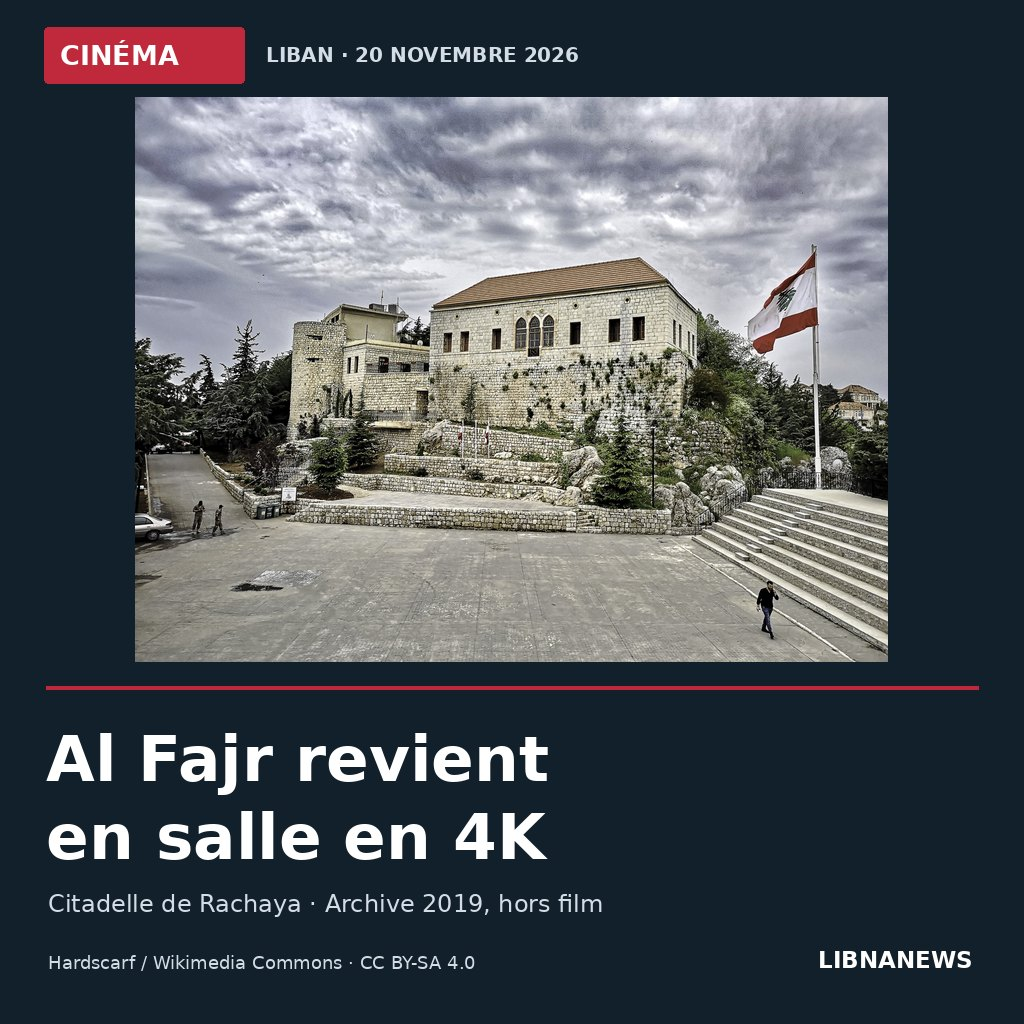
The arrests of November 1943 took place. The authorities of the French mandate detained at the Rashaya citadel President Bechara al-Khoury, the head of the government Riad al-Solh and other Lebanese officials. Their release on 22 November became Lebanon’s commemorative date. In the film, this real episode gives its timeline to an invented plot. He also explained Rachaya’s place in the narrative, without the scenes being used as archival images of 1943.
A spring in Arabic for the Independence weekend
The return to the hall takes place three days before the 83rd anniversary of Independence. The film is programmed in Arabic, notably at the City Centre Beirut and in other theatres that list it under its English title. Operators’ records do not give the same duration or classification everywhere. They remain the best starting point for checking the hour and the conditions for access to a projection, which depend on the cinema chosen.
Citadel of Rachaya, photograph of 6 May 2019; This visual is not an image of the film. Photo:Hardscarf / Wikimedia Commons,CC BY-SA 4.0. Resized whole photo, Libnanews dressing under the same license.






Comments