

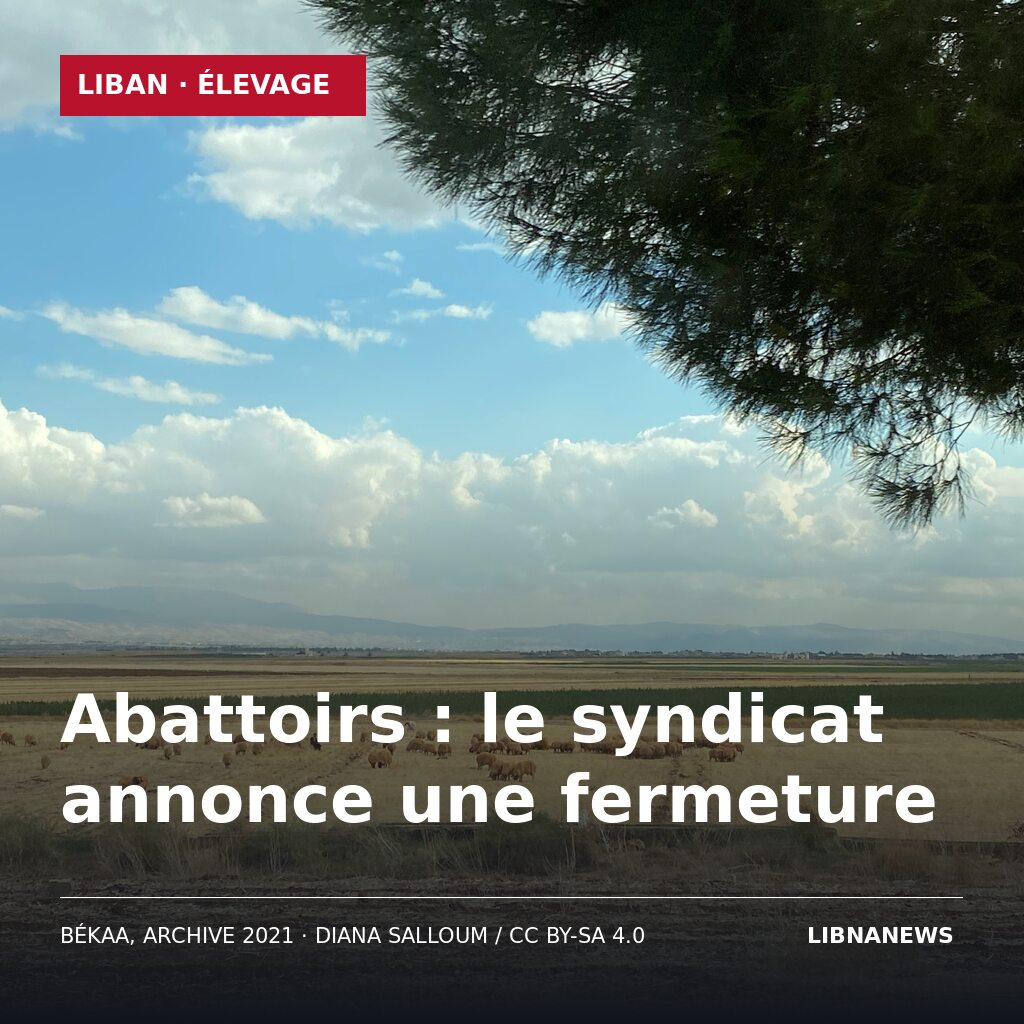
The cattle butchers’ and cattle traders’ union announced that livestock farms and slaughterhouses would be closed indefinitely in response to sealing and difficulties in obtaining permits. Its press release of 25 November does not specify the start date of the movement or the participating institutions.
The Lebanese cattle butchers and traders’ union announced on Wednesday 25 November that it would resolve to close the livestock farms and slaughterhouses indefinitely. The organization presents this measure as a response to prosecutions and sealing that, in its view, are aimed at facilities without the required authorizations. It gave no start time, no schedule of application or list of establishments that would follow the movement.
The union questions the conditions of establishment
In its statement, the union states that it met several officials without obtaining a solution for establishments threatened with closure. According to him, the difficulty begins before health control: farmers struggle to find land where livestock or slaughter activities can be allowed. He adds that some projects face opposition from residents even in areas he considers appropriate. Its communiqué does not detail the municipalities concerned or the unanswered applications for permits.
The organisation also blames the authorities for allowing operators to slaughter to supply the market and then prosecuting those who do not have the necessary authorisations. She said she wished to continue the dialogue and said that she did not defend the shortcomings relating to food security. She thanked the Minister of Agriculture, Nizar Hani, for having received a delegation. The meeting, as described by the union, did not lead to the announcement of an agreement.
The announced movement is not worth general administrative closure
In particular, the Ministry of Agriculture publishes Decision No. 949 on technical and sanitary conditions for the registration of livestock slaughterhouses. The health registration of a site and the possibility of implanting on a given field are two distinct questions. The union contests the concrete conditions for access to authorisations; it does not present its approach as an exemption from inspections.
Seals reported by the union are for specific establishments. The collective judgment announced on Wednesday is a trade union decision. No order of general closure of slaughterhouses or any assessment of its application had been made public with the press release.
No broken supply established
The text covers livestock and slaughter facilities. It does not announce the closure of retail butchers and does not specify the part of slaughter that would be interrupted. No volume withdrawn from the market or price changes due to the movement were documented at the time of publication.





Comments